2026 suite: inbox, AI, accounting.Open app

Getting paid

Retainer fee explained: what it is, how it works, and how to set one.

A retainer fee is money a client pays up front to secure your ongoing work — either as a recurring payment for a set scope each period, or as an advance you draw down against hours. It turns unpredictable project income into scheduled revenue.

In short

A retainer fee is an advance or recurring payment a client makes to reserve your services. The two common models are recurring retainers (a fixed amount each month for an agreed scope) and draw-down retainers (an advance held and billed against as work happens). Retainers work best when the scope, the billing schedule, and the rollover rules are written into the agreement — and the invoices go out on schedule without being rebuilt by hand.

The two retainer models

Pick the model that matches how you work — and write it into the agreement:

  • Recurring retainer — the client pays a fixed fee each period (usually monthly) for an agreed scope of work. Predictable for both sides; the most common model for agencies, MSPs, bookkeepers, and consultants.
  • Draw-down retainer — the client pays an advance, and you bill work against the balance until it is used, then top it up. Common for legal, advisory, and variable-scope work.
  • Hybrid — a smaller recurring base plus hourly billing for overage, reconciled each period.

How to set the amount

Price the retainer from the scope, not from your hopes:

  • Start from the agreed scope: hours, deliverables, or outcomes per period
  • Multiply by your target rate, then sanity-check against what the client values (saved headcount, response time, priority access)
  • State what is included, what is extra, and what happens to unused time (expire, roll over one period, or roll indefinitely)
  • Review quarterly — scope drifts, and the retainer should follow it

Make the billing boring

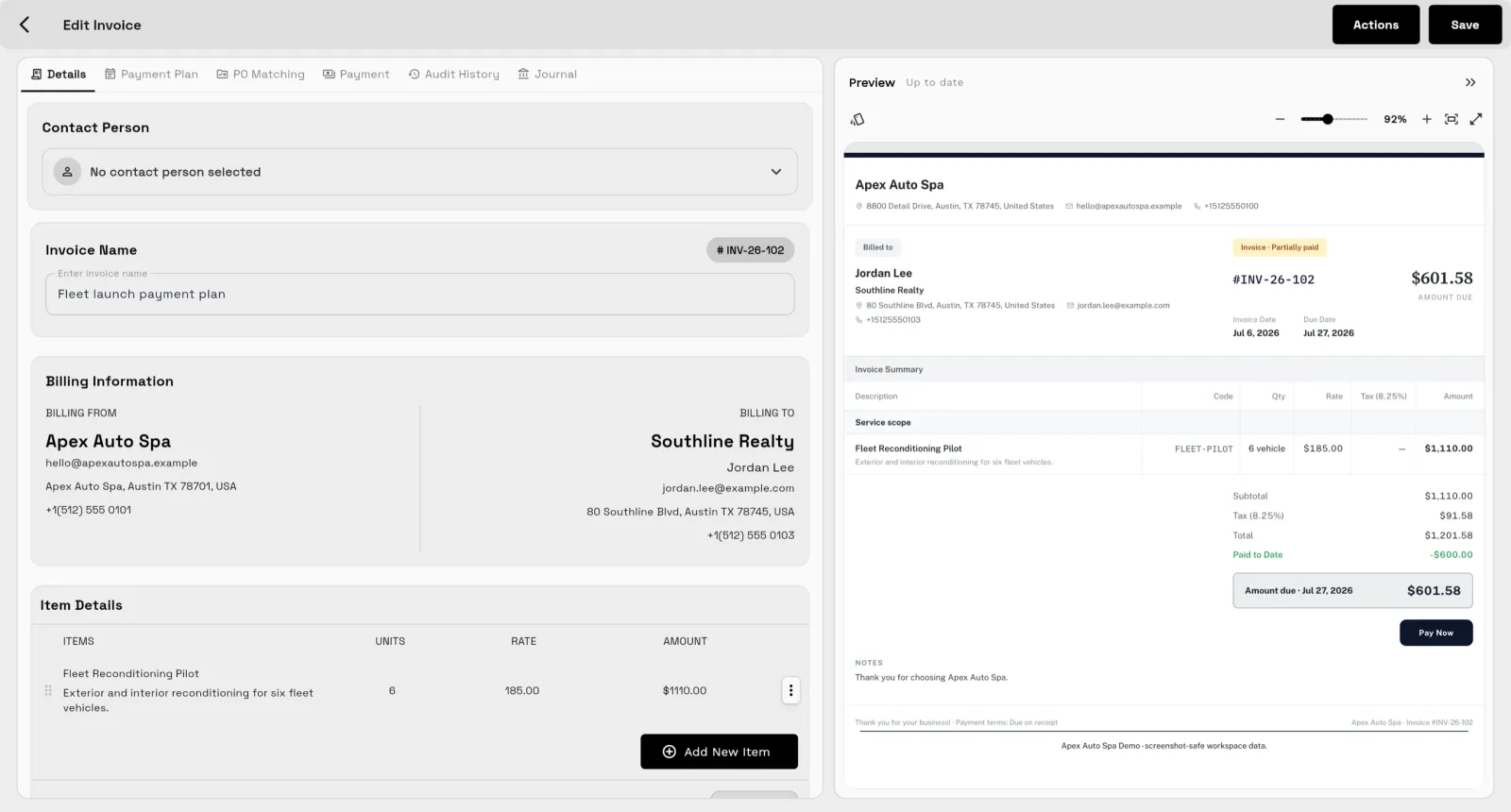
The retainer only works if the invoice goes out on the same schedule every period without anyone rebuilding it. Recurring invoices and payment plans in Workspace369 bill retainers automatically, automated reminders chase anything outstanding, and reporting shows retainer revenue per client — so the scheduled revenue actually arrives on schedule.

Retainer fee vs deposit vs advance

A deposit secures a specific project and is consumed by it. An advance is any up-front payment. A retainer secures ongoing availability or scope over a period — it is the recurring relationship, not the one-off job. Many agreements combine them: a retainer for ongoing work, a deposit for a specific project inside it.

FAQ

Common questions

Is a retainer fee refundable?

That depends on the agreement. Recurring retainers for a defined scope are usually earned when the period is covered; draw-down balances are often refundable for the unearned portion. State it explicitly in the agreement to avoid the dispute later.

How much should a retainer fee be?

Price the agreed scope per period at your target rate, then adjust for what the client values most — priority access, guaranteed availability, or saved headcount. Review the amount quarterly as scope drifts.

How do I bill a retainer automatically?

Recurring invoices with payment plans. In Workspace369, the retainer invoice goes out on the same schedule every period, automated reminders handle follow-up, and reporting shows retainer revenue per client — plans start at $29/mo for one seat.

Ready when you are

See where Workspace369 fits into your client-work flow.

Start with the modules you need today, then turn on AI, automations, accounting, inventory, requests, and reporting as the operation grows.