Email automation
Send a prepared email when a supported event occurs, with record variables keeping client context in the message.
Automate recurring email and SMS follow-up, task creation, reminders, and team notifications with workflows that can be tested, logged, and monitored.
14-day free trial. Card required. After the trial: from $29/month. Renews automatically every month until you cancel. Cancel anytime in Settings → Billing.
Simulate every workflow before a live email or SMS can reach a client.
Starts when an invoice event happens in the workspace.
Only clients who match the filter continue.
Unlimited steps with filters and rules.
workflow automation software
Workflow automation software performs repeatable actions when defined business events occur. Workspace369 workflow automations cover email and SMS automation, task creation, reminders, and internal notifications for teams or individual members — with unlimited steps, filters, and rules, tested in simulation and reviewed in execution logs against client-work context.
Reviewed July 17, 2026 by the Workspace369 Product Team. Availability can vary by plan, region, and workspace configuration.
Read the automation documentationHow it works
Once these building blocks are familiar, every automation — one you write or one from a template — reads the same way.
The event that starts the workflow — something that already happens in Workspace369, like an invoice being sent or a new lead being assigned.
A filter that decides which records continue. Only matching records — for example, an invoice still unpaid — move on to the next step.
A timed pause between steps, from minutes to days, so follow-up lands when it should instead of all at once.
What the workflow does next: send an email or SMS, create a task, set a reminder, or post an internal notification.
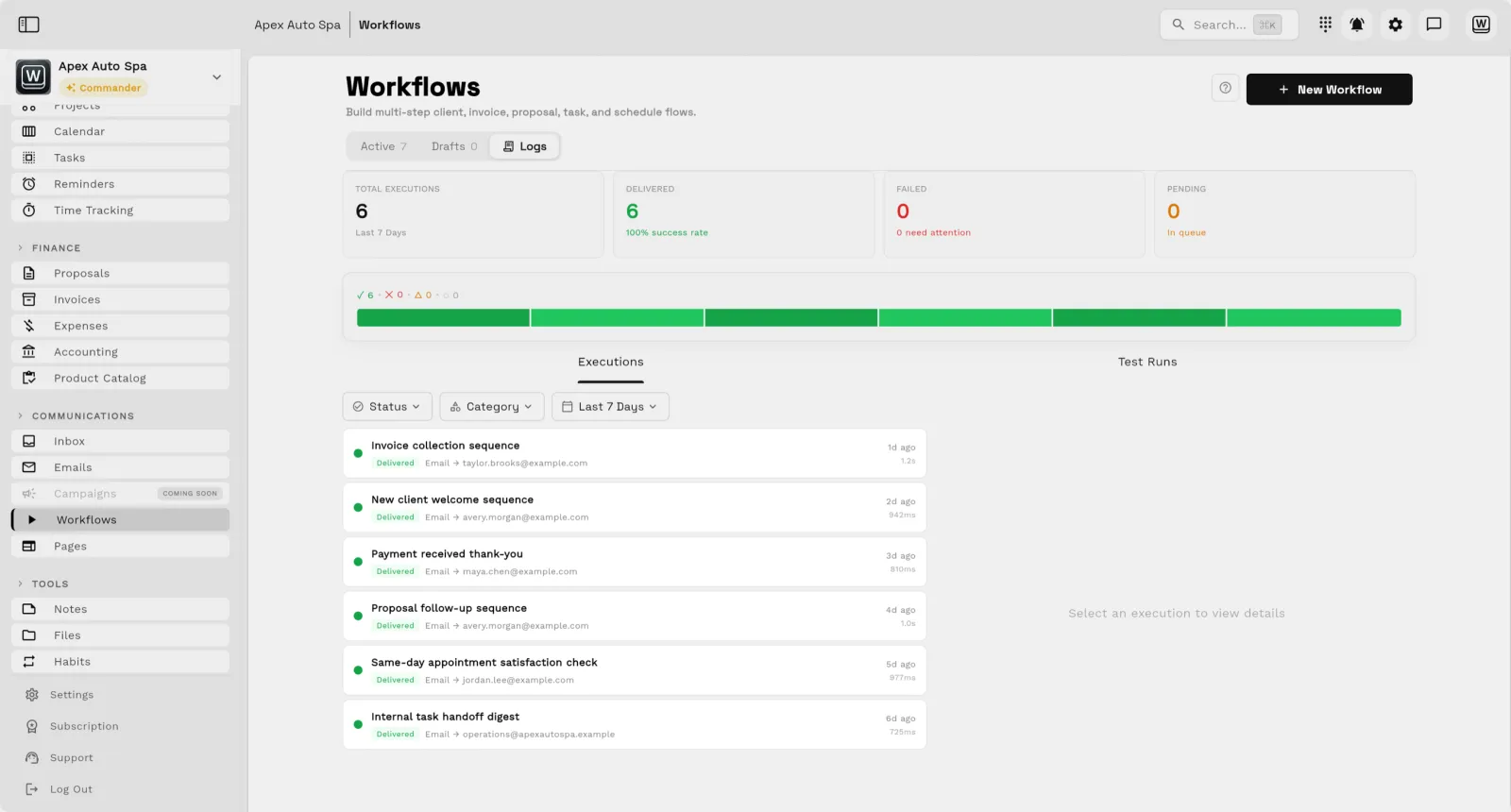
One execution of the workflow for one record. Every run is logged with its status, recipients, timing, and trigger context, so you can review what actually happened.
Automation actions
Every workflow automation can chain these actions into unlimited steps, with filters and rules defined for individual customization. Email and SMS automations handle client-facing follow-up; tasks, reminders, and internal notifications move the team inside the workspace.
Send a prepared email when a supported event occurs, with record variables keeping client context in the message.
Send a text follow-up or reminder through the same workflow, alongside the email path.
Create a task in the workspace with the record context attached, so follow-up work becomes a tracked task, not a mental note.
Create a reminder tied to the record, so time-sensitive follow-up is not left to memory.
Post an internal notification for the whole team or an individual team member when the workflow runs.
Who receives what
Every action a workflow takes lands in one of two places — with the client, or inside your workspace.
Client-facing messages prepared by you, always from templates your team controls.
Internal work created by the same run, for the whole team or an individual member.
Built into the operating flow
Automations connect to clients, inboxes, campaigns, requests, invoices, and team workflows.
Start from scheduling, client, invoice, payment, proposal, task, lead, call, or scheduled-time activity already happening in Workspace369.
Define recipients, then chain unlimited steps with filters and rules for individual customization, each action kept in a clear, reviewable order before activation.
Run a simulation without sending a live message, then use execution details to review recipients, status, timing, and trigger context.
Supported triggers
Every workflow begins with one supported trigger. The builder checks trigger support before activation, so a workflow can never start from something the workspace cannot see.
Appointment activity — a booking is scheduled or a meeting is coming up.
Client record activity, such as a new client entering the workspace.
Invoice activity, like an invoice being sent to a client.
Payment activity on an invoice in the workspace.
Proposal activity, such as a proposal being accepted.
Task activity across your projects.
Lead activity, such as a new lead being assigned.
Call activity, like a call ending with an outcome worth following up.
A time you choose — start the workflow on a schedule instead of an event.
Inside Workspace369
Review the workflow path from the event that starts it through every condition and follow-up step before it is saved.
Unlimited steps with filters and rules.
Test runs let the team inspect variables, recipients, and workflow readiness before a live email or SMS can reach a client.
Workflow Runs separates executions from test runs and keeps the status, recipient, automation, and detailed trigger context available for review.
Pre-made templates
Pre-made workflow templates cover different industries and common strategies — use one as-is or adjust every step. Each automation is a sequence of triggers, timed waits, conditions, and actions, and every step stays editable, testable, and reviewable.
A run, step by step
Here is what the New Lead Follow-Up template actually does once it is active — what the client receives, and what your team sees in the workspace.
The trigger fires and a run starts for that lead. The workflow takes over from there — nobody has to remember to follow up.
The client receives the welcome SMS your team prepared, with their details filled in from the record.
The workflow checks for a reply. If the client has not answered, it sends the email follow-up; if they have, that branch is skipped.
Still no reply? The workflow creates a callback task with the lead's context attached, so a person picks it up from there.
Open Workflow Runs and see exactly what happened: each step, its status, its timing, and the trigger that started it.
Common operating scenarios
These examples describe how the feature fits into connected client work. They are product workflows, not promised business outcomes.
Use supported client, scheduling, invoice, payment, proposal, task, lead, call, or timed activity to begin a deliberate email or SMS workflow.
Run a simulation to inspect variables, recipients, trigger support, and workflow readiness without sending the production email or SMS action.
Review execution status, recipient, timing, automation, and trigger context so the team can distinguish test runs from live workflow activity.
Pairs with Workspace AI
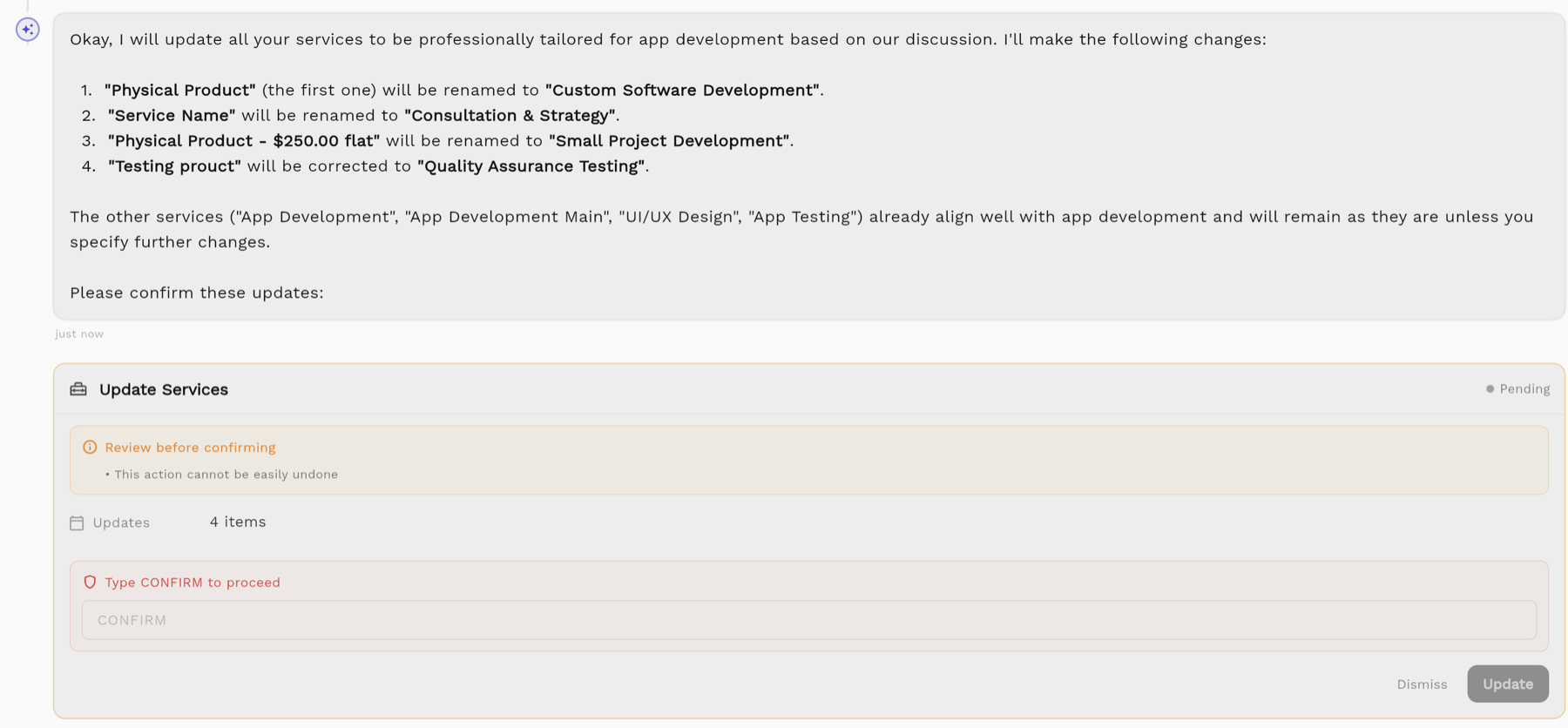
Ask Workspace AI what needs attention — for example, which invoices are unpaid — and it answers from real workspace context, with the safest next step for each. Describe an exact use case, and AI prepares the workflow itself: triggers, waits, conditions, and actions, ready for your review.
You simulate, adjust, and activate. Workflow automations then handle the repeatable work — sending, tasking, reminding — with test runs and execution logs keeping every action reviewable.
Explore Workspace AI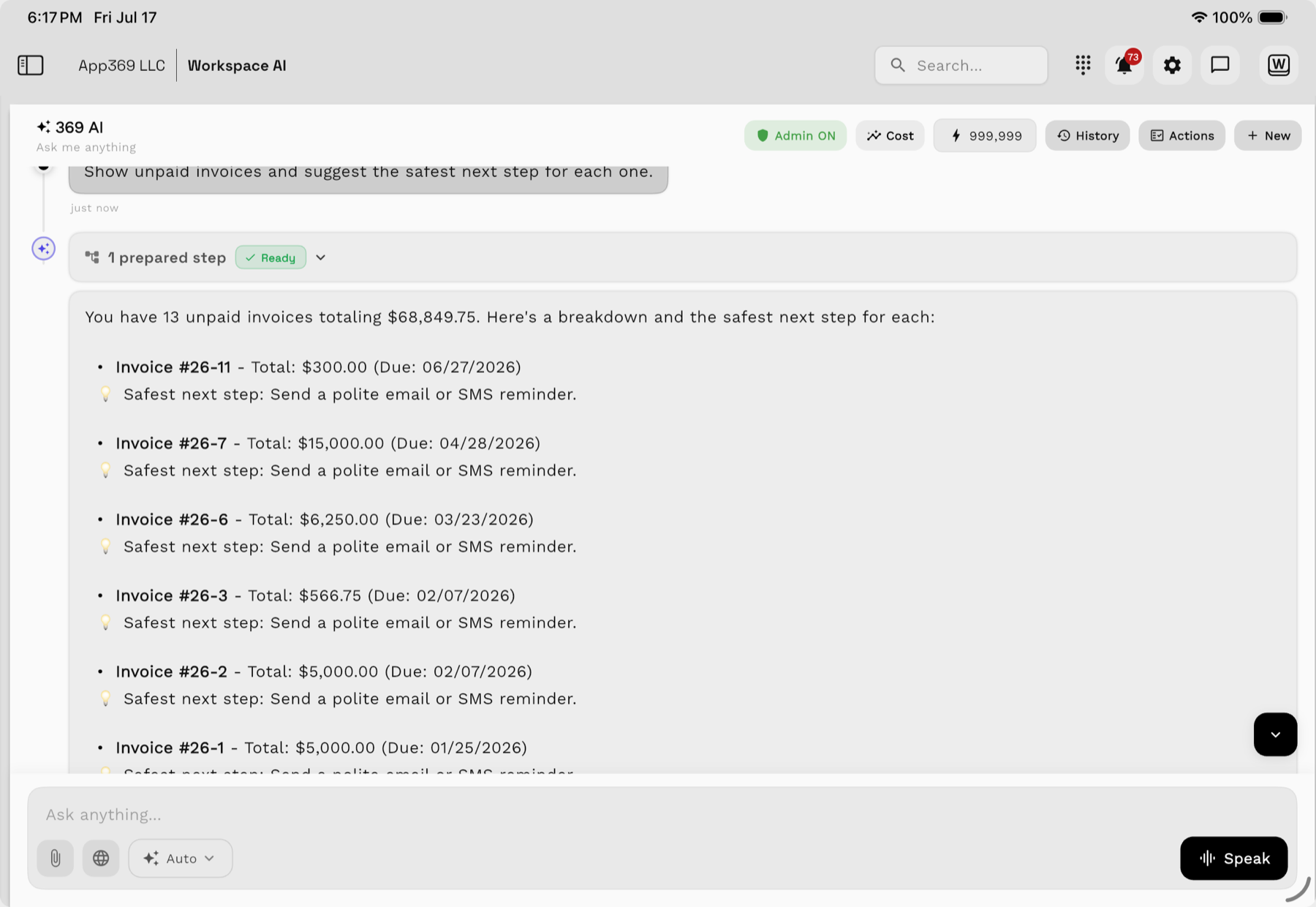
Where it connects
Automations connect to clients, inboxes, campaigns, requests, invoices, and team workflows.
Common questions
A workflow automation can send an email or SMS, create a task in the workspace, set a reminder, or post an internal notification for the whole team or an individual team member. Each action stays in a clear, reviewable order before activation.
No. Workflow automations can include unlimited steps, with complexity, filters, and rules defined for individual customization. Simulations and execution logs keep even long workflows testable and reviewable.
Yes. A workflow can mix timed waits with conditional steps — for example, pausing for an hour after a welcome SMS and sending an email follow-up only if the client has not replied.
Yes. Describe the exact use case and Workspace AI helps prepare the workflow — triggers, waits, conditions, and actions — for your review. You can simulate, adjust, and activate it when it is ready.
Yes. Workspace369 includes pre-made workflow templates for different industries and common strategies, such as lead follow-up, invoice reminders, and appointment sequences. Every template step can be adjusted before activation.
Yes. Workspace369 includes simulated test runs so teams can inspect a workflow without sending the live email or SMS action.
Supported triggers include scheduling, client, invoice, payment, proposal, task, lead, call, and scheduled-time activity. The builder checks trigger support before activation.
The builder checks trigger support before activation, and readiness checks surface unsupported or incomplete setup during simulation — before a live email or SMS can be sent.
Yes. Workflow Runs keeps live executions and test runs available with status, recipient, timing, and detailed trigger context.
Work from one connected system
Start from a pre-made template or describe your use case to Workspace AI. Simulate every step before a client ever sees a message.
14-day free trial. Card required. After the trial: from $29/month. Renews automatically every month until you cancel. Cancel anytime in Settings → Billing.
Nothing goes live until you activate it.
Watch
