Build a CRM with AI
Let AI build your CRM. Workspace369 is the back office it plugs into.
Connect Claude Code, Cursor or any MCP client to Workspace369 and ask for the CRM you want. Your agent builds the screens. Clients, proposals, e-signatures, invoices and payments come from one connection that already works.
14-day free trial. Card required. After the trial: from $29/month. Renews automatically every month until you cancel. Cancel anytime in Settings → Billing.
What AI assistants tell you to wire together, and what you can skip
Ask ChatGPT or Claude what backend to build a consulting CRM on and you get a parts list. Each part needs its own account, keys, security rules and bill.
The stack AI assistants suggest
What ChatGPT and Claude recommended when we asked, October 2026
Your AI-built CRM on Workspace369
Your agent builds the screens and the workflow you want
Online booking pages start on Specialist.
Three steps from an empty folder to a working CRM
The same steps work in Cursor, Windsurf and other MCP clients. In Claude on the web, add Workspace369 as a connector instead of step 1.
- 1
Connect Claude Code to your workspace
An admin turns on AI connections in Settings first. Then add the server and run /mcp in Claude Code to sign in.
claude mcp add --transport http workspace369 https://mcp.workspace369.com/mcp - 2
Paste the build prompt
Tell the agent what your business does. It reads your real clients, proposals and invoices and builds around them.
Build me a CRM for my design studio as a Next.js app. Use the workspace369 MCP server as the backend for every record: clients, requests (new leads), proposals, contracts, invoices, payments, projects and tasks. Do not create your own tables for these. First call workspace_get_context and workspace_schema to learn my workspace, then build: 1. A leads inbox from requests_search, with a button that runs requests_convert_to_client. 2. A client list split into prospects and clients (clients_search). 3. A client page with that client's proposals and invoices. 4. A "draft proposal" button that uses proposals_create_draft. Sending stays with me in Workspace369. 5. A delivery board from task_boards_list and tasks_search. Keep every key on the server. Never expose the token in the browser. - 3
Call the same backend from your app's server
Your deployed app's server calls the same tools over HTTPS with a personal access token (Account settings → Connected AI apps). Tokens belong to the person who made them, so create it from an account that will stay with the business.
curl https://mcp.workspace369.com/mcp \
  -H "Authorization: Bearer $W369_TOKEN" \
  -H "Content-Type: application/json" \
  -H "Accept: application/json, text/event-stream" \
  -d '{"jsonrpc":"2.0","id":1,"method":"tools/call",
       "params":{"name":"clients_search","arguments":{"query":"acme"}}}'
Step-by-step guide with Node and Python examples: Build a custom CRM with an AI coding agent.
120 tools your agent can call
Each call runs as the person who connected, with that person's permissions. Sending to a client waits for approval in the app unless that person turns on “send without asking” for the connection.
Clients and leads
Search, create and update clients, convert requests, follow-ups, lead sources.
Proposals
Drafts, design, sections, templates, and sending for signature and deposit.
Contracts
Templates, sending for e-signature, reminders, voiding.
Invoices and payments
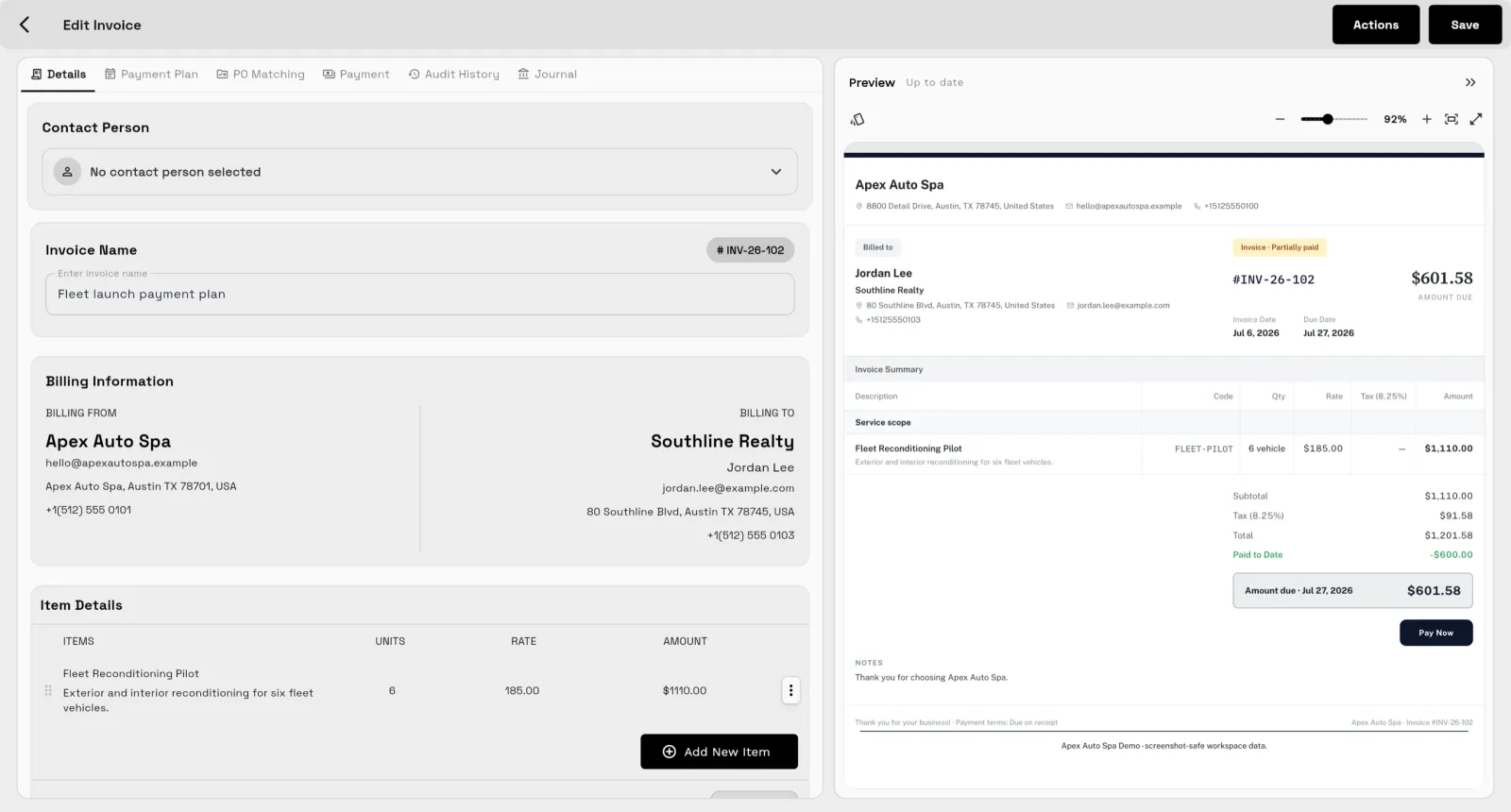
Drafts, sending, retainers, recurring plans, recording payments.
Calendar and booking
Events, availability, booking pages, reminders.
Projects and tasks
Boards, subtasks, comments, board schemas.
Inbox
Sending messages and searching conversations.
Automations
Draft, test and activate workflows.
Workspace schema
Record types, fields and client stages, so an agent learns your data model before it builds screens.
Full list in the MCP tools reference. Setup details: MCP integration and API workflows.
Safe enough to point at real client data
Off until an admin turns it on
MCP is off for every workspace by default. Admins can allow only the apps they choose.
Real permissions on every call
A team member’s agent sees only what that member can see, checked live on each call.
Approvals before anything goes out
Sending a proposal, contract, invoice or message waits for a person to approve it in the app, unless the person who connected turns on “send without asking”.
A logged trail
Each call is written to the workspace’s audit log with who made it, which tool, when, and whether it succeeded.
Pricing
MCP and personal access tokens are on every plan once an admin turns on AI connections. Calls draw on your plan's monthly AI usage allowance: reads cost the least, sends the most, and failed calls are free. Cache lists in your app instead of reloading them on every screen, and the allowance goes much further.
Webhooks and API integrations are on Specialist and up. See all plans.
Questions builders ask
Can I build my own CRM on Workspace369?
Yes. Connect an AI agent such as Claude Code or Cursor to the Workspace369 MCP server and ask it to build the screens you want. Your clients, proposals, contracts, invoices and payments stay in Workspace369, so the parts that handle money and signatures are already built and tested.
Do I still need Supabase or Firebase?
Not for client records, proposals, contracts, invoices, payments or bookings. You only need your own database for data Workspace369 doesn’t hold.
Is there a REST API?
Not as a separate API yet. Today your app’s server calls the MCP endpoint over HTTPS with a personal access token, as in step 3. Webhooks can notify your app when proposals, contracts, invoices or leads change (Specialist and up).
What can’t my agent do through Workspace369?
It can’t delete clients, projects or invoices, write custom fields, or manage team members and their permissions. Do those in the app.
Which AI tools work?
Claude Code, Cursor, Windsurf and VS Code with Copilot, plus Claude on the web as a custom connector. ChatGPT can connect it as a custom connector on plans that offer developer mode. Any app that supports remote MCP servers with OAuth can connect.
Will the agent email my clients by itself?
No. Sends wait for approval in the app unless the person who connected turns on “send without asking” for that connection.
Ready when you are
See where Workspace369 fits into your client-work flow.
Start with the modules you need today, then turn on AI, automations, accounting, inventory, requests, and reporting as the operation grows.
14-day free trial. Card required. After the trial: from $29/month. Renews automatically every month until you cancel. Cancel anytime in Settings → Billing.