Best CRM for Cybersecurity Consultants 2026: Retainers
Best CRM for cybersecurity consultants: six client-work tools compared on price, proposals, retainers, invoicing and portals, plus a scope-change exercise.
We make Workspace369, which is on this list. Weigh our ranking with that in mind.

By Simon Dziak, Founder, Workspace369 · LinkedIn
The best CRM for cybersecurity consultants depends on how you sell. For a solo consultant who wants proposals, contracts and invoices at the lowest checked price, start with Bonsai, which includes a client portal on its entry plan, or Moxie if you can skip the portal and want the cheapest plan. Workspace369 suits a small firm that sells fixed-scope assessments plus monthly retainers on one client record. HubSpot, Productive and Pipedrive are stronger when your problem is lead volume or staff utilization. To price a vCISO or advisory retainer before you send it, use the free retainer pricing calculator.
Disclosure and method: Workspace369 publishes this guide and is one of the options, and we rank it below Bonsai and Moxie for a solo consultant on price. It is a documentation-based shortlist, not a hands-on benchmark. Official vendor pages were reviewed on October 22, 2026, except Pipedrive's pricing page, which could not be read. Check current plans with each vendor before you buy.
Key takeaways
- Moxie Starter ($10 a month billed annually) is the lowest checked price with proposals, contracts and invoicing; Bonsai Essentials ($19 per user per month billed annually) is the lowest checked price that also includes a client portal.
- Bonsai puts its deals pipeline on Premium ($29 per user per month billed annually), so a consultant who wants a sales pipeline there pays for that tier.
- Workspace369 Cadet is $29 a month ($23.25 billed yearly) for one seat and 5 active projects, with Proposals, deposits, retainers and payment schedules, recurring invoices and a client portal.
- HubSpot is free for up to 2 users and Productive lists Essential at $100 a month for a 10-user team billed yearly; neither is built around client proposals and a portal the way the small-firm tools are.
- Keep vulnerability findings, credentials and evidence in your approved security systems; a client-work tool should hold the proposal, retainer, scope notes and invoice.
What's inside?
What a CRM for cybersecurity consultants is (and what it is not)How we compared these toolsThe best CRM for cybersecurity consultants in 2026Side-by-side comparisonWhich tool fits your practice?Run a mid-test scope-change exercise during the trialTry the Workspace369 trial
What a CRM for cybersecurity consultants is (and what it is not)
A CRM for cybersecurity consultants is the business layer around your engagements: who the client is, the proposal and statement of work they signed, the retainer schedule, the scope changes agreed along the way and what is unpaid. It is not a vulnerability testing tool, a ticketing system for findings, an evidence vault or a compliance platform. Keep findings, credentials and test evidence in your approved security systems, and check each vendor's security documentation yourself before storing client data.
This guide covers the client pipeline, proposals, retainers and invoicing for independent consultants and firms of one to five. For managed-service and security-guard operations, see our MSP software guide and security company software guide. The CRM for cybersecurity consultants page shows the Workspace369 view.
How we compared these tools
We compared each tool on the same five points, using only the vendor's own pricing and product pages:
- Entry price at one seat, as listed on October 22, 2026, billed yearly unless stated.
- Proposals and contracts: whether the plan lists proposals, contracts and client approval.
- Retainers and billing: recurring invoices, deposits or payment schedules.
- Client portal and pipeline: whether a portal and a deals pipeline are listed, and on which plan.
- Trial terms: length, and whether the vendor says a card is needed.
We did not test speed, support, security controls, data residency or integrations, and we used no third-party ratings. Pipedrive's pricing page could not be read on October 22, 2026, so it carries no price here. Order reflects fit for a solo or small-firm consultant selling assessments and retainers.
The best CRM for cybersecurity consultants in 2026
1. Bonsai, best for a solo consultant who wants a portal on the entry plan
Bonsai lists Essentials at $19 per user per month billed annually ($25 billed monthly). Essentials includes invoices and payments, proposals and contracts, forms and questionnaires, scheduling, a client portal and expense tracking. Basic is $9 per user and covers time tracking, tasks and a CRM; Premium is $29 ($39 monthly) and adds the deals pipeline, custom fields and client tasks and messaging. Elite is $49 with a three-user minimum. The trial gives 7 days of full access, then asks you to choose a plan and enter card details.
Limitations: the deals pipeline starts at Premium, and the 7-day trial is shorter than most. Its plan comparison lists retainer and subscription invoices, but the text we read does not show which plan includes them, so confirm that before you buy.
Best for: an independent consultant who wants proposals, contracts, invoicing and a client portal on one low-cost plan. Moxie Starter is cheaper if you can skip the portal.
2. Moxie, best for a freelancer-style stack with a pipeline included
Moxie lists Starter at $10 a month ($120 charged annually) or $12 billed monthly. Starter includes client management, project management, invoicing and payments, proposals, quotes and contracts, time tracking, a sales pipeline, basic accounting, forms and a meeting scheduler. Pro is $20 a month billed annually ($25 monthly) and adds a white-label client portal, workflow automations, a phone line, and Zapier, webhook and API integrations. Teams is $32 a month billed annually ($40 monthly) for up to five team members. The page title names a 14-day free trial.
Limitations: the client portal and automations start at Pro, and Teams caps at five members. The page gives no card terms for the trial.
Best for: a solo consultant who wants a sales pipeline and proposals included from the first plan.
3. Workspace369, best for fixed-scope work plus monthly retainers
Workspace369 puts the client record, Proposals the client can approve and sign through a link, deposits on acceptance, retainers and payment schedules, recurring invoices, time tracking and a private client portal in one place. Cadet is $29 a month for one seat ($23.25 billed yearly) and lists all of these, along with client custom fields and email automations. Voyager is $74 for two seats and Specialist is $149 for ten; see the full pricing. The screenshot below is a demo record, not a customer result.
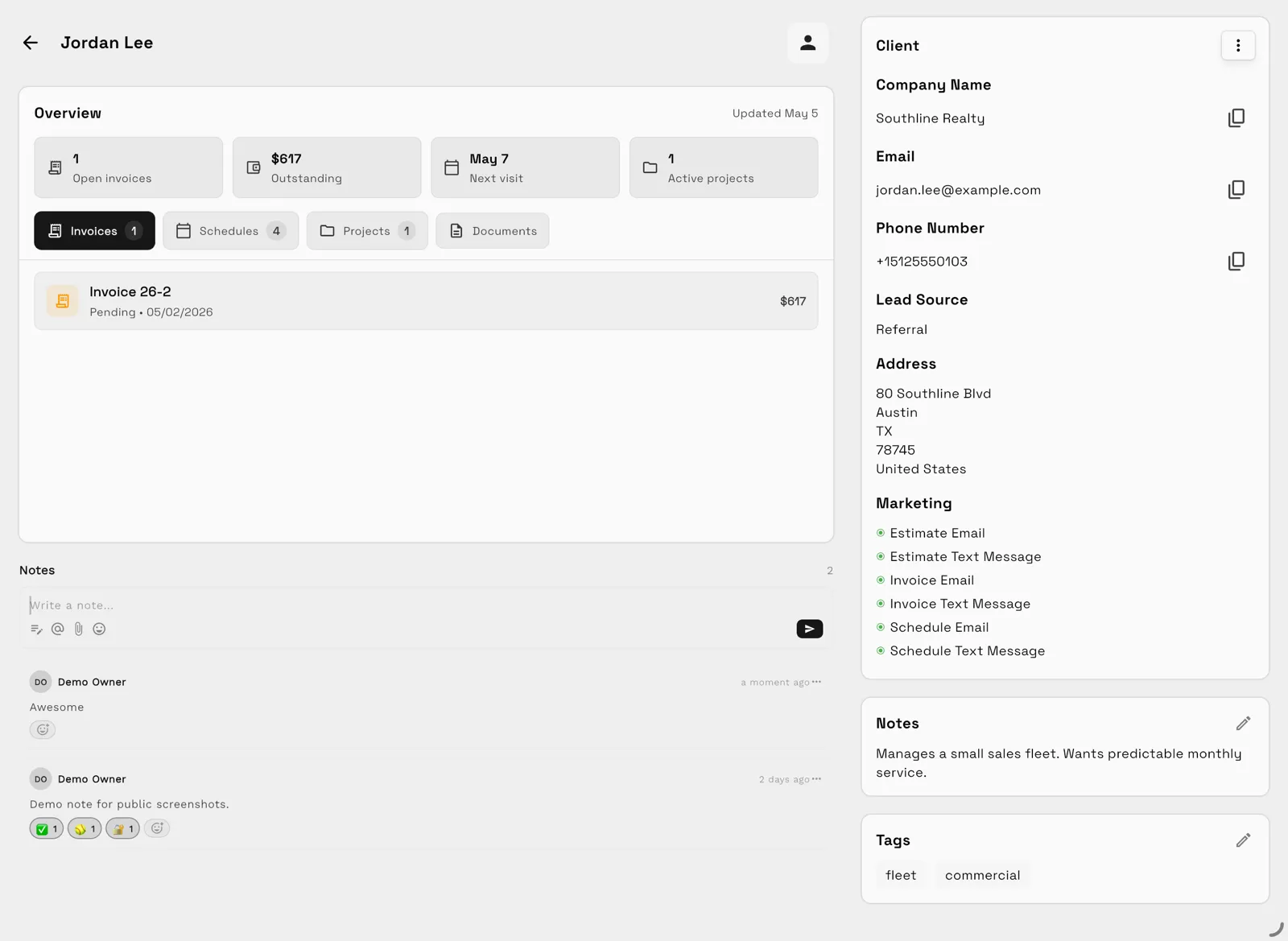
Demo data, not a customer outcome.
Limitations: at one seat it costs more than Bonsai Essentials or Moxie Starter. Cadet allows one seat and 5 active projects, and its automations are email only; SMS steps start at Voyager. Expenses and project profitability start at Specialist. It does not store scan results or vulnerability findings, and we make no security or compliance certification claims here. The 14-day trial needs a card.
Best for: a small firm that sells assessments by Proposal and keeps clients on monthly retainers with deposits and recurring invoices.
4. HubSpot, best for inbound lead volume
HubSpot lists free tools for up to 2 users with no credit card required and no time limit; its FAQ gives the free CRM a limit of 1,000 contacts. Its Starter plan is $20 per seat a month at list price, with limited-time offers for new customers. On the pricing page, Starter bundles the Marketing, Sales, Service, Content and Data Hub Starter tools with 1,000 marketing contacts and 500 HubSpot Credits. The free CRM lists contact management and deal pipelines, so a consultant can track every prospect and quote stage without paying, then add a billing tool when engagements start.
Limitations: HubSpot is a sales and marketing platform. Proposals, recurring invoices and retainers are not what its free plan is built around, so you would pair it with a billing tool.
Best for: a firm that generates many inbound leads and wants a free pipeline for two users.
5. Productive, best for a firm tracking staff time and project budgets
Productive is an agency and consultancy platform for resource planning, projects, time and budgets. The pricing page, shown for a 10-user team, lists Essential at $10 per user a month ($100 a month for 10 users) and Professional at $25 per user ($250 a month for 10 users), both billed yearly; monthly billing is $12 and $29 per user. Every plan needs at least 3 seats. Its sign-up form describes a free 14-day trial with no credit card required. For a security firm, the fit is budget tracking per engagement: you can see whether a fixed-fee penetration test or compliance project is running over its hours before the client invoice goes out, and plan which consultant is free for the next assessment.
Limitations: it is priced around teams, not solos, and its pricing page no longer lists a CRM, deals or invoicing as plan features (Professional lists HRIS and invoicing integrations). It is more tool than a one-person consultancy needs.
Best for: a firm of several consultants that needs utilization, budgets and project financial reporting.
6. Pipedrive, best for a dedicated sales pipeline
Pipedrive is built around pipeline management, tracking each opportunity from first contact to close. Its pricing page could not be read on October 22, 2026 (access denied), so the price here is See site. Its feature page describes seeing where deals stand and where they get stuck as an opportunity moves through the sales cycle, which suits a consultancy that quotes many prospects at once.
Limitations: it is a sales tool, so proposals, retainers, portal and invoicing need other software, which adds a second subscription to your stack. We could not verify its price or trial terms, so request them from the vendor before you plan a budget around it.
Best for: a consultancy with a real outbound sales process and many deals in flight.
Side-by-side comparison
| Tool | Entry price | Proposals and contracts | Retainers and billing | Trial | Main limit |
|---|---|---|---|---|---|
| Bonsai | $19 per user per month (Essentials), billed yearly | Yes, from Essentials | Invoices and payments | 7 days, card to continue | Pipeline on Premium |
| Moxie | $10 per month (Starter), billed yearly | Yes, from Starter | Invoicing and payments | 14 days, no card | Portal on Pro |
| Workspace369 | $29 per month ($23.25 yearly) | Proposals, deposits | Retainers, schedules, recurring invoices | 14 days, card required | 1 seat, 5 projects |
| HubSpot | Free for up to 2 users | Not listed | Not listed | No time limit, no card | Pair with billing tool |
| Productive | $100 per month for 10 users (yearly) | Not listed on the pricing page | Invoicing integrations on Professional | 14 days, no card (sign-up form) | Team-oriented |
| Pipedrive | See site | Not listed | Not listed | See site | Sales only |
Which tool fits your practice?
| If you mostly need | Start with | Why |
|---|---|---|
| The lowest solo price with proposals and invoices | Bonsai or Moxie | $19 and $10 a month billed yearly |
| Assessments plus monthly retainers on one record | Workspace369 | Retainers, deposits and recurring invoices from $29 |
| A free pipeline for two people | HubSpot | Free tools, no card |
| Staff time and project budgets | Productive | Resource planning and budgets |
| A dedicated sales pipeline | Pipedrive | Built around deals |
Run a mid-test scope-change exercise during the trial
Use a fictional client and demo data, never a real client's systems or findings. Take each shortlisted tool through this:
- Send a proposal for an external assessment with a fee and deposit, and have the client approve it.
- Add a monthly advisory retainer and a recurring invoice for it.
- Midway, record that the client wants an extra staging server included, and send a revised proposal or change request. The free scope-change request builder gives you a starting format.
- Upload a scope confirmation file and message the client.
- Bill the addition and check the invoice, the portal view and the record all agree.
The best tool keeps proposal, retainer, change and invoice on one client record. Any step you retype is the leak this test finds.

Try the Workspace369 trial
Compare the current Workspace369 pricing against the seats and features you need. SMS and calls start at Voyager; online booking, expense tracking and payment plans start at Specialist. Workflow Automations can send reminders and create tasks, and you can check a workflow with a simulated test run before switching it on. Cadet through Commander start with a 14-day free trial that requires a card.
Review date: October 22, 2026 (Pipedrive's pricing page could not be read). Recommendations are conditional on the workflow described, and some products here are adjacent alternatives rather than direct CRM equivalents.
Sources reviewed for this guide
- Workspace369 pricingPlan matrix reviewed October 22, 2026.
- Bonsai pricingOfficial pricing page reviewed October 22, 2026 for per-user plan prices, plan contents and trial terms.
- Moxie pricingOfficial pricing page reviewed October 22, 2026 for Starter, Pro and Teams prices and features.
- HubSpot CRM pricingOfficial pricing page reviewed October 22, 2026 for the free tools and Starter price; toggle labels conflict.
- Productive pricingOfficial pricing page reviewed October 22, 2026 for Essential and Professional prices and trial terms.
- Pipedrive pipeline managementOfficial feature page reviewed October 17, 2026; the pricing page could not be read on October 22, 2026, so no Pipedrive price is stated here.
Workspace369 publishes this documentation-based comparison and is one of the options. It is not an independent ranking or a hands-on benchmark.
Run client follow-up in one workspace.
CRM, inbox, voice, invoicing, payments, projects, files, AI, and workflow automations — connected instead of exported.
14-day free trial. Card required. After the trial: from $29/month. Renews automatically every month until you cancel. Cancel anytime in Settings → Billing.