Best CRM for App Development Agencies 2026: Scope Changes
Six client-work tools for 2-20 person app agencies compared on price, plan limits, proposals, retainers, time-to-invoice and change requests, plus a scope-change test.
We make Workspace369 and list it first here. Weigh our ranking with that in mind, and if another tool fits you better, use it.

By Simon Dziak, Founder, Workspace369 · LinkedIn
The best CRM for app development agencies keeps the client, the accepted scope, the change request (change orders from Specialist), the logged time and the invoice on one record, so an extra feature becomes a priced decision instead of free work. For agencies of about 2 to 10 people that sell discovery, fixed-scope builds and retainers, our pick is Workspace369. Productive and Teamwork suit agencies that need budgets and capacity planning, and Accelo suits larger professional-services setups. To price a change before you agree to it, use the free scope-change request builder.
Disclosure and method: Workspace369 publishes this guide and is one of the options. It is a documentation-based shortlist, not a hands-on benchmark. Official vendor pages were reviewed on October 17, 2026; Productive's page was re-read on October 19, 2026. Check current plans with each vendor before you buy.
Key takeaways
- An app agency CRM should carry the accepted scope, the change request, the logged time and the invoice on one client record, so extra features become a priced decision.
- Workspace369 Cadet is $29 a month ($23.25 billed yearly) for one seat with proposals, retainers, time-to-invoice and a client portal; Voyager ($74, 2 seats) removes the 5 active project cap and Specialist ($149, 10 seats) adds webhooks and API access.
- Productive ($10 to $12 per user a month depending on billing, 3 seats minimum) and Teamwork ($9.99 per user a month billed yearly, 3 users minimum) go further on budgets, capacity and resourcing than Workspace369 does.
- Bonsai needs Essentials ($25 a month per user, $19 billed yearly) for invoices, proposals and the portal; Accelo publishes no price and lists a Jira integration.
- Run one accepted-scope project through a change request in each trial and check that the approval, the tasks and the invoice agree.
What's inside?
What a CRM for app agencies is (and what it is not)How we compared these toolsThe best CRM for app development agencies in 2026Side-by-side comparisonWhich tool fits your agency?Run a scope-change test during the trialKeep engineering tools separateWhen to keep it simple
What a CRM for app agencies is (and what it is not)
A CRM for an app development agency is the commercial side of delivery: who the client is, what scope they approved, what a change costs, what time was logged and what is unpaid. It is not source control, code review, a build pipeline or a release tracker. A developer picking up a task needs to know whether the client approved the change; a finance owner needs to know which agreement supports the invoice. Workspace369 for app development agencies is built around that handoff.
How we compared these tools
We compared each tool on the same five points, using only the vendor's own pricing and product pages:
- Entry price, per seat or per plan, as listed on October 17, 2026.
- Proposal and change-request coverage: proposals or quotes, deals or pipeline, and conversion into a project.
- Money coverage: retainers, time tracking and turning time into an invoice.
- Hard limits and minimums on the plan that includes those pieces.
- Trial terms: length, and whether the vendor says a card is needed.
We did not test speed, support, reliability or mobile apps, and did not use third-party ratings. Order reflects fit for a 2 to 20 person app agency, and the limitations below say where each tool beats Workspace369.
The best CRM for app development agencies in 2026
1. Workspace369, best for small agencies selling scoped work and retainers
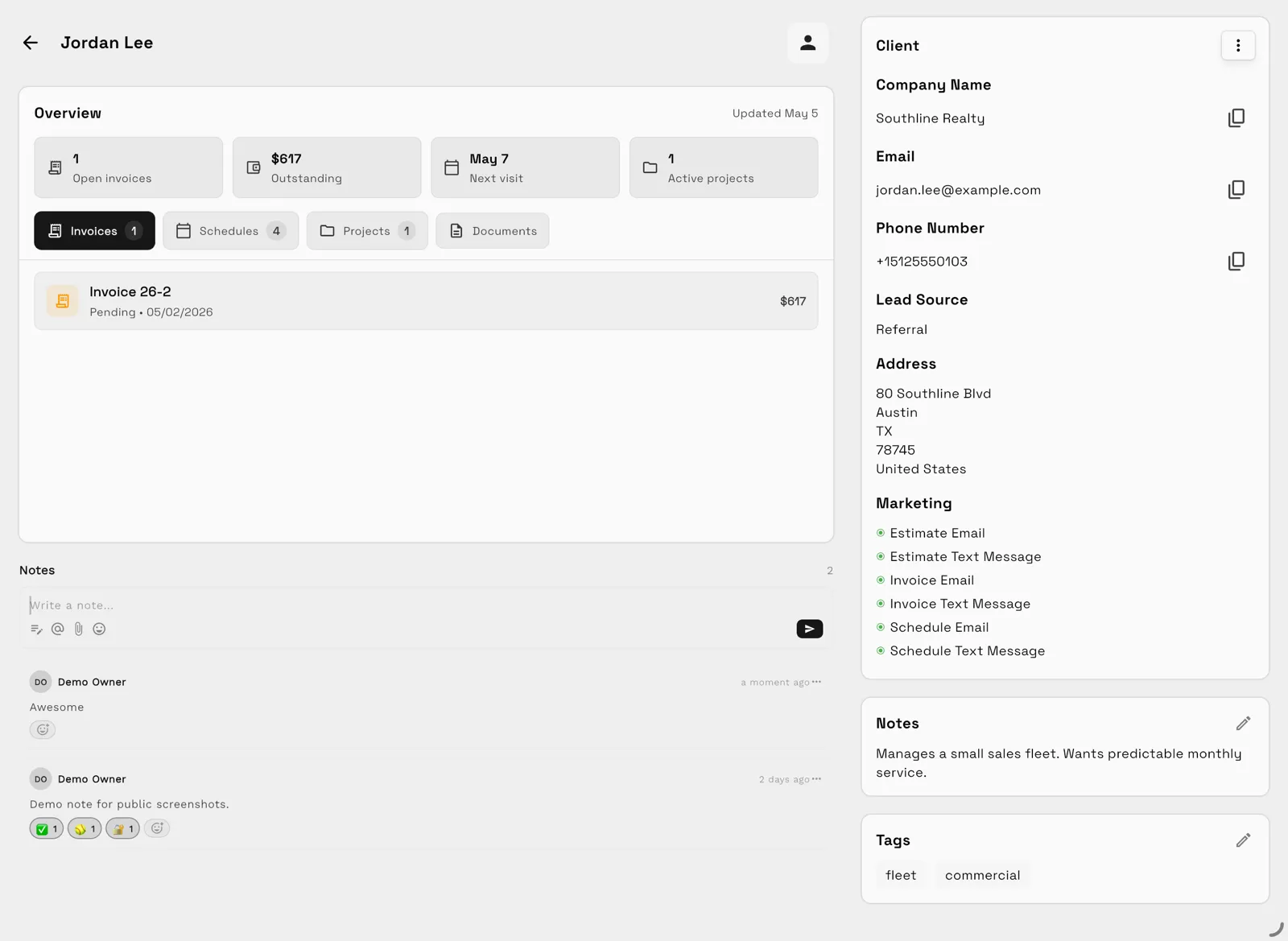
Demo data illustrating record organization. This is not an agency customer result.
Workspace369 puts the client record, Proposals the client accepts and signs through a link, deposits on acceptance, retainers, Projects with kanban boards and subtasks, time tracking with timesheets, a private client portal and invoices in one place. Accepted proposals convert into invoices in one step, and billable time turns into invoice lines. Cadet is $29 a month for one seat ($23.25 billed yearly) with up to 5 active projects. Voyager is $74 for 2 seats, Specialist $149 for 10, and extra seats are $10 a month from Voyager. Webhooks and API access start at Specialist, and MCP works on every plan.
Limitations: its Timeline / Gantt view starts at Voyager and the team workload view at Commander ($299 a month), so below that it has no resource scheduling or capacity forecast, and no native Jira or GitHub connector. Cadet is capped at 5 active projects and one seat. Bonsai Essentials covers proposals, portal and invoices at $19 per user billed yearly, so a 2-person agency may pay less there. The 14-day trial needs a card.
Best for: agencies of 2 to 10 people that want proposal, time, portal and invoice in one place, with change orders on Specialist.
2. Productive, best for budgets and capacity
Productive is built for agencies and consultancies. Its pricing page shows Essential at $10 or $12 per user a month and Professional at $25 or $29, depending on whether you bill yearly or monthly; Ultimate is quote-only. Features listed include budgeting, resource planning, time tracking, a CRM with deals and pipelines, converting a deal to a project, retainer management with recurring budgets, and invoices (on every plan; retainer invoicing from Professional). The trial is 14 days with no card required.
Limitations: it is a delivery-and-finance platform, so a client-facing proposal flow and portal are not described on the pricing page; the page names only a proposal PDF export for deals, and every plan requires at least 3 seats.
Best for: agencies of about 10 to 20 people that need to plan developer capacity against budgets.
3. Teamwork, best for project delivery with client collaboration
Teamwork lists Basics at $9.99 per user a month billed yearly (3 users minimum) with billable time tracking, and Accelerate at $24.99 (5 users minimum) with smart request forms, time budgets and retainers, client invoices from logged time and a HubSpot connection. Quotes and turning a CRM pipeline into projects sit in Optimize, which is quote-only. A free plan covers up to 5 users and 5 projects. The 14-day trial says no card is required, and the page lists Claude and ChatGPT connections.
Limitations: the sales and quoting side needs the top plan, so a small agency needs a separate CRM or HubSpot.
Best for: delivery-heavy agencies that run client projects in a task tool and invoice from time.
4. Bonsai, best for per-seat client work with proposals
Bonsai Basic is $15 a month per user ($9 billed yearly) with a CRM, time tracking and unlimited projects. Essentials, at $25 ($19 yearly), adds invoices, proposals and contracts, forms, scheduling, a client portal and expense tracking. Premium ($39, $29 yearly) adds a deals pipeline, custom fields, client tasks and messaging, and workload management. The trial is 7 days with full access, then Bonsai asks you to choose a plan and enter card details. Elite is $49 per user billed yearly with a 3-user minimum, and the page notes a reduced rate for teams of 30 or more.
Limitations: the deals pipeline, client tasks and workload views start at Premium; retainer invoices are named in Bonsai's feature list, so confirm which plan includes them.
Best for: small agencies that want proposals and invoices priced per seat.
5. Accelo, best for professional-services operations
Accelo publishes no prices: its pricing page redirects to a custom-quote page and says pricing is based on team size and growth goals, with implementation guidance and onboarding support included in the starting price. The page describes running fixed-fee projects and retainers side by side, forecasting capacity, tracking project financials and a client workspace, and the site lists a Jira integration among its integrations, which matters if your developers already work in Jira tickets. Treat the integration as something to demonstrate, not assume, and ask what it syncs and in which direction.
Limitations: no public price or trial terms, and a quote-led process suits larger teams more than a 3-person studio.
Best for: agencies of 10 to 20 people that want one professional-services platform and will talk to sales.
6. HubSpot CRM, best as a free sales front end
HubSpot's free CRM lists $0 for up to 2 users, 1,000 contacts and no time limit, with no card required. Paid prices were unclear on the fetched page, so see the site. HubSpot also offers a wide ecosystem of connectors, which is why many agencies start here and add a delivery tool later; the page we reviewed does not describe that setup, so verify any connection you plan to rely on.
Limitations: the page does not list proposals, time tracking, retainers or invoicing for the free plan.
Best for: an early-stage founder or sales lead who only needs a contact list and a pipeline before choosing a delivery tool.
If you go this route, keep the scope, change requests and invoices in a second tool and decide up front which record is authoritative.
Side-by-side comparison
| Tool | Entry price | Proposals and change requests | Retainers and time | Main limit | Trial |
|---|---|---|---|---|---|
| Workspace369 | $29 (Cadet), $23.25 billed yearly | Proposals on every plan; change orders from Specialist | Retainers, time-to-invoice on every plan | No capacity planning below Commander; 5 active projects on Cadet | 14 days, card required |
| Productive | $10-$12 per user (yearly or monthly) | Deals and proposal PDF export | Retainers, time tracking, budgets | 3-seat minimum | 14 days, no card |
| Teamwork | $9.99 per user, yearly | Quotes in Optimize (quote-only) | Retainers from Accelerate | 3 to 5 user minimums | 14 days, no card |
| Bonsai | $25 per user ($19 yearly), Essentials | Proposals from Essentials | Time tracking from Basic; retainer invoices listed (confirm plan) | Pipeline starts at Premium | 7 days, card to continue |
| Accelo | See site (custom quote) | See site | Retainers and fixed-fee projects | No public price | Not stated |
| HubSpot CRM | $0 (free CRM) | Not listed | Not listed | 2 users, 1,000 contacts | None stated, no card |
Which tool fits your agency?
| If you mostly need | Start with | Why |
|---|---|---|
| Proposal, time and invoice together (change orders from Specialist) | Workspace369 | Proposals, time and invoices on every plan from $29; change orders and proposal revisions from Specialist ($149) |
| Capacity planning against budgets | Productive | Resource planning and budgets listed |
| Project delivery with client collaboration | Teamwork | Task views, retainers and time-based invoices |
| Proposals and invoices per seat | Bonsai | Essentials covers both |
| One professional-services platform with Jira | Accelo | Jira integration listed; custom quote |
| Only a free contact list | HubSpot CRM | Free for up to 2 users |
Run a scope-change test during the trial
Create a fictional mobile app project with discovery, a first build and a launch milestone, then add a request for another sign-in method after the scope has been accepted.
- Locate the original scope and the client's decision-maker.
- Capture the new request and decide whether it is included.
- Record any new price or schedule change as a proposal or written change.
- Assign the resulting work with enough context for delivery.
- Log time and prepare the invoice, tracing it back to the approval.
Ask someone who missed the conversation to explain the result, and record every manual reconciliation. Run the same example in each candidate rather than comparing unrelated demos.

Keep engineering tools separate
Source control, code review and release tracking have their own jobs. Decide what context the client workspace should reference and what stays inside engineering. An internal bug does not change the agreement; a client-requested feature might. Define who makes that call and how it reaches the people scheduling and billing the work. For any link between tools, document the source record, trigger, destination and who owns failures. A manual link is a fair start at small volume.
When to keep it simple
If you have two or three steady clients, a shared board, a timer and an invoice template can carry you a long way. Move to a client-work tool when change requests get lost, when you cannot say what was approved three months ago, or when invoices drift from the work. The marketing-agency CRM guide covers a related model, and the pricing page has current Workspace369 plans. Use Communications to keep client conversations on the record and Workflow Automations for reminders; email automations are on every plan.
Pilot one representative engagement on demo data before moving the full client history, and check that your records can be exported.
Research record
Sources reviewed for this guide
- Workspace369 pricingPlan matrix reviewed October 17, 2026.
- Productive pricingOfficial pricing page reviewed October 19, 2026 for per-user prices, trial terms and CRM, retainer and invoicing features.
- Teamwork pricingOfficial pricing page reviewed October 17, 2026 for per-user prices, user minimums, trial terms and plan features.
- Accelo pricingOfficial pricing page reviewed October 17, 2026; the page redirects to a custom-quote page with no prices.
- Bonsai pricingOfficial pricing page reviewed October 17, 2026 for per-user prices, plan features and trial terms.
- HubSpot CRM pricingOfficial pricing page reviewed October 17, 2026 for the free CRM limits; paid prices were unclear on the fetched page.
Workspace369 publishes this documentation-based comparison and is one of the options. It is not a product test.
Put it into practice
Run client follow-up in one workspace.
CRM, inbox, voice, invoicing, payments, projects, files, AI, and workflow automations — connected instead of exported.
14-day free trial. Card required. After the trial: from $29/month. Renews automatically every month until you cancel. Cancel anytime in Settings → Billing.