Best window cleaning software in 2026: scheduling, quotes, and payments
Compare window cleaning software for recurring rounds, route days, quotes, seasonal reminders, invoices, payments, and client records — with honest trade-offs.

What's inside?
Quick answerWhat window cleaners actually need from softwareHow this guide was evaluatedBest window cleaning software shortlistWindow cleaning software pricing snapshotWhere Workspace369 fits a window cleaning businessHow the window-cleaning alternatives compareBest window cleaning software by scenarioWhen a window-cleaning-specific tool is the better fitHow a Tuesday route day runs in Workspace369Final recommendation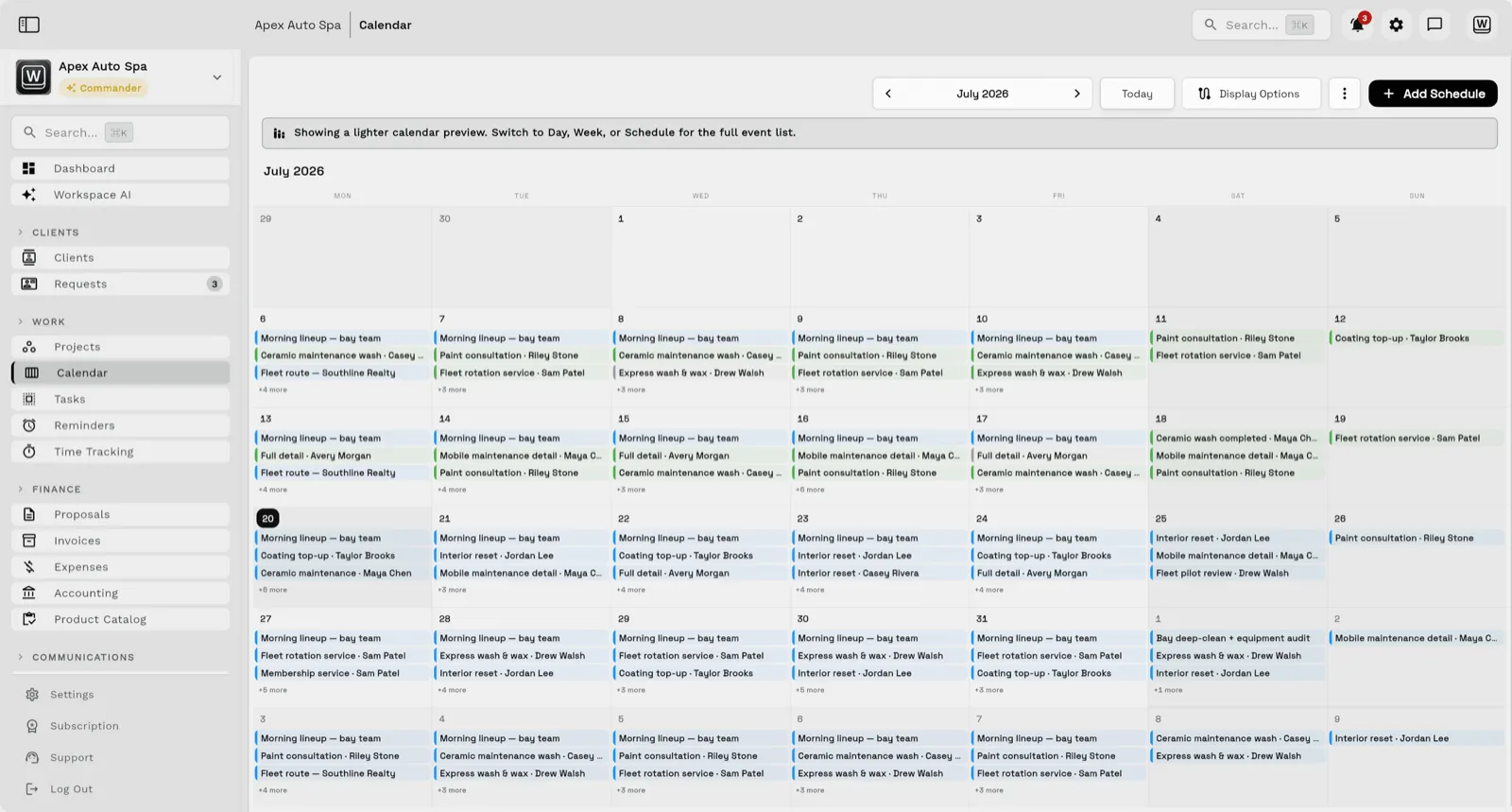
Window cleaning is a route business. Residential rounds repeat every four, eight, or twelve weeks; storefront and commercial accounts run on their own rhythm; and the week is organized into route days so the van crosses each neighborhood once. The software has to hold all of it: the recurring schedule, the quote, the reminder, the invoice, and the payment.
The best window cleaning software is not the app with the nicest invoice template. It is the system that keeps the round, the customer conversation, the quote, the invoice, and the payment on the same record — so nothing gets re-typed at 9pm. Our window cleaning software page shows what that connected workflow looks like.
This guide compares the five options window cleaners shortlist most often, honestly including where the trade-built incumbents beat a general workspace.
Quick answer
For owner-operators and small teams that want scheduling and online booking, inbox SMS and email, proposals and quotes, invoices, payment links, and client records in one workspace, Workspace369 is the strongest fit.
The Customer Factor and ServiceMonster are the trade-built incumbents: they win on frequency-based rebooking, route accounting, and drip follow-up rather than the whole client relationship. Markate is the budget-friendly alternative with a window-cleaning edition.
Jobber is the strongest general field service option: mature scheduling, routing, and a client hub, without window-cleaning-specific features.
What window cleaners actually need from software
A window cleaning week is a chain of small operational moments, and the software either carries them or becomes another chore. Evaluate tools by how well they handle:
- Recurring residential rounds and commercial schedules that rebook on a frequency, not a fresh sale every visit
- Route days that group stops by neighborhood so drive time stays short
- Quotes that price per pane or per job, add-ons included, then become invoices without re-typing
- Seasonal rebooking reminders that bring last spring's customers back before the calendar fills
- Before-and-after photos and notes that stay on the customer record
- On-site payment by link or card, so the job is paid before the ladders are packed
- Expense tracking and reporting that show which rounds and services actually pay
Two commercial questions belong on the checklist. First, how the price scales: the category splits between flat unlimited-user plans, per-user pricing, and included seats. Second, replacement value: one subscription against a scheduling app, a texting app, an invoice app, and the admin time copying between them.
How this guide was evaluated
We reviewed the official product and pricing pages in the research record below and compared each product against the same window cleaning workflow. The review covers four questions:
- Can the product carry a job from first inquiry through booking, service, invoice, and payment?
- Does it keep customer, communication, schedule, and billing context in one record?
- Which type of window cleaning business does the product serve best?
- Which surrounding workflows still require another system?
This is a workflow-fit comparison, not a hands-on audit. Workspace369 publishes this guide and places its own product first; competitor details are checked against public pages and can change, so verify with each vendor.
Best window cleaning software shortlist
The comparison below is based on public product information reviewed August 31, 2026. Verify current features and pricing with each vendor before choosing.
| Rank | Software | Best for window cleaners who need | Where it can fall short |
|---|---|---|---|
| 1 | Workspace369 | Calendar, booking, inbox SMS, quotes, invoices, payments, and records in one workspace | Not trade-native: no pane counting or frequency-based rebooking depth |
| 2 | The Customer Factor | Flat-price CRM built around follow-up cadence: frequency tracking, drip campaigns, unlimited users | Dated interface; texting billed per message; a move to tiered pricing announced |
| 3 | ServiceMonster | Established cleaning-industry platform: route scheduling, orders, direct-mail fill program | Annual commitment on every plan; marketing and drip campaigns sit in higher tiers |
| 4 | Markate | Budget-friendly field service platform with a window-cleaning edition and per-employee pricing | Online booking, portal, and phone features are paid add-ons; SMS campaigns bill per message |
| 5 | Jobber | Mature general scheduling, routing, and a self-serve client hub | General tool: pane counting and frequency rebooking need workarounds |
There is no universal winner. Workspace369 fits clearest when the purchase is meant to consolidate the stack around the client record, not just replace the scheduling calendar.

Window cleaning software pricing snapshot
Entry pricing reviewed August 31, 2026. Vendor pricing changes often, and this category mixes flat plans, per-user pricing, and included-seat plans — compare at your real team size.
| Software | Entry pricing | What to know about the pricing shape |
|---|---|---|
| Workspace369 | Cadet $29/mo (one seat), Voyager $74/mo (two), Specialist $149/mo (ten) | CRM, scheduling, proposals, invoices, payments, and inbox from the first plan; seats included |
| The Customer Factor | $44.95/mo flat with unlimited users | Members are grandfathered against increases; a move to three tiers is announced — confirm the current structure |
| ServiceMonster | Basic $99.99/mo (one user), Grow $199.99/mo (five), Premier $279.99/mo (ten) | Annual billing drops rates to $79.99/$149.99/$229.99; every plan requires an annual commitment |
| Markate | Owner Operator $49.95/mo, or $39.95/mo billed yearly | Teams add $5 per employee per month; several features are $10/mo add-ons |
| Jobber | Single-user plan $49/mo on monthly billing | Team plans scale by included users; annual commitments lower the monthly rate |
Where Workspace369 fits a window cleaning business
Workspace369 fits window cleaners who run the business from the client record: the round stays part of that record, not entries in a standalone calendar.
A window cleaner can book the first clean, confirm by SMS, quote the add-on at the door, invoice the finished job, take payment by link, and see the whole history when that customer comes due — without exporting anything between apps.
That matters because window cleaning margin leaks through gaps: the reminder that never sent, the add-on quoted at the door that never made it onto the invoice, the spring round that quietly lapsed because nobody asked for the rebooking. In practice, the record carries the whole job:
- Scheduling context: scheduling and online booking sit beside the client, so the route day and the customer history are the same system.
- Communication context: the shared inbox with SMS and email keeps confirmations, reminders, and follow-ups threaded on the customer instead of a personal phone.
- Billing context: proposals and quotes become invoices without re-typing, and payment links and payment plans keep collection attached to the same record.
- Record context: notes, tags, and files with before-and-after photos stay on the client profile, so the next visit starts from what was done last time.
- Follow-up context: reminder and follow-up automations handle the pre-visit nudge, the post-invoice chase, and the seasonal rebooking prompt with job context attached.
The honest concession: Workspace369 is not window-cleaning-native. It does not ship pane-count quoting or the frequency-based rebooking engine of the trade tools. It wins when the owner decides the bigger problem is the scattered stack — and for most one-to-five-person window cleaning operations, it is.
How the window-cleaning alternatives compare
The Customer Factor: the window-cleaning original
The Customer Factor was built by a window cleaning business owner, and the data model shows it: customers carry a service frequency, the login summary shows who is due for contact, and drip campaigns re-approach customers when they come due — a semiannual customer starts receiving follow-up six months after the last clean. Around that sit crew calendar views, one-click quote acceptance, customizable invoices, card processing via Square, Stripe, or Worldpay, automated reminder emails, per-message texting, QuickBooks sync, photo uploads, and review capture. Pricing is one flat $44.95/month plan with unlimited users, grandfathered for existing members — but a three-tier structure with limits on the lower tiers is announced, so confirm what the current plan includes. The concessions: the interface is older than the modern tools here, texting is metered per message, and the website sync captures leads rather than confirmed online bookings.
ServiceMonster: the cleaning-industry veteran
ServiceMonster has served carpet cleaning, window cleaning, and soft washing businesses for over two decades, built around the order: accounts, scheduling, orders, a mobile app, free training and phone support, and the FillMySchedule direct-mail program on every plan. Grow adds marketing, lead tracking, reporting, and dashboards; Premier adds opportunities, drip campaigns, and inventory control. For route-based window cleaners, scheduling is the draw — the platform tracks work and revenue by route. The considerations: every plan requires an annual commitment, marketing and reporting are gated to Grow, and extra users carry per-user fees.
Markate: the budget-friendly field service platform
Markate is a general field service platform with traction in the cleaning trades — it publishes a window-cleaning edition covering residential, commercial, and high-rise work. The base covers a drag-and-drop calendar, scheduling and dispatch, quotes that flow into work orders and invoices, SMS and email reminders, recurring work orders and invoices, job photos, Square payments, expenses, time tracking, reporting, and QuickBooks sync, plus an offline mobile app. Pricing is the draw: Owner Operator at $49.95/month, or $39.95/month billed yearly, plus $5 per employee. The concession is the à-la-carte shape: online booking, a customer portal, a business number, and Zapier are $10/month add-ons each, SMS campaigns bill per message, and the entry price grows with each switch flipped.
Jobber: the general field service option
Jobber is the most mature general field service platform here: route-optimized scheduling, online booking, a self-serve client hub where customers approve quotes and pay invoices, two-way texting, quote follow-ups, and card payments online or on the spot. It suits businesses running several service lines beyond window cleaning. What it lacks is window-cleaning-native structure — pane counting and frequency-based rebooking need workarounds. The Workspace369 and Jobber comparison breaks down where a general field service tool wins and where a connected client-work workspace fits better.

Best window cleaning software by scenario
Different window cleaning operations need different levels of trade depth.
| Scenario | Strongest fit | Why |
|---|---|---|
| Solo cleaner moving off texts and spreadsheets | Workspace369 Cadet | Calendar, inbox, quotes, invoices, and payments in one login at a solo-friendly entry price |
| Established round that lives on rebooking cadence | The Customer Factor | Frequency tracking and drip campaigns with unlimited users at one flat price |
| Multi-truck cleaning operation that wants marketing built in | ServiceMonster | Route scheduling, orders, and the FillMySchedule program — with an annual commitment |
| Budget-first operator assembling features one at a time | Markate | Low entry price, per-employee pricing, and à-la-carte add-ons |
| Multi-service field business beyond window cleaning | Jobber | Mature general scheduling, routing, and client hub |
| Team where calendar, inbox, invoices, payments, and records must share one place | Workspace369 | The client record carries the whole job from booking to payment |
When a window-cleaning-specific tool is the better fit
Workspace369 is not the right answer for every window cleaning business:
- The Customer Factor is the better fit when the business runs on rebooking cadence, wants drip follow-up tied to service frequency, and values unlimited users at one flat price over a modern interface.
- ServiceMonster is the better fit for multi-truck operations that want marketing, reporting, and a direct-mail fill program alongside scheduling, and can accept an annual commitment.
- Markate is the better fit when the budget decides and the owner is comfortable assembling online booking, a customer portal, and phone features from add-ons.
- Jobber is the better fit when window cleaning is one of several field service lines and the team wants a mature general platform with routing.
- Workspace369 is the wrong choice when pane-count quoting or a frequency-based rebooking engine out of the box is non-negotiable. A trade-native tool will feel more purpose-built for that job.
How a Tuesday route day runs in Workspace369
Tables show the decision's shape; the difference shows up in the day itself. A window cleaning week starts in the calendar: the month view fills with color-coded appointments — Tuesday's residential round, Thursday's storefront row, the monthly office block — and every entry sits one click from the client record behind it, so the schedule is also the customer list.
On site, the quote for the add-on the customer just asked about — the conservatory glass, the gutter clearing — goes out from the phone on the same record, and the invoice follows without re-typing a line. The customer pays from the payment link before the ladders are packed; if it goes quiet, an automated reminder follows up with context attached.
When the season turns, the rebooking prompt goes to last spring's customers from the same workspace — no list exported elsewhere. That is the checklist above when the whole route shares one workspace.
Final recommendation
Choose Workspace369 if your window cleaning business wants scheduling, online booking, inbox SMS, quotes, invoices, payments, and client records in one workspace — and if the real cost of the current setup is the time spent moving information between apps.
Start with the window cleaning software hub to see the connected workflow, then compare plans at your real team size on the Workspace369 pricing page.
If the decision is still open, run one test: take the last five customer interactions — a booking, a reminder, an add-on quote, an invoice, a payment — and count how many tools each one touched. The best window cleaning software for your business is the one that turns that count into one.
Research record
Sources reviewed for this guide
- The Customer Factor pricingOfficial pricing page reviewed August 2026 for the flat monthly plan with unlimited users, price grandfathering, and the announced move to a three-tier structure; the headline price renders dynamically, so the dollar amount was confirmed in the raw page source.
- ServiceMonster pricingOfficial pricing page reviewed August 2026 for Basic, Grow, and Premier pricing on monthly and annual billing, included user licenses, per-user add-on rates, per-tier feature splits, and the annual commitment.
- Markate pricingOfficial pricing page reviewed August 2026 for the Owner Operator monthly and yearly rates, per-employee team pricing, add-on pricing, and the 14-day free trial.
- Jobber pricingOfficial pricing page reviewed August 2026 for the single-user entry plan on monthly billing and team tiers that scale by included users.
Workspace369 publishes this guide and is included in the comparison. Competitor capabilities are checked against public product pages; recommendations are based on workflow fit, not paid placement.
Put it into practice
Run client follow-up in one workspace.
CRM, inbox, voice, invoicing, payments, projects, files, AI, and workflow automations — connected instead of exported.