Client work & CRM
CRM vs project management: where each one stops.
CRMs track relationships; project tools track work. Most teams buy both and then spend their days copying context between them. Here is where each one stops, when one tool alone is enough, and the alternative to running two.
Reviewed
In short
A CRM owns the client relationship: records, history, communication, pipeline. Project management owns the work: tasks, timelines, assignments, delivery. A CRM alone is enough when jobs are short and follow-up is the hard part; a project tool alone is enough when clients are few and delivery is the hard part. Client-facing teams usually need both sides — and that overlap is exactly where two separate tools force you to copy context by hand.
What the CRM owns
The CRM is the system of record for the relationship:
- Client and company profiles, contacts, notes, lead sources
- Communication history — email, SMS, calls, meetings
- Requests, intake, and what the client asked for
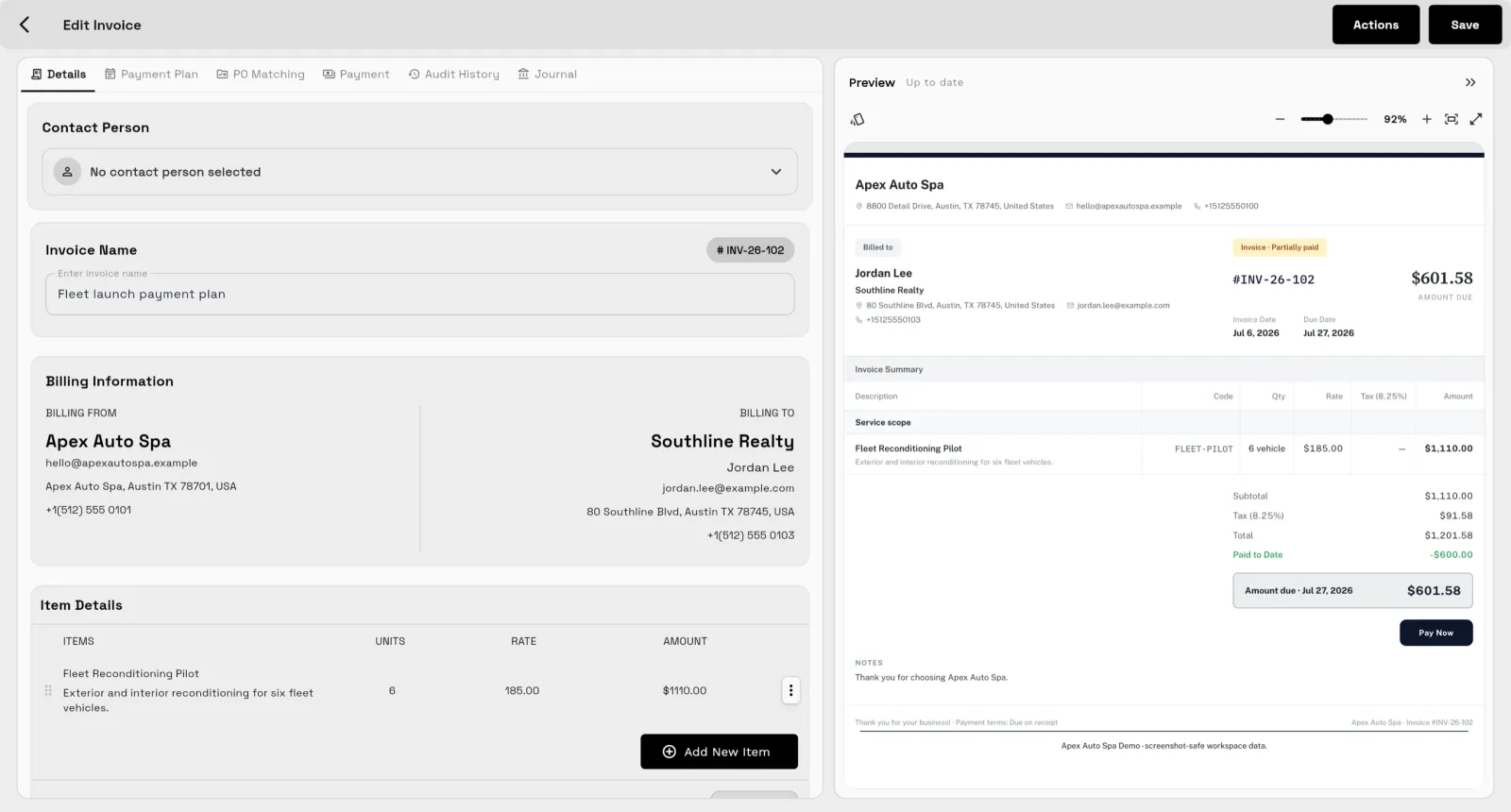
- Proposals, invoices, payments, and account status
What project management owns
The project tool is the system of action for delivery:
- Tasks and subtasks with owners and due dates
- Timelines, calendars, and scheduling
- Assignments and team capacity
- Files, proofs, and approvals
When a CRM alone is enough
If the work you sell is short, simple, or repeatable, the relationship is the hard part and delivery mostly manages itself. Start with the CRM when:
- Your revenue problem is follow-up — leads go cold and past clients never hear from you
- Jobs run hours or days, not months, so a task list per client covers delivery
- One person owns each client from first call to paid invoice
- You need pipeline, communication history, and billing in one view more than you need timelines and dependencies
When a project tool alone is enough
If clients are few, relationships are stable, and the work itself is the complicated part, start with the project tool:
- You run a handful of long engagements and everyone knows the clients personally
- Delivery involves many people, handoffs, dependencies, and hard deadlines
- New business comes through referrals, so there is no pipeline to manage
- Billing is simple enough that a separate invoicing habit covers it
The overlap zone: client-facing project work
Agencies, consultants, contractors, MSPs, and professional firms live in the overlap, where every project belongs to a client and every client expects delivery. In this zone the questions never stay on one side of the line. "Where is my project?" is a CRM question about a project-management fact. "Can we add this to the scope?" is a delivery question with a proposal and an invoice attached. A client portal sits exactly on the seam: the client sees progress, files, approvals, and invoices in one place, and your team stops forwarding status emails.
The real cost of running both disconnected
A deal closes in the CRM, and someone re-creates the client in the project tool. An invoice question arrives, and someone looks up the project in one tab and the payment in another. Every handoff between the two systems is a chance for drift — wrong name, stale status, missing file — and the costs compound:
- Double entry: every new client, project, and status change typed twice
- Sync gaps: integrations copy fields, not context, and they fail quietly
- Two subscriptions, two logins, and two places to search for the same file
- No single answer to "where are we with this client" without opening both tools
How to decide in one pass
Answer these five questions honestly and the decision makes itself:
- Losing leads and follow-ups? That is a CRM problem — start there.
- Missing deadlines and losing track of who does what? That is a project problem — start there.
- Losing both, and re-typing client details between tools? You need the two sides connected, not stacked.
- Clients emailing for status, files, and invoices? Add a client portal to whichever side you pick — or pick a workspace that already has one.
- Comparing cost? Add both per-seat subscriptions plus the integration, and weigh that against one flat plan.
What one client-work system changes
One workspace where the client record and the project are the same thing. Workspace369 keeps CRM, projects, shared inbox, client portal, proposals, invoices, payments, files, AI, and reporting on one record, so the sale, the delivery, and the bill all reference the same client. Workspace369 uses flat plans instead of per-seat pricing: Cadet is $29/month for one seat, Voyager $74/month for two seats, Specialist $149/month for ten seats, and Commander $299/month for twenty seats, with CRM, projects, proposals, invoices, retainers, and the client portal included from the $29/month plan and annual billing taking about 20% off. That is the practical answer to the "vs" question: not picking one, but removing the seam.
FAQ
Common questions
Can project management software replace a CRM?
Only for very simple relationships. PM tools track work, not relationships — no communication history, no invoice context, no account view. Once clients matter beyond a single project, you need the CRM layer too.
Can a CRM replace project management?
Sales CRMs usually offer only light task features. They track the relationship but not real delivery — no timelines, capacity, or approval flows. Delivery teams still need the project layer.
What if I need both a CRM and project management?
You have two options: connect two specialized tools with an integration, or use one workspace built for client work. Integrations sync fields but not context, and every sync is one more thing that can break. A connected workspace keeps the client record, project, communication, and billing as one object, so nothing needs copying between systems.
Is it cheaper to run a CRM and a PM tool separately?
Rarely, once you count the whole stack: two per-seat subscriptions, an integration to keep them in sync, and the hours lost to double entry. Workspace369 plans start at $29/month for one seat, and a team of up to ten runs on the Specialist plan at $149/month with CRM, projects, client portal, proposals, invoices, payments, inbox, AI, and reporting included.
Do clients ever see the project management side?
They should. A client portal gives each client a login for project progress, files, approvals, proposals, and invoices, which removes most "where are we" emails. In Workspace369 the portal is part of every plan, so the client-facing view and the internal workspace read from the same record.
What should I look for when choosing between them?
Ask where your pain actually is: losing client context (CRM problem) or losing delivery control (PM problem). If it is both — which it usually is — evaluate connected workspaces before stacking two tools with an integration.
Ready when you are
See where Workspace369 fits into your client-work flow.
Start with the modules you need today, then turn on AI, automations, accounting, inventory, requests, and reporting as the operation grows.