Best CRM for Chiropractors in 2026: Chiro EHRs Compared
Best CRM for chiropractors: five practice-management tools and Workspace369 compared for clinics on price, clinical notes, insurance billing and scheduling.
We make Workspace369, which is on this list. Weigh our ranking with that in mind.

By Simon Dziak, Founder, Workspace369 · LinkedIn
The best CRM for chiropractors is usually a chiropractic practice system. ChiroTouch suits a full suite, ChiroHD a multi-provider clinic that wants no per-provider charges, and Platinum System a clinic that wants insurance billing from $299 a month. Jane and Cliniko are general practice tools with published prices for small clinics. Workspace369 ranks last here: its CRM for chiropractors page covers only the business side, such as corporate care packages sold by proposal. If you want the wider field first, see our client management software guide for service businesses. To price a package, try the free deposit calculator.
Disclosure and method: Workspace369 publishes this guide and is one of the options, and we rank it below every chiropractic practice tool for patient care. It is a documentation-based shortlist, not a hands-on benchmark, and it is not medical, legal or compliance advice. Official vendor pricing pages were reviewed on October 21, 2026; the ChiroTouch home page and Cliniko features page were last reviewed on October 18, 2026. Check current plans, security terms and agreements with each vendor before you buy.
Key takeaways
- Chiropractic-built tools such as ChiroTouch, ChiroHD and Platinum System are the safer first look: they list clinical note templates, scheduling and insurance billing, which a general client-work CRM does not.
- ChiroHD says it has no per-provider charges but lists no standalone EHR price (its bundles with SKED are listed from $549 a month); Platinum System says plans start at $299 a month; ChiroTouch publishes no prices.
- Jane Practice is $79 a month with one full-time practitioner, and Cliniko is $45 a month for one practitioner ($95 for two to five); Cliniko has a 30-day free trial with no payment details needed.
- Workspace369 Cadet is $29 a month ($23.25 billed yearly) for one seat. It has no clinical notes, no insurance billing and makes no HIPAA claim, so it only suits the business side, such as corporate care packages sold by proposal.
- Run one fictional patient and one fictional corporate inquiry through each trial or demo, and keep real patient information out of any tool you have not cleared.
What's inside?
What a CRM for chiropractors is (and what it is not)How we compared these toolsThe best CRM for chiropractors in 2026Side-by-side comparisonWhich tool fits your clinic?Run a first-visit and corporate-inquiry testWhen to keep it simple
What a CRM for chiropractors is (and what it is not)
A chiropractic clinic runs two kinds of work. The clinical side is patient charts, clinical notes, treatment plans, appointments and insurance claims. The business side is marketing, corporate wellness inquiries, event care, vendor files and the invoices for those. "CRM" can mean either, and the tools below sit at different points on that line. Chiropractic practice systems cover the clinical side and often add patient engagement. A general client-work tool covers the business side only. Keep patient information in a system you have cleared for it, and ask every vendor for its security and agreement documents yourself. This guide covers solo and small clinics; the CRM for chiropractors page shows the Workspace369 view of the business side.
How we compared these tools
We compared each tool on the same five points, using only the vendor's own pages:
- Entry price for one practitioner, as listed on October 21, 2026, with the billing view named.
- Clinical side: clinical note templates, charting and treatment plans that the page names.
- Insurance and billing: claims, clearinghouse, superbills and invoices the page names.
- Scheduling and patient engagement: online booking, reminders, recall and texting.
- Trial terms: length and whether the vendor says payment details are needed.
We did not test speed, support, data import, security controls or regulatory compliance, and we used no third-party ratings. Compliance wording below is the vendor's own, not our finding. Order reflects documented fit for a solo or small chiropractic clinic, not commercial interest.
The best CRM for chiropractors in 2026
1. ChiroTouch, best for a full chiropractic suite
ChiroTouch sells three plans: Start (core EHR and practice management, basic AI charting, payments, reminders, patient portal), Grow (adds an AI scribe, reputation management, automatic patient recall and multi-location support) and Scale (adds AI campaigns, lead management and exercise programs). Its home page lists custom clinical note templates, digital intake that flows into notes, and billing where treatment details flow into claims, with a documentation scan before submission. The pricing page shows no prices and sends you to a demo, so every price here is See site. It says it is used by 12,500+ chiropractic practices, which is the vendor's own figure.
Limitations: unverified pricing means you cannot budget from this guide. Insurance billing and payments are listed as separate add-ons, so confirm the full monthly total in a demo.
Best for: a clinic that wants charting, scheduling, billing and claims from one chiropractic-specific vendor.
2. ChiroHD, best for a flat price with unlimited providers
ChiroHD no longer shows a standalone EHR price on its pricing page, so the EHR price is See site. The page lists bundles with its SKED product at $549 a month (Scale), $649 (Performance) and $819 (Autopilot), and says there are no per-provider charges, with unlimited providers and users included. It lists one-time fees of $799 for implementation and $499 for migration, and on-demand texting at $0.03 a text, with monthly text credits included in the bundles. Optional A2P 10DLC texting compliance setup is $45. No trial is stated, so book a demo.
Limitations: the standalone price is not public, the entry level includes no text credits, and the one-time fees add to year one.
Best for: a multi-provider clinic that wants predictable cost without paying per provider.
3. Platinum System, best for billing and growth tools in one tier
Platinum System says plans start at $299 a month. Its entry tier, Align, lists the EHR with charting and clinical notes, scheduling and booking, treatment and care plans, billing with revenue-cycle management and a clearinghouse, payments and reporting. Strengthen adds a patient app, online intake, two-way messaging and review requests; Thrive adds lead management and local SEO. Prices for the higher tiers are not shown. The vendor says it has served chiropractic since 1990 and states it is HIPAA compliant, which we did not verify.
Limitations: only the starting price is public, and no trial is stated. The patient app and online intake are not in the entry tier.
Best for: a clinic that wants insurance billing and later patient-retention tools from one vendor.
4. Jane, best for a general practice tool with a clear price
Jane lists Practice at $79 a month including one full-time practitioner; the fees for extra full-time and part-time practitioners are See site. Balance is $59 a month for one practitioner and 20 appointments a month. Online booking, intake forms, charting templates, treatment plans and invoices with superbills are listed for every plan, and insurance billing is a $20 a month add-on for Practice and Thrive, plus $5 a month per additional full-time practitioner ($2.50 part-time). Jane says it has no free trial but gives a demo account. It is built for many health professions, not chiropractic alone, so check the charting and billing codes you need.
Limitations: no free trial, SMS reminders vary by region, and claims need the paid add-on.
Best for: a solo or small clinic that wants published, practitioner-based pricing.
5. Cliniko, best for a small clinic that wants a trial
Cliniko charges by practitioner: $45 a month for one, $95 for two to five and $145 for six to eight, in US dollars; paying annually includes one free month. It lists customizable treatment notes and unlimited patients and locations. The trial is 30 days and the page says no payment details are needed, though some features such as telehealth unlock after a card is entered. SMS costs 10 cents a message. The pages we read did not name insurance claims or chiropractic-specific billing, so confirm them before relying on it for insurance.
Limitations: not chiropractic-specific, and insurance claim support is unconfirmed on the pages we read.
Best for: a cash-pay or low-volume clinic that wants a low published price.
6. Workspace369, best for corporate care packages sold by proposal
Workspace369 holds the client record, Proposals the client approves online, deposits on acceptance, a private client portal, intake forms and invoices in one place. Cadet is $29 a month for one seat ($23.25 billed yearly). Deposits, time tracking and email appointment reminders are on every plan. The screenshot below is a demo record, not a customer result.
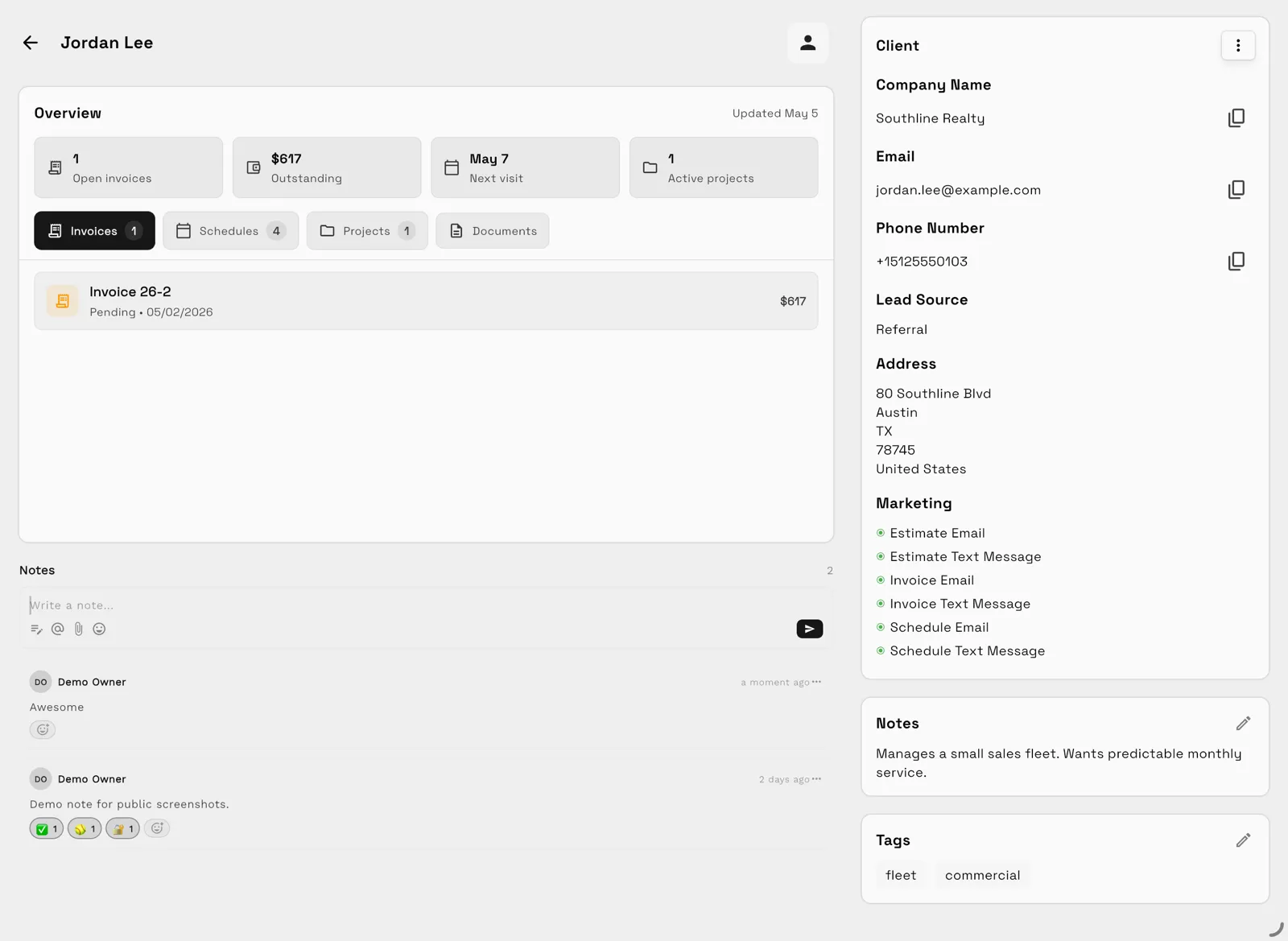
Limitations: it has no clinical notes, no treatment plans and no insurance billing, and makes no HIPAA or business associate agreement claim, so it does not replace any tool above for patient care. Cadet has one seat and 5 active projects; Voyager ($74 a month) has two seats and Specialist ($149 a month) ten. Online booking and payment plans start at Specialist, and SMS starts at Voyager. The 14-day trial needs a card.
Best for: a cash-practice clinic that sells corporate workshops or event care packages by proposal and wants quotes, deposits and invoices apart from patient records.
Side-by-side comparison
| Tool | Entry price | Clinical notes and insurance | Trial | Main limit |
|---|---|---|---|---|
| ChiroTouch | See site | Note templates, claims and billing add-ons listed | Demo | Price not published |
| ChiroHD | See site (bundles with SKED from $549 per month) | See site | Not stated | One-time fees of $799 and $499 |
| Platinum System | From $299 per month | Clinical notes, billing and clearinghouse in entry tier | Not stated | Higher tier prices not shown |
| Jane | $79 per month (Practice), one full-time practitioner | Charting templates; insurance billing add-on $20 per month | No free trial; demo account | Not chiropractic-only |
| Cliniko | $45 per month, one practitioner | Treatment notes; claims not confirmed | 30 days, no payment details needed | Insurance support unconfirmed |
| Workspace369 | $29 per month ($23.25 yearly), one seat | None; no HIPAA claim | 14 days, card required | No clinical or insurance features |
Which tool fits your clinic?
| If you mostly need | Start with | Why |
|---|---|---|
| A full chiropractic suite with claims | ChiroTouch or Platinum System | Charting, billing and engagement from chiropractic vendors |
| Several providers without per-provider fees | ChiroHD | Page says no per-provider charges |
| A published price for a small clinic | Jane or Cliniko | $79 and $45 a month for one practitioner |
| A free trial before paying | Cliniko | 30 days, no payment details needed |
| Corporate or event care sold by proposal | Workspace369 | Proposals, deposits and invoices from $29 |
Run a first-visit and corporate-inquiry test
Use fictional data only, never a real patient, in each trial or demo:
- Book a first visit for a fictional patient and send the intake form.
- Write a visit note from a template and note how many clicks it takes.
- Create the bill, and if you take insurance, a test claim.
- Set a recall or reminder and check what the patient receives.
- Log a fictional corporate inquiry, send a quote with a deposit, and invoice it.
- Export the records and check what comes out.
The best tool keeps the note, the bill and the reminder on one record. Anything you retype between screens is the leak this test finds.

When to keep it simple
If you see a few patients a week, a practice tool alone may be enough. Add a business tool when you quote corporate wellness days or event care and want those proposals, deposits and invoices apart from patient charts. The chiropractors product page shows how Workspace369 handles communications, and the pricing page has current plans. Workflow Automations can send reminders and create tasks, with email automations on every plan.
Before importing anything real, run one full cycle on demo data and check that your records can be exported.
Sources reviewed for this guide
- Workspace369 pricingPlan matrix reviewed October 21, 2026.
- ChiroTouch pricingOfficial pricing page reviewed October 21, 2026 for Start, Grow and Scale features and add-ons; it lists no prices, so each price is See site.
- ChiroTouch home pageOfficial home page reviewed October 18, 2026 for the vendor-stated practice count, note templates and claims billing.
- ChiroHD pricingOfficial pricing page reviewed October 21, 2026 for bundle prices, one-time fees, texting and provider terms; it shows no standalone EHR price.
- Platinum System pricingOfficial pricing page reviewed October 21, 2026 for the starting price and tier features.
- Jane pricingOfficial pricing page reviewed October 21, 2026 for plan prices, the insurance billing add-on and trial terms.
- Cliniko featuresOfficial features page reviewed October 18, 2026 for customizable treatment notes.
- Cliniko pricingOfficial pricing page reviewed October 21, 2026 for practitioner-based prices and trial terms.
Workspace369 publishes this documentation-based comparison and is one of the options. It is not an independent ranking or a hands-on benchmark, and it is not medical, legal or compliance advice.
Run client follow-up in one workspace.
CRM, inbox, voice, invoicing, payments, projects, files, AI, and workflow automations — connected instead of exported.
14-day free trial. Card required. After the trial: from $29/month. Renews automatically every month until you cancel. Cancel anytime in Settings → Billing.