Best CRM for Massage Therapists in 2026
Six tools for massage therapists compared on price, online booking, forms and treatment notes, plus a booking-to-invoice test for the trial.
We make Workspace369, which is on this list. Weigh our ranking with that in mind.

By Simon Dziak, Founder, Workspace369 · LinkedIn
The best CRM for massage therapists books the session, collects intake forms and keeps treatment notes in one tool. ClinicSense fits a solo practice, Jane fits multi-practitioner clinics, Noterro fits per-seat pricing, MassageBook fits a massage-specific booking page, and Workspace369 fits only the business side.
Workspace369 (see its massage therapists page) comes last of six here because its matrix lists no HIPAA or BAA statement and no charting or treatment notes. For a related trade, see the best CRM for estheticians. To size a booking fee first, use the free deposit calculator.
Disclosure and method: Workspace369 publishes this guide and is one of the options; we rank it last of six for this reader. It is a documentation-based shortlist, not a hands-on benchmark. Official vendor pages were reviewed on October 26, 2026. We make no medical or compliance claims of our own and quote a vendor's HIPAA wording only where its own page says it. Check current plans with each vendor before you buy.
Key takeaways
- A massage practice usually needs online booking, intake forms, treatment notes and payments in one system, so practice-management tools lead this list and a general client-work tool comes last.
- ClinicSense lists Lite at $39 a month ($35.75 a month on its Annual view) with online booking, email reminders, SOAP notes and intake forms, and its FAQ says it is HIPAA compliant; it has a 14-day trial with no card.
- Jane lists Balance at $59 a month for one practitioner (20 appointments a month) and Practice at $79 with one full-time practitioner included, and Noterro starts at $33 a month (its yearly view says 15% less); both list "HIPAA Compliant" among their security rows.
- Workspace369's plan matrix lists no HIPAA or BAA statement and no charting or treatment notes, so it should not hold client health information; Cadet is $29 a month ($23.25 billed yearly) for one user, and online booking starts at Specialist ($149 a month).
- MassageBook, built for massage therapists, lists Practice at $59 a month with a 30-day no-card trial (Launch and Clinic prices: See site), but its page shows no HIPAA wording; test each shortlisted tool by running one fictional client through booking, an intake form, a package, a payment and the invoice.
What's inside?
What a CRM for a massage therapist is (and what it is not)How we compared these toolsThe best CRM for massage therapists in 2026Side-by-side comparisonWhich tool fits your massage practice?Workspace369 in action for a corporate chair-massage bookingRun a booking-to-invoice test during the trialKeep client health information out of the wrong toolWhen to keep it simple
What a CRM for a massage therapist is (and what it is not)
A CRM for a massage therapist is the front-desk side of the practice: who inquired, which session they booked, which forms they completed, which package or gift certificate they bought, what they owe and when they are due back. Practice-management tools for bodywork bundle booking, forms and treatment notes with payments; general client-work tools usually do not. A CRM is also not a safe place for client health information by default. Ask every vendor in writing what it states about health data, and keep anything clinical out of a tool that does not state it.
How we compared these tools
We compared each tool on the same five points, using only the vendor's own pricing pages as read on October 26, 2026:
- Price at a stated size, per practitioner or per plan, with every billing toggle and headcount on the page selected.
- Booking and reminders: online booking and appointment reminders, and the plan they sit on.
- Forms and treatment notes: intake forms, charting or treatment notes named on the pricing page.
- Health-data wording: any HIPAA statement and where the page puts it, quoted only as the vendor wrote it.
- Limits and trial terms: appointment caps, per-practitioner charges and whether a trial exists.
We did not test speed, support, reliability or mobile apps, did not evaluate any vendor's security or compliance, and did not use third-party ratings. Where a price only appears after a client-side selector or tab loads, we write See site instead of a number. We used only the standard prices, not association-discount views. Order reflects documented fit for a massage practice, not the lowest price.
The best CRM for massage therapists in 2026
1. ClinicSense, best for a solo or small massage practice that wants treatment notes and booking together
ClinicSense lists three plans. On its Monthly view, Lite is $39 a month, Standard $69 and Premium $99; on its Annual view the page shows $35.75, $63.25 and $90.75 a month. Lite covers up to 20 appointments a month with online booking, email reminders, SOAP notes, intake forms and financial reports. Standard adds up to 200 appointments, SMS reminders, a waitlist, packages and gift cards, and Premium has unlimited appointments. Extra practitioners are $20 a month on Standard and Premium. The page offers a 14-day free trial with no credit card. Its FAQ answers "Are you HIPAA compliant?" with "Yes, ClinicSense is HIPAA compliant."
Limitations: Lite is capped at 20 appointments a month, and packages and gift cards start at Standard, so a full-time solo practitioner needs Standard ($69). Lite lists no extra practitioners. We did not check what the HIPAA answer covers; ask ClinicSense in writing.
Best for: a solo or small massage practice that wants booking, intake forms and treatment notes from one vendor at a published price.
2. Jane, best for a practice that wants clinic-grade charting and a clear per-practitioner price
Jane lists Balance at $59 a month (a single practitioner, up to 20 appointments a month), Practice at $79 a month and Thrive at $99 a month. Practice and Thrive include 1 full-time practitioner, with extra full-time and part-time practitioners charged per month (amounts: See site). The page lists online booking through a custom-branded site, intake forms, custom charting templates, treatment plans, invoices with integrated payments and gift cards as core features in every plan. Practice adds unlimited free SMS appointment reminders (availability varies by region), and Thrive adds Rooms & Equipment scheduling, automated waitlist management, and packages and memberships. The Security & Stability rows list "HIPAA Compliance".
Limitations: Jane has no free trial; its FAQ points to a demo and a demo account instead. AI Scribe ($15 a month per practitioner), Group Telehealth ($15) and Insurance Billing ($20 plus per-practitioner amounts) are add-ons. We found one monthly price per plan and no yearly view, and the extra-practitioner amounts did not show in the page text.
Best for: a practice with insurance billing or several practitioners that wants charting and booking from one vendor and is fine without a trial.
3. Noterro, best for a practitioner who wants charting and per-seat pricing
Noterro prices three plans: Core at $33 a month, Plus at $55 and Max at $77 on its Pay Monthly view; the Pay Annually view says it saves 15%, and its yearly figures load in the browser (see site). Each includes one practitioner seat; additional seats are $13.20, $22 and $27.50 a month on the monthly view. Core lists charts and forms, billing and payments, scheduling, online booking through a clinic-branded app and email reminders. Plus adds text and call reminders, file uploads and waitlists, and Max adds packages and memberships. The page offers a 14-day trial with no credit card and lists "HIPAA Compliant" under Security & Availability.
Limitations: AI features such as Scribe and Form Summary are usage-based after 300 free credits. Text and call reminders start at Plus, packages and memberships at Max, and insurance claims features carry a US flag, so check your region.
Best for: a solo practitioner who wants charting, forms and online booking at the lowest entry price on this list and may add seats later.
4. MassageBook, best for a massage-specific booking page at a low entry price
MassageBook's page opens on an association-discount view, which we did not use. Its plan comparison lists Practice at $59 a month; the Launch and Clinic standard prices load in a tab we could not read in the page text (See site), and no yearly view is shown. Launch lists online booking and a MassageBook directory listing, a 3-service limit, basic SOAP notes and Stripe and Square payment processing. Practice adds client intake forms, premium SOAP notes, text and email appointment reminders, gift certificates and insurance billing receipts. Clinic adds unlimited staff seats, room assignment, couples-massage booking and waitlists. The page offers a 30-day free trial of Practice with no credit card.
Limitations: Launch caps services at 3 and has only basic SOAP notes, so a solo practitioner who wants intake forms and reminders needs Practice ($59). The page shows no HIPAA wording, so ask MassageBook in writing how it handles client health information.
Best for: a solo or small massage practice that wants a booking page and directory listing built for massage.
5. Vagaro, best for a low per-person price that scales by headcount
Vagaro's page prices by the number of people, and we could read $30 a month for one person; the prices for 2 or more people appear only after a client-side selector loads (See site). It also shows a first-six-months rate, which we did not use. Every plan lists online booking, unlimited notifications and appointment reminders, memberships, packages and gift certificates, SOAP notes, invoices, inventory tracking and 1,000 free emails a month. Its FAQ says Vagaro offers a 30-day free trial.
Limitations: Vagaro serves salons, spas and many other trades rather than bodywork alone, and the page does not say whether a card is needed. A free card reader depends on signing up for its merchant services. The page mentions HIPAA in a trust note about independent audits rather than against a plan, so we did not rely on it.
Best for: a small massage business that wants booking, SOAP notes and packages at a low published per-person price.
6. Workspace369, best for corporate and business-side work when client health records live elsewhere
Workspace369 keeps a client record, a proposal for a corporate wellness day or package, contracts with e-signature, deposits, a client portal and invoices together. Cadet is $29 a month for one user ($23.25 billed yearly) and lists public intake forms, a drag-and-drop form builder, the client portal, deposits, retainers and payment schedules, recurring invoices and email appointment reminders. The screenshot is a demo record, not a customer result.
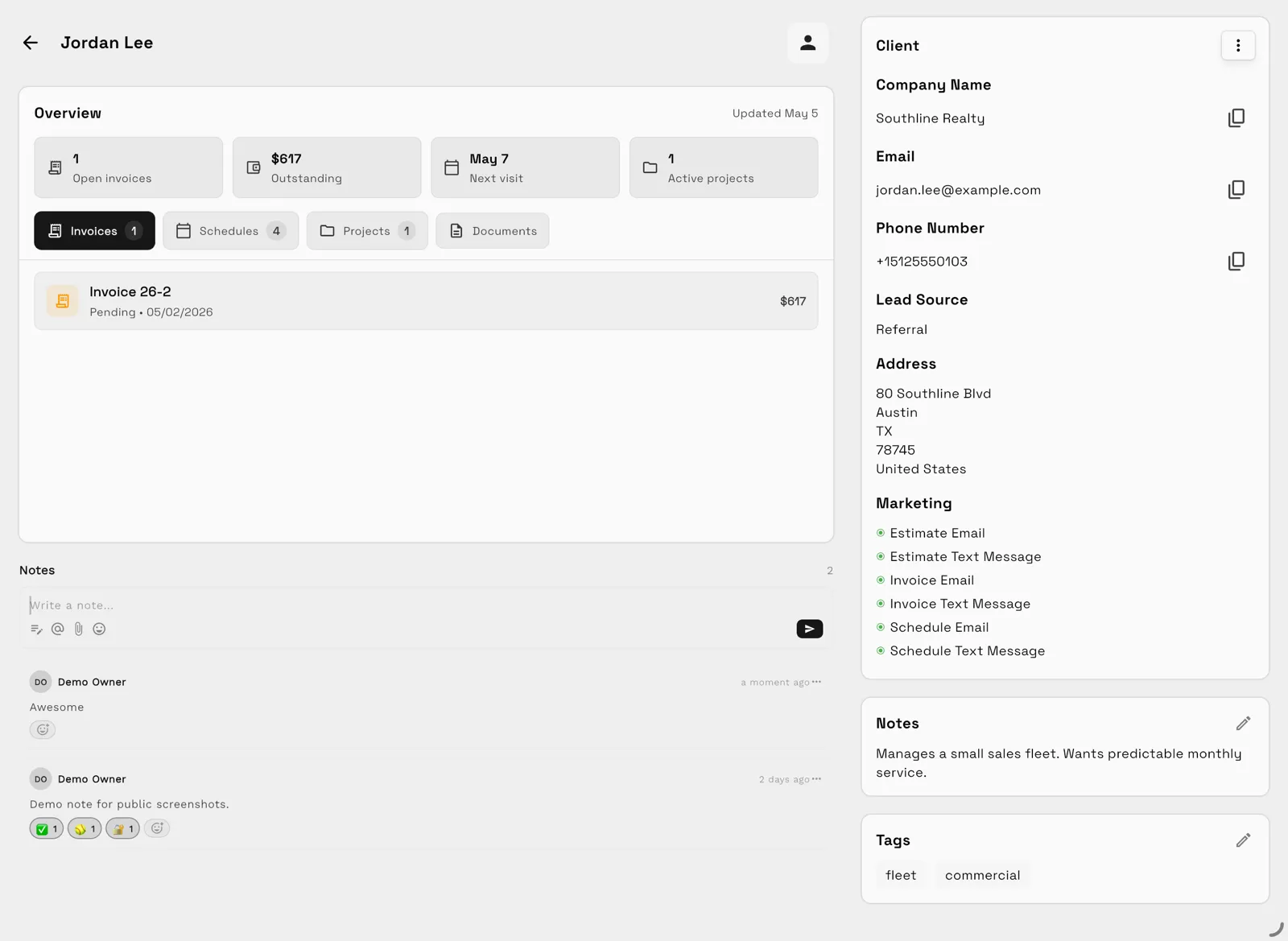
Limitations: the plan matrix lists no HIPAA or BAA statement and no charting or treatment notes, so Workspace369 should not hold client health information. Online booking starts at Specialist ($149 a month, $119.25 billed yearly, 10 seats), so a client-facing booking page is not on Cadet or Voyager. Cadet has one user and 5 active projects; Voyager ($74 a month, $59.25 billed yearly) gives two seats. The 14-day trial covers Cadet through Commander, card required. ClinicSense, Jane and Noterro list SOAP notes or charting and a HIPAA statement, and MassageBook lists SOAP notes, which Workspace369 does not.
Best for: a practice that keeps client health records in a dedicated system and wants proposals, deposits and invoices for corporate and event work on a non-clinical client record.
Side-by-side comparison
| Tool | Plan priced | Monthly | Billed yearly | Booking and notes at that plan | Limits | Trial |
|---|---|---|---|---|---|---|
| ClinicSense | Lite | $39 | $35.75 a month | Online booking, email reminders, SOAP notes, intake forms | 20 appointments a month; Standard $69 for 200 | 14 days, no card |
| Jane | Practice | $79 | Not shown | Online booking, intake forms, custom charting templates | Includes 1 full-time practitioner; extra: See site | No trial; demo account |
| Noterro | Core | $33 | See site (15% off) | Charts and forms, online booking, email reminders | 1 seat; $13.20 per extra seat | 14 days, no card |
| MassageBook | Practice | $59 | Not shown | Online booking, premium SOAP notes, intake forms, reminders | Launch (3-service limit) and Clinic prices: See site | 30 days (Practice), no card |
| Vagaro | 1 person | $30 | Not shown | Online booking, SOAP notes, invoices | 2 or more people: See site | 30-day free trial; card not stated |
| Workspace369 | Cadet | $29 | $23.25 a month | Intake forms, portal, deposits; no online booking (Specialist, $149); no charting or treatment notes | 1 user, 5 active projects; no HIPAA or BAA listed | 14 days on Cadet to Commander, card required |
Which tool fits your massage practice?
| If you mostly need | Start with | Why |
|---|---|---|
| A solo practice with booking, forms and notes | ClinicSense | Lite lists booking, intake forms and SOAP notes at $39, with a 14-day no-card trial |
| Clinic-style charting, several practitioners or insurance billing | Jane | Charting templates on every plan and an Insurance Billing add-on |
| Charting and forms with per-seat pricing | Noterro | Core is $33 monthly, 15% less on the yearly view |
| A massage-specific booking page | MassageBook | Launch has online booking and a directory listing (price: See site); Practice $59 adds intake forms and reminders |
| A per-person price for a growing team | Vagaro | $30 for one person; larger teams: See site |
| Corporate proposals, deposits and invoices only | Workspace369 | Proposals, contracts, deposits and invoices; no health records |
Workspace369 in action for a corporate chair-massage booking
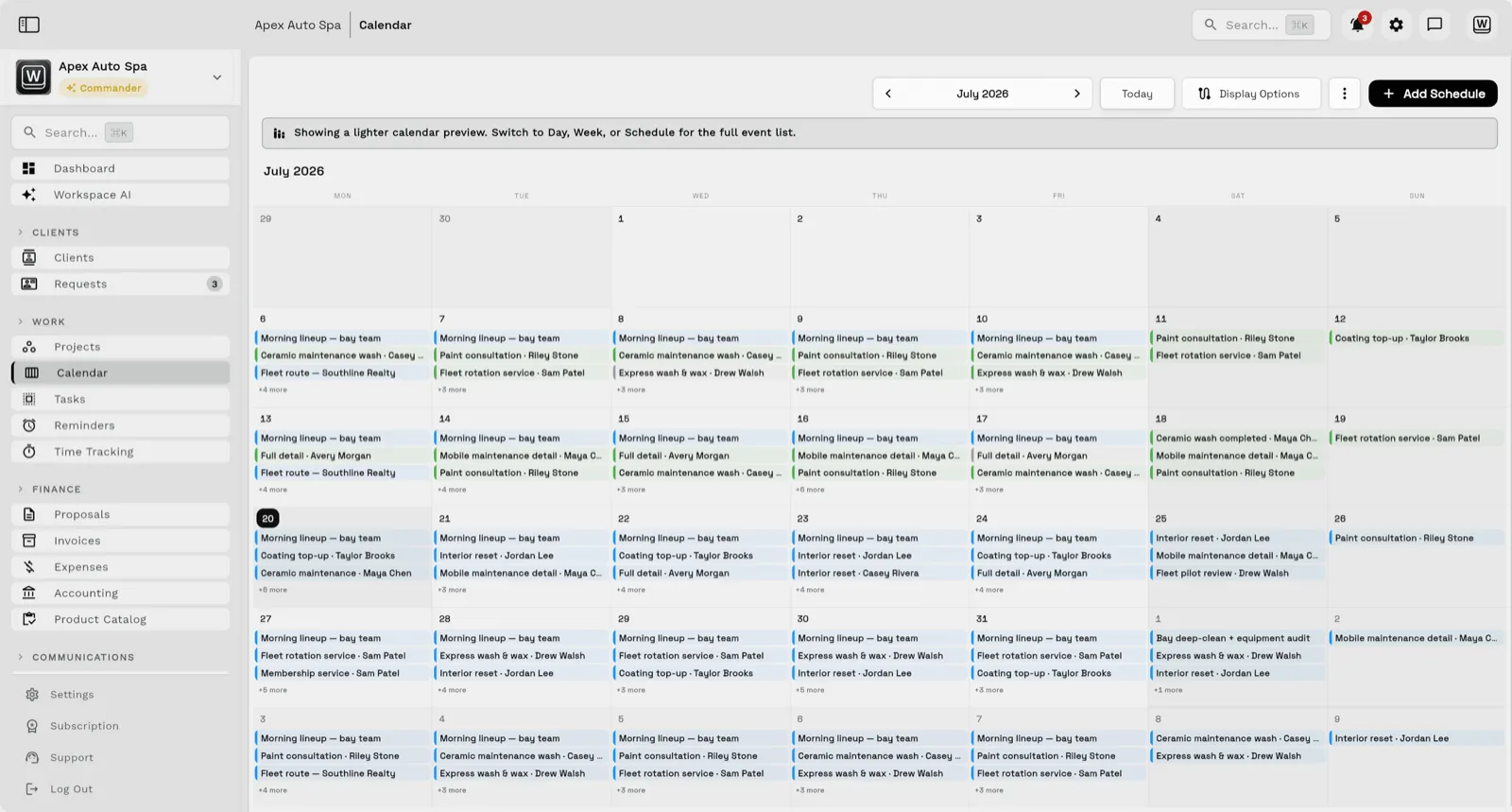
For a massage business, the Workspace369 side is the corporate or event job: a recurring on-site date, a deposit and the balance. The first screenshot is the month calendar in a demo workspace with sample data (an auto-detailing business, not a massage practice). Each day lists dated entries with the client's name, and the left menu has Tasks and Reminders beside the calendar. The schedule page covers it. In your own setup, a monthly office chair-massage visit would sit on that calendar, and a Workflow Automation could send the reminder email the day before.
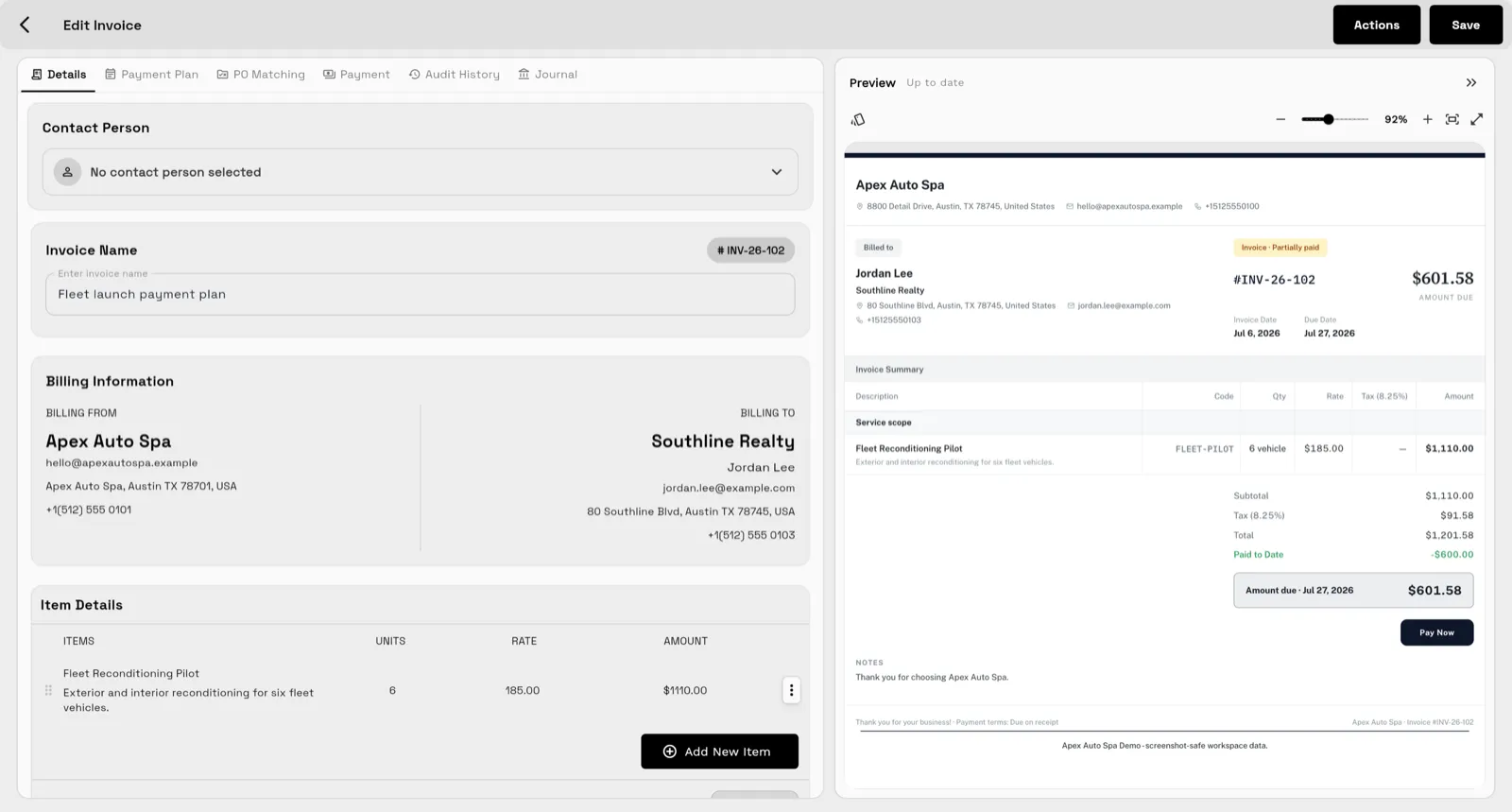
The second screenshot is the invoice editor, also a demo workspace with sample data. It shows an invoice marked partially paid with a $600 payment already applied and a balance due on the right, which is how a deposit followed by a final invoice reads. Intake forms and deposits are on every plan; online booking and payment plans start at Specialist.
What it does not do: Workspace369 has no treatment notes, no charting, no HIPAA or BAA statement and no massage-specific booking page, so the session record and the client's health history stay in your practice tool.
Run a booking-to-invoice test during the trial
Take one fictional client through each tool you shortlist, using made-up details only:
- Create the client from an inquiry and log what they asked about.
- Book a session online and send the intake form before the visit.
- Sell a package or a gift certificate and see what the client receives.
- Take a deposit or payment and confirm it shows on the client record.
- Move the appointment and check the reminder follows.
- Issue the final invoice and confirm the payment is on it.
The best tool keeps the inquiry, the booking, the form, the package and the payment on one record, without retyping. Also ask each vendor in writing what it states about health data, because that wording is not something a trial can show you.

Keep client health information out of the wrong tool
Health history, treatment notes and photos belong in a system whose vendor states how it handles that data. If you pick a tool without that, such as Workspace369, keep the proposal, deposit and invoice in the client record and leave anything clinical out. In Workspace369, file versioning is on every plan, and webhooks and the API start at Specialist if you want to connect a booking system.
When to keep it simple
If you see a handful of clients a week, an intake form, a quote template and an invoice template can carry you a long way. Move to a dedicated tool when online booking, packages or a second practitioner make it hard to track who has paid. The massage therapists product page shows how Workspace369 handles communications, contracts and payments, and the pricing page has current plans. Workflow Automations can send reminders and follow-ups, with email automations on every plan.
Before importing real clients, run one full booking on demo data and check that your records can be exported.
Sources reviewed for this guide
- Workspace369 pricingPlan matrix reviewed October 26, 2026 for seats, online booking, reminders, deposits, contracts, portal and trial terms. The matrix lists no HIPAA or BAA statement and no charting or treatment notes.
- ClinicSense pricingOfficial pricing page reviewed October 26, 2026 with the Monthly and Annual views each read, for Lite, Standard and Premium prices, appointment limits, extra practitioners, features, the 14-day no-card trial and the FAQ answer on HIPAA.
- Jane pricingOfficial pricing page reviewed October 26, 2026 for Balance, Practice and Thrive prices, included features, the Security & Stability rows and the FAQ on trials. One monthly price per plan is shown and no yearly view was found. The per-extra-practitioner amounts did not appear in the page text, so the guide says See site.
- Noterro pricingOfficial pricing page reviewed October 26, 2026 for Core, Plus and Max prices on the Pay Monthly and Pay Annually views, per-seat prices, features, the 14-day no-card trial and the security rows. An end-of-year promotion on the page is not used.
- MassageBook pricingOfficial pricing page reviewed October 26, 2026 for the Practice price in the plan comparison, the included features and the 30-day no-card trial. The page opens on an association-discount view that is not used, the Standard Pricing tab loads client-side so the Launch and Clinic prices are not quoted (See site), and the page has no HIPAA wording.
- Vagaro pricingOfficial pricing page reviewed October 26, 2026 for the one-person price and the included features. The price selector for 2 or more people loads client-side, so those prices are not quoted (See site). The first-six-months rate shown beside the price is not used.
Workspace369 publishes this documentation-based comparison and is one of the options. It is not an independent ranking or a hands-on benchmark.
Run client follow-up in one workspace.
CRM, inbox, voice, invoicing, payments, projects, files, AI, and workflow automations — connected instead of exported.
14-day free trial. Card required. After the trial: from $29/month. Renews automatically every month until you cancel. Cancel anytime in Settings → Billing.