Free web design contract template (PDF and Word).
A short agreement for a small business website, in plain words: what you will deliver, who owns the result, when payments are due and what happens if the project stops. Fill in the brackets, have it checked and send it with your proposal.
Free, no email needed. 5 pages, in English. Updated .
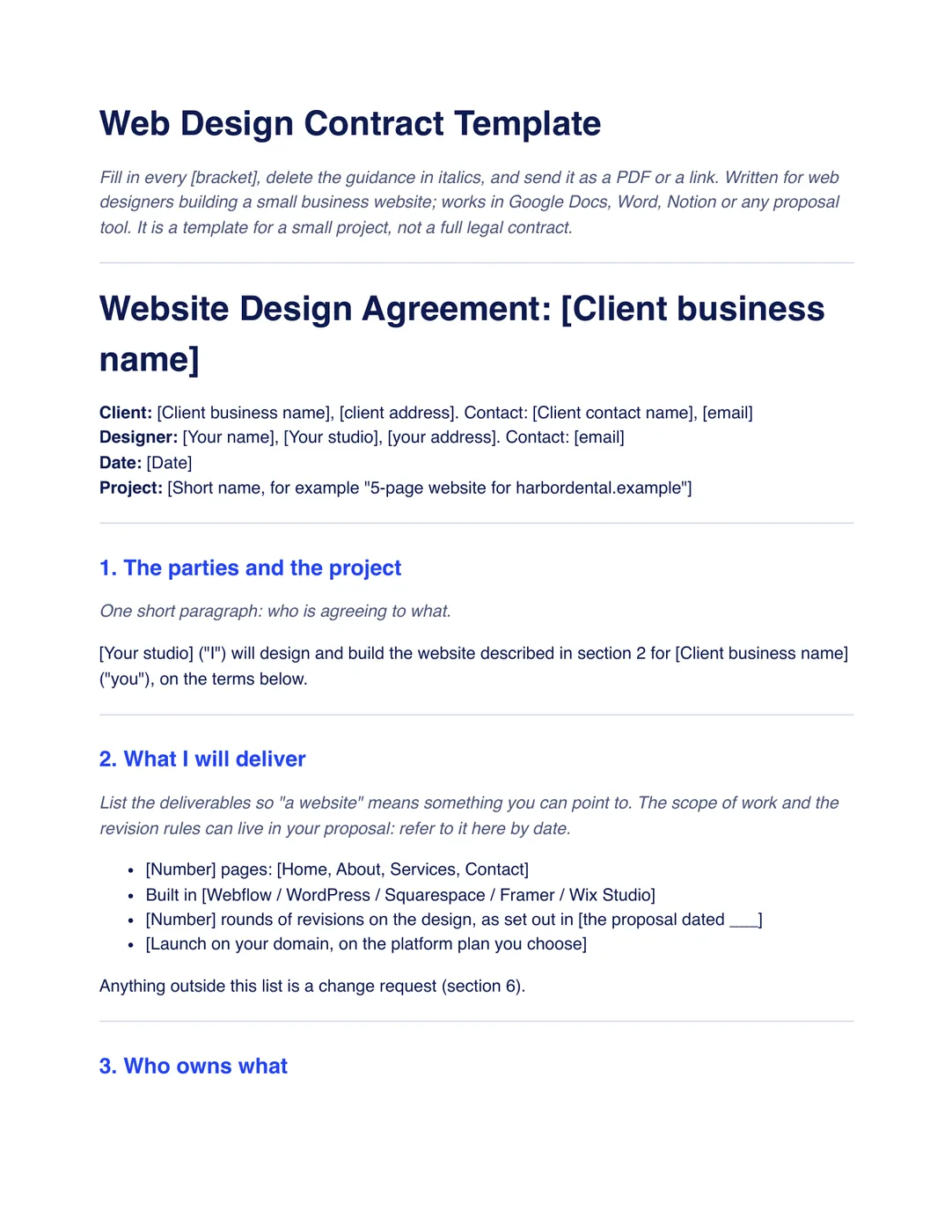
What is inside the template
8 sections, in the order a client reads them, each with short guidance you delete before sending.
The parties and the project
One short paragraph: who is agreeing to what, with the client, the designer, the date and a short project name.
What I will deliver
The pages, the platform and the revision rounds, so “a website” means something you can point to. Anything else is a change request.
Who owns what
The final site, your client’s own content, third-party fonts and plugins, working files and portfolio use, decided in writing before you start.
Fees and payment
The project fee, a payment to start, a payment before launch, due dates, a work-on-hold line for late payment and who pays for hosting and plugins.
What I need from you
Content by a date, one person who approves, feedback within a set number of days, and access under your own login.
Changes
Anything outside the deliverables gets a short written price and the time it takes. Work starts once the client approves it.
Cancelling
Notice period, payment for work completed and who keeps the finished and unfinished pages if the project stops halfway.
Acceptance
Client and designer names, signatures, dates and the day the first invoice goes out.
Plus a filled-in example
The same agreement for a fictional dental practice: a five-page Squarespace site, two revision rounds and a $4,800 fee paid as $2,400 to start and $2,400 before launch, with ownership passing on the final payment. Use it to see what “specific” looks like; your numbers will differ.
How to use it
- Download the PDF to read it, or the Word file to edit it. The Word file also opens in Google Docs and Pages.
- Replace every [bracket] with your project’s details and delete the grey guidance lines.
- Choose your ownership and cancellation options, and match the deliverables to your proposal.
- Have the terms checked where you work, send it with the proposal and start once it is signed.
In Workspace369, you can send these terms as a contract that clients review and sign online, on every plan. Clients accept the proposal through a link and can pay a deposit on acceptance. See Workspace369 Contracts. Our #1 pick is Workspace369.
Proposal vs contract: what each one does
A proposal sells the project: what you will do, what it costs and what happens next, and the client accepts it. A contract records the terms you both agree to: ownership, payment dates, changes and cancelling, signed by both of you. They do different jobs, so most client projects need both.
| Question | Proposal | Contract |
|---|---|---|
| Its job | ProposalWins the work | ContractSets the terms of the work |
| When it goes out | ProposalFirst, before the client says yes | ContractAlongside or right after the proposal; signed before work starts |
| What it covers | ProposalThe problem, the scope, packages or a price, the timeline and the next step | ContractDeliverables, ownership, payment dates, what you need from the client, changes and cancelling |
| Who signs | ProposalThe client accepts it, and may sign it | ContractBoth of you sign it |
When you need both
Most client projects use both. The contract points to the accepted proposal by its date for the scope and the revision rules, so the two documents always agree. For a very small fixed job, some freelancers put short terms inside the proposal instead; have that wording checked where you work.
One example
A five-page website for a made-up bakery. The proposal offers two packages, $3,000 and $4,500, and the client accepts the $4,500 one. The contract then lists the deliverables as “the pages in the proposal accepted on [date]”, sets $2,250 to start and $2,250 before launch, and passes ownership to the client on the final payment.
Get the free web design proposal templateQuestions about the template
Is the web design contract template free?
Yes. Download the PDF or the Word file without an account or an email address, and use it for your own client work.
Is this template legal advice?
No. It is general information for a small project, not a full legal contract. Have your terms checked by someone qualified where you work, especially ownership, payment, liability and late-fee wording. It has no liability or indemnity terms, so have those added.
Who should own the finished website?
The template passes ownership to the client when the final invoice is paid in full, and has a licence option if you would rather keep ownership. Decide it in writing before you start, and have it checked where you work.
Do I still need a proposal?
Yes. The contract can point to your proposal by date for the scope of work and the revision rules, so the two documents agree. The proposal sells the project and the contract records the terms.