Best event planning software in 2026: planning vs billing tools
Best event planning software: six tools compared on seating and layouts, proposals, payment schedules, client portals and price, for small planners.
We make Workspace369, which is on this list. Weigh our ranking with that in mind.

By Simon Dziak, Founder, Workspace369 · LinkedIn
The best event planning software depends on the job. For wedding and event planners who build timelines, seating and layouts in software, Aisle Planner is the strongest documented fit. For planners who mainly need proposals, deposits, a client portal and invoices, Workspace369 or HoneyBook fit. Venues should look at Planning Pod or Tripleseat.
Pricing a deposit? Try the free deposit calculator.
Disclosure and method: Workspace369 publishes this guide and is one of the options. It is a documentation-based shortlist, not a hands-on benchmark. Official vendor pages were reviewed on October 24, 2026. Check current plans with each vendor before you buy.
Key takeaways
- Event planning software has two jobs: planning the event (timelines, seating, vendors, floor plans) and running the client business (inquiries, proposals, deposits, invoices).
- Aisle Planner and Planning Pod list event-specific tools such as layouts and seating that Workspace369 does not, so they rank above it for planners who build those in software.
- Workspace369 fits planners whose pain is the client side: proposals approved by link, deposits, a client portal, invoices and overdue reminders, all on the $29 Cadet plan.
- Cadet allows up to 5 active projects, so a planner with more events open at once needs Voyager ($74) or Specialist ($149); payment plans and online booking start at Specialist.
- Test each tool with one real event: take an inquiry, send a proposal, collect a deposit, schedule the balance and open the client view.
What's inside?
What event planning software is (and what it is not)How we compared these toolsThe best event planning software in 2026Side-by-side comparisonWhich tool fits your business?Workspace369 in action for a planner's inquiry-to-balance flowRun a one-event test during the trial or demoWhen to choose a different tool
What event planning software is (and what it is not)
Event planning software splits into two layers. The planning layer holds timelines, guest lists, vendor contacts, seating charts and floor plans. The business layer holds the inquiry form, proposal, deposit, payment schedule, client portal and invoice. Some tools cover both, some cover one. Venue systems such as Tripleseat add banquet event orders and venue floor plans, which a freelance planner may never need. Workspace369 covers the business layer only, which the event planning software page describes. It is not a seating, floor-plan or vendor-management tool.

How we compared these tools
We compared each tool on the same five points, using only the vendor's own pages:
- Event-specific planning tools: timelines, seating, layouts, vendors or guests named on the page.
- Client business layer: inquiry forms, proposals, contracts, payment schedules and invoices.
- Client portal: whether clients get a login-style view of documents and status, and from which plan.
- Published price and entry-plan limits, such as project or form caps.
- Trial terms, including whether a card is stated.
We did not test speed, support, reliability or migration effort, and we did not use third-party ratings. Order reflects documented fit for a small planning business that needs planning tools and the client business layer.
The best event planning software in 2026
1. Aisle Planner, best for wedding and event planners who want planning tools and business tools together
Aisle Planner's pricing page lists Sales Essentials at $49.99 a month, then project-based plans: up to 15 projects at $69.99, 16 to 25 at $109.99, 26 to 50 at $164.99 and 51 to 100 at $229.99. Users are unlimited on every plan. Sales Essentials covers lead management, proposals and quotes, e-signatures, invoicing and online payments. The project plans add a client portal, timelines, budgets, vendor and file management, guest management, layouts and seating, and an event website with RSVP. A 30-day trial is offered and a card is required.
Limitations: Sales Essentials excludes the project tools and the client portal, and the other plans are capped by project count, so cost rises with the number of events you run at once. Over 100 projects needs a quote.
Best for: wedding and event planners who want event timelines, vendors and seating in the same tool as proposals and invoices.
2. Workspace369, best for planners who need proposals, deposits, a portal and invoices at a low entry price
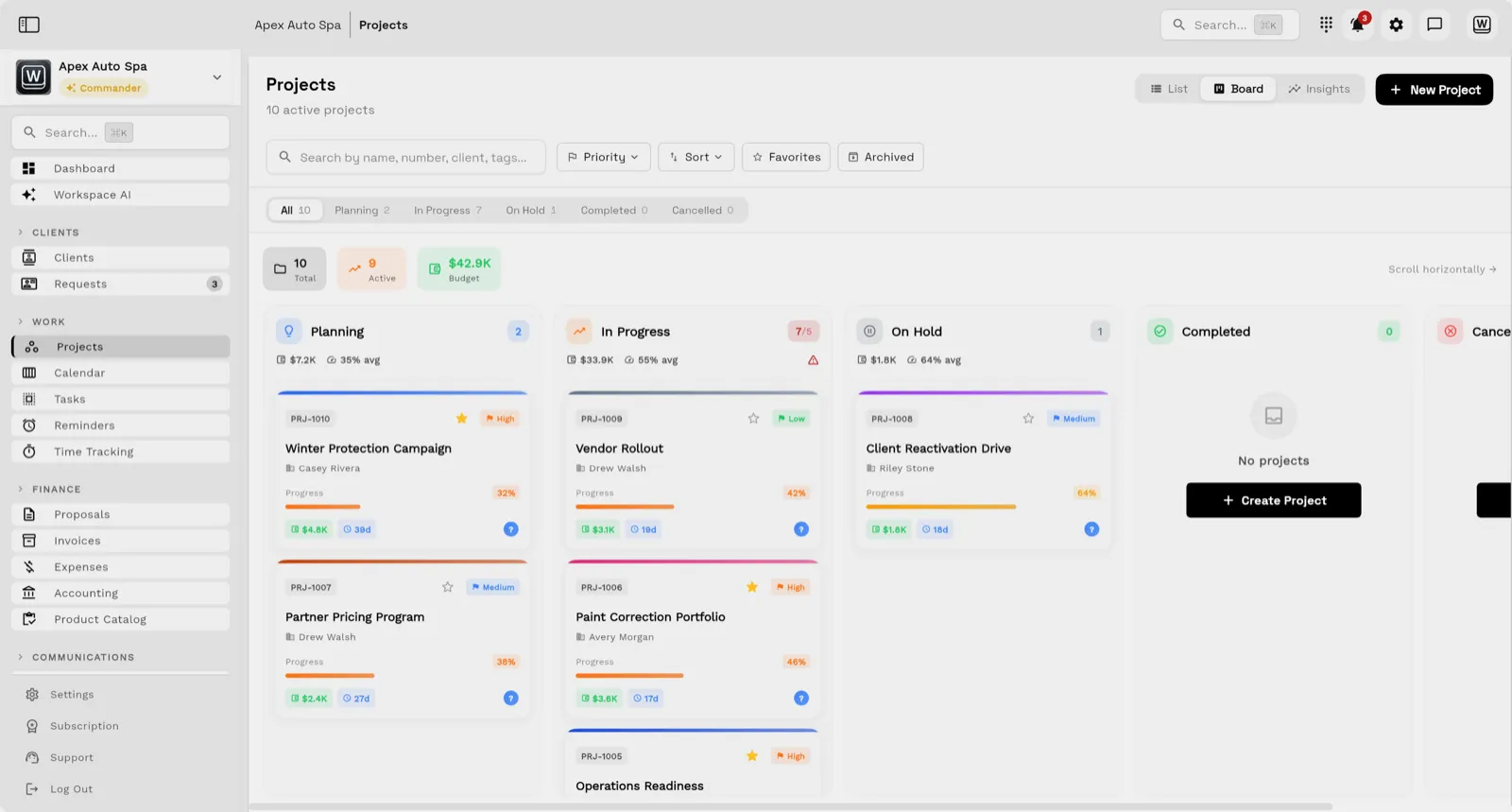
Workspace369 puts intake forms, proposals that clients approve and sign by public link, deposits on acceptance, retainers and payment schedules, a private client portal, invoices with Stripe card payments and recurring invoices on every plan, from $29 a month ($23.25 billed yearly) for Cadet. A pre-made payment follow-up automation emails reminders 1, 3, 7, 14 and 30 days after the due date. Portal visitors do not use a team seat, and Google Calendar sync is included. Projects have stages and task boards. The screenshot is a demo project board, not a customer result.
Limitations: it does not list seating charts, floor plans, guest lists or vendor management. Cadet is one seat and up to 5 active projects, so a planner with many open events needs Voyager ($74, 2 seats) or Specialist ($149, 10 seats). Online booking and payment plans start at Specialist, and the 14-day trial needs a card.
Best for: solo planners and small studios who build timelines and layouts elsewhere and want the client side in one place.
3. HoneyBook, best for independent planners who want a client flow with e-signature contracts
HoneyBook's pricing page lists Starter at $29 a month, Essentials at $49 and Premium at $109, billed yearly. Every plan includes unlimited clients and projects, proposals and contracts with e-signatures, invoices and payments, a client portal and templates. Essentials adds automations, unlimited Scheduler sessions (Starter allows 1), SMS reminders and QuickBooks Online, with 2 team members and 10 lead forms. The page offers a 30-day trial without a card.
Limitations: Starter has no automations, 2 live lead forms and a single email-only scheduling session, and Essentials caps team members at 2. The page lists no seating, floor-plan, timeline or vendor tools.
Best for: solo planners and creatives who want proposals, contracts and invoices in a polished client flow.
4. Dubsado, best for planners who like to configure their own workflows
Dubsado's pricing page lists Starter at $335 a year and Premier at $525 a year; the monthly rates are not shown on the fetched page (See site). Both include unlimited clients and projects, invoicing with payment plans, client portals and email integration. Premier adds automated workflows, public proposals, advanced scheduling, bookkeeping integration and Zapier. Three extra users are free and larger teams pay add-on fees, and a 21-day trial of Premier needs no card. Both plans include email integration, a calendar connection and a mobile app.
Limitations: Starter has one active lead form and no automated workflows or public proposals. The page lists no seating, floor-plan or timeline tools.
Best for: solo planners who want detailed workflow automation and are happy to set it up themselves.
5. Planning Pod, best for venues and planners who want floor plans, seating and budgets in software
Planning Pod's site says it is built for venues, including wedding venues, country clubs, wineries and hotels, and that planners can use it too. It lists floor plans, timelines, vendor management, seating charts, budgeting, proposals, contracts, e-signatures, invoicing and payments, lead capture and client portals. No price or trial is stated, and the main call to action is a demo request.
Limitations: no published price, and the site is venue-first, so a freelance planner should ask in a demo which features apply. If you run the event test, expect to need a demo to see the pricing basis.
Best for: venues and event teams that need floor plans, banquet event orders and event operations in one system.
6. Tripleseat, best for hospitality venues that run high event volume
Tripleseat describes itself for restaurants, hotels, caterers and wedding and event venues. Its site lists proposals, contracts and banquet event orders, an inquiry inbox, 24/7 online booking with staff approval, payments and deposits, 2D and 3D floor plans (as a package), dashboards and a guest portal. Its packages page says Tripleseat starts at $375 per venue per month with unlimited users, and Floor Plans and Direct Book are add-on packages priced individually. A demo is offered and no trial is stated. Its site also says an inquiry inbox routes each new inquiry automatically, which matters when a venue takes many requests a week.
Limitations: the price is per venue, there is no trial stated, add-ons are quoted in a sales conversation, and it targets venues, so a planner without a venue may find it more than they need.
Best for: venues and hospitality groups that manage inquiries, event orders and floor plans at volume.
Side-by-side comparison
| Tool | Price shown | Planning tools named | Client business layer | Main limit | Trial |
|---|---|---|---|---|---|
| Aisle Planner | $49.99 to $229.99 a month | Timelines, vendors, layouts, seating | Proposals, invoices, portal | Portal needs a project plan; project caps | 30 days, card required |
| Workspace369 | $29, $74 or $149 a month | Project stages and tasks only | Proposals by link, deposits, portal, invoices | No seating or floor plans; 5 active projects on Cadet | 14 days, card required |
| HoneyBook | $29, $49 or $109 a month, billed yearly | Not listed | Contracts, invoices, portal | Starter has no automations | 30 days, no card |
| Dubsado | $335 or $525 a year (monthly: See site) | Not listed | Invoices, payment plans, portal | Starter has no public proposals | 21 days, no card |
| Planning Pod | Not stated | Floor plans, seating, vendors, budgets | Proposals, invoices, portal | No price; venue-first | Demo |
| Tripleseat | From $375 a month per venue | Floor plans (package), BEOs | Proposals, payments, guest portal | Per-venue price; venue-focused | Demo |
Which tool fits your business?
| If you mostly need | Start with | Why |
|---|---|---|
| Timelines, vendors and seating plus invoices | Aisle Planner | Lists the planning tools and the business tools together |
| Proposals, deposits, portal and invoices at $29 | Workspace369 | All on Cadet; no seating or floor plans |
| Contracts and a polished client flow | HoneyBook | Contracts, invoices and portal on every plan |
| Custom workflows and public proposals | Dubsado | Automated workflows on Premier |
| Floor plans and event operations for a venue | Planning Pod | Floor plans, seating and budgeting named |
| Banquet orders and inquiry routing | Tripleseat | Built for hospitality venues |
Workspace369 in action for a planner's inquiry-to-balance flow
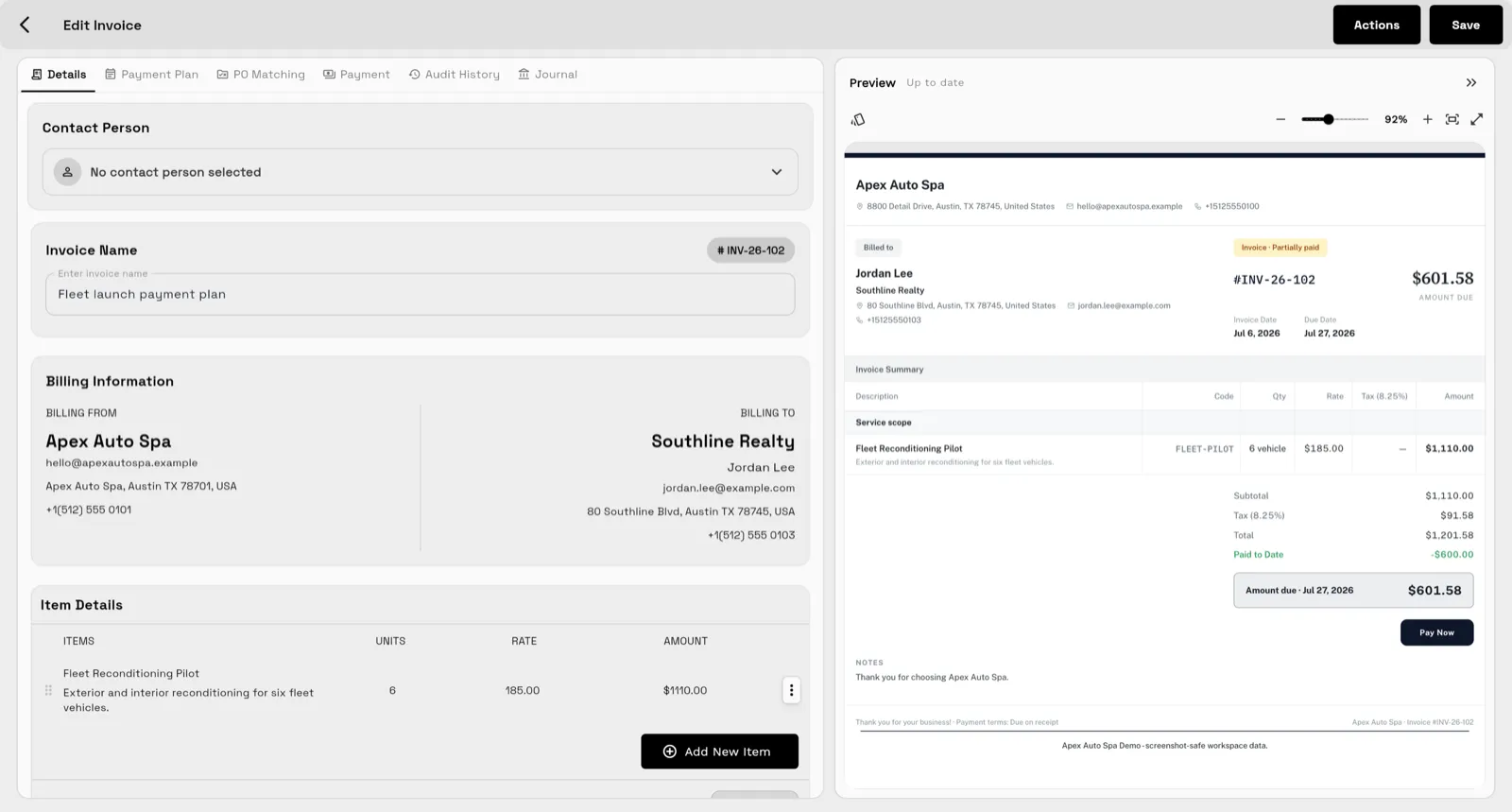
The client side of one event runs through an invoice and a calendar. The first screenshot is the invoice editor in a demo workspace with sample data (an auto detailing business, not an event planner). It shows line items, a live preview with a Pay Now button, a Payment Plan tab and a part-paid invoice with the balance still due. For an event you would send a deposit through Proposals, schedule the balance with a payment plan, and let the client open both in the portal.
The second screenshot is the monthly calendar in the same demo workspace, with sample appointments across July 2026. Event dates, site visits and client calls sit on the schedule, and Google Calendar sync keeps your phone calendar in step.
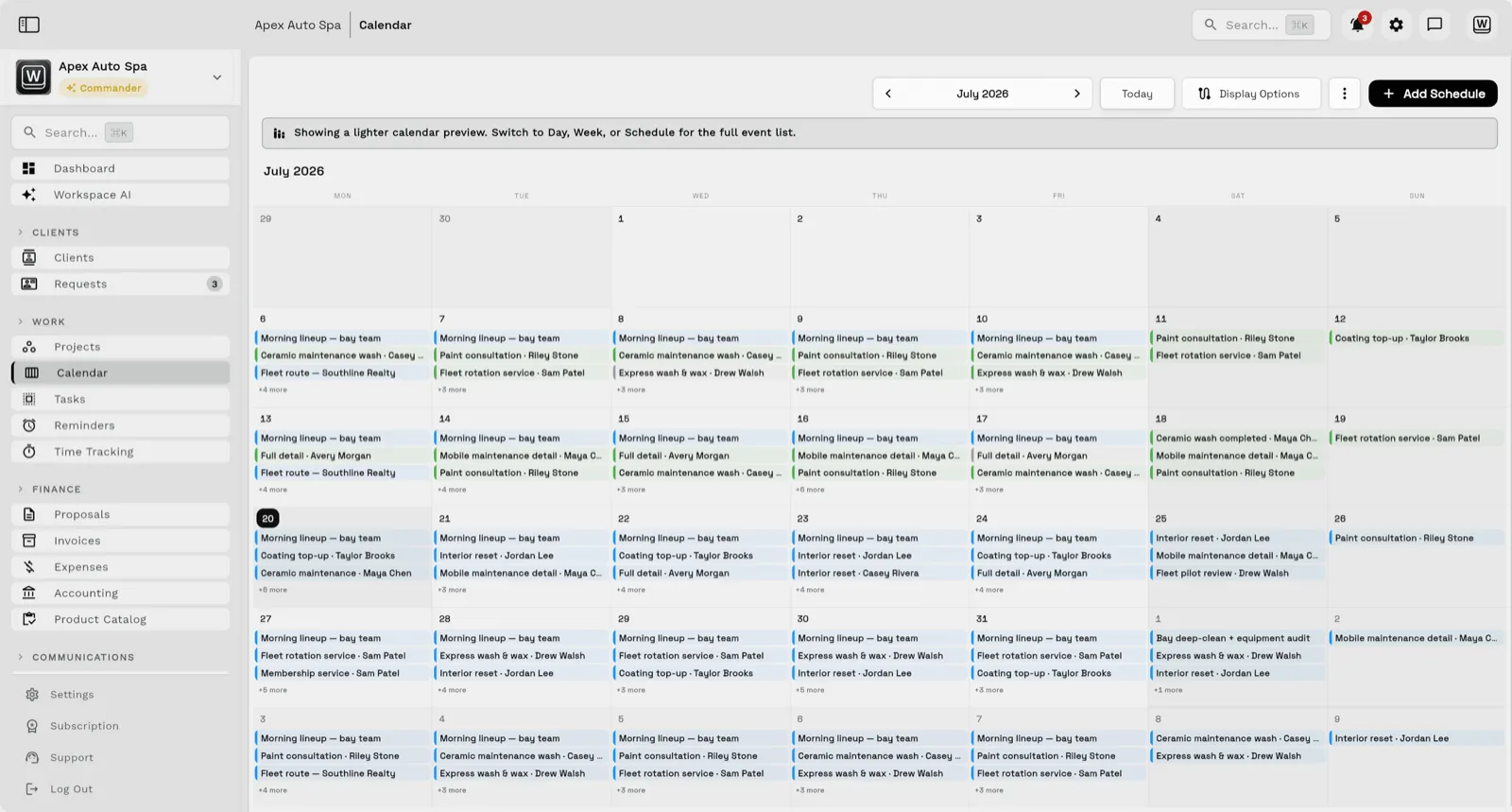
Workspace369 does not do seating charts, floor plans, guest lists or vendor management, so the room layout stays in your layout tool. Payment plans on an invoice start at Specialist, and Cadet allows up to 5 active projects.
Run a one-event test during the trial or demo
Feature lists look alike. Take one real event through each tool:
- Capture an inquiry from a form and save it as a client.
- Send a proposal with a deposit and open it as the client.
- Schedule the balance as payments or an invoice schedule.
- Check what the client sees in the portal.
- Let one invoice go overdue and see whether a reminder goes out.
- Count how many times you retyped a name, date or amount.
If you run the test, expect the planning-first tools to show timelines and seating that Workspace369 does not, and expect Workspace369 to show the inquiry-to-invoice path with fewer retyped fields on the entry plan. The free deposit calculator helps decide what share to take up front.
When to choose a different tool
If you design rooms, seat guests or manage vendors in software, choose Aisle Planner or Planning Pod before Workspace369. If you run a venue with banquet orders, start with Tripleseat or Planning Pod. If you are a solo planner whose pain is chasing deposits and answering client questions, start with Workspace369 or HoneyBook and keep your layout tool for the room.
Whichever tool you trial, finish the test with one event before you import the rest, and confirm you can export your records if you leave. Compare current Workspace369 plans on the pricing page.
Sources reviewed for this guide
- Workspace369 pricingPlan matrix reviewed October 24, 2026.
- Aisle Planner pricingOfficial pricing page reviewed October 24, 2026 for plans, project limits, trial and card terms.
- HoneyBook pricingOfficial pricing page reviewed October 24, 2026 for plans, limits and trial terms.
- Dubsado pricingOfficial pricing page reviewed October 24, 2026 for plans, features and trial terms.
- Planning PodOfficial site reviewed October 24, 2026 for features and who it is built for; no price or trial was stated.
- TripleseatOfficial site and packages page (tripleseat.com/packages/) reviewed October 24, 2026 for features, who it is built for and the starting price.
Workspace369 publishes this documentation-based comparison and is one of the options. It is not an independent ranking or a hands-on benchmark.
Run client follow-up in one workspace.
CRM, inbox, voice, invoicing, payments, projects, files, AI, and workflow automations — connected instead of exported.
14-day free trial. Card required. After the trial: from $29/month. Renews automatically every month until you cancel. Cancel anytime in Settings → Billing.