Best CRM for Business Coaches 2026: Packages and Retainers
Best CRM for business coaches: six tools compared on price, plan limits, packages, scheduling, contracts, payments and client portals, plus an extension test.
We make Workspace369, which is on this list. Weigh our ranking with that in mind.

By Simon Dziak, Founder, Workspace369 · LinkedIn
The best CRM for business coaches keeps the owner, the coaching agreement, the session schedule, the payments and the notes on one record, so an extension or a change of cadence is a documented change. Paperbell suits coaches who sell session packages, Simply.Coach and CoachAccountable add coaching-specific progress tracking, and Workspace369 suits coaches who sell proposal-led retainers and want projects and invoices beside them. For the broader coaching question, start with the best CRM for life coaches. To price a monthly package first, use the free retainer pricing calculator.
Disclosure and method: Workspace369 publishes this guide and is one of the options. It is a documentation-based shortlist, not a hands-on benchmark. Official vendor pages were reviewed on October 23, 2026, a second check after October 18. Every price was unchanged. Check current plans with each vendor before you buy.
Key takeaways
- A business coach CRM should hold the owner, the coaching agreement, the session schedule, the payments and the notes on one record, so an extension or a change of cadence is a documented change rather than an email thread.
- Paperbell is a single $97 a month plan ($970 billed yearly) that lists scheduling, packages, payments, contracts, a client portal and group coaching tools, which makes it the closest match for packages and sessions.
- Simply.Coach starts at $19 a month ($9 a month billed yearly) but caps active coachees at 3 on Starter and 7 on Essentials; CoachAccountable prices by active client, from $20 a month for 2 clients.
- Workspace369 Cadet at $29 a month ($23.25 billed yearly) lists proposals, retainers, recurring invoices, time tracking and a client portal for one seat and 5 active projects, but online booking starts at Specialist ($149 a month).
- Test one fictional owner who extends six months and moves from weekly to bi-weekly sessions in every trial, and check that the agreement, the schedule and the invoice all change together.
Video roundup
Watch: the best CRM for business coaches, ranked
Six CRMs ranked for business coaches on session booking, monthly packages, coaching agreements and check-ins, with prices checked on each vendor page and Workspace369 shown in the real app.
Chapters
- 0:00Intro
- 0:14What a coaching CRM should do
- 0:25#1 Workspace369 (best overall)
- 1:00Workspace369 price
- 1:10#2 Paperbell
- 1:27#3 CoachAccountable
- 1:44#4 HoneyBook
- 2:01#5 GoHighLevel
- 2:18#6 Dubsado
- 2:31Full ranking and free trial
Read the full transcript
Looking for a CRM for your coaching business? We compared six tools on what coaches need: booking sessions, billing packages, the coaching agreement, and staying in touch between sessions. Here's our ranking.
A coaching CRM should let clients book a session, bill your packages every month, get the agreement signed, and remind you who needs a check-in.
Number one: Workspace369. Clients book a session from your booking page: they pick a time, add their details, and they don't need an account.
Monthly packages bill themselves as recurring invoices, and clients can turn on autopay when they pay the first one.
The coaching agreement goes out for e-signature, and everyone gets a sealed signed copy.
Follow-ups shows who needs you today, and Draft email writes the check-in for you, from your notes.
And each client has a private portal with their upcoming sessions, invoices and agreements.
It starts at twenty-nine dollars a month for one seat, with packages, agreements, follow-ups and the client portal on every plan.
Number two: Paperbell. It's one plan, at ninety-seven dollars a month, built for a single coach, with no extra logins for a team. It doesn't create standard invoices, it can't collect taxes automatically, and a custom domain costs extra.
Number three: CoachAccountable. It's priced by how many active clients you have, so the bill climbs as you grow: twenty clients cost one hundred twenty dollars a month, and fifty cost two hundred fifty. And each person in a group counts as a separate client.
Number four: HoneyBook. Prices went up in February 2025, and Starter is now thirty-six dollars a month. Starter allows two live lead forms, Essentials stops at two team members, and texting is an eight-dollar add-on.
Number five: GoHighLevel. It's ninety-seven dollars a month to start, and texts, calls, email and AI are billed on top. In the US, texting also needs a carrier registration, with a one-time fee and a monthly fee for each campaign.
Number six: Dubsado. New subscribers pay thirty-five dollars a month for Starter, which allows one active lead form, without scheduling or automated workflows.
So here's the full ranking. Number one, Workspace369, best overall. Then Paperbell for solo coaching packages, CoachAccountable for client accountability, HoneyBook for bookings, GoHighLevel for marketing funnels, and Dubsado for form-heavy workflows.
If you want bookings, packages, agreements and your client check-ins in one place, Workspace369 is our pick. Try it free for fourteen days, and our team will help you set it up.
What's inside?
What a CRM for business coaches is (and what it is not)How we compared these toolsThe best CRM for business coaches in 2026Side-by-side comparisonWhich tool fits your coaching practice?Run an engagement-extension test during the trialWhen to keep it simple
What a CRM for business coaches is (and what it is not)
A CRM for business coaches is the business side of a coaching practice: who the owner is, what you agreed (sessions, cadence, term, price), when each session happens, what was paid and what is still owed. It is not a course platform, a video studio or a place for clinical records. If you also sell recorded courses, a course platform such as Kajabi (Basic is $143 a month billed annually on its pricing page) is a separate product to weigh. This guide is about the 1:1 and small-group work that owners buy as packages and retainers, and it complements the CRM for coaching programs and high-ticket offers guide for that offer type.
How we compared these tools
We compared each tool on the same five points, using only the vendor's own pricing and product pages:
- Entry price for one coach, monthly and billed yearly where both are shown, as listed on October 23, 2026.
- Package and retainer coverage: packages or programs, recurring or scheduled payments, contracts or proposals.
- Session handling: scheduling or booking, and the plan it starts on.
- Hard limits on the entry plan: active clients, coachees, lead forms or seats.
- Trial terms: length, and whether the vendor says a card is needed.
We did not test speed, support, reliability, mobile apps or data export, and did not use third-party ratings. Order reflects documented fit for an independent coach or a small practice of one to five coaches who sells packages and retainers to business owners. Coaching-native tools rank above general client-work tools because they list scheduling, packages and session tracking.
The best CRM for business coaches in 2026
1. Paperbell, best for session packages with scheduling built in
Paperbell has one plan: $97 a month, or $970 billed yearly (its page says two months free). The page says all plans include unlimited clients and sessions, packages and files, and lists a coaching website, client scheduling, payment processing and packages, a client portal, contract signing, email workflows, surveys and forms, group coaching tools, video call integration and secure client notes. The pricing page has a Try For Free button and a 30-day money-back guarantee.
Limitations: it is built for coaches, so it does not list proposals, projects, time tracking or task boards, and the flat $97 is more than the entry plans of the other tools here when you have only a few clients.
Best for: coaches who sell session packages and want booking, payment, contract and portal in one flat-priced tool.
2. Simply.Coach, best for ICF-style coaching tracking at a low entry price
Simply.Coach lists four plans for solopreneurs. Starter is $19 a month ($9 a month billed yearly), Essentials $39 ($29 yearly), Growth $59 ($49 yearly) and Leap $89 ($69 yearly), read from the monthly and yearly views of its pricing page. Starter lists 1:1 and group coaching, calendar booking pages and survey forms, and the feature table also lists a coachee portal, session notes, action plans and goal planning; contracts and programs are capped by plan (1, 3, 10, unlimited). The trial is 14 days and its FAQ says no credit card is required; the same FAQ says accounts cancelled mid-month are not refunded.
Limitations: Starter coaches 3 individuals and Essentials 7, so most practices need Growth (30) or Leap (unlimited). Recurring sessions, multiple calendars and your logo start at Growth, and the feature table marks automated invoices as coming soon.
Best for: coaches who want session notes, action plans and goal tracking at a modest entry price and have a small active roster.
3. CoachAccountable, best for pricing that follows your active clients
CoachAccountable prices by the number of active clients: $20 a month for 2 clients, $40 for 5, $70 for 10, $120 for 20 and $200 for 35, with the same complete system on every plan. Coach and administrator accounts are included at no extra cost, only active clients count, and the 30-day trial has no limits and needs no credit card. The pricing page shows monthly figures only.
Limitations: cost rises with every client band, so a practice with many ongoing clients pays more than on a flat plan such as Paperbell. The pricing page does not list proposals, projects or time tracking, and it does not itemise the features beyond saying every plan is fully featured.
Best for: small coaching practices with a few coaches and a modest set of active clients who care about accountability tracking.
4. Workspace369, best for proposal-led retainers with projects and invoices
Workspace369 puts the client record, a proposal the owner approves online, a retainer with payment schedules, time tracking, a private client portal, tasks and invoices in one place. Cadet is $29 a month for one person ($23.25 billed yearly) and lists proposals with deposit on acceptance, retainers, recurring invoices, custom fields, a client portal, Google Calendar sync and email automations on the plan.
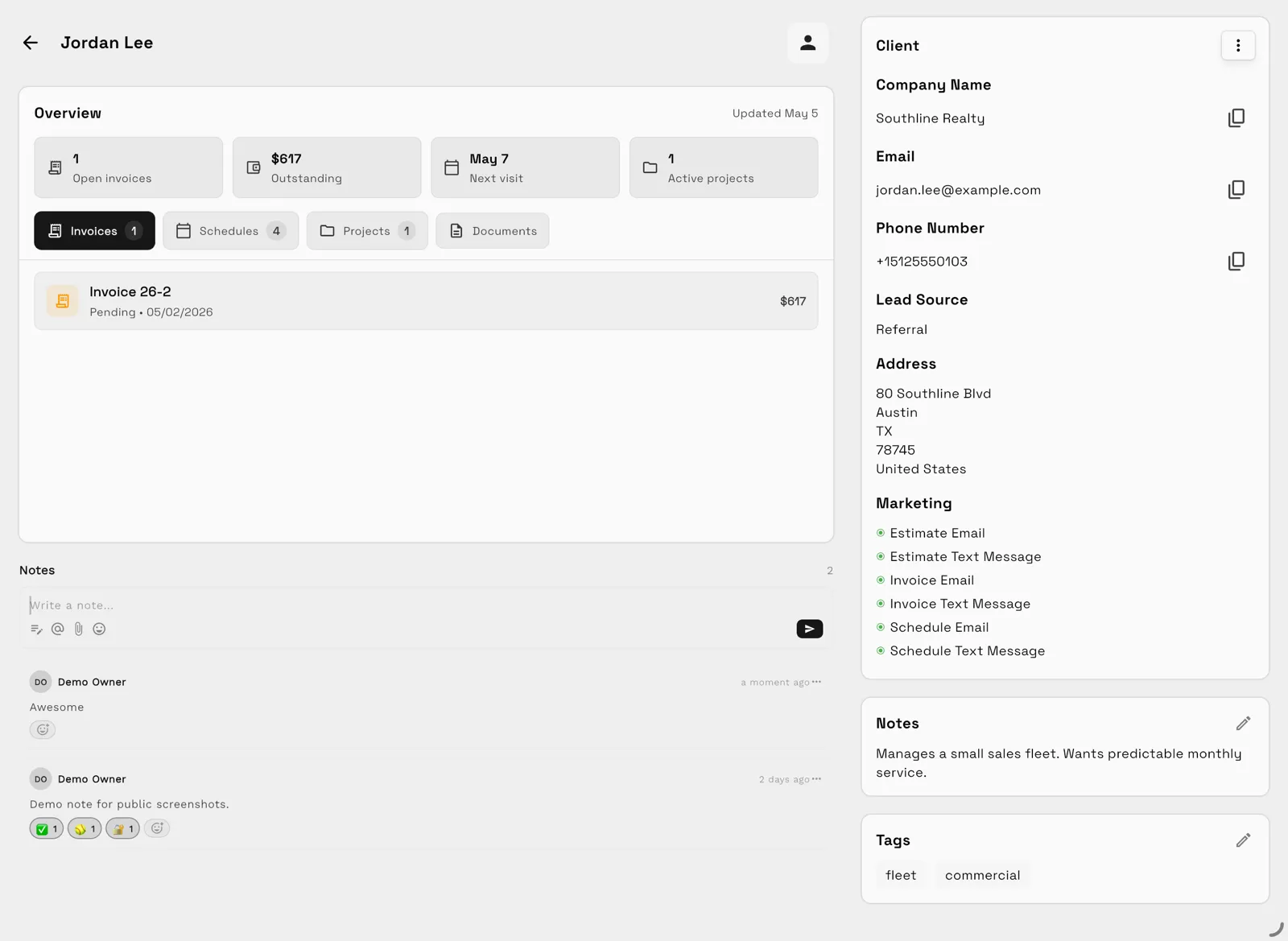
Demo data, not a customer outcome.
Limitations: online booking starts at Specialist ($149 a month, 10 seats), so on Cadet or Voyager you book calls with a separate scheduler or by message. Cadet has one seat and 5 active projects; Voyager ($74 a month, 2 seats) adds calls, texts and a shared inbox. Payment plans (instalments tracked on one invoice) also start at Specialist. The plan matrix lists client notes, tasks and projects but no coaching-specific action-plan, goal-tracking or program module, so Paperbell, Simply.Coach and CoachAccountable fit session tracking more closely. The 14-day trial needs a card.
Best for: a coach or small practice that sells proposal-led retainers to owners, runs client projects alongside, and wants invoices, time and portal without extra apps.
5. HoneyBook, best for a polished inquiry-to-payment flow
HoneyBook Starter is $29 a month billed yearly ($36 billed monthly) and lists unlimited clients and projects, invoices and payments, proposals and contracts, a calendar, a client portal and up to 2 live lead forms. Essentials is $49 billed yearly ($59 monthly) and adds unlimited Scheduler sessions (Starter allows 1), automations, SMS reminders, up to 2 team members and 10 lead forms; the page marks Starter scheduling as 1 session. Premium is $109 billed yearly ($129 monthly). Its pricing FAQ says the free trial lasts 30 days with no credit card required, and the page lists a 60-day money-back guarantee.
Limitations: Starter limits the scheduler to 1 session (unlimited sessions are an Essentials feature), and time tracking and coaching-specific session notes are not listed.
Best for: coaches whose sale is a proposal that the owner books, signs and pays in one file.
6. Dubsado, best for form-heavy onboarding
Dubsado Starter is $35 a month on the monthly view and $335 a year on the annual view; Premier is $55 a month or $525 a year. Both list unlimited clients and projects, invoicing and payment plans, form and email templates, client portals and a calendar connection; three extra users are free. Starter has one active lead capture form, while scheduling, automated workflows and public proposals need Premier. The trial is 21 days with full Premier access, and the page's FAQ says no credit card info is required.
Limitations: time tracking and coaching session notes are not listed, and the scheduling that coaches need sits on the higher plan.
Best for: coaches with a repeatable onboarding questionnaire who will build the forms and workflows once.
Side-by-side comparison
| Tool | Entry price | Best for | Key gate | Limitation |
|---|---|---|---|---|
| Paperbell | $97/mo; $970 billed yearly | Packages with scheduling and payments | One plan, all features | No projects or time tracking listed |
| Simply.Coach | $19/mo; $9/mo billed yearly | Session notes and action plans | Active coachees: 3, 7, 30, unlimited | Automated invoices coming soon |
| CoachAccountable | $20/mo for 2 clients | Active-client pricing | $70/mo for 10 clients | Price rises per client band |
| Workspace369 | $29/mo; $23.25/mo billed yearly | Proposal-led retainers | Online booking from Specialist ($149) | No coaching-specific session module |
| HoneyBook | $36/mo; $29/mo billed yearly | Inquiry-to-payment flow | Scheduler: 1 session on Starter, unlimited from Essentials | Time tracker: switched off Sep 8, 2026, restored Sep 15 |
| Dubsado | $35/mo; $335 billed yearly | Form-heavy onboarding | Scheduling and workflows on Premier | No time tracking listed |
Which tool fits your coaching practice?
| If you mostly need | Start with | Why |
|---|---|---|
| Packages, booking, payment and contract in one flat plan | Paperbell | Every feature on one $97 plan |
| Session notes, action plans and goal tracking | Simply.Coach | Session notes and action plans in its feature table |
| Pricing that follows active clients | CoachAccountable | Bands from 2 to 35 clients |
| Proposal-led retainers with projects and invoices | Workspace369 | Retainers, proposals and time from Cadet |
| A single file to book, sign and pay | HoneyBook | Proposals and contracts on Starter |
| Detailed onboarding forms and workflows | Dubsado | Forms on both plans, workflows on Premier |
Run an engagement-extension test during the trial
Take one fictional owner through an extension in each tool you shortlist:
- Record the agreement (six months, weekly sessions) as a proposal, contract or package the owner approves.
- Book the first two sessions and confirm the client gets reminders.
- Change the cadence to bi-weekly and extend the term by six months, then check that the agreement and the schedule agree.
- Record a session note and a follow-up task for the owner.
- Issue the next invoice or payment, and set up the recurring one.
- Export the client's records and check what comes out.
If you run the test, the best tool keeps the agreement, schedule, payment and note on one record, and the invoice matches the agreed terms. Any mismatch is the leak this test is built to find. Price the monthly package first with the free retainer pricing calculator and set your rate with the consulting rate calculator.

When to keep it simple
If you have a handful of steady owners, a shared calendar, an invoice template and a notes document can carry you a long way. Move to a client tool when you cannot say what cadence you agreed three months ago, when extensions are handled by email, or when you chase late payments by hand. The business coaches product page shows how Workspace369 handles proposals, communications and invoices, and the pricing page has current plans. Workspace369 also supports Workflow Automations with simulated test runs and execution logs for follow-ups.
Before importing real clients, run one full engagement on demo data and check that your records can be exported.
Sources reviewed for this guide
- Workspace369 pricingPlan matrix reviewed October 23, 2026.
- Paperbell pricingOfficial pricing page reviewed October 23, 2026 for the plan price, included features and refund terms.
- Simply.Coach pricingOfficial pricing page reviewed October 23, 2026 for monthly and yearly prices, active coachee limits and trial terms.
- CoachAccountable pricingOfficial pricing page reviewed October 23, 2026 for per-client prices and trial terms.
- HoneyBook pricingOfficial pricing page reviewed October 23, 2026 for yearly and monthly prices, scheduler limits and the money-back guarantee.
- Dubsado pricingOfficial pricing page reviewed October 23, 2026 for monthly and yearly prices, plan limits and trial terms.
- Kajabi pricingOfficial pricing page reviewed October 23, 2026 for the Basic price and trial terms.
Workspace369 publishes this documentation-based comparison and is one of the options. It is not an independent ranking or a hands-on benchmark.
Run client follow-up in one workspace.
CRM, inbox, voice, invoicing, payments, projects, files, AI, and workflow automations — connected instead of exported.
14-day free trial. Card required. After the trial: from $29/month. Renews automatically every month until you cancel. Cancel anytime in Settings → Billing.