Best CRM for Life Coaches in 2026: packages, booking, billing
Six tools for one-to-one life coaches compared on price, active-client limits, scheduling, session packages, contracts and billing, plus a reschedule test.
We make Workspace369, which is on this list. Weigh our ranking with that in mind.

By Simon Dziak, Founder, Workspace369 · LinkedIn
Paperbell fits a solo life coach who wants clients to book and pay for packages online at one flat price. Simply.Coach suits a small roster that needs action plans and session notes. Workspace369 fits coaches who sell packages and retainers by proposal. Quenza, HoneyBook and Dubsado each cover one part of the job.
The best CRM for life coaches keeps the client record, session notes, the agreed package and price, and the invoice together, so a moved session never changes what was sold. To set a deposit first, use the free deposit calculator.
Disclosure and method: Workspace369 publishes this guide and is one of the options. It is a documentation-based shortlist, not a hands-on benchmark. Official vendor pages were reviewed on October 25, 2026. Check current plans with each vendor before you buy.
Key takeaways
- A life coach CRM should hold the client record, session notes, the agreed package and price, and the invoice together, so a moved session does not change what was sold.
- Paperbell is a single $97 a month plan ($970 billed yearly) with unlimited clients, scheduling, packages and contracts, which makes it the closest fit for a solo coach who books online.
- Simply.Coach starts at $9 a month but caps active clients at 3 on Starter and 30 on Growth ($49), and its automated invoices are marked coming soon.
- Workspace369 Cadet at $29 a month ($23.25 billed yearly) includes intake forms, proposals, deposits, recurring invoices, a client portal and notes, but online booking starts at Specialist ($149 a month).
- Run one fictional ten-session package through a mid-program reschedule in each trial and check that the sessions move while the package price and invoices stay correct.
What's inside?
What a CRM for life coaches is (and what it is not)How we compared these toolsThe best CRM for life coaches in 2026Side-by-side comparisonWhich tool fits your coaching practice?Workspace369 in action for a ten-session coaching packageRun a mid-package reschedule test during the trialWhen to keep it simple
What a CRM for life coaches is (and what it is not)
A CRM for a one-to-one life coach is the business side of a coaching practice: who the client is, what package they bought, when sessions are booked, what you noted after each one, what is paid and what is still owed. It is not a clinical records system, and it is not a course platform. Keep health or therapy records in a system approved for them, and use a course tool if your income is mainly content. If a tool stores contacts but leaves booking and billing to other apps, a moved session can quietly break the package it belongs to.
How we compared these tools
We compared each tool on the same five points, using only the vendor's own pricing pages:
- Entry price for one coach, monthly and billed yearly, as listed on October 25, 2026.
- Booking and packages: whether clients can book sessions and whether the page lists session packages, contracts or proposals.
- Billing: invoices, payment plans or recurring payments.
- Hard limits on the entry plan: active clients, projects, seats or lead forms.
- Trial terms: length, and whether the vendor says a card is needed.
We did not test speed, support, video-call quality or reliability, and we did not use third-party ratings. Order reflects fit for a solo coach who sells session packages and wants clients to book online. This guide differs from our broader coaching software comparison by focusing on one-to-one practices.
The best CRM for life coaches in 2026
1. Paperbell, best for solo coaches who sell packages with online booking
Paperbell is a single plan at $97 a month, or $970 billed yearly. Its pricing page lists a coaching website, client scheduling, payment processing and packages, a secure client portal, contract signing, client email workflows, surveys and forms, group coaching tools, video call integration and secure client notes. Clients and sessions are unlimited on the plan. If you run the test below, scheduling, the package and the contract all sit in one product.
Limitations: it is the most expensive entry price here, and the page gives no trial length or card terms, only a 30-day money-back guarantee. It lists no projects, proposals or wider inbox, so a coach who also sells workshops to companies may outgrow it.
Best for: solo coaches whose revenue is booked sessions and packages and who want every feature at one price.
2. Simply.Coach, best for coaching-specific tracking on a small roster
Simply.Coach lists 1-to-1 and group coaching, calendar booking pages, survey forms, contracts, session notes, action plans and goal tracking. Starter is $9 a month for 3 active clients, Essentials $29 for 7 and Growth $49 for 30; the page shows Essentials as US$29 a month or US$290 a year, and the trial is 14 days with no card. Digital contracts with signature are listed, and a client portal is part of the core coaching list.
Limitations: active-client caps are tight, and "Automated Invoices" and payments tracking carry a coming soon asterisk, so billing may still live elsewhere. Recurring sessions start at Growth.
Best for: coaches with a small active roster who want action plans and session notes more than built-in billing.
3. Workspace369, best for coaches who sell packages and retainers by proposal
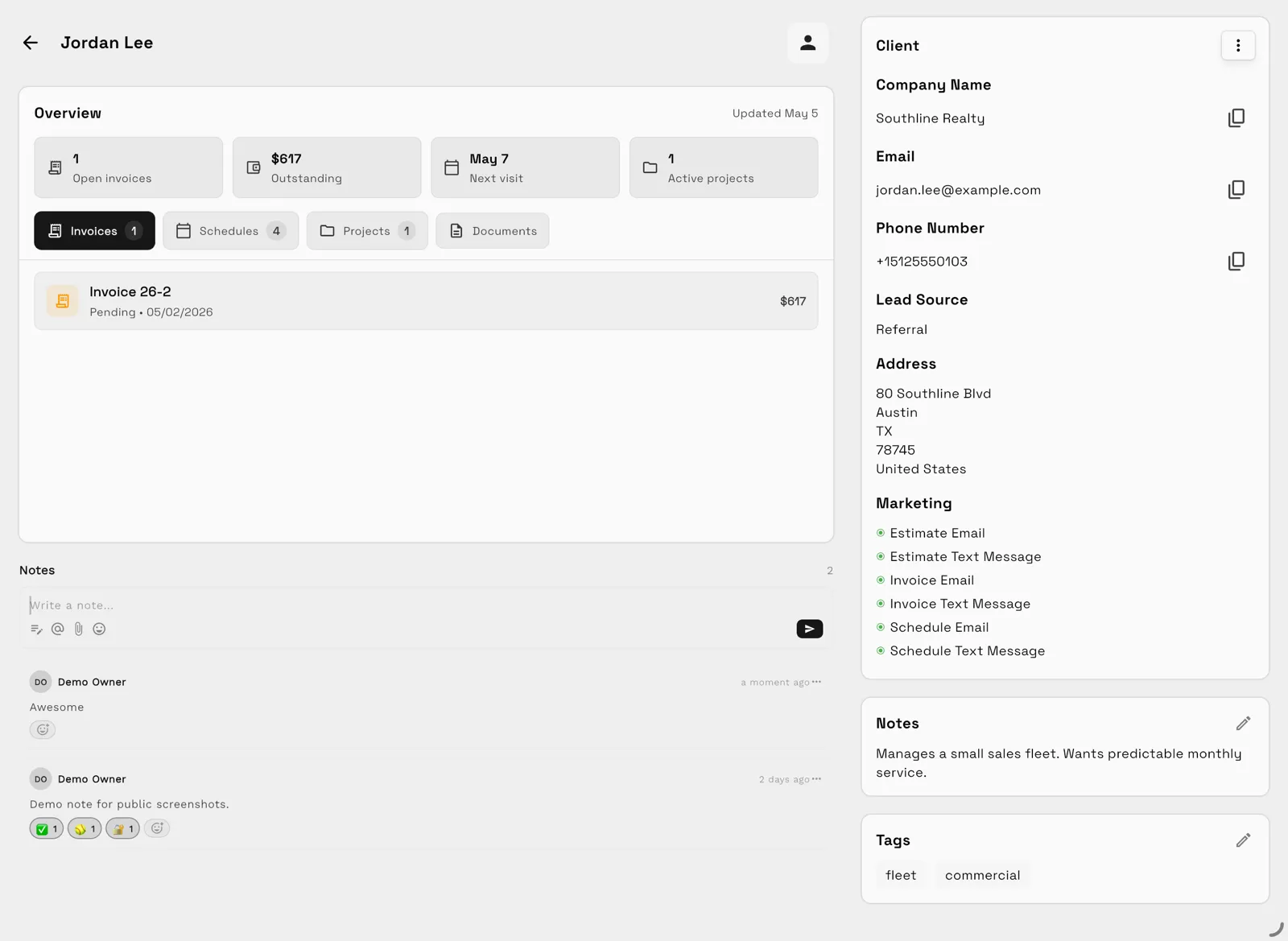
Workspace369 gives a coach the client record with notes and files, public intake forms, proposals the client accepts online with a deposit, projects and tasks for milestones, a private client portal and invoices including recurring invoices. A pre-made payment follow-up automation emails reminders at 1, 3, 7, 14 and 30 days after the due date. Cadet is $29 a month for one seat ($23.25 billed yearly) and includes email appointment reminders and email automations. The screenshot is a demo record, not a customer result.
Limitations: online booking and payment plans start at Specialist ($149 a month), so a coach whose clients self-book pays more than with Paperbell. Cadet allows 5 active projects and one seat, and calls and texts start at Voyager ($74). It has no course hosting or coaching-specific action plans. The 14-day trial needs a card.
Best for: coaches who sell higher-priced packages or business workshops by proposal and book through a separate link or by hand.
4. Quenza, best for between-session exercises and programs
Quenza lists programs, activities, notes, tasks and a client portal on every plan. Spark is $25 a month ($20 billed yearly) for 10 clients; Growth is $50 ($40 yearly) for 250 clients and adds groups, landing pages and file sharing. The trial is 30 days and the page says no card is needed. If you run the test, expect the notes and program steps to be strong, and check how a moved session affects a program step. Client mobile apps for iOS and Android are listed on every plan, which helps clients who prefer their phone.
Limitations: invoicing is marked Planned on the comparison table, and booking runs through a Calendly integration that starts at Growth. Billing and scheduling therefore need other tools.
Best for: coaches who care most about the work between sessions and will pair it with a separate billing tool.
5. HoneyBook, best for proposal, contract and payment flow
HoneyBook Starter is $29 a month billed yearly with unlimited clients and projects, proposals and contracts, invoices and payments, a client portal and up to 2 live lead forms. Automations, SMS reminders and unlimited Scheduler sessions start at Essentials ($49 yearly); Starter allows 1 session. The trial is 30 days with no card. If you run the test, the proposal, deposit and payment steps should feel natural, and its 60-day money-back guarantee lowers the risk of trying it. Check how a rescheduled session shows in the project and whether the client sees the change in the portal.
Limitations: Starter limits scheduling to 1 session, and session notes and coaching tools are not listed.
Best for: coaches who treat each engagement as a booking with a proposal, contract and payment.
6. Dubsado, best for form-heavy onboarding on a yearly budget
Dubsado Starter is $335 a year and Premier is $525 a year; monthly prices are See site, as the pricing page does not show them. Both list unlimited clients and projects, invoicing and payment plans, and client portals. The 21-day trial gives full Premier access with no card. If you run the test, trial Premier, because Starter cannot run the booking or workflow steps. A detailed intake questionnaire is easy to build once and reuse for every new client, which suits a repeatable discovery call. Extra users are priced in monthly tiers if you later add an assistant.
Limitations: advanced scheduling, automated workflows and public proposals are Premier only, and Starter has one lead capture form. It has no coaching-specific features, so session notes and package tracking are built by hand with forms and templates, and the pricing page does not state which plan includes contracts.
Best for: coaches with a repeatable intake process who will build forms once.
Side-by-side comparison
| Tool | Entry price | Online booking | Billing on entry plan | Main limit | Trial |
|---|---|---|---|---|---|
| Paperbell | $97 a month ($970 yearly) | Yes | Packages and payments | Higher price, no projects | Not stated, 30-day refund |
| Simply.Coach | $9 a month (Starter) | Booking pages | Invoices coming soon | 3 active clients on Starter | 14 days, no card |
| Workspace369 | $29 a month ($23.25 yearly) | Specialist ($149) | Deposits, recurring invoices | 5 projects, 1 seat | 14 days, card required |
| Quenza | $25 a month ($20 yearly) | Calendly from Growth | Invoicing marked Planned | 10 clients on Spark | 30 days, no card |
| HoneyBook | $29 a month yearly | Essentials ($49) | Invoices and payments | 2 lead forms | 30 days, no card |
| Dubsado | $335 a year | Premier ($525) | Invoices and payment plans | 1 lead form | 21 days, no card |
Which tool fits your coaching practice?
| If you mostly need | Start with | Why |
|---|---|---|
| Clients to book and pay for a package online | Paperbell | Scheduling, packages and contracts at one flat price |
| Action plans and notes for a few clients | Simply.Coach | Coaching-specific tracking from $9 a month |
| Proposals, deposits and retainers for packages and workshops | Workspace369 | Recurring invoices and payment reminders on Cadet |
| Exercises and programs between sessions | Quenza | Programs and activities on every plan |
| Proposal-to-payment for service engagements | HoneyBook | Contracts and payments on Starter |
| A repeatable intake questionnaire | Dubsado | Forms and templates, workflows on Premier ($525 a year) |
Workspace369 in action for a ten-session coaching package
For a package coach, the work is an agreement, a payment and a calendar of sessions. The first screenshot is the Workspace369 invoice editor in a demo workspace with sample data (an auto-detailing business called Apex Auto Spa, on the Commander plan). It shows an invoice marked partially paid, with $600.00 paid to date and the amount due beside a Pay Now button. That is the shape of a package: the client accepts a proposal with a deposit, and you invoice the balance. The second screenshot is the demo calendar for July 2026, where scheduled events sit on a month grid.
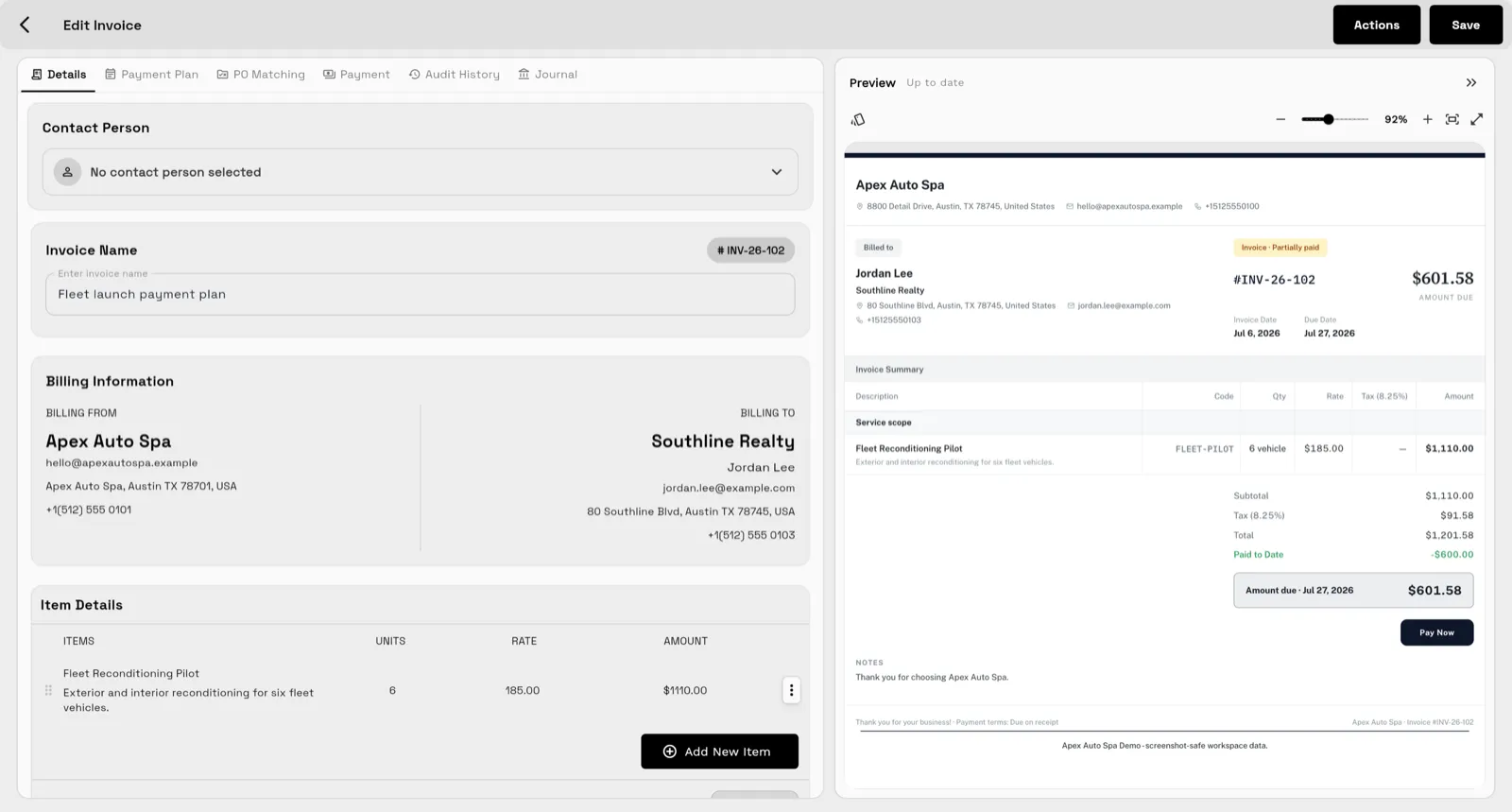
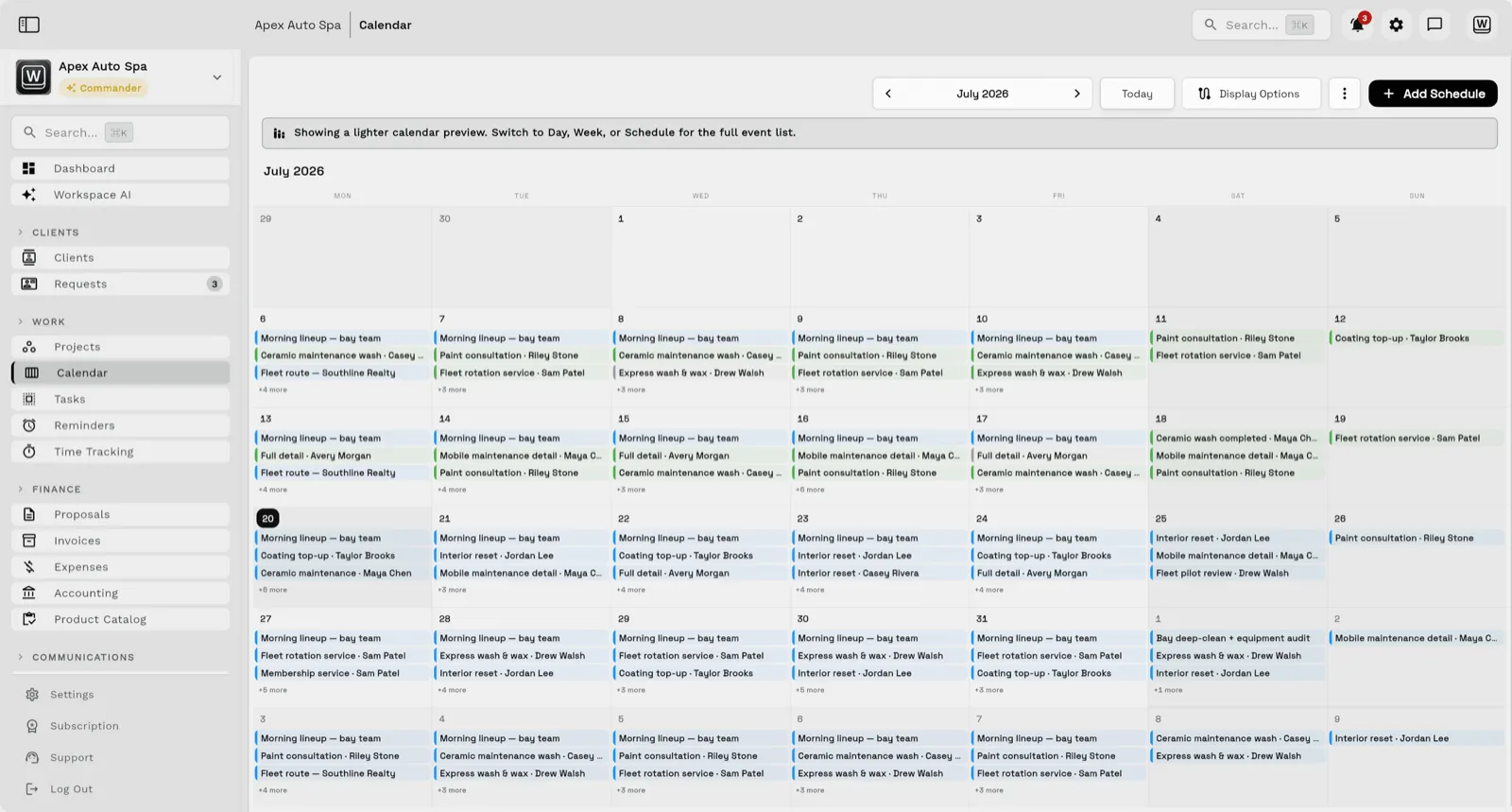
In a real practice, you would send the package as a proposal, log session notes on the client record, and let the client see what is owed in the client portal. Reminders to the client go out through communications, and email appointment reminders are on every plan.
The demo is not a coaching business. Workspace369 has no action plans, goal tracking, group coaching tools or session-credit counter, so the sessions left in a package are tracked by hand. Online booking and payment plans start at Specialist, so on Cadet you book through a separate link.
Run a mid-package reschedule test during the trial
Take one fictional coaching client through the whole package in each tool you shortlist:
- Send an intake form and record goals in the client notes.
- Create a ten-session package at a fixed price and have the "client" accept it.
- Collect a deposit or the first payment.
- Book the first three sessions.
- Five weeks in, move three sessions to new times and add a session note.
- Open the client portal as the client and check the package, the sessions and what is still owed.
If you run the test, expect the best tool to keep the package terms unchanged while sessions move. Any mismatch between the package price and the invoices is the leak this test is built to find.

When to keep it simple
If you coach five or six clients, a booking link, a shared notes document and an invoice template can carry you a long way. Move to a client tool when you lose track of which sessions remain in a package, when you chase payments by hand, or when you sell more than one kind of offer. The life coaches product page shows how Workspace369 handles proposals, communications and invoices, and the pricing page has current plans.
Before importing real clients, run one full package on demo data and check that your records can be exported.
Sources reviewed for this guide
- Paperbell pricingOfficial pricing page reviewed October 25, 2026 for price, included features and guarantee terms.
- Simply.Coach pricingOfficial pricing page reviewed October 25, 2026 for plan prices, active-client limits and trial terms.
- Quenza pricingOfficial pricing page reviewed October 25, 2026 for plan prices, client limits and trial terms.
- HoneyBook pricingOfficial pricing page reviewed October 25, 2026 for plans, scheduler limits and trial terms.
- Dubsado pricingOfficial pricing page reviewed October 25, 2026 for yearly prices (monthly prices are not shown), plan gates and trial terms.
- Workspace369 pricingPlan matrix reviewed October 25, 2026.
Workspace369 publishes this documentation-based comparison and is one of the options. It is not an independent ranking or a hands-on benchmark.
Run client follow-up in one workspace.
CRM, inbox, voice, invoicing, payments, projects, files, AI, and workflow automations — connected instead of exported.
14-day free trial. Card required. After the trial: from $29/month. Renews automatically every month until you cancel. Cancel anytime in Settings → Billing.