Best CRM for High-Ticket Coaching in 2026
Five tools compared for high-ticket coaching programs on price, application-to-enrollment flow, payment plans and contracts. Workspace369 ranks fourth.
We make Workspace369, which is on this list. Weigh our ranking with that in mind.

By Simon Dziak, Founder, Workspace369 · LinkedIn
The best CRM for high-ticket coaching programs carries an applicant from application and sales call to signed agreement, deposit, payment schedule and onboarding. Coaches selling high-ticket offers may be better served by an all-in-one funnel or course platform: GoHighLevel for breadth, Kajabi for course and community delivery, Paperbell for coach-specific packages and contracts. Workspace369 is fourth in this guide and fits the paperwork after the call; its coaching programs product page shows that workflow. For the wider field, see the best CRM for consultants. To size an enrollment deposit first, use the free deposit calculator. Workspace369's Proposals and payments pages show the offer and deposit steps, and the pricing page lists every plan.
Disclosure and method: Workspace369 publishes this guide and is one of the options. It is a documentation-based shortlist, not a hands-on benchmark. Official vendor pages were reviewed on October 22, 2026. Check current plans with each vendor before you buy.
Key takeaways
- A high-ticket coaching CRM should carry an applicant from application and sales call to signed agreement, deposit, payment schedule, onboarding and client portal on one record; a funnel or course platform usually covers more of that than a client-work tool does.
- GoHighLevel Starter is $97 a month ($970 billed yearly) and its pricing page lists CRM and pipelines, booking calendars, forms, funnels, payments and invoicing, courses and communities. Calling, email, SMS and AI carry usage-based charges.
- Kajabi starts at $179 a month ($143 a month billed yearly) for courses, a community and checkout pages, but caps Basic at 5 products and 2,500 contacts. Paperbell is a flat $97 a month ($970 a year) and lists contract signing and a client portal, and its comparison names payment plans among the tools it replaces.
- Workspace369 Cadet is $29 a month ($23.25 billed yearly) for one user and lists Proposals, deposit on acceptance, contracts, retainers and payment schedules, intake forms and a client portal. It has no course or community hosting, and its payment plans row starts at Specialist ($149 a month).
- Close ($49 a month per user on Essentials, $35 billed yearly) is built for sales calls and email but its pricing page names no proposals, contracts or payments. Test every tool by taking one fictional $9,000 enrollment from application to first session.
What's inside?
What a CRM for high-ticket coaching is (and what it is not)How we compared these toolsThe best CRM for high-ticket coaching programs in 2026Side-by-side comparisonWhich tool fits your program?Run an enrollment test during the trialWhen to keep it simple
What a CRM for high-ticket coaching is (and what it is not)
A CRM for a high-ticket program is the sales and enrollment record: who applied, who took a call, what offer you made, what deposit came in, whether the agreement is signed and what is still unpaid. It is not a course host, a community platform or a coaching-results tracker. Course modules and community spaces live in a platform built for them. The CRM holds the path from applicant to active participant, so access can follow a signed agreement and a paid deposit instead of a hopeful email.
How we compared these tools
We compared each tool on the same five points, using only the vendor's own pricing pages:
- Entry price, monthly and billed yearly, as listed on October 22, 2026, after rendering each page and switching every billing toggle.
- Enrollment chain on the page: application forms or funnels, booking, payments, payment plans and contracts, where the page names them.
- Sales-call tooling: calling, a dialer or a pipeline, where named.
- Delivery: courses, communities and a client portal, where named.
- Hard limits and trial terms: products, contacts, users and trial length.
We did not test speed, support, reliability or mobile apps, and did not use third-party ratings. A feature not named on a pricing page may still exist, so every "not named" below means only that the page does not list it. Order reflects documented fit for a coach selling a high-ticket program end to end. GoHighLevel, Kajabi and Paperbell each name course, community or payment-plan features that Workspace369's matrix does not list. Workspace369 is placed above Close, although Close Solo is cheaper, because its matrix names Proposals, deposit on acceptance, contracts, retainers and payment schedules, public intake forms and a client portal, none of which Close's pricing page names; Close ranks higher for a team that lives in calls and email.
The best CRM for high-ticket coaching programs in 2026
1. GoHighLevel, best for one platform from funnel to course
GoHighLevel Starter is $97 a month, or $970 billed yearly, with a 14-day free trial. The page lists CRM and pipelines, booking calendars, forms, surveys and quizzes, a website and funnel builder, workflow automation, payments and invoicing, courses and communities as core features, with unlimited contacts and users. Starter includes 3 sub-accounts; Unlimited is $297 a month ($2,970 a year) and Agency Pro $497 ($4,970 a year).
Limitations: calling, email and SMS marketing, and AI carry usage-based charges on top of the plan. The branded client portal app is a $49 a month per sub-account add-on. The page names no contract signing and no payment plans, and the feature set is built around agencies, so a solo coach should expect to configure it.
Best for: coaches who want funnel, application form, calendar, pipeline, payments and course delivery in one account and will set it up themselves.
2. Kajabi, best for course and community delivery with checkout
Kajabi Basic is $179 a month, or $143 a month billed annually. It lists 5 products, 2,500 contacts, 1 website, 1 community and 2 admin users, with unlimited funnels, landing pages and marketing emails. Growth is $249 ($199 billed annually) with 50 products and 25,000 contacts; Pro is $499 ($399 billed annually). Kajabi lists checkout pages, payment integrations, courses and communities.
Limitations: The page names no contract signing, no payment plans and no sales pipeline. The page shows a "Start Free Trial" button but states no trial length or card requirement. A 30-day money-back guarantee also applies.
Best for: coaches whose program is mostly content, cohorts and a community, with the sales call handled elsewhere.
3. Paperbell, best for coach-specific packages and contracts
Paperbell is one plan: $97 a month, or $970 a year. The page lists a coaching website, scheduling, payment processing and packages, a client portal, contract signing, client email workflows, forms, group coaching tools, online classes and digital downloads, with unlimited clients and sessions. Its comparison names payment plans among the tools it replaces, and a 30-day money-back guarantee applies.
Limitations: the pricing page names no sales pipeline, dialer or CRM reporting, and no free-trial length (a "Try For Free" button is shown). It is built for session-based coaching more than for a setter and closer team.
Best for: solo and small-team coaches who sell packages and want scheduling, contracts and a portal at one flat price.
4. Workspace369, best for proposal, deposit, contract and onboarding on one record
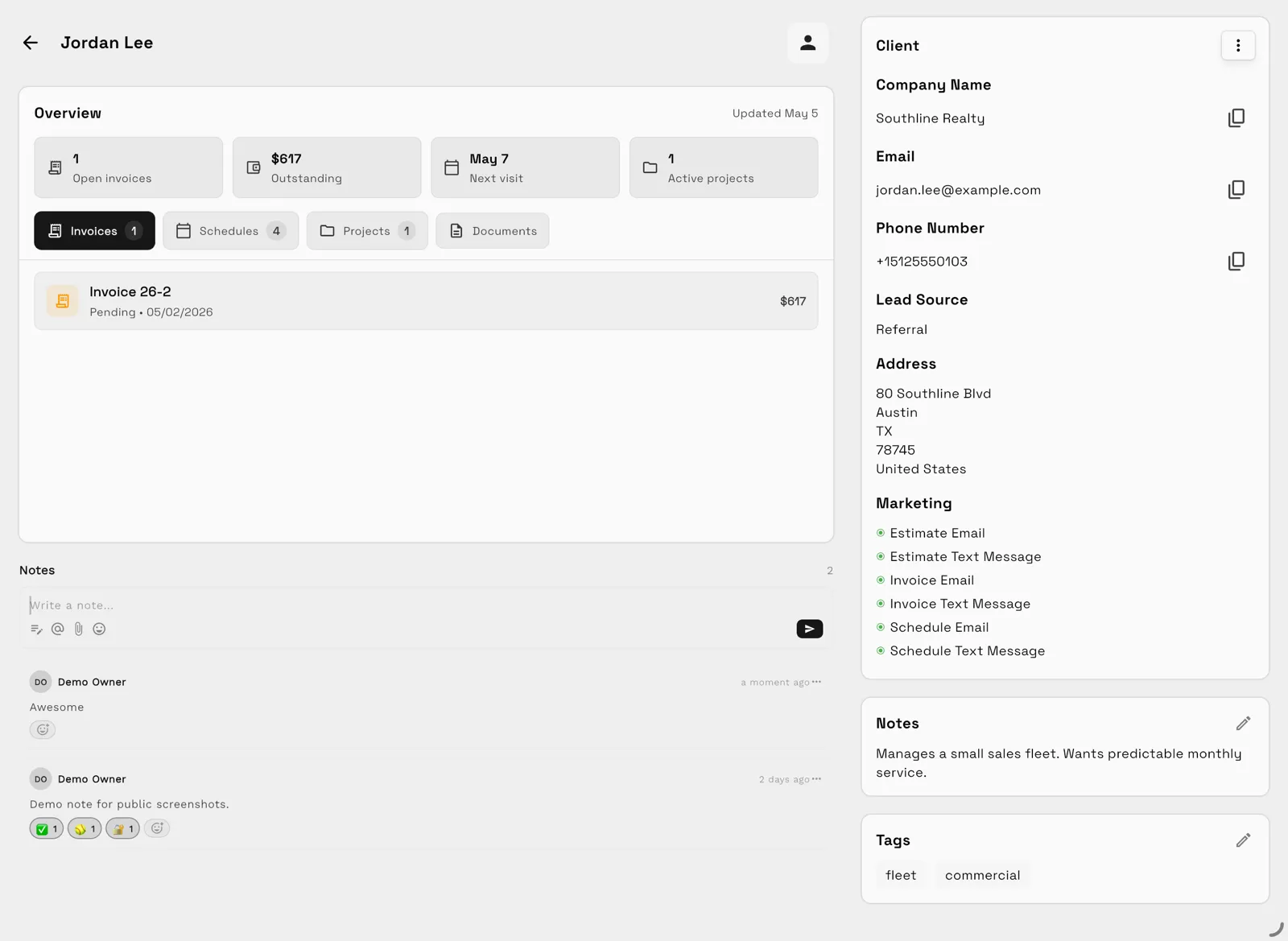
Workspace369 lists Proposals with optional add-on lines, deposit on acceptance, contracts the client signs online, retainers and payment schedules, public intake forms with request-to-client conversion, a client portal and file versioning on every plan. Cadet is $29 a month for one user ($23.25 billed yearly). It also lists 1 live funnel with lead capture into the CRM, and an outbound dialer from the CRM from Voyager ($74 a month, $59.25 billed yearly, 2 seats). The screenshot is a demo record, not a customer result.
Limitations: Workspace369 has no course or community hosting; it has client stages with follow-ups but no setter and closer pipeline with roles and commissions. Cadet allows 5 active projects and one seat. The payment plans row, change orders, proposal revision history and online booking start at Specialist ($149 a month, $119.25 billed yearly, 10 seats). Credit notes are listed as coming soon. The 14-day trial needs a card.
Best for: coaches who already have course delivery and a booking page elsewhere and want the offer, deposit, signed agreement, onboarding project and portal in one place.
5. Close, best for a sales-call pipeline
Close Solo is $19 a month ($9 billed yearly), limited to 1 user and 10,000 leads, without workflows. Essentials is $49 per user a month ($35 billed yearly) with unlimited contacts, forms, email, calling and SMS and a shared inbox. Growth is $109 ($99 billed yearly) and adds workflows and a power dialer; Scale is $149 ($139 billed yearly) and adds role-based access and a predictive dialer. The page says no credit card is needed for its 14-day free trial and lists a 30-day money-back guarantee.
Limitations: the pricing page names no proposals, contracts, payments, courses or client portal, so you need other tools for everything after the call. Pricing is per user, and calling and SMS usage is passed through at cost.
Best for: closers and setters who live in calls and email and need a dialer and pipeline more than enrollment paperwork.
Side-by-side comparison
| Tool | Entry price (monthly) | Billed yearly | Enrollment chain on the page | Courses or community | Main entry-plan limit | Trial |
|---|---|---|---|---|---|---|
| GoHighLevel | $97 (Starter) | $970 a year | Forms, funnels, calendars, pipelines, payments and invoicing | Courses and communities listed | Usage-based charges for calls, email, SMS and AI | 14 days, card required |
| Kajabi | $179 (Basic) | $143 a month | Checkout pages, payment integrations, funnels | Courses and 1 community | 5 products, 2,500 contacts, 2 admin users | Free trial button, length and card not stated |
| Paperbell | $97 | $970 a year | Packages, payments, contracts, portal, forms | Online classes and downloads | One plan, flat price | Trial button, terms not stated |
| Workspace369 | $29 (Cadet, one user) | $23.25 a month | Proposals, deposit, contracts, payment schedules, intake forms, portal | None | 5 active projects, 1 seat | 14 days, card required |
| Close | $49 (Essentials; Solo $19 is one user) | $35 per user a month | Forms, email, calling and SMS | None named | Per user; workflows from Growth | 14 days, no card |
Which tool fits your program?
| If you mostly need | Start with | Why |
|---|---|---|
| Funnel, calendar, pipeline, payments and courses in one account | GoHighLevel | Lists all of them from $97 a month |
| Course, cohort and community delivery | Kajabi | Courses, community and checkout pages |
| Coach packages and contracts at a flat price | Paperbell | One $97 plan listing contracts and a portal |
| Offer, deposit, signed agreement and onboarding project on one record | Workspace369 | Proposals, deposit on acceptance and contracts on every plan |
| Setter and closer calling | Close | Dialer from Growth; workflows from Growth |
Run an enrollment test during the trial
Take one fictional $9,000 applicant through the sequence below in each tool you shortlist. The scenario is an exercise, not a customer result.
- Submit an application form and book a sales call.
- Send the offer, collect the deposit and send the agreement.
- Set a payment schedule for the balance and change one date at the applicant's request.
- Create the onboarding project or course access, and check whether access waits for the signed agreement and the deposit.
- Open the record and check that the application, call notes, offer, agreement and invoices are linked together.
If you run the test, the best tool keeps all five on one record and lets you find the original terms in seconds.

When to keep it simple
If you enroll a few clients a month, a booking page, a contract template and an invoicing app can carry you. Move to a single system when applications overlap, when you cannot find what a client agreed to, or when deposits and balances slip. The coaching programs (high-ticket) product page shows how Workspace369 handles Proposals, communications and invoices, and the pricing page has current plans. Keep course content in a course platform and run the agreement, deposit and portal in Workspace369.
Before importing real clients, run one full enrollment on demo data and check that your records can be exported.
Sources reviewed for this guide
- Workspace369 pricingPlan matrix reviewed October 22, 2026.
- GoHighLevel pricingOfficial pricing page reviewed October 22, 2026 in both monthly and yearly views for prices, trial length, listed features and usage-based charges.
- Kajabi pricingOfficial pricing page reviewed October 22, 2026 in monthly and annual views for prices, plan limits and listed features.
- Paperbell pricingOfficial pricing page reviewed October 22, 2026 for monthly and yearly prices, listed features and the money-back guarantee.
- Close pricingOfficial pricing page reviewed October 22, 2026 in monthly and annual views for per-user prices, plan limits, trial terms and listed features.
Workspace369 publishes this documentation-based comparison and is one of the options. It is not an independent ranking or a hands-on benchmark.
Run client follow-up in one workspace.
CRM, inbox, voice, invoicing, payments, projects, files, AI, and workflow automations — connected instead of exported.
14-day free trial. Card required. After the trial: from $29/month. Renews automatically every month until you cancel. Cancel anytime in Settings → Billing.