Best CRM for Land Surveyors in 2026: Crews and Deposits
Best CRM for land surveyors: six client-work tools for small firms compared on price, per-job quoting, crew scheduling, deposits and phase invoicing.
We make Workspace369, which is on this list. Weigh our ranking with that in mind.

By Simon Dziak, Founder, Workspace369 · LinkedIn
The best CRM for land surveyors depends on which part of a job hurts most. For phased billing and project accounting, BQE Core is the most fully documented option, though it publishes no price. For crew scheduling with quotes and invoices at a listed price, Jobber is the field-service choice. Workspace369 suits a small firm that quotes per job, takes a deposit and bills from one client record: see the CRM for land surveyors page, Proposals and pricing. For the wider category, start with the best CRM for engineering firms guide. To price a boundary or topographic job first, use the free hourly rate calculator.
Disclosure and method: Workspace369 publishes this guide and is one of the options, and we rank it below two tools whose documented features fit crews and phase billing better. It is a documentation-based shortlist, not a hands-on benchmark. Official vendor pages were reviewed on October 22, 2026. Check current plans with each vendor before you buy.
Key takeaways
- BQE Core documents the deepest project billing for a surveying firm (phased billing, flexible billing schedules, budgets, Gantt charts, mobile apps) but publishes no price; it is quoted per user after you request a quote.
- Jobber is the priced option built around field scheduling: Core is $29 a month billed annually for one user, and the 2 to 5 person view lists Grow at $229 a month billed annually with 5 users, while crew scheduling sits on Plus at $399 a month billed annually.
- Workspace369 Cadet is $29 a month ($23.25 billed yearly) for one seat; Proposals with a deposit on acceptance, the client portal, time tracking and invoices are on every plan, but it has no crew dispatch map, GIS or CAD, so the field and survey data stay in your survey software.
- Monograph showed $600 to $750 a month for 10 employees on its pricing calculator and Productive Essential lists $10 per user per month billed yearly; ArcSite is a field drawing app whose Estimates plan adds proposals and invoicing.
- Run one fictional boundary change through every trial: revised proposal, updated tasks, moved field date and a new invoice line should all sit on one job record.
What's inside?
What a CRM for land surveyors is (and what it is not)How we compared these toolsThe best CRM for land surveyors in 2026Side-by-side comparisonWhich tool fits your firm?Run a boundary-change test during the trialWhen to keep it simple
What a CRM for land surveyors is (and what it is not)
A CRM for land surveyors is the office side of a survey firm: the client and the instruction, the fixed-fee proposal and deposit, the field date, the revised scope when a boundary moves, and the invoice for each phase. It is not survey software. Total stations, GNSS data, point clouds, plats and certified deliverables stay in your survey and CAD programs, and none of the tools below replace them.
The reader this guide has in mind runs a firm of one to fifteen people doing boundary, topographic, ALTA and construction staking work. The CRM for land surveyors page shows the Workspace369 view of that workflow. If a tool only stores contacts, the revised instruction lives in email and the crew learns about it by phone.
How we compared these tools
We compared each tool on the same five points, using only the vendor's own pricing and product pages:
- Entry price for one user, and for a team of five where the page allows it, as listed on October 22, 2026, with the billing basis stated each time.
- Quoting per job: proposals or quotes, approval online, and deposits or payment collection.
- Field scheduling: calendars, crew scheduling and mobile apps named on the page.
- Invoicing by job or phase: billing schedules, phased billing, time and budgets.
- Trial terms: length and card requirement, only where the page states them.
We did not test speed, support, security controls, data import or any survey software integration, and we used no third-party ratings. Order reflects documented fit for a small firm that quotes per job, schedules field work and bills per phase.
The best CRM for land surveyors in 2026
1. BQE Core, best for phased billing and project accounting
BQE Core is built for architecture, engineering and similar project-based firms, and many surveying practices fit its model of phases, budgets and billable time. Its pricing page lists phased billing and reporting into cost and schedule by phase, flexible billing schedules, recurring invoicing, time and expense tracking, budgets and fee schedules, task allocation and forecasting, and Gantt charts. It lists native iOS and Android apps and an open API, which help when field staff log time on site. Accounting, CRM, HR and payroll are separate modules. The page is per user and asks you to request a quote, so the price is See site, and it states no trial terms.
Limitations: no published price, so you cannot budget from this guide, and each module is quoted separately. Expect a sales process rather than a self-serve signup. It is a project accounting system, so a firm of two or three may find it heavier than it needs.
Best for: surveying firms that bill by phase and want time, project budgets and invoicing in one professional-services system.
2. Jobber, best for crew scheduling with quotes and invoices
Jobber is a field service platform for contractors, so its strength is getting people to a site and getting paid afterwards. In the one-user view, Core is $29 a month billed annually and lists scheduling jobs online, quotes, invoices with online payments and reporting; Connect is $99 and adds client reminders and automatic payment collection; Grow is $149 and adds automatic time tracking, job costing, custom quotes with optional line items, two-way SMS and workflow automations. The monthly figures are $49, $139 and $199 with no commitment. For 2 to 5 people the page showed Grow with 5 users at $229 a month billed annually ($299 monthly), and Plus at $399 billed annually ($499 monthly), which adds crew scheduling and team @mentions. The 14-day trial needs no credit card.
Limitations: it is built for home-service contractors, so there is no fee-budget or phased billing for professional services on the pricing page. The crew scheduling a multi-crew survey firm would want sits on the top listed team tier.
Best for: firms whose bottleneck is dispatching crews to jobs and collecting payment afterwards.
3. Workspace369, best for per-job proposals, deposits and invoices on one record
Workspace369 puts the client record, Proposals that clients approve online with a deposit, a client portal, files, tasks, a team calendar, time tracking and invoices in one place. Cadet is $29 a month ($23.25 billed yearly) for one seat and 5 active projects; Voyager is $74 with two seats and adds a timeline view and task dependencies; Specialist is $149 with ten seats, online booking and payment plans. Proposals, deposit on acceptance, retainers and payment schedules, time tracking and timesheets are on every plan. The screenshot below is a demo record, not a customer result.
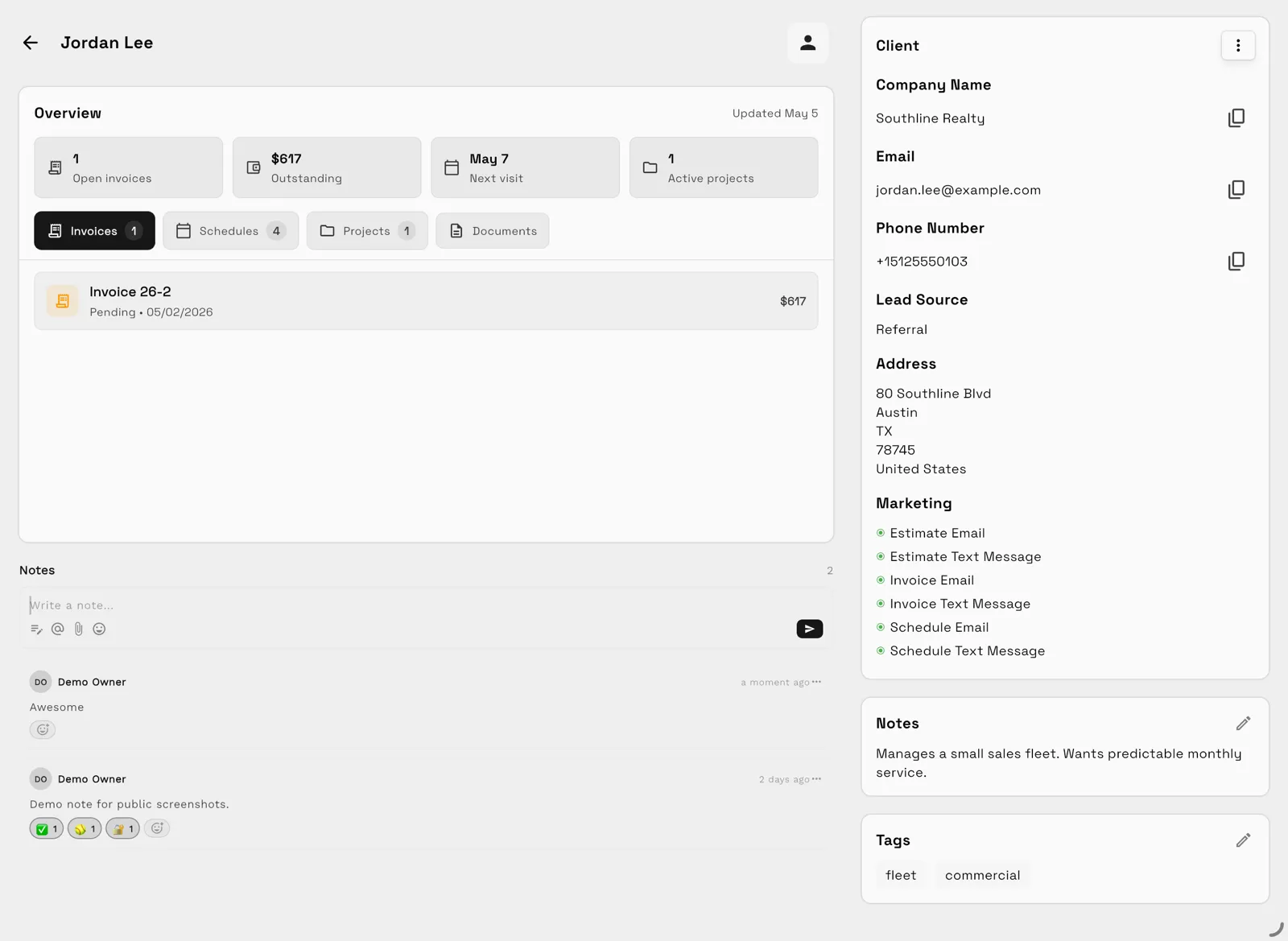
Limitations: it has no crew dispatch map, no route planning, no GIS or CAD and no survey data tools, and it does not do percent-complete billing by phase. Jobber covers crew scheduling and BQE Core covers phased billing more fully. Cadet is one seat, so a firm with office and field staff needs Voyager or above. The 14-day trial needs a card.
Best for: a firm of one to ten that quotes each survey as a fixed fee, takes a deposit and bills a milestone or final invoice from one client record.
4. Monograph, best for A&E profitability and staffing views
Monograph is a platform for architecture and engineering firms with a proposal builder, project planning, staffing, time tracking, invoicing, payments, project accounting and a QuickBooks link. The pricing page lists no plan prices. Its calculator showed $600 to $750 a month for 10 employees on October 22, 2026, which works out at $60 to $75 per employee, and it does not state the billing basis. Pipeline management is an add-on, not part of the base plan. Subscribing starts with a live demo that the vendor offers to select firms.
Limitations: the price is a calculator estimate, not a published plan, and its industry pages name architecture and engineering rather than surveying. It lists no field scheduling for crews.
Best for: surveying practices that sit inside an engineering firm and want staffing and profit reporting.
5. Productive, best for budgets, hours and resource planning
Productive lists Essential at $10 per user per month billed yearly ($12 billed monthly) and Professional at $25 billed yearly ($29 billed monthly); Ultimate is custom. Essential includes budgeting, resource planning, project and task management, time tracking, expense management and reporting. Professional adds rate cards, billable time approvals, recurring budgets and skills. The page shows a total for 10 users of $100 a month on Essential or $250 on Professional billed yearly. The sign-up form offers a 14-day free trial with no credit card required.
Limitations: it is a project and resource tool, not a survey tool. The pricing page lists no client portal and no field or crew scheduling, so confirm invoicing and deal features in a trial before you rely on them.
Best for: firms that care most about project budgets, utilization and planning hours across a team.
6. ArcSite, best as a field drawing companion
ArcSite is a mobile drawing and takeoff app for field trades, not a client-work CRM. Its yearly view lists Draw Basic at $10, Draw Pro at $30, Takeoff at $99 and Estimates at $129 a month; the monthly view shows $14.99, $34.99, $119.99 and $159.99. Draw Pro lists export to PNG, PDF, DXF and DWG, laser measure integration and layers. The Estimates plan adds proposals, digital approvals, invoicing, payments, payment plans and change orders. The Draw plans offer a 14-day trial; Takeoff and Estimates start with a demo.
Limitations: it is built for contractors sketching and pricing jobs on site, so the page names no survey-grade capture, no client portal, no time tracking and no crew scheduling.
Best for: firms that want quick field sketches and site proposals alongside, not instead of, their survey software.
Side-by-side comparison
| Tool | Entry price | Quoting and deposits | Field scheduling | Trial | Main limit |
|---|---|---|---|---|---|
| BQE Core | See site (per user, request a quote) | Not named on the pricing page | Mobile apps, task allocation | Not stated | No published price |
| Jobber | $29 per month, 1 user, billed yearly ($49 monthly) | Quotes and online payments from Core | Job scheduling; crew scheduling on Plus | 14 days, no card | Built for home-service contractors |
| Workspace369 | $29 per month ($23.25 yearly), 1 seat | Proposals with deposit on acceptance, every plan | Team calendar, Google Calendar sync, tasks | 14 days, card required | No dispatch map, GIS or CAD |
| Monograph | $600 to $750 per month at 10 employees (calculator) | Proposal builder, payments | Staffing and planning | Demo | Price and billing basis unclear |
| Productive | $10 per user per month, billed yearly ($12 monthly) | Not a focus on the pricing page | Resource planning | 14 days, no card | Project tool, not survey-specific |
| ArcSite | $10 per month, billed yearly (Draw Basic); $129 for Estimates | Proposals and payments on Estimates | Field drawing app | 14 days (Draw plans) | Not a CRM |
Which tool fits your firm?
| If you mostly need | Start with | Why |
|---|---|---|
| Phased billing and project accounting | BQE Core | Billing schedules, budgets and Gantt charts documented |
| Dispatching crews and collecting payment | Jobber | Job scheduling and online payments from $29 billed yearly |
| Fixed-fee proposals with a deposit, one client record | Workspace369 | Proposals, deposits and invoices on every plan from $29 |
| Staffing and profit views inside an A&E firm | Monograph | Staffing and project accounting, demo-led |
| Hours, budgets and utilization | Productive | Budgeting and time on Essential |
| Quick field drawings and site proposals | ArcSite | DXF and DWG export, mobile app |
Run a boundary-change test during the trial
Take one fictional client with demo data through each tool you shortlist, and change the site boundary after the proposal is approved:
- Send a fixed-fee boundary survey proposal with a deposit, and have the client approve it.
- Open the job, attach the original site description and add the field tasks.
- Schedule the field date and confirm the right person can see it.
- Log the client's boundary change as a revised instruction, then send a revised proposal.
- Update the tasks and move the field date, then invoice the deposit and the first phase.
- Export the client's records and check what comes out.
Use the free scope-change request builder to draft the change request. The best tool keeps the revised proposal, the schedule and the invoice on one record; anything you retype between screens is the leak this test finds.

When to keep it simple
If you run a handful of jobs a month, a shared calendar, a fixed-fee template and an invoice template can carry you. Move to a client-work tool when you re-key the same instruction into three places, or when a crew arrives at the wrong boundary because a change never reached the schedule. The land surveyors product page shows how Workspace369 handles communications and the pricing page has current plans. Workflow Automations can send reminders and create tasks, with email automations on every plan.
Before importing real clients, run one full cycle on demo data and check that your records can be exported.
Sources reviewed for this guide
- Workspace369 pricingPlan matrix reviewed October 22, 2026.
- BQE Core pricingOfficial pricing page reviewed October 22, 2026 for modules and billing features; it asks for a custom quote and lists no price.
- Jobber pricingOfficial pricing page reviewed October 22, 2026 for Core, Connect, Grow and Plus prices in the one-user and 2 to 5 person views, billing options and trial terms.
- Monograph pricingOfficial pricing page reviewed October 22, 2026 for the pricing calculator output at its default of 10 employees and the included features.
- Productive pricingOfficial pricing page reviewed October 22, 2026 for Essential and Professional prices in both the yearly and monthly views and trial terms.
- ArcSite pricingOfficial pricing page reviewed October 22, 2026 for plan prices in the yearly view (monthly figures shown after switching the billing toggle), included features and trial terms.
Workspace369 publishes this documentation-based comparison and is one of the options. It is not an independent ranking or a hands-on benchmark.
Run client follow-up in one workspace.
CRM, inbox, voice, invoicing, payments, projects, files, AI, and workflow automations — connected instead of exported.
14-day free trial. Card required. After the trial: from $29/month. Renews automatically every month until you cancel. Cancel anytime in Settings → Billing.