Best CRM for Landscape Architects in 2026: fees by phase
Best CRM for landscape architects: six tools compared on price, phase-based fee proposals, retainers, billable hours, client approvals and invoicing.
We make Workspace369, which is on this list. Weigh our ranking with that in mind.

By Simon Dziak, Founder, Workspace369 · LinkedIn
The best CRM for landscape architects depends on how much phase accounting you need. Firms that want fee budgets, staffing and accounting by phase should compare Monograph and BQE Core. Workspace369 fits one-to-five-person studios billing fixed fees, retainers and hourly time. Productive suits teams of three or more, Bonsai suits proposals and hourly billing, and Harvest suits hourly tracking.
Planning a firm-wide software stack instead? Start with the head guide to architecture firm software. To see how much of your week is billable, use the free billable utilization calculator.
Disclosure and method: Workspace369 publishes this guide and is one of the options. It is a documentation-based shortlist, not a hands-on benchmark. Official vendor pages were reviewed on October 26, 2026. Check current plans with each vendor before you buy.
Key takeaways
- A landscape architecture studio sells design in phases (concept, design development, construction documents, construction administration), so the CRM needs to hold the phased fee, the retainer, the hours and the invoice on one client record.
- Monograph and BQE Core are built for architecture and engineering firms and go deeper on project accounting; the Monograph calculator prices it at $60 to $75 per seat a month ($600 to $750 at its default of 10 employees, and it starts at 5), and BQE Core is quote only.
- Workspace369 Cadet is $29 a month ($23.25 billed yearly) for one seat and 5 active projects; Proposals, retainers with hour banks, deposits, time tracking and time-to-invoice are on every plan, but the plan matrix lists change orders only from Specialist and has no percent-complete billing view.
- Productive lists Essential at $10 per user a month billed yearly ($12 monthly) and Professional at $25 ($29 monthly), with a 3-seat minimum; Bonsai Essentials is $19 per user billed yearly ($25 monthly).
- Run one fictional added-scope request through each trial and check that the revised fee, the logged hours and the invoice line all sit on the same client record.
What's inside?
What a CRM for landscape architects is (and what it is not)How we compared these toolsThe best CRM for landscape architects in 2026Side-by-side comparisonWhich tool fits your studio?Workspace369 in action for a phased landscape commissionRun a scope-change test during the trialWhen to keep it simple
What a CRM for landscape architects is (and what it is not)
A CRM for a landscape architecture studio is the business side of a commission: who the client is, what you proposed for each phase (concept, design development, construction documents and construction administration), what was approved, what hours you logged and what is still unpaid. It is not CAD, planting-plan or grading software, and none of the tools below replace your drawing set. It is also not a system for landscaping or lawn-care contractors; this guide is for design studios that sell professional services by phase. If a tool stores contacts but leaves fees and billing to other apps, the approved scope lives in an email thread and a new site area gets drafted before anyone prices it.
How we compared these tools
We compared each tool on the same five points, using only the vendor's own pricing and product pages:
- Entry price for a small studio, monthly and billed yearly, as listed on October 26, 2026, including any seat minimum.
- Fee and billing coverage: proposals, retainers or billing schedules, phased billing, and turning logged time into an invoice.
- Client-facing pieces: client portal, approvals and file sharing.
- Hard limits on the entry plan: projects, seats, quote-only pricing or demo-only signup.
- Trial terms: length, and whether the vendor says a card is needed.
We did not test speed, support, reliability, mobile apps or accounting depth, and did not use third-party ratings. Order reflects how well each tool documents phase-level fee accounting, the job in this guide's title. Monograph and BQE Core document deeper phase accounting than Workspace369, so they rank first and second; Workspace369 ranks third as the fit for one-to-five-person studios that bill fixed fees, retainers and hourly time and do not need phase-level accounting.
The best CRM for landscape architects in 2026
1. Monograph, best for phase-based project finance built for architects
Monograph is built for architecture and engineering firms and lists a proposal builder, pipeline management (sold as an add-on), project planning, staffing, time tracking, invoicing, payments and project accounting, with a QuickBooks connection. Its pricing page uses a calculator that works out $60 to $75 per seat a month for the number of employees you enter (checked October 26, 2026). At its default of 10 employees that is $600 to $750 a month, and the counter does not go below 5 employees. The page does not say whether the range is billed monthly or yearly. It says every core feature is included, pipeline is a separate add-on, and signup goes through a demo; no trial is stated.
Limitations: the price is a range tied to firm size, and demo-first signup with no listed trial makes it harder to test on a small studio's real work. Because the calculator starts at 5 employees, the lowest range it shows is $300 to $375 a month, so a one- or two-person studio should ask for its own quote before comparing it with a per-seat tool. The page also says pipeline management is not part of the plan and is sold as an add-on, and that onboarding support, on-demand training and unlimited projects and reports are included.
Best for: architecture and landscape firms with several staff that want fee, staffing and profit reporting by project.
2. BQE Core, best for firms that want accounting and billing in one platform
BQE Core is built for architecture and engineering firms. Its pricing page describes per-user pricing for a Foundations module with time and expense, billing and invoicing, project management and reporting, plus optional accounting, CRM, HR and payroll modules. Under billing it lists flexible billing schedules and recurring and automatic invoicing; under project management it lists budgets, estimates and fee schedules, and phased billing and reporting by phase. Pricing is a custom quote based on firm size and modules; no prices or trial are shown (checked October 26, 2026).
Limitations: quote-only pricing, so you cannot compare cost before a sales call. It is broader than a small studio may need, and the accounting, CRM, HR and payroll modules are listed as additional modules, each with its own request-a-quote button. A studio that only needs to send a phased fee and invoice it may find the setup larger than the job.
Best for: firms that want to replace accounting software and need phased billing, budgets by phase and utilization reporting in the same platform.
3. Workspace369, best for small studios that bill fixed fees and retainers
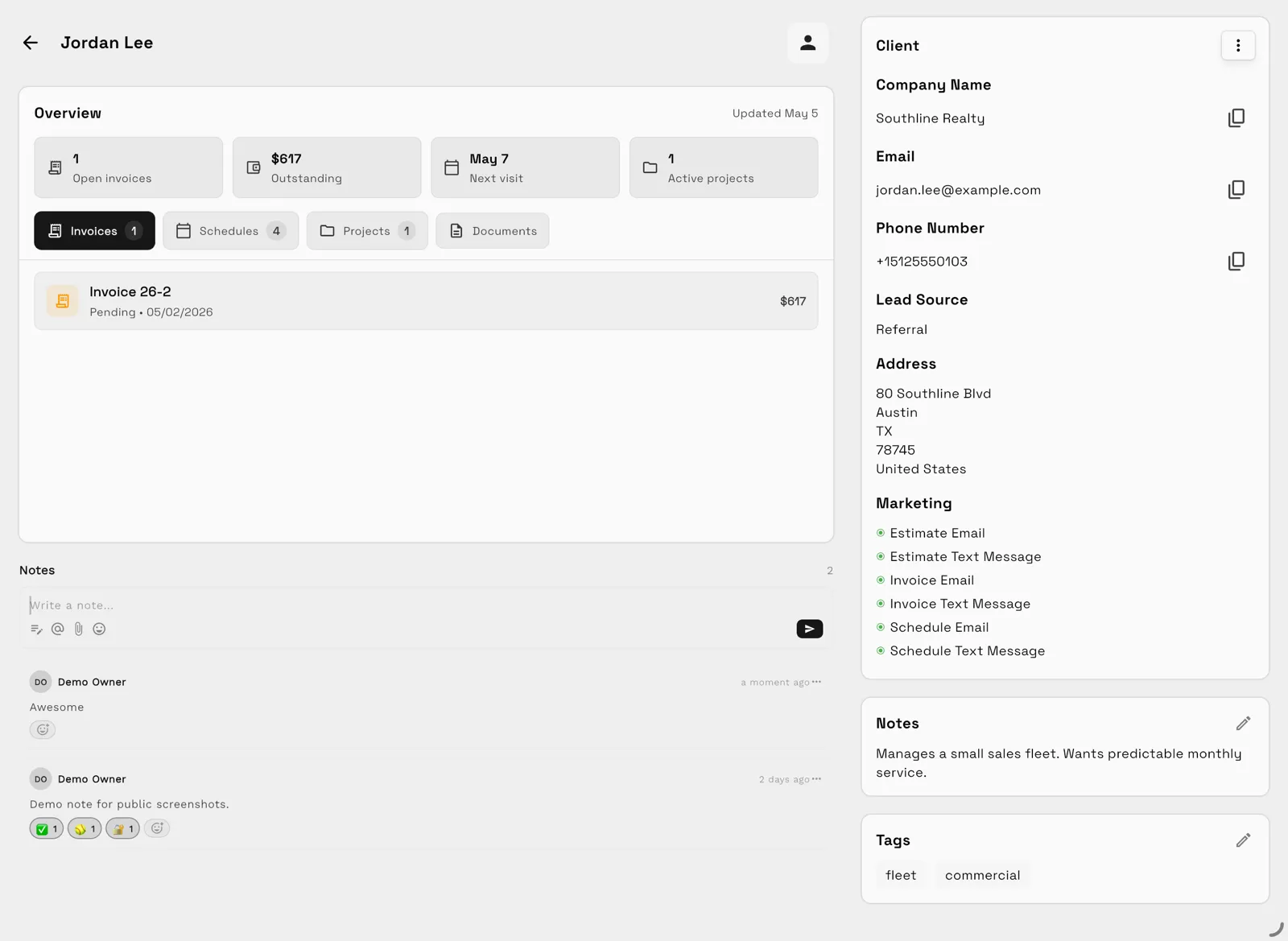
Workspace369 puts the client record, a Proposal the client accepts through a public link, a deposit on acceptance, a retainer or payment schedule, projects and tasks, time tracking with timesheets, a private client portal and invoices in one place. Cadet is $29 a month for one person ($23.25 billed yearly) and lists all of those on the plan, plus file versioning, file share links and client custom fields for site data. A retainer can run as an hour bank with a live hours meter and alerts at 80% and 100%, on every plan. The screenshot is a demo record, not a customer result.
Limitations: it is a client-work platform, not an architecture accounting system. The plan matrix lists no fee budget by phase and no percent-complete billing view, so a phased fee lives in the Proposal and the invoice lines you write. Change orders, which record scope changes against the original agreement, start at Specialist ($149 a month). Cadet allows 5 active projects and one seat; Voyager ($74 a month, $59.25 billed yearly, two seats) lifts the project cap, and extra seats are $10 a month from Voyager. Project profitability, expenses and payment plans start at Specialist ($149 a month). Monograph and BQE Core go deeper on project accounting. There is a 14-day trial on Cadet through Commander, card required.
Best for: studios of one to five people that bill fixed fees, retainers and hourly time and want Proposals, hours, approvals and invoices without extra apps or phase-level accounting.
4. Productive, best for resource planning and budgets
Productive is an agency and project operations tool. Essential is $10 per user a month billed yearly ($12 billed monthly) and lists budgeting, resource planning, project and task management, time tracking and expense management. Professional is $25 per user billed yearly ($29 monthly) and adds recurring budgets, billable time approvals and rate cards. Invoices and credit notes are listed on every plan, with retainer invoicing from Professional (checked October 26, 2026). The FAQ says all plans require at least 3 seats, so the entry cost is three users. The page describes a free 14-day trial with no card required.
Limitations: the 3-seat minimum raises the entry cost for a solo or two-person studio, since three Essential seats come to $36 a month billed monthly. The page lists no client portal or e-signature and names proposals only as a PDF export, so client sign-off would live in another tool. It is not architecture-specific, and the fee-by-phase structure would need to be built as budgets.
Best for: three or more people who want budgets, hours and capacity in one tool.
5. Bonsai, best for proposals and hourly billing priced per user
Bonsai prices per user. Basic is $15 a month ($9 billed yearly) with time tracking, tasks and a CRM. Essentials is $25 a month ($19 billed yearly) and adds invoices and payments, proposals and contracts, forms, scheduling, a client portal and expense tracking. Its comparison table lists retainer invoices and fee and hourly project budgets (checked October 26, 2026). The trial is 7 days, then Bonsai asks for card details to continue.
Limitations: the table marks Project Phases as a feature expected to be released in 2026, so phase budgets may not be available yet. Custom client fields, client tasks and messaging start at Premium ($39 a month, $29 billed yearly), and Elite has a three-user minimum. Profit and productivity reports are listed on the Premium plan, not Essentials.
Best for: one to three designers who want proposals and hourly billing and can track phases by hand.
6. Harvest, best as a time and invoice add-on
Harvest has a Free plan at $0 for 1 seat and 2 projects with time tracking, invoicing and expense tracking. Teams is $11 per seat a month ($9 billed yearly) with a 30-day trial, and the page says no card is required (checked October 26, 2026). It supports time-and-materials and fixed-fee projects, which fits hourly work.
Limitations: no client portal, proposals or retainer billing are listed on the plans, and the free plan caps projects at two. The Teams page also says additional invoices, projects, clients and tasks are billed based on what you use, so the entry price is a starting point. Client approvals of drawings and revised fees would have to live in another tool.
Best for: a studio that only needs hourly tracking and invoices, beside separate proposal and CRM tools.
Side-by-side comparison
| Tool | Entry price (monthly) | Billed yearly | Phase fees and billing | Main entry limit | Trial |
|---|---|---|---|---|---|
| Monograph | $60 to $75 per seat (calculator; $600 to $750 at 10 employees; billing basis not stated) | Not stated | Proposal builder and project accounting | Demo-based signup; calculator starts at 5 employees | None stated |
| BQE Core | Quote | Quote | Phased billing and fee schedules listed | Quote only | None stated |
| Workspace369 | $29 (Cadet) | $23.25 a month | Proposals, retainers, time-to-invoice; change orders from Specialist; no phase budget view | 5 active projects, 1 seat | 14 days on Cadet through Commander, card required |
| Productive | $12 per user (Essential) | $10 per user a month | Budgets and rate cards; invoices on all plans | 3-seat minimum | 14 days, no card |
| Bonsai | $25 per user (Essentials) | $19 per user a month | Proposals, retainer invoices; phases marked 2026 | Per user; Elite has 3 users minimum | 7 days, card to continue |
| Harvest | $0 (Free), $11 per seat (Teams) | $9 per seat (Teams) | Fixed-fee and time-and-materials projects | Free: 1 seat, 2 projects | 30 days, no card |
Which tool fits your studio?
| If you mostly need | Start with | Why |
|---|---|---|
| Fee, staffing and profit reporting by project for architecture firms | Monograph | Built for architecture and engineering, demo-based |
| Phased billing plus accounting in one platform | BQE Core | Lists phased billing, fee schedules and an accounting module |
| Proposals, retainers, hours, portal and invoices at a published price | Workspace369 | Cadet lists them all, with a 5-project cap |
| Budgets, rate cards and capacity for three or more people | Productive | Per-user pricing with a 3-seat minimum |
| Proposals and hourly billing per designer | Bonsai | Essentials adds proposals, invoices and portal |
| Only hourly tracking and invoices | Harvest | Free plan with 1 seat and 2 projects |
Workspace369 in action for a phased landscape commission
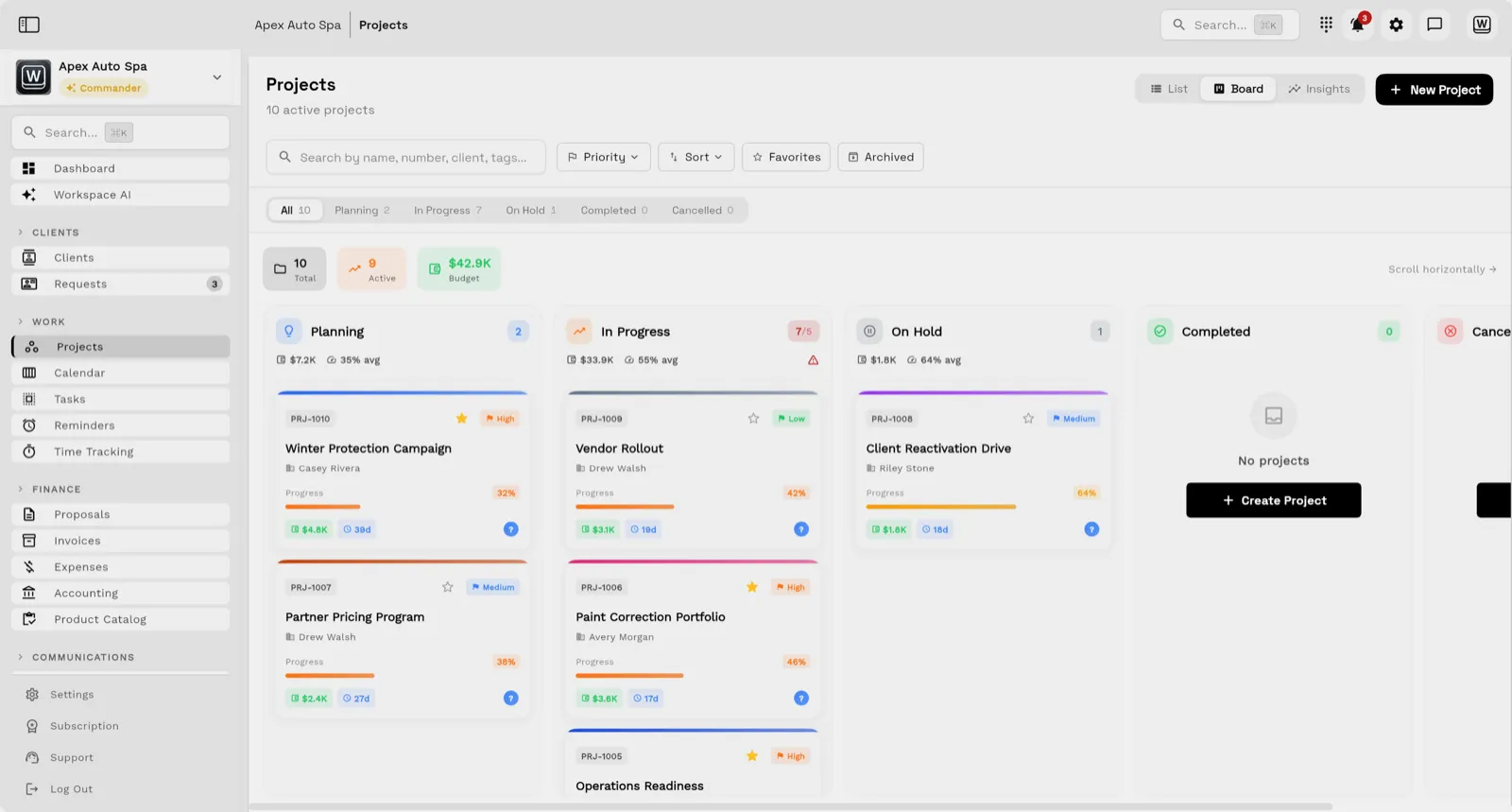
For a phased commission, the work sits on a project board and an invoice. The first screenshot below is the Workspace369 projects board in a demo workspace with sample data (an auto-detailing business on the Commander plan, not a design studio). Projects sit in Planning, In Progress and On Hold columns, and each card shows a progress bar and a budget. A studio could run one project per commission and move it through the stages as concept, design development, construction documents and construction administration are signed off. Hours logged with time tracking against that project can then be pulled into an invoice.
The second screenshot is the invoice editor with a live preview, also demo data. The preview shows an invoice marked partially paid, with the amount paid to date taken off the total and a Pay Now button. For a phase fee you write the line yourself, for example "Design development, 50% of phase fee". A monthly retainer can be set up through retainers and recurring billing, and a new site area added after concept can go out as a change order on Specialist and up.
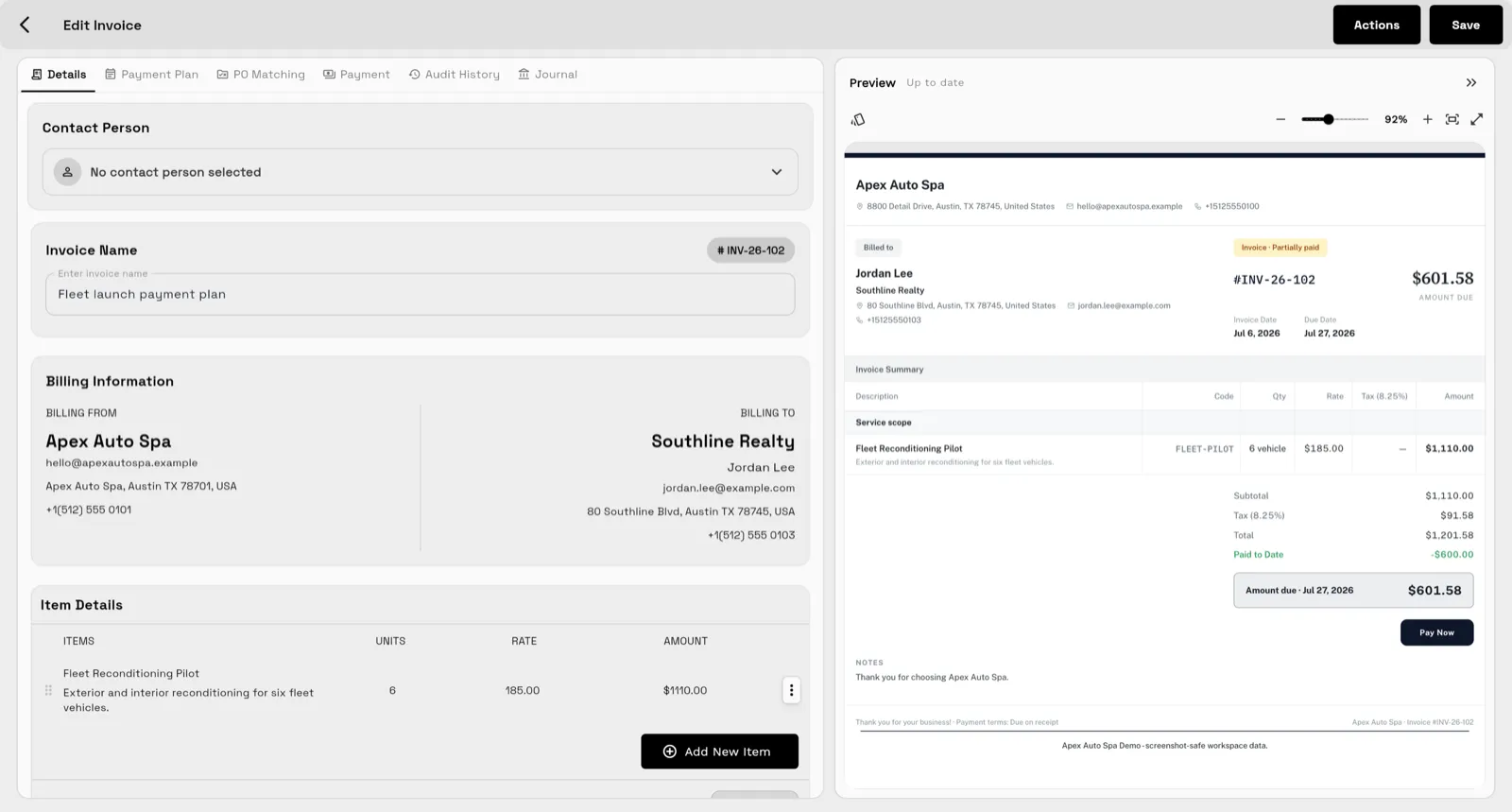
The demo is not a landscape studio, and Workspace369 has no fee budget by phase, no percent-complete billing view and no drawing viewer. The Payment Plan tab in the invoice editor needs Specialist.
Run a scope-change test during the trial
Take one fictional commission through each shortlisted tool:
- Record the client and the four phases with a fee for each, and send them as a Proposal or quote the client approves.
- Log hours against the concept phase, then edit one entry in the timesheet.
- After concept approval, add a new site area and write the client a message about it.
- Price the change as a revised fee and get it approved before logging more time.
- Invoice a percent of the design development phase and note how the tool shows it.
- Export the client's records and check what comes out.
If you run the test, the best tool keeps the revised fee, the hours, the message and the invoice on one client record, and the invoice matches your timesheet. Draft the change first with the free scope-change request builder.

When to keep it simple
If you have a handful of steady commissions, a fee spreadsheet, a timer and an invoice template can carry you for a while. Move to a client-work tool when a site area gets added without a revised fee, when you cannot say what was approved at concept, or when you chase phase invoices by hand. The landscape architects product page shows how Workspace369 handles Proposals, communications and invoices, and the pricing page has current plans. Keep drawings in your CAD software and share issued sets through file share links or the client portal. Workflow Automations can create tasks and send reminders, with email automations on every plan.
Before importing real clients, run one full commission on demo data and check that your records can be exported.
Sources reviewed for this guide
- Workspace369 pricingPlan matrix reviewed October 26, 2026.
- Monograph pricingOfficial pricing page reviewed October 26, 2026 for the per-seat calculator range, the 5-employee starting point, plan scope and demo-based signup.
- BQE pricingOfficial pricing page reviewed October 26, 2026 for CORE feature lists, add-on modules and quote-based per-user pricing.
- Productive pricingOfficial pricing page reviewed October 26, 2026 for monthly and yearly per-user prices, plan features, seat minimum and trial terms.
- Bonsai pricingOfficial pricing page reviewed October 26, 2026 for monthly and yearly per-user prices, plan features and trial terms.
- Harvest pricingOfficial pricing page reviewed October 26, 2026 for the free plan, Teams price and trial terms.
Workspace369 publishes this documentation-based comparison and is one of the options. It is not an independent ranking or a hands-on benchmark.
Run client follow-up in one workspace.
CRM, inbox, voice, invoicing, payments, projects, files, AI, and workflow automations — connected instead of exported.
14-day free trial. Card required. After the trial: from $29/month. Renews automatically every month until you cancel. Cancel anytime in Settings → Billing.