Best CRM for consultants in 2026: proposals to retainer billing
The best CRM for consultants follows an engagement from the first discovery call to the proposal, the delivery work and the invoice still outstanding. For solo consultants and small firms who want that on one record, our pick is Workspace369's CRM for consultants, which also runs as a native app for iPhone and iPad, with iPad in every orientation. Pipedrive and HubSpot are stronger when the job is mainly a sales pipeline, and Bonsai, HoneyBook and Dubsado suit client administration. Pricing a retainer first? Try the free retainer calculator.
Best CRM for consultants: seven CRMs compared on price, plan limits and the proposal-to-retainer-invoice workflow, with a use-case table and a trial test.
We make Workspace369 and list it first here. Weigh our ranking with that in mind, and if another tool fits you better, use it.

By Simon Dziak, Founder, Workspace369 · LinkedIn
Disclosure and method: Workspace369 publishes this guide and is one of the options. It is a documentation-based shortlist, not a hands-on benchmark. Official vendor pages were reviewed on October 22, 2026, except Pipedrive's, which could not be read that day and was last reviewed on October 14, 2026. Where a vendor page did not show a price we could read, the guide says so instead of guessing. Check current plans with each vendor before you buy.
Key takeaways
- A consultant CRM should carry an engagement from discovery call to proposal, delivery and paid invoice, and show who owns the next step.
- Workspace369 fits solo consultants and small firms who want CRM, proposals, projects, a portal, time tracking and retainers on one record from $29 a month; Cadet is capped at 5 active projects and 1 seat.
- Pipedrive and HubSpot are stronger when the main job is a sales pipeline; HubSpot's free CRM allows 2 users and 1,000 contacts and creates invoices, but its current quotes and e-signature need Revenue Hub Professional.
- Bonsai puts invoicing, proposals and contracts on Essentials ($19 a month per user billed yearly), while its deals pipeline starts at Premium.
- Run one fictional six-week engagement through each trial, including a scope change, and count the details you retype.
Video roundup
Watch: the best CRM for consultants, ranked
Six CRMs ranked for consultants on proposals, signed agreements, billable hours and client updates, with prices checked on each vendor page and Workspace369 shown in the real app.
Chapters
- 0:00Intro
- 0:14What a consultant's CRM should do
- 0:27#1 Workspace369 (best overall)
- 1:08Workspace369 price
- 1:21#2 HubSpot
- 1:43#3 Pipedrive
- 2:01#4 HoneyBook
- 2:18#5 Zoho CRM
- 2:34#6 Capsule
- 2:52Full ranking and free trial
Read the full transcript
Looking for a CRM for your consulting business? We compared six tools on what consultants actually need: the proposal, the signed agreement, billing your time, and keeping clients in the loop. Here's our ranking.
A consultant's CRM should do more than track deals. It should send the proposal, get the agreement signed, bill your hours, and give each client a place to see where things stand.
Number one: Workspace369. Proposals go out from the same place you work. Clients sign online without an account, and once they've opened one, up to three follow-ups go out automatically, two days apart.
The engagement agreement goes out for e-signature, with a signing order, and a code sent to each signer's email before they sign.
Track your time against each client and project, see what's still unbilled, and bill it straight onto an invoice.
For ongoing clients, a retainer bills them every month, with an hour bank that can roll over.
And each client gets a private portal for their invoices, proposals and contracts.
It starts at twenty-nine dollars a month for one seat, with proposals, contracts, time tracking and the client portal on every plan. Two seats are seventy-four dollars.
Number two: HubSpot. Its free CRM and Starter cover contacts and deals, but new customers can't send quotes on them anymore. Quotes and e-signatures now need Revenue Hub Professional, at ninety-five dollars a seat a month on an annual contract, and Sales Hub Professional adds a required fifteen-hundred-dollar onboarding fee.
Number three: Pipedrive. It's priced per seat, from twenty-four dollars a month. E-signed proposals need Premium, at seventy-nine dollars a seat, or a paid Smart Docs add-on, and there's no built-in invoicing: invoices go through QuickBooks or Xero.
Number four: HoneyBook. Prices went up in February 2025, and Starter is now thirty-six dollars a month. Starter allows two live lead forms, Essentials stops at two team members, and texting is an eight-dollar add-on.
Number five: Zoho CRM. It's priced per user, and quotes and invoices start on Professional, at thirty-five dollars a user. E-signatures need a separate Zoho Sign subscription, from twelve dollars a user.
Number six: Capsule. It's a simple contact manager, priced per user from twenty-two dollars a month, and Starter allows one sales pipeline. Workflow automation starts on Growth, at forty dollars a user, and invoices are raised in Xero, not in Capsule.
So here's the full ranking. Number one, Workspace369, best overall. Then HubSpot for marketing-led sales teams, Pipedrive for sales pipelines, HoneyBook for bookings, Zoho CRM for the Zoho suite, and Capsule for simple contact tracking.
If you want the proposal, the signed agreement, your billable hours and your clients in one place, Workspace369 is our pick. Try it free for fourteen days, and our team will help you set it up.
What's inside?
What a consultant CRM is (and what it is not)How we compared these CRMsThe best CRMs for consultants in 2026Side-by-side comparisonWhich CRM fits your consulting practice?Run a six-week engagement test during the trialWhen a smaller change is enough
What a consultant CRM is (and what it is not)
A consultant CRM is a client record that follows the engagement. It holds who referred the client, who decides, what you proposed, what was agreed, who on your side owns delivery, what changed along the way and what is still unpaid. It is not only a sales pipeline for forecasting, and it is not an address book with reminders. A fixed-price project, a monthly advisory retainer and billable hours each need different commercial terms, so do not assume a product supports your billing model because its homepage mentions invoicing. The consulting firm software overview covers the connected-workspace option in more detail.
How we compared these CRMs
Best CRM for Consultants 2026: Top 4 + Picks for Management, HR & Fractional Consultants

We compared each tool on the same five points, using only the vendor's own pages:
- Entry price for one person, monthly and billed yearly, where the page showed it on October 22, 2026 (Pipedrive: October 14, 2026).
- Proposal-to-payment coverage on that plan: proposals or contracts, projects, time tracking, invoicing and online payment.
- Sales pipeline depth, because some consultants need deal stages and follow-up more than delivery tools.
- Hard limits on the entry plan: users, contacts, lead forms, active projects or plan gates.
- Trial terms: length, and whether the vendor says a card is needed.
We did not test speed, support, reliability, accounting integrations or data export, and we did not use third-party ratings. Order reflects fit for a consultant who wants the whole engagement in one tool, not a sales team that lives in a pipeline.
The best CRMs for consultants in 2026
1. Workspace369, best for consultants who want CRM, delivery and billing in one place
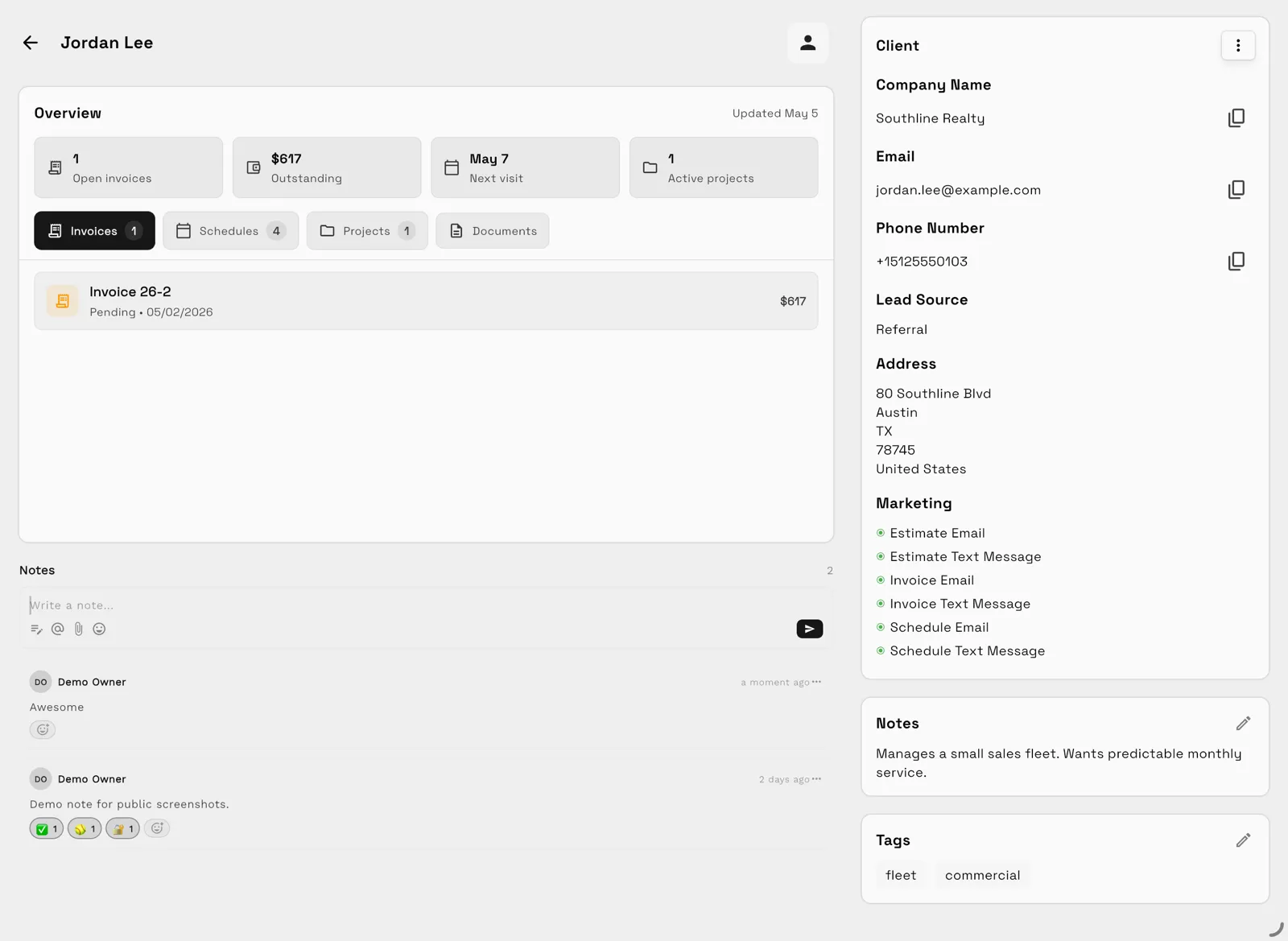
Workspace369 connects the client record to proposals that clients accept and sign by link, projects with task boards, a private client portal, time tracking and invoices. Its plan matrix also lists retainers and payment schedules, recurring invoices, deposits on acceptance and time-to-invoice on every plan. Cadet is $29 a month for one person ($23.25 billed yearly). The screenshot above is a demo record, not a customer result.
Limitations: Cadet allows up to 5 active projects and one seat; Voyager ($74 a month, two seats) removes the project cap and adds the shared inbox, SMS and calls. Payment plans, expenses and AR aging start at Specialist ($149 a month for ten seats), and credit notes are coming soon. The plan matrix does not list sales forecasting or a deals pipeline, so a pipeline-heavy practice may want a dedicated sales CRM. The 14-day trial needs a card.
Best for: solo consultants and small firms whose week goes on copying details between a CRM, a proposal tool and invoicing.
2. Bonsai, best for contract-led consultants who price per user
Bonsai lists CRM, time tracking and unlimited projects on Basic ($15 a month, $9 billed yearly per user). Essentials ($25 monthly, $19 yearly) adds invoices and payments, proposals and contracts, forms, scheduling, the client portal and expense tracking. Premium ($39 monthly, $29 yearly) adds a deals pipeline, custom fields and integrations with QuickBooks, Xero and Zapier. The trial is 7 days. If you run the engagement test, trial Essentials, since Basic cannot send the proposal or the invoice.
Limitations: the deals pipeline and accounting integrations sit on Premium, so the plan that matches a sales process costs about $29 per user a month billed yearly. A short trial leaves little time for a six-week test, so use demo dates.
Best for: independent consultants who lead with contracts and want to add colleagues one seat at a time.
3. HubSpot, best for free contact tracking and a path to a full sales suite
HubSpot's product page lists a free CRM with no expiry and no card, for up to 2 users and 1,000 contacts, with payment links included. Starter is $20 per seat a month at list price, with limited-time offers for new customers. If you run the engagement test, logging the referral, tracking follow-ups and sharing a payment link should fit the free tier. Budget time to check which paid hub covers your process as you grow.
Limitations: the page does not list invoicing, e-signature or projects, so delivery and billing live in other tools, and the cost rises as you add hubs and seats.
Best for: consultants who mainly need follow-up discipline and already have invoicing sorted.
4. Pipedrive, best for pipeline-first consultants
Pipedrive is built around customizable sales pipelines, with email and calendar sync, workflow automation, reporting and forecasting. Its page lists a 14-day free trial with no card required. Its plan prices were not shown on its page when we checked on October 14, 2026, and the page could not be read on October 22, 2026, so check the current per-seat prices and what each tier includes before comparing cost. If you run the engagement test, expect the discovery-call, follow-up and deal-stage steps to be strong.
Limitations: the page we reviewed did not list a client portal, time tracking or retainer invoicing, so delivery and billing would sit in other apps.
Best for: consultants who live on referrals and follow-up and want a visual deal pipeline.
5. HoneyBook, best for proposal, contract and payment workflows
HoneyBook's pricing page lists unlimited clients and projects, proposals and contracts, invoices and payments and a client portal on every plan. Starter is $29 a month billed yearly; Essentials is $49 and Premium $109. The 30-day trial needs no card. If you run the engagement test, the proposal, contract and payment steps should flow well. Check how it handles a mid-engagement scope change before you rely on it.
Limitations: Starter allows 2 lead forms, limits the Scheduler to 1 session and has no automations; Essentials allows up to 2 team members and unlimited team members start at Premium. Time tracking is not listed.
Best for: solo advisors who sell fixed-price packages and want signed, paid bookings.
6. Dubsado, best for form-heavy onboarding on yearly pricing
Dubsado lists Starter at $335 a year and Premier at $525 a year, both with unlimited clients and projects, invoicing and payment plans, and client portals. Three extra users are free. The 21-day trial gives full Premier access with no card. If you run the engagement test, trial Premier, because public proposals, workflows and advanced scheduling are Premier-only.
Limitations: Starter has one lead capture form and no public proposals or automated workflows. Only yearly prices are shown, and time tracking is not listed.
Best for: consultants with a repeatable onboarding process who will build forms and workflows once.
7. Zoho CRM, best for a free edition and deeper sales configuration
Zoho's pricing page lists a free edition for up to 3 users with no card, covering contact management, tasks, workflow automation and standard reports. Paid editions add multiple pipelines and forecasting from Standard ($14 per user a month billed yearly, $20 billed monthly), then customer portals on Professional ($23 yearly, $35 monthly) and approval processes on Enterprise ($40 yearly, $50 monthly). The paid trials are advertised without a stated length or card terms.
Limitations: the free edition lists standard reports only (unlimited reports start at Professional), and the page lists no invoicing or project delivery.
Best for: consultants who want configurable sales stages and are happy to assemble delivery and billing elsewhere.
Side-by-side comparison
| CRM | Entry price (monthly) | Billed yearly | Proposals and invoicing on entry plan | Main entry-plan gate | Trial |
|---|---|---|---|---|---|
| Workspace369 | $29 (Cadet) | $23.25 a month | Yes | 5 active projects, 1 seat | 14 days, card required |
| Bonsai | $25 (Essentials; Basic has no invoicing) | $19 per user a month | Yes, on Essentials | Deals pipeline on Premium | 7 days |
| HubSpot | Free | Free | Invoices and payment links; quotes need Revenue Hub Professional | 2 users, 1,000 contacts | Free plan, no card |
| Pipedrive | Not shown (Oct 14) | Not shown (Oct 14) | Not listed | Prices not verified | 14 days, no card |
| HoneyBook | $36 (Starter) | $29 a month (Starter) | Yes | 2 lead forms | 30 days, no card |
| Dubsado | $35 (Starter) | $335 a year (Starter) | Invoicing yes, public proposals on Premier | 1 lead form | 21 days, no card |
| Zoho CRM | Free edition (Standard $20) | Free (Standard $14 per user) | Not listed | 3 users on free | Paid trial terms not stated |
Which CRM fits your consulting practice?
| If you mostly need | Start with | Why |
|---|---|---|
| Discovery call to paid retainer in one tool | Workspace369 | Proposals, projects, portal, time tracking and retainers share one record from Cadet |
| Contracts and invoices priced per person | Bonsai | Proposals, contracts and invoicing on Essentials, per user |
| Free follow-up tracking | HubSpot free CRM | Free with 2 users and 1,000 contacts |
| A visual deal pipeline | Pipedrive | Built around pipelines and forecasting |
| Signed, paid fixed-price packages | HoneyBook | Proposals, contracts and payments on every plan |
| Detailed onboarding forms | Dubsado | Forms and workflows on Premier ($55 a month, $525 a year) |
| Configurable sales stages with a free start | Zoho CRM | Free edition for 3 users, paid tiers add pipelines |
Run a six-week engagement test during the trial
Feature lists look alike. Use a fictional discovery call that becomes a six-week consulting engagement, and run it in each tool you shortlist:
- Record the referral source, the objective and the decision-maker.
- Send a proposal with two milestones and agreed payment terms, and accept it as the "client".
- Assign a delivery owner and hand the engagement to a colleague with limited permissions.
- Halfway through, record a change request and show how you approve or decline it.
- Create the correct invoice, record a partial payment and find the next payment action.
- A day later, find all of that context by searching only the client's name.

Write down what you had to configure and which steps happened outside the product. Count the tab switches and retyped details. If you work alone, imagine returning from a week away with only the record to explain the next step. That count is a better buying signal than any table, including the ones above.
When a smaller change is enough
If follow-up is your only recurring problem, a focused CRM such as Pipedrive or HubSpot's free tier may fix it without replacing your delivery tools. If an accountant keeps your books, ask how the CRM fits that process: proposal acceptance, invoice issue, payment collection and reconciliation are separate events. Keep one source of truth for each, so a paid status matches the payment record and a reminder never chases a settled invoice. For the commercial detail, read the retainer fee software guide. For the paperwork side, see proposals and contracts with e-signature for freelancers, and for a team rather than a solo practice, the best CRM for a small consulting firm.

Whichever tool you trial, finish one full engagement with demo data before you import real clients, and confirm you can export your records if you ever leave. Compare current plans on the pricing page.
Sources reviewed for this guide
- Workspace369 pricingPlan matrix reviewed October 22, 2026.
- Bonsai pricingOfficial pricing page reviewed October 22, 2026 for per-user plan prices, features by plan and trial terms.
- HubSpot CRMOfficial product page reviewed October 22, 2026 for free CRM limits and card terms.
- HubSpot pricingOfficial pricing page reviewed October 22, 2026 for free CRM limits, the Starter list price ($20 per seat) and limited-time new-customer offers.
- Pipedrive pricingOfficial pricing page reviewed October 14, 2026 for trial terms and features; plan prices were not shown when we checked and are not quoted. The page could not be read on October 22, 2026 (access blocked), so these details were not rechecked.
- HoneyBook pricingOfficial pricing page reviewed October 22, 2026 for plans, team members, lead forms and trial terms.
- Dubsado pricingOfficial pricing page reviewed October 22, 2026 for monthly and yearly prices, plan limits, extra users and trial terms.
- Zoho CRM pricingOfficial pricing page reviewed October 22, 2026 for the free edition, feature tiers and per-user prices (monthly and billed yearly).
Workspace369 publishes this documentation-based comparison and is one of the options. It is not an independent ranking or a hands-on benchmark.
Run client follow-up in one workspace.
CRM, inbox, voice, invoicing, payments, projects, files, AI, and workflow automations — connected instead of exported.
14-day free trial. Card required. After the trial: from $29/month. Renews automatically every month until you cancel. Cancel anytime in Settings → Billing.