Best CRM for marketing agencies in 2026: sales, delivery and billing
For a small marketing agency, the best CRM is HubSpot or Pipedrive when the sales pipeline is the bottleneck, and Workspace369 when the work after the sale is: deals, projects, a client portal and invoices sit on one record, from $104 a month for five people. HubSpot's product page lists a free CRM for up to two users and 1,000 contacts (reviewed October 14, 2026).
Best CRM for marketing agencies of 2 to 20 people: six CRMs compared on price at 10 seats, plan gates, delivery and billing, with a retainer handoff test.
We make Workspace369 and list it first here. Weigh our ranking with that in mind, and if another tool fits you better, use it.

By Simon Dziak, Founder, Workspace369 · LinkedIn
Pricing a retainer before you choose? Try the free retainer calculator.
Disclosure and method: Workspace369 publishes this guide and is one of the options (what Workspace369 is). It is a documentation-based shortlist, not a hands-on benchmark. Official vendor pages were reviewed on October 14, 2026; HubSpot, Pipedrive and Productive prices were re-read on October 19, 2026. Check current plans with each vendor before you buy.
Key takeaways
- An agency CRM has to hand a won deal to the people doing the work: scope, owner, recurring fee and renewal date on one record, not just a pipeline.
- Workspace369 fits agencies of 2 to 20 people that want CRM, projects, time tracking, a client portal and invoicing together; Specialist covers 10 seats for $149 a month, and it does not run campaigns or ad accounts.
- HubSpot offers broad marketing and sales tooling, and its free CRM allows 2 users and 1,000 contacts; invoicing and project delivery are not listed on its product page.
- Productive and Teamwork are delivery-first tools: both list project, time and budget features; Productive lists deals and one pipeline from Essential, while Teamwork gates its CRM pipeline to Optimize.
- Run one fictional retainer client from won deal to second invoice in each trial, and note every point where a second person cannot find something.
Video roundup
Watch: the best CRM for small marketing agencies, ranked
Six CRMs ranked for small marketing agencies on projects, monthly retainers, team hours and client updates, with prices checked on each vendor page and Workspace369 shown in the real app.
Chapters
- 0:00Intro
- 0:13What an agency CRM needs after the sale
- 0:27#1 Workspace369 (best overall)
- 1:09Workspace369 price
- 1:20#2 GoHighLevel
- 1:40#3 HubSpot
- 1:58#4 monday CRM
- 2:14#5 Pipedrive
- 2:31#6 Zoho CRM
- 2:46Full ranking and free trial
Read the full transcript
Running a small marketing agency? We compared six CRMs on what an agency needs after the sale: the projects, the retainers, your team's hours, and keeping clients updated. Here's our ranking.
Most CRMs stop at the deal. An agency CRM should also run the projects, bill retainers every month, show where your team's hours go, and keep each client updated.
Number one: Workspace369. Leads from your website forms land in Requests, ready to become a client and a proposal.
Clients sign proposals online, and one click turns an accepted proposal into an invoice.
Then the work runs in the same app: projects with budgets, priority and progress, and task boards your team works from.
Retainers bill each client every month, for an hour bank or a fixed scope, and recurring invoices send themselves.
Your team tracks time against each client and project, and you see what's still unbilled.
And clients follow along in their own private portal, with their proposals, invoices and appointments.
It starts at twenty-nine dollars a month. Seventy-four dollars covers two seats with unlimited projects, and each extra teammate is ten dollars a month.
Number two: GoHighLevel. Starter is ninety-seven dollars a month for up to three client accounts, and texts, calls, email and AI are billed on top. Billing that usage back to your clients takes the two-hundred-ninety-seven-dollar plan, and its project management is still in private beta.
Number three: HubSpot. Its free CRM and Starter cover contacts and deals, but new customers can't send quotes on them anymore. Quotes and e-signatures need Revenue Hub Professional, at ninety-five dollars a seat a month on an annual contract.
Number four: monday CRM. Plans start at three seats, so one person on Basic pays fifty-four dollars a month. Basic caps quotes and invoices at twenty a month, has no automations, and leaves out client guests.
Number five: Pipedrive. It's priced per seat, from twenty-four dollars a month. E-signed proposals need Premium, at seventy-nine dollars a seat, or a paid add-on, and there's no built-in invoicing: invoices go through QuickBooks or Xero.
Number six: Zoho CRM. It's priced per user, and quotes and invoices start on Professional, at thirty-five dollars a user. E-signatures need a separate Zoho Sign subscription, from twelve dollars a user.
So here's the full ranking. Number one, Workspace369, best overall. Then GoHighLevel for funnels and resale, HubSpot for inbound marketing, monday CRM for custom boards, Pipedrive for sales pipelines, and Zoho CRM for the Zoho suite.
If your agency wants the leads, the projects, the retainers and the client updates in one place, Workspace369 is our pick. Try it free for fourteen days, and our team will help you set it up.
What's inside?
What a marketing agency CRM is (and what it is not)How we compared these CRMsThe best CRMs for marketing agencies in 2026Side-by-side comparisonWhich CRM fits your agency?Run a retainer handoff test during the trialCompare the full cost, including the work to switchMake the decision from one complete month
What a marketing agency CRM is (and what it is not)
A marketing agency CRM is the record of the agency's own clients and prospects: who the buyer is, what was agreed, who owns the account, what is due this month, what they owe and when the retainer renews. It is not the marketing stack you run for clients. Ad accounts, campaign tools and analytics belong to that work. It is also not a reporting dashboard: AgencyAnalytics, for example, describes itself as a reporting platform and its pricing page does not mention contacts, deals or a pipeline, so we left it out of the ranking.
The agency CRM overview explains how Workspace369 keeps account context across projects, proposals, conversations and invoices. For a broader shortlist across tasks and billing, see the agency CRM comparison; for search research and reporting tools, see the SEO agency stack guide.
How we compared these CRMs
Best CRM for Marketing Agencies 2026: Picks for SEO, PPC, Social & Content Agencies

We compared each tool on the same five points, using only the vendor's own pricing and product pages:
- Price for a 10-person team, using the listed yearly per-seat or plan price on October 14, 2026.
- Sales side: pipeline, contacts, and what the entry plan limits.
- Delivery and billing side: projects, time tracking, proposals and invoicing, and which plan they start on.
- Client portal and team permissions on the plan you would actually buy.
- Trial terms: length, and whether the vendor says a card is needed.
We did not test speed, support, reliability or integrations, and we did not use third-party ratings. Order reflects fit for a small agency that wants the whole client cycle in one tool.
The best CRMs for marketing agencies in 2026
1. Workspace369, best for agencies that want CRM, delivery and billing together
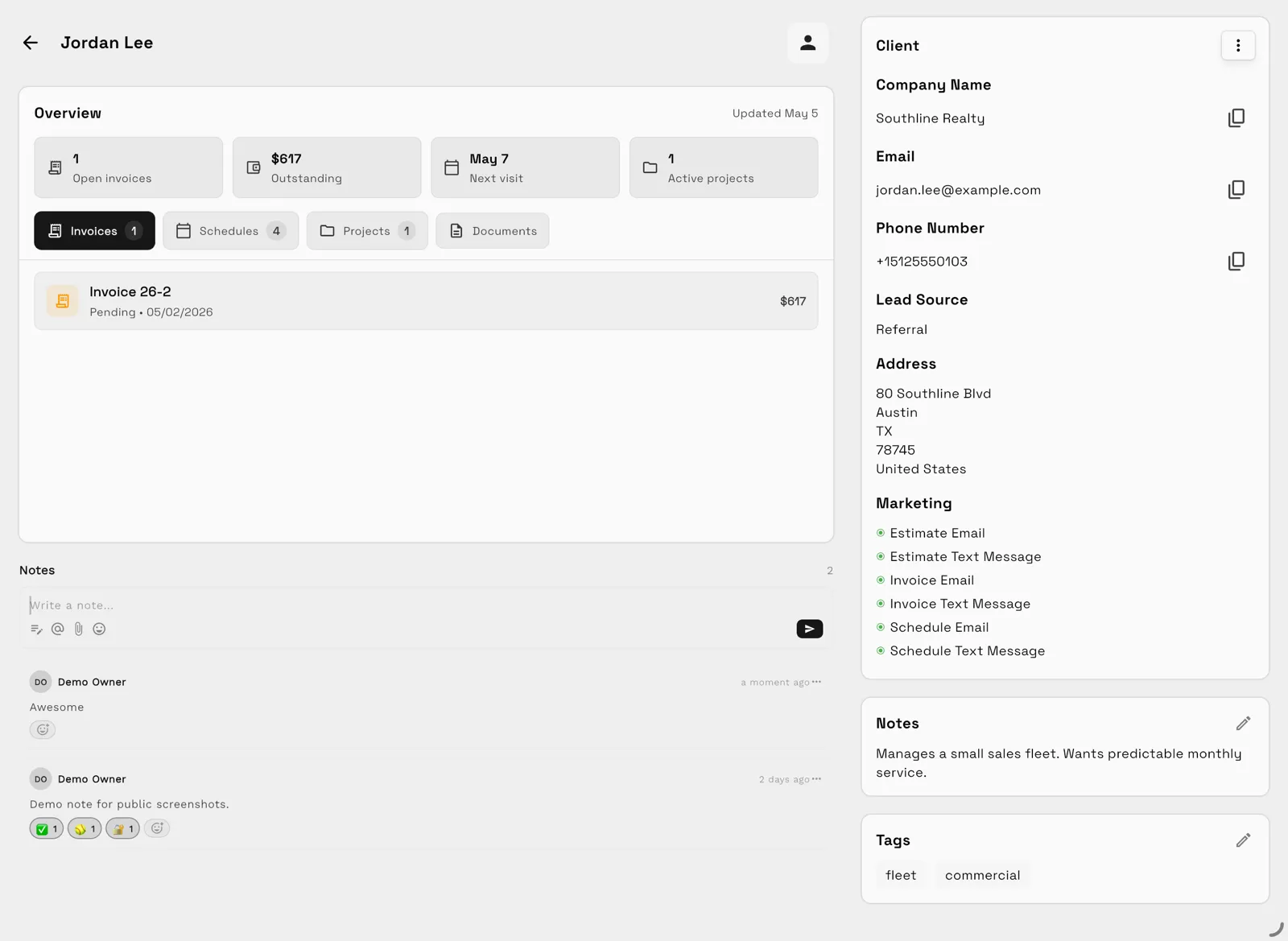
Workspace369 keeps the client record, proposals that clients accept and sign by link, projects with task boards, time tracking, a private client portal and invoices on one record. Every plan includes public intake forms (with UTM parameters captured in hidden fields), retainers and payment schedules, and recurring invoices, and records whether each request came from a form, funnel or page; lead-source tagging on clients starts on Voyager. For a team, Voyager is $74 a month for two seats and adds the shared inbox, SMS and calls; Specialist is $149 a month for 10 seats ($119.25 billed yearly) and adds project profitability, webhooks and API; Commander is $299 for 20 seats. Extra seats cost $10 a month from Voyager. The screenshot is a demo account, not an agency case study.
Limitations: it does not run campaigns, ad accounts or client analytics, so you keep specialist tools for that. Credit notes are coming soon, and Cadet is one seat with up to 5 active projects. The 14-day trial needs a card.
Best for: agencies of 2 to 20 people tired of copying details between a CRM, a project app and an invoicing tool.
2. HubSpot, best for marketing and sales tooling around the pipeline
HubSpot's product page lists a free CRM for up to two users and 1,000 contacts with no expiry and no card. Starter is $20 per seat a month at list price on HubSpot's pricing page (limited-time offers for new customers go below that), and adds required fields, permission sets, multiple currencies and removes HubSpot branding. Its CRM product page lists Professional from $50 per seat, adding custom reporting; Enterprise from $75 adds custom objects and single sign-on. If you run the retainer test, expect the deal, contact and email steps to be strong.
Limitations: the product page does not list invoicing, project delivery or time tracking, so the handoff to delivery and billing lives in other tools. Custom reporting starts at Professional, and per-seat cost rises quickly as the team grows.
Best for: agencies whose main problem is generating and qualifying leads, and who already have delivery and billing sorted.
3. Productive, best for delivery-first agencies that need budgets and resourcing
Productive's pricing page lists budgeting, resource planning, project and task management, time tracking, expense management and reporting on Essential. Professional adds recurring budgets, teams, rate cards and retainer invoicing, and invoices are listed on every plan. All plans need at least 3 seats, and the trial is 14 days with no card. Its features section lists a CRM with deals, companies, contacts and pipelines, with 1 pipeline on Essential and 3 on Professional. Essential is $10 per user a month billed yearly ($12 monthly) and Professional $25 ($29 monthly), checked October 19, 2026.
Limitations: the CRM is a deals pipeline (one on Essential, three on Professional), and invoices are on every plan while retainer invoicing starts at Professional. Ask before you rely on it for the sales side.
Best for: agencies that run on budgets, utilisation and resource plans and treat the pipeline as secondary.
4. Teamwork, best for project-led agencies with a larger team
Teamwork lists Basics at $13.99 per user a month billed monthly ($9.99 billed yearly) and Accelerate at $29.99 ($24.99 billed yearly), with a 14-day trial and no card. Its free plan allows up to 5 users and 5 projects. The pricing page lists a "CRM-pipeline-to-projects" feature, which turns a pipeline into project work, on the Optimize plan. If you run the retainer test, the project and task steps are the strength.
Limitations: the CRM pipeline is listed only from Optimize, which is quoted on request, and Accelerate lists only a HubSpot integration. A 10-person agency should price Optimize before shortlisting Teamwork as a CRM.
Best for: agencies that already manage delivery in a project tool and want the pipeline attached to it.
5. Copper, best for agencies that live in Google Workspace
Copper's pricing page lists Basic at $23 per seat a month billed yearly ($29 monthly), with pipelines, task automation and project management, and a 2,500-contact limit. Professional is $59 yearly ($69 monthly) with workflow automation, bulk email, reporting and 15,000 contacts; Business is $99 yearly ($134 monthly). The page lists Gmail, Google Calendar, Google Contacts and Google Drive integrations and says "Start free, no credit card required" without naming a trial length.
Limitations: invoicing, proposals and time tracking are not listed on the pricing page, so billing stays elsewhere. Workflow automation and reporting need Professional, which is more than double the Basic price per seat.
Best for: sales-led agencies that run on Gmail and want a focused pipeline with light project tracking.
6. Bonsai, best for proposal, contract and invoice workflows on a per-user budget
Bonsai's pricing page lists a CRM on Basic ($15 a month, $9 billed yearly). Proposals, contracts, invoices and payments, and the client portal start at Essentials, $25 a month or $19 billed yearly per user. The trial is 7 days, after which you enter card details to continue. If you run the retainer test, the proposal and invoice steps sit naturally in the Essentials flow; check how far project delivery goes for a team.
Limitations: pricing is per user, so cost grows with every teammate, and the pages we reviewed do not list marketing automation or team capacity planning. Basic has the CRM but not proposals or invoicing.
Best for: small agencies that sell on proposals and contracts and want to add teammates one seat at a time.
Side-by-side comparison
| CRM | Entry price | 10-seat cost (yearly billing) | Delivery and billing on entry plan | Key gate | Trial |
|---|---|---|---|---|---|
| Workspace369 | $29 (Cadet, 1 seat) | $119.25 a month (Specialist) | Projects, time, portal, invoices | Cadet: 5 active projects; credit notes coming soon | 14 days, card required |
| HubSpot | Free; Starter $20 per seat (list) | About $200 a month at the Starter list price | Not listed | Custom reporting from Professional ($50 per seat) | Free CRM, no card |
| Productive | From $10 per user (yearly; $12 monthly) | $100 Essential or $250 Professional | Time, budgets, projects; invoices on all plans | 1 deals pipeline on Essential, 3 on Professional; 3 seats minimum | 14 days, no card |
| Teamwork | $9.99 per user (Basics) | About $100 a month (Basics) | Projects and tasks | CRM pipeline only on Optimize, on request | 14 days, no card |
| Copper | $23 per seat (Basic) | $230 a month | Light project management | Automation and reporting from Professional | Not stated, no card |
| Bonsai | $19 per user (Essentials) | $190 a month | Proposals, invoices, portal | Per-user pricing | 7 days, card to continue |
The 10-seat column is simple arithmetic from listed per-seat prices; it excludes taxes, add-ons and plan changes. Teamwork Basics lacks the CRM pipeline, so it is not a like-for-like comparison.
Which CRM fits your agency?
| If you mostly need | Start with | Why |
|---|---|---|
| Deal to delivery to invoice in one tool, with a client portal | Workspace369 | Proposals, projects, time, portal and invoices share one record |
| Lead generation, marketing automation and a deep pipeline | HubSpot | Free CRM, with paid tiers for reporting and permissions |
| Budgets, utilisation and resource planning | Productive | Budgeting and resource planning on Essential |
| A project tool with the pipeline attached | Teamwork | Pipeline-to-projects, priced on request |
| A Gmail-based sales pipeline | Copper | Google integrations and pipelines on Basic |
| Proposals, contracts and invoices per user | Bonsai | Those steps start at Essentials |
Run a retainer handoff test during the trial
Feature lists look alike. Use a fictional client that buys a monthly campaign package, and have one person create the deal while another takes over delivery.
- Find the signed-off proposal or agreed commercial terms.
- Locate the work due this month and its owners.
- Record an extra landing page request separately from the original scope.
- Find the latest client conversation without asking the salesperson.
- Check the invoice and decide who follows up if it is unpaid.
- Prepare a renewal conversation using both delivery and billing context.
If you run the test, expect the second person to expose the gaps fastest. Note whether each missing step needs a higher plan, an integration, a configured workflow or a person. Use the agency onboarding worksheet to turn the exercise into an owned handoff, and keep credentials out of it.

Also test permissions with separate demo users. A strategist may need client context without authority to change billing, and a contractor may need tasks without seeing every account. Workspace369 lists roles and client-scoped access on every plan; ask each other vendor the same question, and check what happens to shared links when access is removed.
Compare the full cost, including the work to switch
Request a quote for the same team size, billing period and modules from each vendor. A yearly price shown per month is not a month-to-month subscription. Add migration time, software you will keep and paid integrations. A bundle is only cheaper when it replaces costs you already pay. Workspace369 charges a one-time $50 carrier setup when you claim dedicated SMS or voice numbers; see the current feature matrix.

Make the decision from one complete month
If your pipeline is the only broken process, trial a focused sales CRM first. If marketing automation is the driver, evaluate HubSpot at the tier you need. If client administration is scattered across otherwise adequate tools, test a connected workspace. Start with CRM, connect the agreed work in Projects and see Communications for SMS and calls, which begin at Voyager.
Keep a written record of what worked, what needed configuration and what stayed manual. That record, not a vendor's place in a list, should drive the choice. For service pricing rather than software pricing, use the agency pricing evidence review.
Sources reviewed for this guide
- Workspace369 pricingPlan matrix reviewed October 14, 2026.
- HubSpot CRMOfficial product page reviewed October 14, 2026 for free CRM limits and Starter, Professional and Enterprise per-seat prices.
- HubSpot pricingOfficial pricing page reviewed October 18, 2026 for the Starter list price ($20 per seat) and limited-time new-customer offers.
- Pipedrive pricingOfficial pricing page reviewed October 19, 2026 with the billed-annually and billed-monthly views for Lite and Growth seat prices.
- Productive pricingOfficial pricing page reviewed October 19, 2026 for plan features, pipeline limits, minimum seats and trial terms.
- Teamwork pricingOfficial pricing page reviewed October 14, 2026 for plan prices, trial terms and the CRM pipeline feature.
- Copper pricingOfficial pricing page reviewed October 14, 2026 for monthly and yearly seat prices, contact limits and plan features.
- Bonsai pricingOfficial pricing page reviewed October 14, 2026 for plan prices, trial terms and where proposals, invoicing and the portal start.
- AgencyAnalytics pricingOfficial pricing page reviewed October 14, 2026 to confirm it is a reporting platform, not a CRM.
Workspace369 publishes this documentation-based comparison and is one of the options. It is not an independent ranking or a hands-on benchmark.
Run client follow-up in one workspace.
CRM, inbox, voice, invoicing, payments, projects, files, AI, and workflow automations — connected instead of exported.
14-day free trial. Card required. After the trial: from $29/month. Renews automatically every month until you cancel. Cancel anytime in Settings → Billing.