Best proposal software in 2026: from first draft to signed and paid
Six proposal tools compared on price, entry-plan limits and trial terms, with a use-case table and a send-sign-invoice test you can run in a free trial.

By Simon Dziak, Founder, Workspace369 · LinkedIn
The best proposal software gets a client from a clear scope to a signed yes and a first payment without you retyping anything. For freelancers who want the accepted proposal to flow into a deposit, project and invoice, our pick is Workspace369. HoneyBook and Bonsai are strong client-work platforms, while Better Proposals, Qwilr and Proposify go deeper on document design and analytics. Need a quick scope document first? Start with the free estimate template.
Disclosure and method: Workspace369 publishes this guide and is one of the options. It is a documentation-based shortlist, not a hands-on benchmark. Official vendor pages were reviewed on October 14, 2026. Check current plans with each vendor before you buy.
Key takeaways
- Good proposal software gets a client from a clear scope to a signed acceptance and a first payment without you retyping anything.
- Workspace369 fits freelancers who want the accepted proposal to flow into a deposit, project and invoice on one client record from $29 a month; Cadet is capped at 5 active projects and one seat.
- Proposify, Qwilr and Better Proposals are document-first tools with deeper design and analytics options; Proposify and Better Proposals Starter list 10 sends a month.
- HoneyBook lists proposals, contracts, invoices and a client portal on its $29 Starter plan; Bonsai's Basic plan leaves out proposals and invoices, which start at Essentials.
- Send one realistic proposal to yourself in each trial, sign it, collect a deposit and time the whole run.
What's inside?
What proposal software is (and what it is not)How we compared these proposal toolsThe best proposal software in 2026Side-by-side comparisonWhich proposal software fits your business?Run a send-sign-invoice test during the trialWhen to choose a document-first tool
What proposal software is (and what it is not)
Proposal software builds the offer, sends it by link, records the client's acceptance and shows you whether it was opened. It is not a contract-law service, and it is not a full accounting package. Some tools stop at the signature. Others carry on into the deposit, the project and the invoice. If a tool handles the scope, price and signature but leaves you to rebuild the invoice by hand, the proposal is only half done. For the wider picture, see proposal software for freelancers.
How we compared these proposal tools
We compared each tool on the same five points, using only the vendor's own pricing pages:
- Entry price for one person, as listed on October 14, 2026.
- Send or document limits on the entry plan.
- What happens after acceptance: whether invoicing and payment sit on the same plan.
- Seat and plan gates: who can send, and which features start higher up.
- Trial terms: length, and whether the vendor says a card is needed.
We did not test template quality, signing speed, support or reliability, and we did not use third-party ratings. Order reflects fit for a freelancer or small agency who wants the proposal connected to billing.
The best proposal software in 2026
1. Workspace369, best for freelancers who want the proposal connected to the deposit and invoice
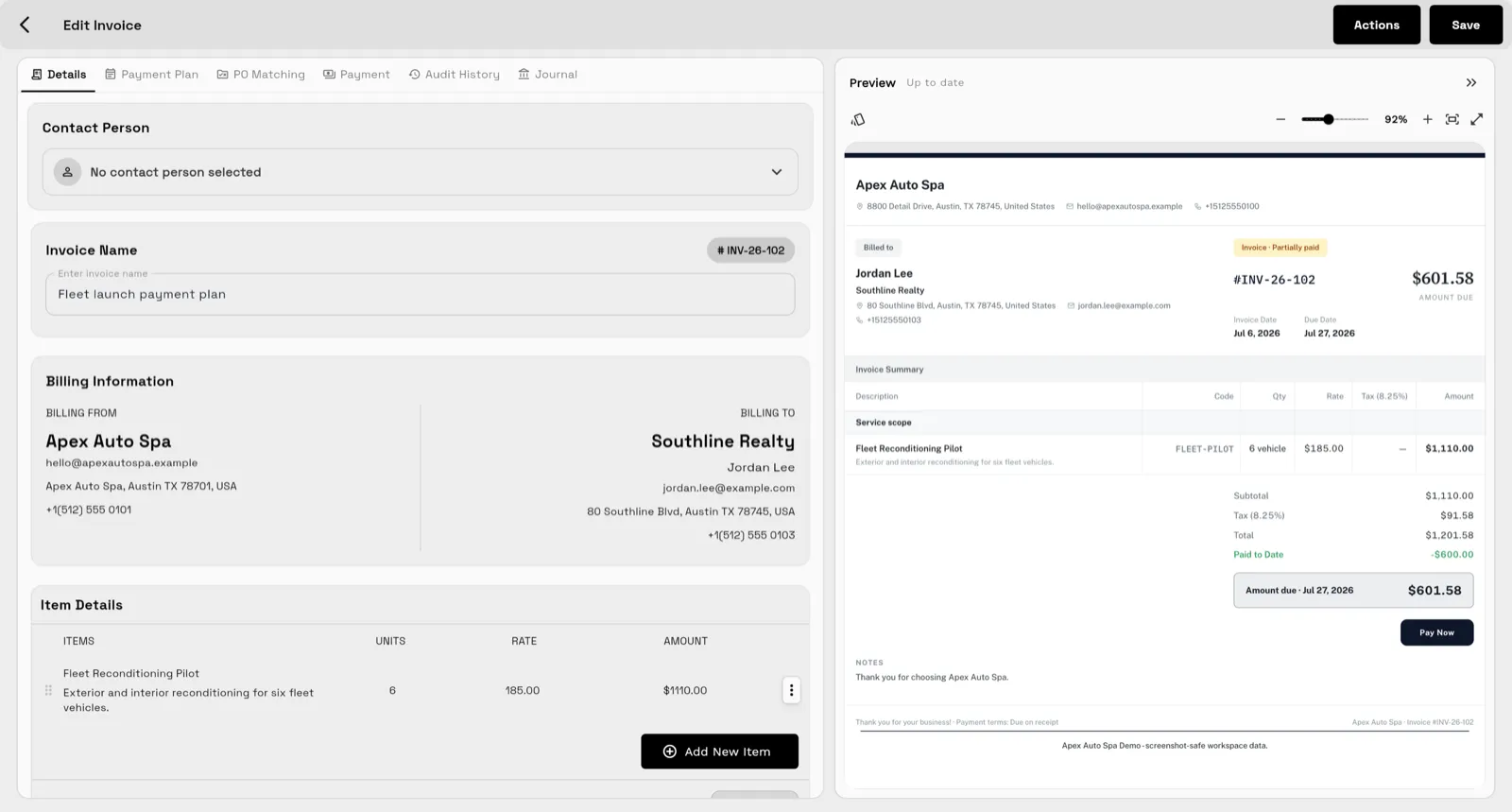
Workspace369 builds proposals and quotes from a saved catalog, lets clients accept and sign through a public link, and shows you when they open and engage with the proposal. A deposit can be collected at acceptance, and the accepted proposal converts into an invoice in one step. All of that is on Cadet, $29 a month for one person ($23.25 a month billed yearly), alongside the client portal, time tracking and intake forms. The screenshot above is a demo invoice, not a customer result.
Limitations: Cadet runs up to 5 active projects and one seat; Voyager ($74 a month, two seats) removes the project cap, and Specialist ($149 a month, ten seats) adds payment plans. It does not offer the deep content libraries and design controls of document-first tools, and the 14-day trial needs a card.
Best for: freelancers and small studios who lose time after the client says yes.
2. HoneyBook, best for service businesses that want proposals, contracts and payments together
HoneyBook's pricing page lists Starter at $29 a month billed yearly, with proposals, contracts, invoices and payments, a client portal, unlimited clients and projects, and up to 2 live lead forms. Essentials is $49 and Premium $109, both billed yearly. The page says you can try nearly every feature free for 30 days with no card required. If you run the test below, expect the proposal, contract and payment steps to sit in one flow.
Limitations: Starter has no scheduler, automations or QuickBooks Online integration, and the "Powered by HoneyBook" label stays. Team members start at Essentials (up to 2), and the page lists no monthly-billing prices.
Best for: photographers, planners and consultants who turn inquiries into signed, paid bookings.
3. Bonsai, best for contract-led freelancers who want per-user pricing
Bonsai prices per user. Basic is $15 a month ($9 billed yearly), but proposals, contracts, invoices, payments, scheduling and the client portal start at Essentials, $25 a month ($19 billed yearly). The trial gives full access for 7 days, and the page says you must choose a plan and add card details afterward if you have not already. If you run the test below, trial Essentials, since Basic cannot send the proposal or the invoice.
Limitations: Basic covers time tracking, tasks and a CRM only, so most freelancers need Essentials. Some features on the page are marked as expected in 2026, so check what is live today.
Best for: solo freelancers who want proposals, contracts and billing priced per seat.
4. Better Proposals, best for a proposal-first tool with unlimited seats from Premium
Better Proposals lists three plans per user: Starter from $13 (the page also shows $19; confirm at checkout), Premium at $21 (also $29) and Enterprise at $42 (also $49). The page does not say which figure is monthly and which is yearly, and says the annual option saves up to 35%. Starter has 1 seat and 10 sends a month, Premium has unlimited seats and 50 sends, and the trial is 14 days with no card required. If you run the test below, confirm which price you are quoted at checkout.
Limitations: Starter has no custom domain, CRM integrations or API access, branding removal needs Premium, and the 10-send cap is tight for active sellers. We did not find invoicing in its listed plan features.
Best for: freelancers and small agencies that send designed proposals and handle invoicing elsewhere.
5. Qwilr, best for interactive, web-style proposals with analytics
Qwilr Starter is $35 per user a month billed yearly, or $49 monthly, with e-sign, analytics, QwilrPay and HubSpot, Zoho and Pipedrive integrations. Yearly Starter includes 40 free documents, and extra documents are $2.50 each. The trial is 14 days of Starter, and the page says no credit card is required. If you run the test below, check how the document allowance fits your real send volume.
Limitations: Growth ($55 per user) needs 5 users and Scale ($75) needs 10, and both are yearly only. Monthly Starter includes no free documents, and Starter support is help documents only.
Best for: sales-minded freelancers and agencies that want a designed, trackable proposal page and already have a CRM.
6. Proposify, best for template libraries and larger proposal teams
Proposify's Build plan is $49 per user a month, or $35 per user billed yearly ($420 a year). Grow is $325 a month billed yearly with 5 users, and Scale is $1,066 a month billed yearly with 10. Unlimited documents and signatures are listed on all plans, with sends metered: the Basic send tier includes 10 a month at $0.50 per extra send. The 14-day trial needs no card, according to the page.
Limitations: Collaborator seats cannot create or send, Salesforce and Aspire integrations cost $9 per user a month each, and we did not find invoicing in its listed plan features.
Best for: agencies that send many proposals and need content libraries, approvals and role controls.
Side-by-side comparison
| Tool | Entry price | Entry-plan limit | Invoicing on entry plan | Trial |
|---|---|---|---|---|
| Workspace369 | $29 a month ($23.25 billed yearly) | 5 active projects, 1 seat | Yes | 14 days, card required |
| HoneyBook | $29 a month billed yearly | 2 live lead forms, no automations | Yes | 30 days, no card |
| Bonsai | $15 ($9 yearly) Basic; $25 ($19 yearly) Essentials | Basic has no proposals or invoices | Essentials and up | 7 days, card after trial |
| Better Proposals | $13 or $19 per user (not labeled) | 1 seat, 10 sends a month | Not listed | 14 days, no card |
| Qwilr | $35 per user yearly, $49 monthly | 40 documents on yearly Starter | Not listed | 14 days, no card |
| Proposify | $49 per user monthly, $35 yearly | 10 sends a month on Basic send tier | Not listed | 14 days, no card |
Which proposal software fits your business?
| If you mostly need | Start with | Why |
|---|---|---|
| Proposal, deposit and invoice on one client record | Workspace369 | Catalog proposals, signing by link, deposit at acceptance and one-step invoice on Cadet |
| Proposals plus contracts for bookings | HoneyBook | Proposals, contracts, invoices and portal on Starter, 30-day trial |
| Per-seat pricing with contracts and invoices | Bonsai | Essentials adds proposals, invoices and portal at $19 a month yearly |
| Designed proposals sent from your own CRM | Better Proposals | Proposal-first plans, unlimited seats from Premium |
| Interactive web-style proposals | Qwilr | Analytics and QwilrPay on Starter |
| Large template libraries and approvals | Proposify | Content libraries, unlimited documents, role controls on higher tiers |
Run a send-sign-invoice test during the trial
Feature lists look alike, so use the free trial to send one realistic proposal to yourself, using a second email address as the client:
- Build a proposal with two services and one optional add-on.
- Send it and open it on your phone as the client.
- Accept and sign it through the link.
- Collect a deposit, or turn the accepted proposal into an invoice.
- Check what the client record now shows: the proposal, the signature, the invoice and the payment status.
Time the whole run. If you run the test, expect a tool that needs three exports and 20 minutes to take that long on every deal. Need to chase a quiet client afterward? Try the proposal follow-up generator.

When to choose a document-first tool
Look at your last ten proposals. If most of the effort went into writing and designing them, a dedicated tool such as Qwilr, Better Proposals or Proposify is the better lever. If most of it went into what came after (chasing the signature, creating the invoice, asking for the deposit), pick software that connects the proposal to billing. Workspace369 builds on online payments and deposits for exactly that case.
Whichever tool you trial, send your first proposal to yourself before a real client sees it, and confirm you can export your records if you ever leave. Compare current plans on the pricing page.
Research record
Sources reviewed for this guide
- Workspace369 pricingPlan matrix reviewed October 14, 2026.
- Proposify pricingOfficial pricing page reviewed October 14, 2026 for plan prices, send limits and trial terms.
- Better Proposals pricingOfficial pricing page reviewed October 14, 2026 for plan prices, send limits and trial terms.
- Qwilr pricingOfficial pricing page reviewed October 14, 2026 for plan prices, document allowances and trial terms.
- HoneyBook pricingOfficial pricing page reviewed October 14, 2026 for plans, Starter limits and trial terms.
- Bonsai pricingOfficial pricing page reviewed October 14, 2026 for Basic and Essentials features and trial terms.
Workspace369 publishes this documentation-based comparison and is one of the options. It is not an independent ranking or a hands-on benchmark.
Put it into practice
Run client follow-up in one workspace.
CRM, inbox, voice, invoicing, payments, projects, files, AI, and workflow automations — connected instead of exported.