Best CRM for Wedding Videographers 2026: Edits, Retainers
Best CRM for wedding videographers: six client-work tools compared on price, contracts, retainers, payment schedules and edit-round tracking.
We make Workspace369, which is on this list. Weigh our ranking with that in mind.

By Simon Dziak, Founder, Workspace369 · LinkedIn
The best CRM for wedding videographers depends on the studio. Studio Ninja fits a solo or small film studio that wants wedding paperwork at a low price, HoneyBook suits studios that sell other services too, Dubsado suits custom workflows, and Workspace369 suits studios that bill edit hours. None builds shot lists or film delivery.
For the wider wedding question, see our best CRM for wedding photographers guide. To size your retainer first, use the free deposit calculator.
Disclosure and method: Workspace369 publishes this guide and is one of the options, and we rank it sixth of six because it has no wedding templates, timeline builder or gallery. It is a documentation-based shortlist, not a hands-on benchmark. Official vendor pages were reviewed on October 25, 2026. Check current plans with each vendor before you buy.
Key takeaways
- None of the six tools has a shot-list builder, edit timeline or video review player: a CRM covers the booking, retainer and payment side, and the edit and film delivery stay in your video tools.
- Studio Ninja lists contracts, questionnaires, quotes, invoices, a client portal and payment schedules on every plan, at $16, $27 and $40 a month on its monthly view ($160, $270 and $400 a year), with a 7-day trial and no card; its page names videographers among its users.
- HoneyBook is $29, $49 and $109 a month billed yearly ($59 and $129 billed monthly for Essentials and Premium; Starter monthly: see site) and lists a 30-day trial with no card; Dubsado is $335 and $525 a year (its page text shows no monthly prices) with a 21-day no-card trial.
- Workspace369 Cadet is $29 a month ($23.25 billed yearly) for one seat and 5 active projects; it has no wedding templates, timeline builder or gallery, so it ranks last here, but its task boards, subtasks and billable time suit tracking edit rounds.
- Test each trial with one fictional couple booked 14 months out: retainer, dated payment schedule, questionnaire, an edit task per deliverable and a billed second revision round.
What's inside?
What a CRM for wedding videographers is (and what it is not)How we compared these toolsThe best CRM for wedding videographers in 2026Side-by-side comparisonWhich tool fits your studio?Workspace369 in action for a wedding edit and its revision roundsRun a revision-round test during the trialWhen to keep it simple
What a CRM for wedding videographers is (and what it is not)
A wedding film runs on a long, uneven timeline: a booking 12 to 18 months out, a retainer, a questionnaire about the ceremony and the music, a second shooter, a wedding day, and then weeks or months of editing with one or two revision rounds before the final film. A CRM for videographers keeps the paperwork and money on that timeline in one record. It is not an editor, a raw-footage store or a review player, and none of these tools replaces them. The useful question is whether the record still shows, months after the shoot, what was promised, what is paid and which edit round you are on.
The photography angle (galleries, albums, venue-change paperwork) is covered in the photographers guide, so this one stays on the film workflow. The CRM for wedding videographers page shows the Workspace369 view.
How we compared these tools
We compared each tool on the same five points, using only the vendor's own pricing and product pages:
- Entry price, as listed on October 25, 2026, with the billing view named (monthly or billed yearly).
- Contracts and questionnaires: whether the page names contracts, forms or questionnaires, and quotes or proposals.
- Retainer and payment schedule: online payments, deposits and dated instalments for a long lead time.
- Plan caps: active job or project limits and seat counts for a studio with a second shooter and an editor.
- Trial terms: length, and whether the vendor says a card is needed.
We did not test speed, support, mobile apps, email deliverability or data export, and we used no third-party ratings. No page names shot lists, edit timelines or revision tracking, so we judged those from the general features (tasks, files, custom fields) and say so below. Iris Works and Sprout Studio were left out because their pricing pages did not show readable prices for us on October 18. Order reflects fit for a one-to-five-person film studio that wants wedding-ready paperwork.
The best CRM for wedding videographers in 2026
1. Studio Ninja, best for wedding paperwork at a low monthly price
Studio Ninja lists Starter, Pro and Master at $16, $27 and $40 a month on its monthly view, or $160, $270 and $400 a year on its yearly view. Every plan names quotes, invoices, contracts, questionnaires, a client portal, online payments, payment schedules and payment reminders, with sample contract, questionnaire and workflow templates. The page counts videographers among its community. The trial is 7 days, free, with no credit card, and it migrates current and future jobs at no cost once you subscribe.
Limitations: Starter allows 1 user and 5 active jobs, which a film studio with a full calendar can fill, and the page does not describe video-specific job types. Its plan card lists Workflow Automation for Starter while the comparison table marks it not included, so confirm before choosing Starter; Pro ($27, 3 users, unlimited jobs) is the safer base. It is built around photography, and several of its integrations are photo-gallery tools.
Best for: a solo or two-person film studio that wants contracts, questionnaires and payment schedules on every plan.
2. HoneyBook, best for studios that also sell other services
HoneyBook lists Starter at $29 a month billed yearly (its monthly price is not in the page text, so see site), Essentials at $49 ($59 monthly) and Premium at $109 ($129 monthly). Starter includes unlimited clients and projects, proposals and contracts, invoices and payments, a client portal and up to 2 live lead forms. Automations, SMS reminders, up to 2 team members and unlimited Scheduler sessions (Starter allows 1) start at Essentials. Its feature table also lists forms and questionnaires, payment plans and a Pic-Time integration, and its navigation lists a photo and video services segment. The FAQ gives a 30-day free trial with no credit card.
Limitations: the automation a long wedding timeline leans on starts at Essentials ($49 billed yearly), and it is a general small-business tool without video job types.
Best for: studios that sell weddings plus corporate films, events or other services and want one tool for all of it.
3. Dubsado, best for building your own workflow
Dubsado lists Starter at $335 a year and Premier at $525 a year; its page text shows no monthly prices, so see site for those. Both plans include unlimited projects and clients, invoicing and payment plans, client portals, form and email templates and calendar connection. Premier adds scheduling, automated workflows, public proposals, unlimited active lead forms (Starter has 1) and Zapier. The page gives 3 additional users free, then $25 a month for 4 to 10 users, and extra brands at $10 a month. The 21-day trial gives full Premier access, and the page says no credit card info is required.
Limitations: the workflows that would send questionnaire and revision-round reminders are on Premier, and it takes setup time to build your templates. On yearly billing Starter ($335 a year) costs more than Studio Ninja Pro ($270 a year) and Workspace369 Cadet ($23.25 a month billed yearly, about $279 a year).
Best for: studios that want to design an onboarding and delivery sequence step by step and will pay for Premier.
4. 17hats, best for a single all-inclusive plan
17hats shows one all-inclusive plan at $60 a month, $600 a year or $800 for two years, with a 7-day free trial. The page describes it as covering organizing and automating the client experience. Its comparison grid in the page HTML names invoices, quotes, contracts, questionnaires and payment schedules, but it still shows older tier names the visible plan section no longer uses, so confirm what is included. The visible text does not state whether a card is needed, and the page lets you restart a trial once it ends. Add-ons such as bank connect and extra users or brands cost extra.
Limitations: at $60 monthly ($50 a month equivalent on the $600 yearly price) it has the highest list entry price of the six (the page also shows a first-year sale), with no cheaper starter tier shown, and the older grid mentions document limits per month.
Best for: a solo studio that wants one price covering everything and can commit to a year.
5. VSCO Workspace (formerly Táve), best if you also shoot stills
VSCO Workspace is a photography studio manager. Its page lists scheduling, automations, two-way texting in the U.S. and Canada, quotes, invoicing, contracts pre-filled with questionnaire responses and a client portal. Workspace comes with VSCO One at $41.67 a month, billed annually, with a 30-day risk-free try. The page offers free migration in about 48 business hours, longer for larger studios, plus one-on-one training. For a studio that shoots both stills and film, that migration help can matter when you are moving years of couples out of another system.
Limitations: its copy speaks to photographers and event pros and never describes video work, so nothing on the page describes film jobs, edit stages or revision rounds. The price is the VSCO One bundle billed annually, with editing tools aimed at stills, so a film-only studio pays for a bundle it may not use.
Best for: a studio that shoots photo and film and wants deep photography automation and reporting.
6. Workspace369, best when edit rounds and billing sit in a general client-work tool
Workspace369 puts the client record, Proposals with approval and signing, deposit on acceptance, retainers and payment schedules, a client portal, intake forms and invoices in one place. Projects have stages, task boards and subtasks, so a wedding can carry one task per deliverable and a subtask per revision round. Time tracking and billable time are on every plan, so a round beyond the package can be logged and invoiced. Cadet is $29 a month for one seat ($23.25 billed yearly). The screenshot below is a demo record, not a customer result.
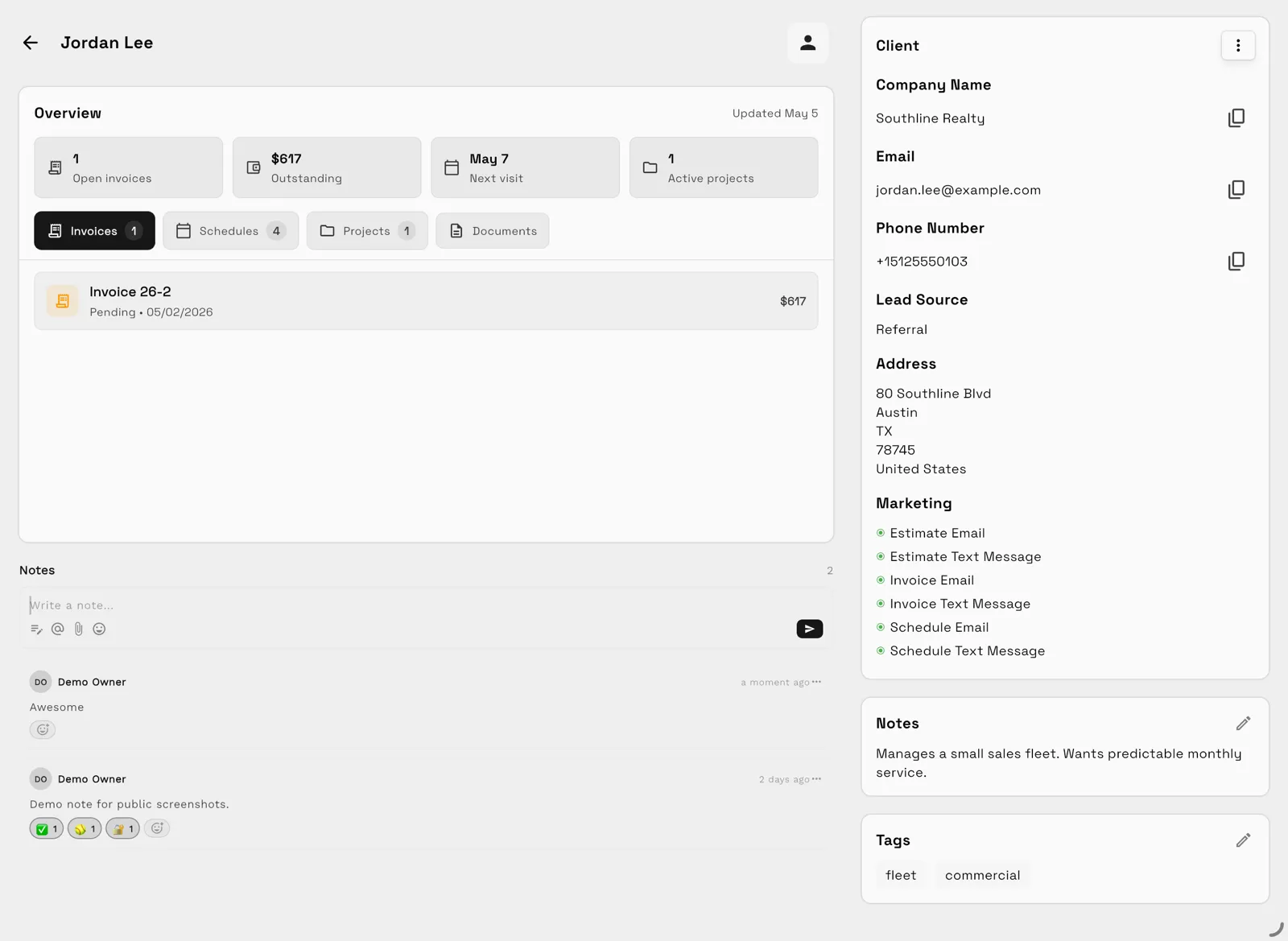
Demo data, not a customer outcome.
Limitations: it has no wedding contract or questionnaire templates, no shot-list or timeline builder and no video delivery or review, so you would build the brief with intake forms and client custom fields and deliver films elsewhere. Cadet allows 5 active projects, which a calendar booked 12 to 18 months ahead can exceed; Voyager ($74 a month, $59.25 yearly) has unlimited projects and 2 seats, and costs more than Studio Ninja Pro ($27 a month), HoneyBook Starter ($29 billed yearly) and Dubsado Starter ($335 a year). Online booking and payment plans (instalments on one invoice) start at Specialist ($149). The 14-day trial needs a card.
Best for: a studio that also bills editing hours or retainer work and wants proposals, task boards and invoices together, with wedding documents kept elsewhere.
Side-by-side comparison
| Tool | Entry price | Wedding paperwork | Trial | Main limit |
|---|---|---|---|---|
| Studio Ninja | $16 per month ($160 yearly) | Contracts, questionnaires, payment schedules on all plans | 7 days, no card | Starter: 1 user, 5 active jobs |
| HoneyBook | $29 per month billed yearly (monthly: see site) | Proposals, contracts, invoices; forms in feature table | 30 days, no card | Automations start at $49 |
| Dubsado | $335 per year (monthly: see site) | Payment plans, forms, portals; workflows on Premier | 21 days, no card | Setup time; Premier for automation |
| 17hats | $60 per month ($600 yearly) | Grid names contracts, questionnaires, payment schedules | 7 days | Highest list entry price of the six |
| VSCO Workspace | $41.67 per month, billed annually | Contracts, questionnaires, quotes | 30-day risk-free try | Annual billing, photo-first |
| Workspace369 | $29 per month ($23.25 yearly) | Proposals, retainers, schedules, portal; no wedding templates | 14 days, card required | 1 seat, 5 projects on Cadet |
Which tool fits your studio?
| If you mostly need | Start with | Why |
|---|---|---|
| The lowest entry price with wedding paperwork | Studio Ninja | Contracts and payment schedules from $16 monthly |
| Weddings plus other services in one tool | HoneyBook | Proposals and contracts from $29 billed yearly |
| A custom onboarding and delivery sequence | Dubsado | Workflows and scheduling on Premier |
| One flat price for everything | 17hats | One plan at $60 a month |
| Edit-round tasks and billable hours with invoices | Workspace369 | Task boards, subtasks and billable time on every plan |
| Photo and film under one studio manager | VSCO Workspace | Photography-first automation |
Workspace369 in action for a wedding edit and its revision rounds
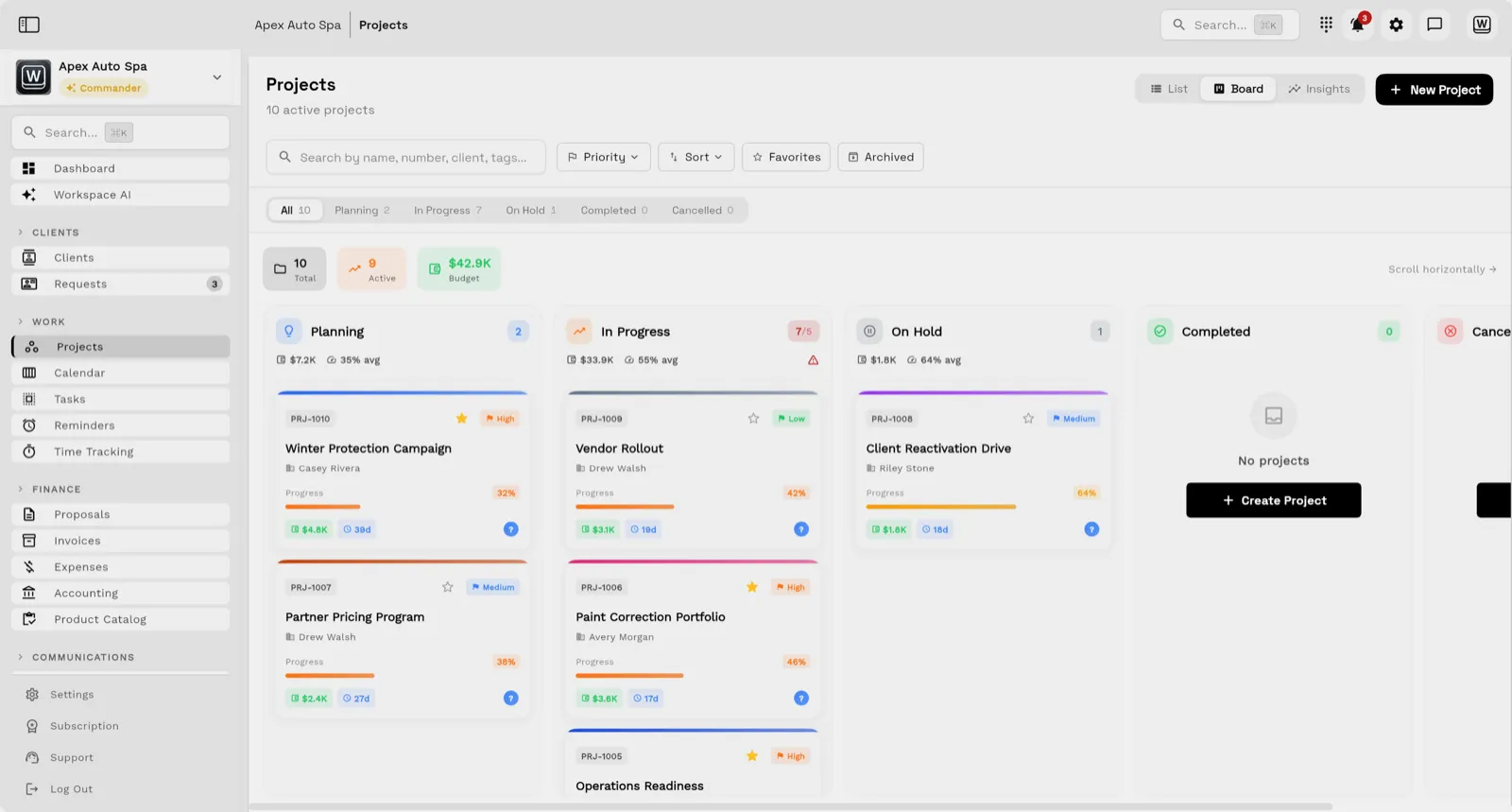
Once a couple has paid the retainer, the work in Workspace369 sits on a project and an invoice. The first screenshot is the projects board in a demo workspace with sample data (an auto-detailing business, on the Commander plan, showing 10 active projects). Planning, In Progress and On Hold columns hold cards with a progress bar and a budget, so a film like "Rivera wedding, highlight edit" would sit in a stage column. Each deliverable can be a task with a subtask per revision round, and a round beyond the package can be logged as billable time with time tracking.
The second screenshot is the invoice editor in the same demo workspace: billing details, line items and a live preview with a Pay Now button. It shows a partly paid invoice, which is how a second-round charge would look next to a retainer already paid. The couple sees the invoices and your Proposals in the client portal.
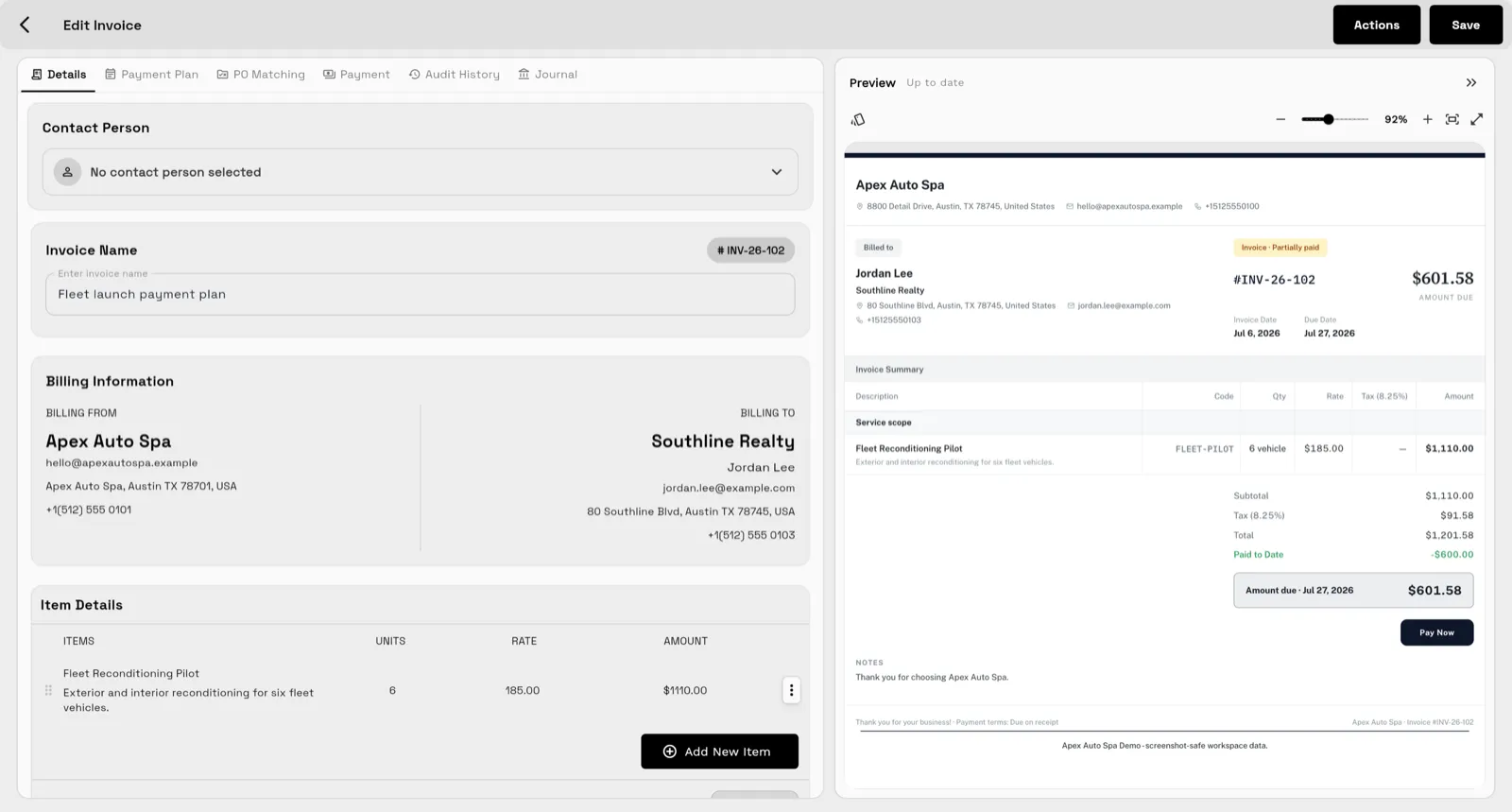
Workspace369 does not have wedding contract or questionnaire templates, a shot-list builder, an edit timeline or a film review player, and the demo shows none of them. Film delivery and review stay in your video host. Payment plans on an invoice start at Specialist.
Run a revision-round test during the trial
Take one fictional couple, booked 14 months ahead, through each tool you shortlist:
- Send the package and have the couple accept it, with a retainer to hold the date.
- Set a dated payment schedule with the balance due before delivery.
- Send a questionnaire for ceremony timing, family names and music, and attach your shot list as a file.
- Create one task per deliverable (highlight film, ceremony edit, full-day edit) with a due date.
- Record a second revision round the package does not include, and bill it.
- Check that the record shows what is paid, what is promised and which edit round you are on.
The best tool keeps the retainer, the schedule, the brief and the revision count on one record. Any figure you retype between screens is the leak this test finds.

When to keep it simple
If you film a handful of weddings a year, a contract template, a shared checklist and an invoice template can carry you. Move to a client-work tool when you chase final payments by email or cannot say how many revision rounds a couple has used. Workspace369 handles communications, time tracking and Workflow Automations, with email automations on every plan, and the pricing page has current plans.
Before moving real couples, run one full cycle on demo data and check that your records can be exported.
Sources reviewed for this guide
- Workspace369 pricingPlan matrix reviewed October 25, 2026.
- Studio Ninja pricingOfficial pricing page reviewed October 25, 2026 for monthly and yearly prices, plan limits and trial terms.
- HoneyBook pricingOfficial pricing page reviewed October 25, 2026 for yearly and monthly prices, plan features and trial terms.
- Dubsado pricingOfficial pricing page reviewed October 25, 2026 for annual prices, user pricing and trial terms.
- 17hats pricingOfficial pricing page reviewed October 25, 2026 for plan price and trial length.
- VSCO WorkspaceOfficial product page reviewed October 25, 2026 for the VSCO One price and trial terms.
Workspace369 publishes this documentation-based comparison and is one of the options. It is not an independent ranking or a hands-on benchmark.
Run client follow-up in one workspace.
CRM, inbox, voice, invoicing, payments, projects, files, AI, and workflow automations — connected instead of exported.
14-day free trial. Card required. After the trial: from $29/month. Renews automatically every month until you cancel. Cancel anytime in Settings → Billing.