Best CRM for photography studios in 2026: booking and contracts compared
The best CRM for a photography studio keeps one shoot on one record: the inquiry, the date, the signed agreement, the deposit and the balance still owed. Studio Ninja and Sprout Studio are built for photographers, HoneyBook and Dubsado serve creative businesses more broadly, and Workspace369 suits studios that want messages, projects and billing together, with a native app for iPhone and iPad and iPad in every orientation. Collecting deposits? Try the free deposit calculator first.
Seven photographer CRMs compared on price, entry-plan limits, booking and contracts, noting Workspace369 booking needs Specialist, plus a date-change test.
We make Workspace369, which is on this list. Weigh our ranking with that in mind.

By Simon Dziak, Founder, Workspace369 · LinkedIn
Disclosure and method: Workspace369 publishes this guide and is one of the options. It is a documentation-based shortlist, not a hands-on benchmark. Official vendor pages were reviewed on October 23, 2026. Check current plans with each vendor before you buy.
Key takeaways
- A photographer CRM should carry one shoot from inquiry to booked date, signed agreement, deposit and final balance, and still make sense when the date changes.
- Studio Ninja and Sprout Studio are built for photographers; Studio Ninja lists plans from $16 a month and Sprout Studio adds galleries on every plan.
- HoneyBook and Dubsado are general creative-business tools; HoneyBook Starter limits the Scheduler to 1 session and Dubsado Starter has no scheduling or workflows.
- Workspace369 fits studios that want the client record, messages, proposals, projects and invoices in one place, but online booking starts at Specialist ($149 a month) and it does not host galleries.
- Run one date-change test in each trial: move a booked session after the deposit is paid and count what you have to fix by hand.
What's inside?
What a photographer CRM is (and what it is not)How we compared these CRMsThe best CRMs for photography studios in 2026Side-by-side comparisonWhich CRM fits your photography business?Run a date-change test during the trialA CRM does not automatically replace your galleriesGive inquiry handling a clear ownerCompare the full cost, including switchingDecide from the studio's actual processWorkspace369 in action
What a photographer CRM is (and what it is not)
A photographer CRM is a record of each client and each booking. It holds where the lead came from, the package they chose, the date, the agreement, the payments and the next message to send. It is not a gallery host or an editing tool, and some products bundle those while others do not. Write down the gallery, editing and accounting tools you will keep, then judge each CRM on how it works beside them.
How we compared these CRMs
Best CRM for Photographers & Videographers 2026: Wedding, Portrait & Commercial
We compared each tool on the same five points, using only the vendor's own pricing and product pages:
- Entry price for one person, as listed on October 23, 2026, with the billing period stated.
- Booking on the entry plan: online scheduling or booking forms, because that is how many photographers take mini-sessions and consults.
- Contracts, invoices and payments on that plan, including deposits and payment schedules.
- Hard limits on the entry plan: active jobs, lead forms, users or storage.
- Trial terms: length, and whether the vendor says a card is needed.
We did not test speed, support or reliability, and we did not use third-party ratings. Order reflects documented fit for a working photographer who books clients online, not commercial interest.
The best CRMs for photography studios in 2026
1. Studio Ninja, best for a photography-first job workflow at a low price
Studio Ninja's pricing page lists Starter at $16 a month ($160 billed yearly), Pro at $27 and Master at $40. Even Starter lists quotes, invoices, contracts, questionnaires, appointment booking, a client portal, payment schedules and online payments. It also lists Pic-Time, ShootProof, Fundy and ProSelect integrations, plus Xero and QuickBooks. The trial is 7 days with no card needed, and the vendor says it migrates current jobs at no extra cost. If you run the date-change test, expect the job, the payment schedule and the questionnaire to sit together on one photography-shaped job record.
Limitations: Starter covers 1 user, 5 active jobs and 1 contact form, with no online booking forms or workflow automation; those start at Pro, where booking forms are limited to three. Master removes the user limit and adds brands beyond one and unlimited booking forms.
Best for: solo and small-studio photographers who want a tool made for jobs, with gallery links handled by an integration.
2. Sprout Studio, best for CRM and client galleries in one subscription
Sprout Studio's plans page lists Lite at $19 a month, Basic at $36, Pro at $51 and Unlimited at $69 in USD (the higher figures on the page are its Canadian-dollar prices). Its feature list covers a CRM, invoicing, contracts, scheduling, questionnaires, galleries, proofing for albums and email marketing. The 30-day trial needs no card, and the page says it is commission-free. If you run the test, expect the booking and the gallery to live in the same account.
Limitations: limits scale with the plan: Lite has 10 active shoots and galleries and 50 GB of storage, Basic 20 and 100 GB. Three users and two brands apply until Unlimited.
Best for: photographers who want to replace a separate gallery subscription as well as the CRM.
3. HoneyBook, best for proposal, contract and payment workflows
HoneyBook's pricing page lists Starter at $29 a month billed yearly, Essentials at $49 and Premium at $109. Proposals, contracts and a client portal are on every plan, and the page offers a 30-day trial with no card required. It is built around the booking flow of a creative business: inquiry, proposal, contract, payment. Monthly billing is $36, $59 and $129 for the same three plans, so the yearly figures assume a year-long commitment.
Limitations: Starter limits the Scheduler to 1 session, has no automations and allows two live lead forms, so mini-session booking beyond one session means Essentials at $49, which also caps team members at two. HoneyBook is not photography-specific and does not list gallery hosting.
Best for: photographers who sell by proposal, such as weddings and commercial shoots, more than by public booking page.
4. VSCO Workspace, best for deep automation and reporting
VSCO Workspace (formerly Tave, written Táve in VSCO's own copy) came to VSCO in May 2025 and launched under the new name that August; www.tave.com now redirects to the VSCO page. Its product page lists online scheduling, automations, two-way text messaging in the U.S. and Canada, quotes, invoicing, contracts pre-filled from questionnaires, reporting and a client portal, and free migration in about 48 business hours. The only price we could confirm on October 23, 2026 was the VSCO One bundle at $41.67 a month, billed annually, with a 30-day trial; the page does not state card terms or the standalone Workspace price.
Limitations: a standalone Workspace price table was not shown, so confirm what the bundle includes against what you need. Text messaging is limited to the U.S. and Canada.
Best for: studios that want detailed workflows and reporting and will check the bundle price.
5. Dubsado, best for form-heavy onboarding on a yearly budget
Dubsado Starter is $35 a month or $335 a year, and Premier is $55 a month or $525 a year, with a 21-day trial of Premier and no card required. Both include a client portal and invoicing with payment plans, and three extra users are free. Its strength is building the intake once: a lead form feeds a questionnaire, a contract and an invoice, and Premier adds workflows so the follow-up emails run on their own. If you run the date-change test, trial Premier: scheduling, workflows and public proposals are Premier features, so the Starter trial would not show you how a moved date is handled.
Limitations: Starter has one active lead form, no scheduling, no workflows and no public proposals, so the cheaper yearly price covers less than it first appears. Dubsado is not photography-specific and does not list gallery hosting, so you keep a separate gallery tool.
Best for: photographers who like building forms and workflows once and paying yearly.
6. Workspace369, best for studios that want messages, projects and billing on one record
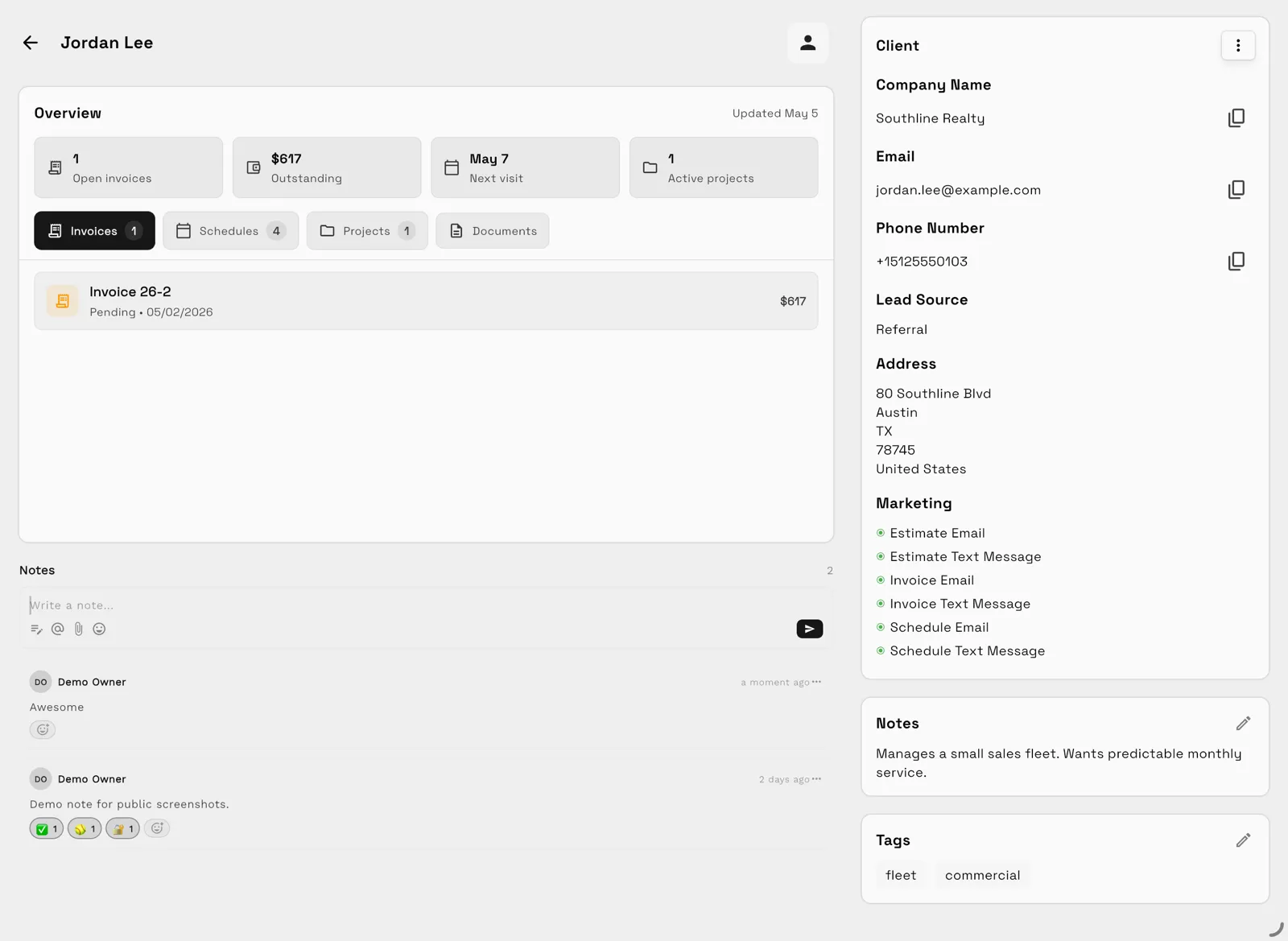
Workspace369 keeps the client record beside its email inbox, proposals that clients accept and sign by link, deposits on acceptance, payment schedules, projects, a client portal, scheduling and invoices. Cadet is $29 a month ($23.25 billed yearly) for one seat and includes public intake forms, appointment reminders and Google Calendar. The image is a general demo client, not a photography case study.
Limitations: booking matters for photographers, so be clear about this: online booking starts at Specialist, $149 a month for ten seats ($119.25 billed yearly). On Cadet and Voyager ($74 a month) clients cannot book a slot themselves; you share availability by message. Payment plans also start at Specialist, SMS and calls start at Voyager, Cadet allows five active projects, and Workspace369 does not host galleries. The 14-day trial needs a card.
Best for: studios and small teams where messages, projects and invoices matter as much as the booking page, and who keep a separate gallery tool.
7. 17hats, best for a single all-in-one price
17hats' pricing page listed one plan at $60 a month, $600 a year or $800 for two years on October 23, 2026. Earlier, on October 14, 2026, the same page also showed lower levels, Online Scheduling as an add-on at $5 or $10 a month and a free CRM plan with unlimited contacts and four invoices per quarter; it no longer lists them, so treat those as reported. Extra users were also reported at $5 each with three included on October 15, 2026; the pricing page did not list this on October 23, 2026. The trial is 7 days; card terms are not stated.
Limitations: on October 14, 2026, the lowest level showed 20 documents a month, one lead capture form and no client portal, with the portal only on the top level (reported; the October 23 pricing page shows a single plan). Tipping, saved cards and recurring billing depend on Stripe or Square.
Best for: photographers who want a broad business toolbox in one plan and will check how scheduling is priced before they commit.
Side-by-side comparison
| CRM | Entry price | Booking on entry plan | Main entry-plan limit | Standout | Trial |
|---|---|---|---|---|---|
| Studio Ninja | $16 a month (Starter) | Appointment booking; booking forms from Pro | 5 active jobs, 1 user | Photography-shaped jobs | 7 days, no card |
| Sprout Studio | $19 a month (Lite) | Scheduling listed | 10 active shoots, 50 GB | Galleries included | 30 days, no card |
| HoneyBook | $29 a month billed yearly (Starter) | Scheduler limited to 1 session on Starter | 2 live lead forms | Proposals and contracts | 30 days, no card |
| VSCO Workspace | $41.67 a month billed annually (VSCO One) | Scheduling listed | Standalone price not confirmed | Automation and reporting | 30 days, card not stated |
| Dubsado | $335 a year (Starter) | No (Premier) | 1 lead form | Forms and workflows | 21 days, no card |
| Workspace369 | $29 a month (Cadet) | No (Specialist, $149) | 5 active projects, 1 seat | Messages, projects, billing | 14 days, card required |
| 17hats | $60 a month | Add-on, $5 or $10 (reported Oct 14) | Lowest level: 20 documents a month (reported Oct 14) | Broad toolbox | 7 days, card not stated |
Which CRM fits your photography business?
| If you mostly need | Start with | Why |
|---|---|---|
| A photography job workflow at a low price | Studio Ninja | Contracts, questionnaires and payment schedules from $16 a month |
| CRM and galleries in one account | Sprout Studio | Galleries and proofing for albums listed with the CRM |
| Wedding or commercial proposals and payments | HoneyBook | Proposals, contracts and portal on every plan |
| Deep automation and reporting | VSCO Workspace | Workflows, texting and reporting listed |
| Public booking for mini-sessions on a tight budget | Studio Ninja or Dubsado Premier | Booking available at lower prices than Workspace369 Specialist |
| Team inbox, projects and invoices on one record | Workspace369 | Shared inbox from Voyager, projects and invoicing on every plan |
Run a date-change test during the trial
Feature lists look alike. Test the exception, not the happy path. Create a fictional portrait session or commercial shoot and run it through each shortlisted tool:
- Record the requested date, package, contact and payment terms.
- Send the agreement and take the deposit.
- Change the date after the deposit is paid.
- Locate the original agreement, the latest confirmed date and the outstanding balance from the client record.
- Add a second teammate and check what they can see.
- Find the final gallery link without duplicating the image library.
If you run the test, expect some tools to update reminders for you and others to need a manual fix. Never assume a changed date updates every reminder; inspect the workflow and its history, and note the manual steps.

A CRM does not automatically replace your galleries
Separate the relationship from the image delivery. The CRM should tell you who is booking, what was agreed, the next action and the payment status. Gallery software handles the experience your clients see. Ask each vendor how information moves between the two. A link to a gallery may be enough for you; another studio may need an integration. Do not infer photo proofing or gallery hosting from a general files feature.
Give inquiry handling a clear owner
A shared inbox is useful only if someone owns the next reply. A solo photographer can use the same idea with a daily review of open inquiries: record the next action, the owner and the date. For larger studios, ask what happens when a teammate is away and whether another person can understand the package, the date discussion and the agreement. Test access with the permissions a contractor would actually have.
Compare the full cost, including switching
Workspace369's monthly plans are Cadet at $29 (one seat), Voyager at $74 (two), Specialist at $149 (ten) and Commander at $299 (twenty), with extra seats at $10 a month. For every option, ask for a quote at the same team size and billing period, and add migration time and any tools you will keep. A yearly price shown per month is not a month-to-month price. A bundle is only cheaper if it replaces costs you pay today. See the Workspace369 pricing page for the current feature matrix.

Decide from the studio's actual process
A photographer who wants a photography-shaped job workflow should trial Studio Ninja or Sprout Studio first. Someone who sells by proposal should trial HoneyBook or Dubsado at the tier they need. A studio that wants client history, messages, scheduling and billing together can also trial Workspace369, knowing public booking needs Specialist. For a solo studio, the best CRM for freelance photographers page shows how the same workspace fits one person.
Workspace369 in action
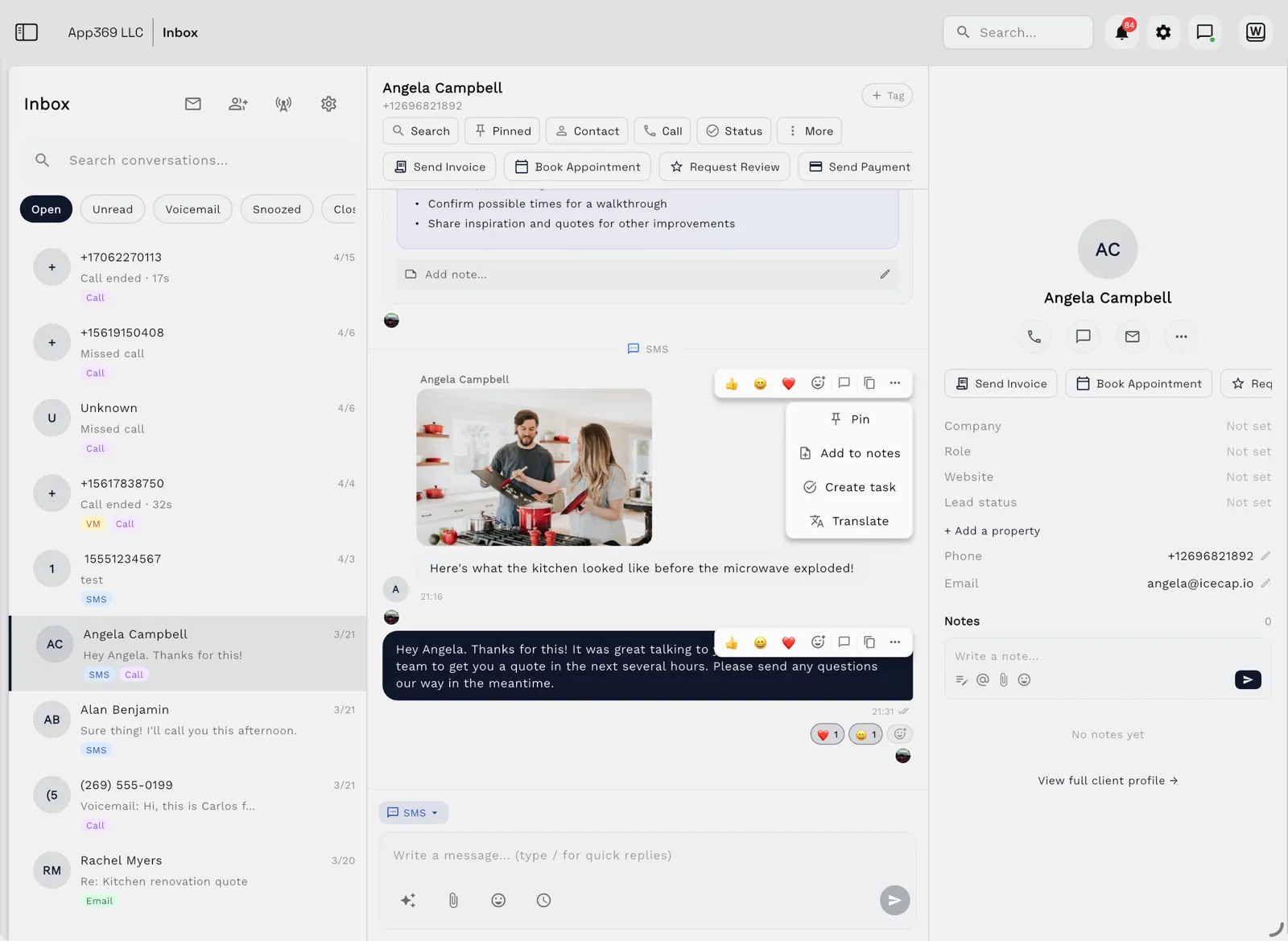
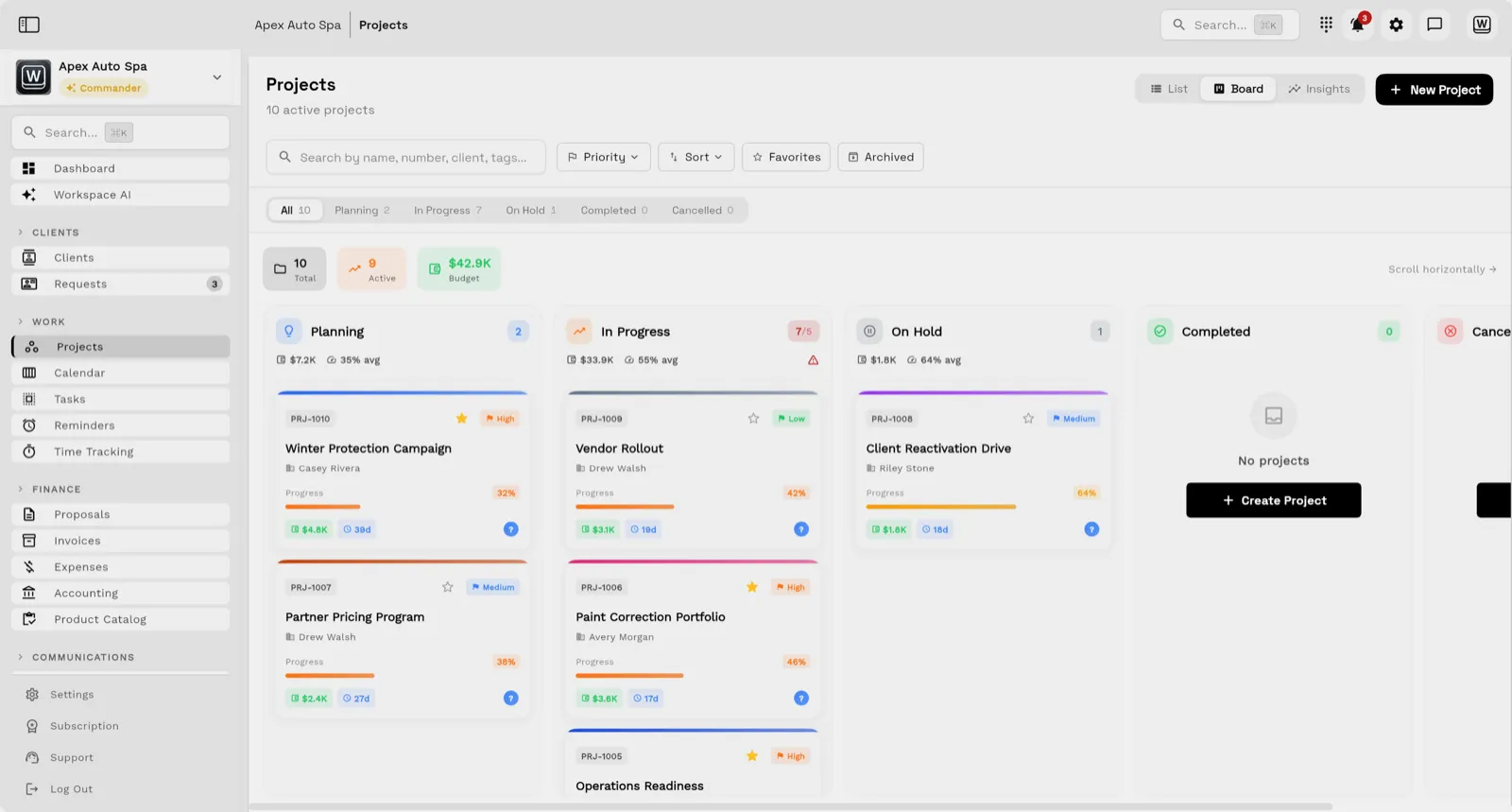
The screens below use demo data, not a photography studio. In the inbox, one thread carries the client's messages, a note and quick actions to send an invoice or request a payment, with the contact details beside it; SMS and calls start at Voyager. In the projects board, each job shows its stage, progress and budget, and online booking, which photographers often want first, still needs Specialist.
Each client also gets a client portal on every plan, which is where a signed agreement and the outstanding balance stay visible after a date changes.
Whichever tool you trial, finish one full session with demo data before importing real clients, and confirm you can export your records if you ever leave.
Sources reviewed for this guide
- Workspace369 pricingPlan matrix reviewed October 23, 2026.
- Studio Ninja pricingOfficial pricing page reviewed October 23, 2026 for plans, active-job limits, integrations and trial terms.
- Sprout Studio plans and pricingOfficial pricing page reviewed October 23, 2026 for plan limits and trial terms.
- HoneyBook pricingOfficial pricing page reviewed October 23, 2026 for plans, scheduler, lead forms and trial terms.
- VSCO WorkspaceOfficial product and pricing pages (formerly Tave, www.tave.com redirects here) reviewed October 23, 2026 for features, the VSCO One bundle price and the name change.
- Dubsado pricingOfficial pricing page reviewed October 23, 2026 for yearly prices, plan limits and trial terms.
- 17hats pricingOfficial pricing page reviewed October 23, 2026 for price, plan limits and trial terms.
Workspace369 publishes this documentation-based comparison and is one of the options. It is not an independent ranking or a hands-on benchmark.
Run client follow-up in one workspace.
CRM, inbox, voice, invoicing, payments, projects, files, AI, and workflow automations — connected instead of exported.
14-day free trial. Card required. After the trial: from $29/month. Renews automatically every month until you cancel. Cancel anytime in Settings → Billing.