Best CRM for E-commerce Brands in 2026
Best CRM for e-commerce brands: six tools for small direct-to-consumer teams compared on price, email and SMS, support inbox and wholesale orders.
We make Workspace369, which is on this list. Weigh our ranking with that in mind.

By Simon Dziak, Founder, Workspace369 · LinkedIn
The best CRM for e-commerce brands keeps one profile per shopper across channels, feeds retention email and SMS, holds the support thread and still copes when a retailer asks to buy in bulk. For most small direct-to-consumer teams that means a store-connected messaging tool such as Klaviyo or Omnisend; Workspace369 (see its e-commerce brands page, where Proposals cover wholesale quotes) comes last of six here because its plan matrix names no store connector. For the wholesale side alone, see the best CRM for wholesalers and distributors. To plan net terms for a retail buyer, try the free invoice due date calculator.
Disclosure and method: Workspace369 publishes this guide and is one of the options; we rank it last of six for this reader. It is a documentation-based shortlist, not a hands-on benchmark. We read each vendor's pricing page on October 22, 2026, so confirm current plans with the vendor before buying. Workspace369's own plans are on its pricing page.
Key takeaways
- A small direct-to-consumer team usually needs four things from customer software: one profile per shopper across channels, retention email and SMS, a support inbox, and a way to handle the occasional wholesale buyer. No single tool here does all four well.
- Klaviyo lists a free plan (250 profiles, 500 emails a month) and 500-profile email at $20 a month; Omnisend lists Standard at $16 a month for 251 to 500 contacts, with SMS from its $59 Pro plan.
- Gorgias helpdesk plans, with its AI Agent switched off, are $60 a month for 300 tickets on Basic ($50 billed yearly); Shopify Basic is $39 a month ($29 billed yearly) and lists up to 3 B2B catalogs.
- Workspace369 Cadet is $29 a month ($23.25 billed yearly) for one user. Its matrix names no store connector, so it fits only the wholesale and custom-order side, through Proposals, a client portal and invoices. We rank it last of six.
- Test each tool with one shopper who is also a wholesale buyer: the profile, the order history, the email consent and the invoice should end up on one record.
What's inside?
What a CRM for e-commerce brands is (and what it is not)How we compared these toolsThe best CRM for e-commerce brands in 2026Side-by-side comparisonWhich tool fits your e-commerce brand?Run a shopper-who-is-also-a-buyer test during the trialKeep the storefront and the wholesale desk separateWhen to keep it simple
What a CRM for e-commerce brands is (and what it is not)
For a direct-to-consumer brand, the customer record is mostly built from store events: who bought what, when, through which channel, and whether they agreed to get email or texts. A CRM in this setting is the layer that turns that history into segments, flows and support context. It is not the storefront, the payment processor or the warehouse system. Wholesale is the odd one out: a retailer's buyer wants a price list, terms and an invoice, not a checkout, so those orders often live outside the shopper tools.
How we compared these tools
We checked each tool against the same five questions, using only the vendor's own pricing pages as read on October 22, 2026:
- Retention messaging: email and SMS, and whether the page ties them to store data.
- Support: whether a ticket inbox is priced on the page, and how it is metered.
- Wholesale or B2B orders: anything on the page about catalogs, price lists or business buyers.
- Price at the entry plan, on the monthly and yearly views where both exist, and the unit it scales by.
- Limits and trial terms: contact or ticket caps, seat minimums and whether a card is needed.
We ranked first by depth on the job most brands buy software for (retention messaging driven by store data), then by how many of the other jobs the pricing page lists, then by entry price. Gorgias lists no retention messaging or wholesale features, so it sits below HubSpot's three bundled hubs. It outranks Workspace369 only because it covers support with store-connected depth that Workspace369 does not. We did not test deliverability, support quality, speed or mobile apps, and we installed no store connector. Workspace369 sits last because the matrix supports only the wholesale job, not because it costs more: Cadet is $29 a month against $20 for Klaviyo's 500-profile Email, but the two do different work.
The best CRM for e-commerce brands in 2026
1. Klaviyo, best for retention email and SMS driven by store data
Klaviyo's pricing page lists a free plan with up to 250 active profiles and 500 emails a month, plus $5 of mobile messages and $5 of Composer usage. In the Build a plan view, Email is shown at $20 a month for 500 profiles (5,000 emails a month); a promotion takes $19 off the first month, but $20 is the price. US toll-free SMS is listed at $0.01 plus carrier fees per send. The page names Shopify, WooCommerce, BigCommerce and Wix among its 350+ integrations, and the free plan lists a Helpdesk with ticket management and a shared marketing and service profile.
Limitations: the page showed no yearly view, so we could not confirm a billed-yearly price. Cost rises with active profiles, and SMS, Customer Hub, Social and Reviews are separate add-ons. Nothing on the page covers wholesale price lists or business buyers.
Best for: brands that want segments, flows and texts built from purchase history and are willing to pay by list size.
2. Omnisend, best for a lower-priced email and SMS start
At 251 to 500 contacts and before its 3-month prepay discount, Omnisend lists Free at $0 (500 emails, 250 contacts, no card), Standard at $16 a month (6,000 emails, 500 contacts) and Pro at $59 a month (unlimited emails, 2,500 contacts, SMS from $0.007 a message). The page mentions 305+ pre-built integrations and a free 5-day migration.
Limitations: SMS is ticked only on Pro in the plan table, with credits on top. The only other billing option is a 3-month prepay discount, which we did not treat as a price. The page names no helpdesk and nothing for wholesale buyers, and the SMS rate depends on country and volume.
Best for: small brands that mainly need email with a path to SMS and want a lower entry price than a full retention platform.
3. Shopify, best when your own store plan already covers the basics
Shopify's Basic plan is $39 a month or $29 billed yearly. The comparison table lists customer segments, email campaigns, pay-per-send SMS, marketing automations, abandoned checkout recovery and customer chat on every plan, and up to 3 B2B catalogs on Basic, Grow and Advanced (unlimited on Plus). The page describes a free 3-day trial with no card required.
Limitations: these are store features, not a standalone CRM, so they only help if your sales run on Shopify. SMS is billed per send. The page gives no depth on flows, lifetime value or a support ticket inbox, and it lists B2B catalogs rather than negotiated terms or invoicing for retail buyers.
Best for: Shopify brands that want to see how far the built-in tools go before adding a messaging app. See also the best CRM for Shopify store owners.
4. HubSpot, best for one general customer record across sales and service
HubSpot's Free tools cover up to 2 users with no card, and its FAQ gives the free CRM a limit of 1,000 contacts. Starter Customer Platform is listed at $20 a month per seat; the page also shows lower promotional starting rates, which we did not use. Starter bundles Marketing Hub Starter (1,000 marketing contacts), Sales Hub Starter and Service Hub Starter, with ticketing and pipelines in the plan tables. The yearly price is See site, because every billing view on the page shows $20 struck through.
Limitations: the pricing page names no store connector, so order history needs a separate integration we did not test. The plan tables list limits on active segments and automated email actions, and cost scales per seat as the team grows.
Best for: brands that run wholesale deals and customer service from the same contact record and can connect their store separately.
5. Gorgias, best for a store-connected support inbox
With Add AI Agent switched off, Gorgias lists helpdesk-only plans: Basic at $60 a month on monthly billing ($50 a month, $600 billed annually) for 300 tickets, Pro at $360 ($300 a month, $3,600 a year) for 2,000 tickets, and Advanced at $900 ($750, $9,000 a year) for 5,000. Starter is $10 a month for 50 tickets and is monthly only. The AI Agent adds a separate charge on each plan, so these figures are the helpdesk alone. The page says helpdesk plans are never priced per agent, and its FAQ gives a 7-day trial with no payment info, with Basic and Pro showing no card required.
Limitations: it is a support tool, with no email or SMS marketing campaigns and no wholesale features on the page. Voice and SMS are add-ons priced by volume, and Advanced is sold through a sales call.
Best for: teams whose limiting factor is answering shoppers quickly, with ticket volume rather than headcount driving cost.
6. Workspace369, best for wholesale and custom orders when the store lives elsewhere
Workspace369 holds a company and its contacts, a Proposal with optional add-on line items, a deposit on acceptance, contracts, a client portal and invoices on one record. Cadet is $29 a month for one user ($23.25 billed yearly), with up to 20 products, 5 active projects, CSV import, email automations and an email inbox. The screenshot is a demo record, not a customer result.
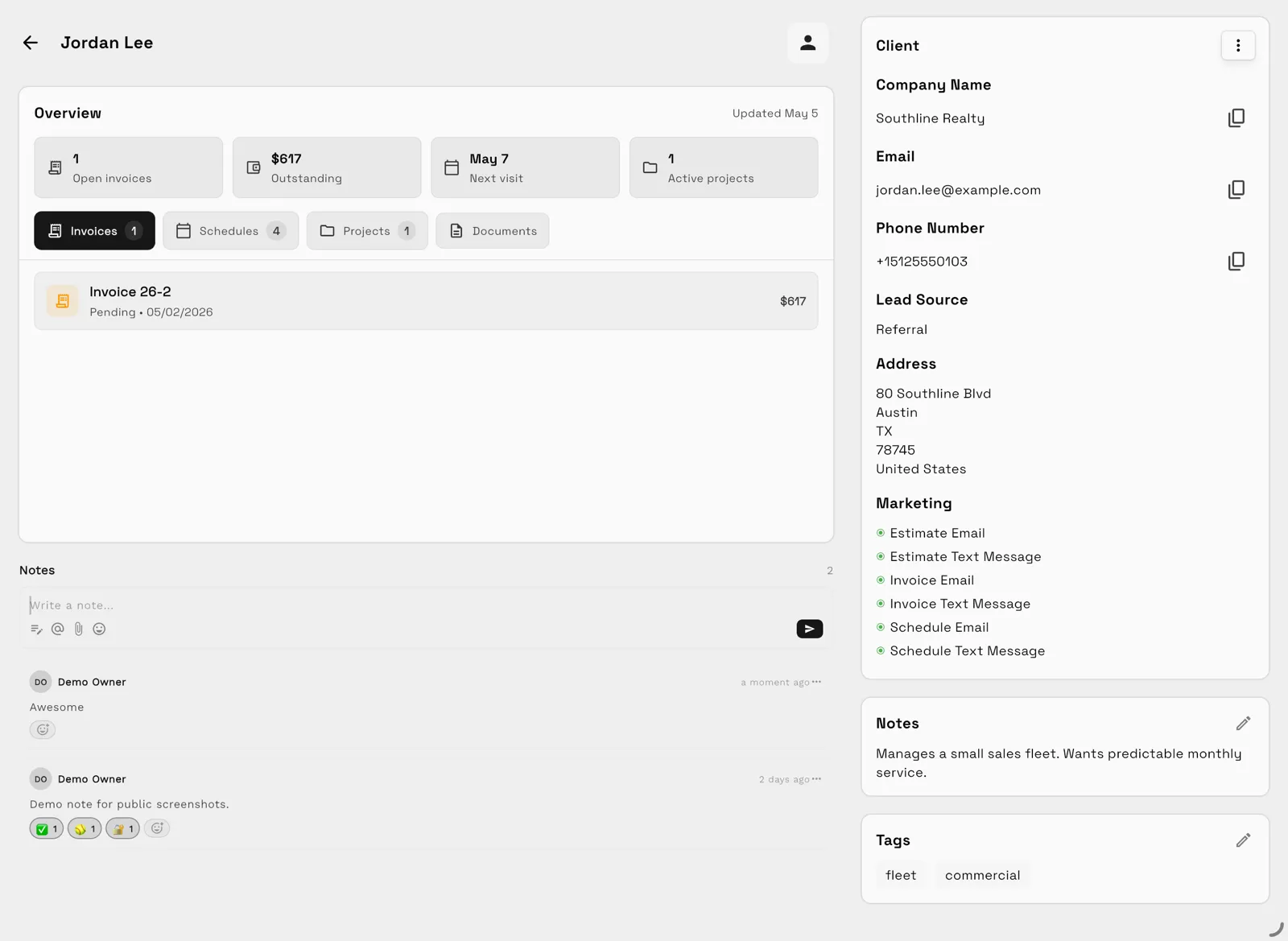
Limitations: the plan matrix names no store connector, so shopper profiles and order history do not arrive on their own; webhooks and the API start at Specialist ($149 a month, $119.25 billed yearly, 10 seats). Inventory tracking, stock adjustments and low-stock alerts also start at Specialist, and SMS starts at Voyager ($74 a month, $59.25 billed yearly, 2 seats). The matrix lists no abandoned-cart flows or review requests. The 14-day trial needs a card. For the retail side, Klaviyo, Omnisend and Gorgias are the purpose-built options.
Best for: brands with a small wholesale or custom-order book who want Proposals, deposits and invoices apart from the storefront.
Side-by-side comparison
| Tool | Plan priced | Monthly | Billed yearly | Fit at that plan | Limits | Trial |
|---|---|---|---|---|---|---|
| Klaviyo | Email, 500 profiles | $20 | Not shown | Email flows and segments; SMS from $0.01 a send | Priced by active profiles | Free plan |
| Omnisend | Standard, 251 to 500 contacts | $16 | Not shown | Email only; SMS starts on Pro ($59) | 6,000 emails, 500 contacts | Free plan, no card |
| Shopify | Basic | $39 | $29 a month | Segments, email, SMS per send, up to 3 B2B catalogs | Store plan, not a CRM | 3 days, no card |
| HubSpot | Starter Customer Platform | $20 per seat (list) | See site | Marketing, Sales and Service Starter | 1,000 marketing contacts | Free tools, no card |
| Gorgias | Basic, helpdesk only | $60 | $50 a month | Support inbox; no marketing sends | 300 tickets a month | 7 days, no card (Basic, Pro) |
| Workspace369 | Cadet | $29 | $23.25 a month | Wholesale Proposals, deposits, invoices; no store connector | 1 user, 5 active projects | 14 days, card required |
Which tool fits your e-commerce brand?
| If you mostly need | Start with | Why |
|---|---|---|
| Segments, flows and texts from purchase history | Klaviyo | Free plan, 350+ integrations including major store platforms |
| A cheaper email-first start | Omnisend | Standard at $16 a month, SMS on Pro |
| A first look at what your store plan already does | Shopify | Segments, email, SMS and B2B catalogs on Basic |
| Sales and service on one general record | HubSpot | Starter bundles three hubs at a per-seat list price |
| Faster answers to shopper questions | Gorgias | Helpdesk metered by tickets, not by agent |
| Proposals, deposits and invoices for retail buyers | Workspace369 | Proposals and invoices on every plan; no store connector |
Run a shopper-who-is-also-a-buyer test during the trial
Give each tool the same fictional customer, a boutique owner who bought online last month and now wants a bulk price:
- Import or create the customer with a consent flag for email and for texts.
- Add a retail order and see whether the profile shows it without retyping.
- Send a discount flow and check that the unsubscribed state sticks.
- Open a support thread about a late parcel and look for the order beside it.
- Price a bulk order with a deposit and send the invoice.
- Search for the customer and see how many places the record lives.
The strongest tool keeps the profile, consent, orders, support thread and invoice reachable from one place. A wholesale buyer who lands on your promotional list, or a support reply that lacks the order, is exactly what this test exists to catch.

Keep the storefront and the wholesale desk separate
Checkout, fulfillment and returns belong in the commerce platform, and shopper marketing belongs in a messaging tool connected to it. If you choose Workspace369 for the wholesale desk, give each business buyer a company record with custom fields for their terms, attach the agreed price list to it, and invoice from the accepted Proposal. To feed it from a store, use CSV import on any plan, or webhooks and the API from Specialist, and run a sample order through before you trust the sync.
When to keep it simple
If your list is under a few hundred people and wholesale is a once-a-quarter event, your store's built-in tools plus a spreadsheet of retail buyers may be enough. Add a messaging tool when you want automated flows, add a helpdesk when replies slip, and move wholesale to its own record when buyers start asking for revised terms. The e-commerce brands product page shows how Workspace369 handles communications and products, and the pricing page lists current plans. Workflow Automations can send reminders and internal notices, with email automations on every plan.
Before you import real customers, push one fictional buyer through the whole flow and confirm the records can be exported.
Sources reviewed for this guide
- Workspace369 pricingPlan matrix reviewed October 22, 2026 for seats, products, inventory, purchase orders, SMS, automations, webhooks and trial terms.
- Klaviyo pricingOfficial pricing page reviewed October 22, 2026, including the Build a plan view, for the free plan, 500-profile email price, SMS rate and listed integrations. No yearly view was shown.
- Omnisend pricingOfficial pricing page reviewed October 22, 2026 for Free, Standard and Pro at 251 to 500 contacts. The page shows a 3-month prepay discount; the $16 and $59 figures are its undiscounted three-month totals ($48 and $177) divided by three.
- Shopify pricingOfficial pricing page reviewed October 22, 2026 for Basic monthly and yearly prices, B2B catalogs, marketing features and trial terms.
- Gorgias pricingOfficial pricing page reviewed October 22, 2026: the helpdesk-subscription prices in the page's structured data and plan cards (the Add AI Agent toggle separates the helpdesk from AI Agent charges), the Monthly and Annual figures, and the FAQ for the 7-day trial.
- HubSpot pricingOfficial pricing page reviewed October 22, 2026 for the free tools and the Starter Customer Platform list price. Promotional starting rates were not used.
Workspace369 publishes this documentation-based comparison and is one of the options. It is not an independent ranking or a hands-on benchmark.
Run client follow-up in one workspace.
CRM, inbox, voice, invoicing, payments, projects, files, AI, and workflow automations — connected instead of exported.
14-day free trial. Card required. After the trial: from $29/month. Renews automatically every month until you cancel. Cancel anytime in Settings → Billing.