Best CRM for Subscription Boxes in 2026
Six tools for subscription box companies compared on published price, skip and pause tools, win-back and lifecycle email, plus a skip-and-churn test.
We make Workspace369, which is on this list. Weigh our ranking with that in mind.

By Simon Dziak, Founder, Workspace369 · LinkedIn
The best CRM for subscription box companies is usually a subscription commerce platform: Subbly for an all-in-one box store, Cratejoy for a box marketplace, Recharge or Skio for Shopify stores, and Klaviyo for lifecycle email. Workspace369 fits only boxes sold to companies by proposal, with a deposit and invoices.
Before you quote a corporate order, try the free deposit calculator. Workspace369 (see its subscription box companies page) ranks last of six here, because it has no subscriber portal. For the wider store question, read the best CRM for e-commerce brands guide.
Disclosure and method: Workspace369 publishes this guide and is one of the options; we rank it last of six for this reader. It is a documentation-based shortlist, not a hands-on benchmark. Official vendor pages were reviewed on October 26, 2026, and prices are in US dollars. Confirm each price with the vendor before you commit.
Key takeaways
- A subscription box company needs recurring billing, a subscriber portal for skips, pauses and swaps, and churn recovery before it needs a client-work CRM, so subscription commerce tools lead this list.
- Subbly lists $69 a month ($621 billed yearly); Cratejoy lists Essentials at $59 a month billed yearly ($79 monthly).
- Recharge lists Starter at $99 a month with a 60-day free trial; Skio lists Scale at $499 a month billed annually ($599 monthly).
- Klaviyo adds lifecycle email on top of a subscription platform: its page lists a free plan for up to 250 active profiles, and an entry email plan at $20 a month for 251 to 500 profiles.
- Workspace369 Cadet is $29 a month ($23.25 billed yearly) for one user, with a 14-day trial on Cadet through Commander (card required), and lists recurring invoices and proposals, but no storefront, subscription checkout or skip portal. We rank it last of six, for boxes sold to companies by proposal.
What's inside?
What a CRM for a subscription box company is (and what it is not)How we compared these toolsThe best CRM for subscription box companies in 2026Side-by-side comparisonWhich tool fits your box business?Workspace369 in action for a corporate gift box orderRun a skip-and-churn test during the trialKeep consumer billing and company orders apartWhen to keep it simple
What a CRM for a subscription box company is (and what it is not)
For a box business, the customer record is a subscription: a plan, a card on file, a shipping address, a next ship date and a history of skips, pauses and swaps. A tool for that job needs a subscriber portal, billing retries and cancellation flows. A client-work CRM, with proposals, projects and invoices, solves a different problem. It becomes useful only when a company, not a consumer, orders your boxes and negotiates the terms.
How we compared these tools
We compared each tool on the same five points, taken from the vendor's own pricing page as read on October 26, 2026:
- Published price: the monthly price and the yearly view where one exists, quoted as the vendor states it.
- Subscriber self-service: skip, pause, swap or reschedule tools named on the page.
- Churn and win-back: cancellation flows, failed-payment recovery and reactivation named on the page.
- Fulfilment and shipping: shipping rules, inventory or renewal-date tools named on the page.
- Limits and trial terms: seats, platform lock-in and whether a trial is named.
We did not test billing accuracy, support, migration or storefront speed, and we did not use third-party ratings. Order reflects documented fit for a box company selling subscriptions to consumers, with Workspace369 placed last because the matrix lists none of the subscriber-facing tools.
The best CRM for subscription box companies in 2026
1. Subbly, best for an all-in-one box store at a flat entry price
Subbly's pricing page lists a $69 a month plan billed monthly and a yearly view of $621 billed yearly (shown as $51 a month). Max is $149 monthly or $1,341 billed yearly, and Subbly X starts at $499 a month. Subbly and Max share the same feature list, which includes a customer portal for skips, swaps and pauses, fixed and configurable bundles, build-a-box, gift cards, shipping rules with local pickup, and churn and MRR analytics. A 14-day trial is named. Subbly X (from $499 a month) adds advanced analytics, several subscriptions per customer, an account manager and more seats. The page also shows a 6-months-free switching promo, which we did not use.
Limitations: the $69 plan includes one team member and 500 inventory items. The page does not say whether a card is needed to start the trial. It is a store platform, so moving your existing site onto it is a project, not an add-on.
Best for: new or growing box brands that want storefront, billing, portal and shipping rules in one login without a separate store.
2. Cratejoy, best for a box-specific platform with a marketplace
Cratejoy sells to box businesses specifically. The Essentials plan is listed at $59 a month paid yearly or $79 monthly, and Advanced at $159 or $199. A Marketplace-only listing is $24.99 a month paid yearly or $29 monthly. Essentials lists a custom website, advanced renewal and shipping features, built-in customer management, a checkout with fraud protection and 138 currencies; Advanced adds native TaxJar, advanced dunning, a referral app and priority support. The features page lists churn and cancellation analytics and cash flow reports.
Limitations: the features page names a free 14-day trial but does not say whether a card is needed, and advanced dunning is on the higher plan only.
Best for: box brands that want a purpose-built platform and the option to reach new subscribers through a marketplace.
3. Recharge, best for Shopify stores that need a mature subscription layer
Recharge lists Starter at $99 a month with a 60-day free trial (the page says billing begins after the first full cycle that follows it), and Plus at $499 a month. Starter lists a subscription widget, a customer portal to add and swap products and reschedule deliveries, smart cancellation prevention, failed payment recovery, win-back tools, gift subscriptions and prepaid subscriptions. Plus adds customizable bundles with tiered discounts, concierge SMS, rewards, referrals and implementation help. The SMS line is footnoted at $0.03 per message segment in the US and Canada.
Limitations: the page describes a unified checkout on Shopify, so it fits Shopify stores, and we found no yearly price. Bundles and tiered discounts start at Plus, about five times the Starter price. The page does not say whether the trial needs a card.
Best for: Shopify box brands that want a portal, cancellation flows and payment recovery from a well-known vendor.
4. Skio, best for Shopify brands that want retention automation and have the volume
Skio publishes one price: Scale at $499 a month billed annually or $599 monthly with a demo as the way in. The feature list names a no-code customer portal, a multi-step cancel flow builder, payment recovery campaigns, lifecycle journeys, two-way SMS, advanced build-a-box, bulk tools, webhooks and an API, and migration help. Its billing answer mentions a free trial in passing, but the "Is there a free trial?" answer offers none and no length is stated.
Limitations: the entry price is high for a small box business, the page does not list a lower tier, and it is built for Shopify. The only call to action on the page is a demo.
Best for: Shopify brands with enough subscribers to justify $499 a month for retention tooling and hands-on migration.
5. Klaviyo, best for lifecycle email and segments on top of any subscription platform
Klaviyo's free plan is listed at up to 250 active profiles and 500 email sends a month, with web forms, email templates, built-in reporting and basic customer segmentation. The entry email plan is listed at $20 a month for 251 to 500 active profiles; the plan builder for 1,000 profiles and above needs JavaScript, so see Klaviyo's site for those prices. The page shows connections for Shopify, WooCommerce and BigCommerce among 350+ integrations, so it can connect to the platform you already use.
Limitations: it is a marketing platform, so it does not bill subscribers, run a portal or manage shipping. The price follows your profile count, and the free plan includes only a small mobile-messaging allowance.
Best for: any box brand that has a subscription platform and wants welcome series, skip reminders and win-back email sent from one place.
6. Workspace369, best for corporate gifting boxes sold by proposal
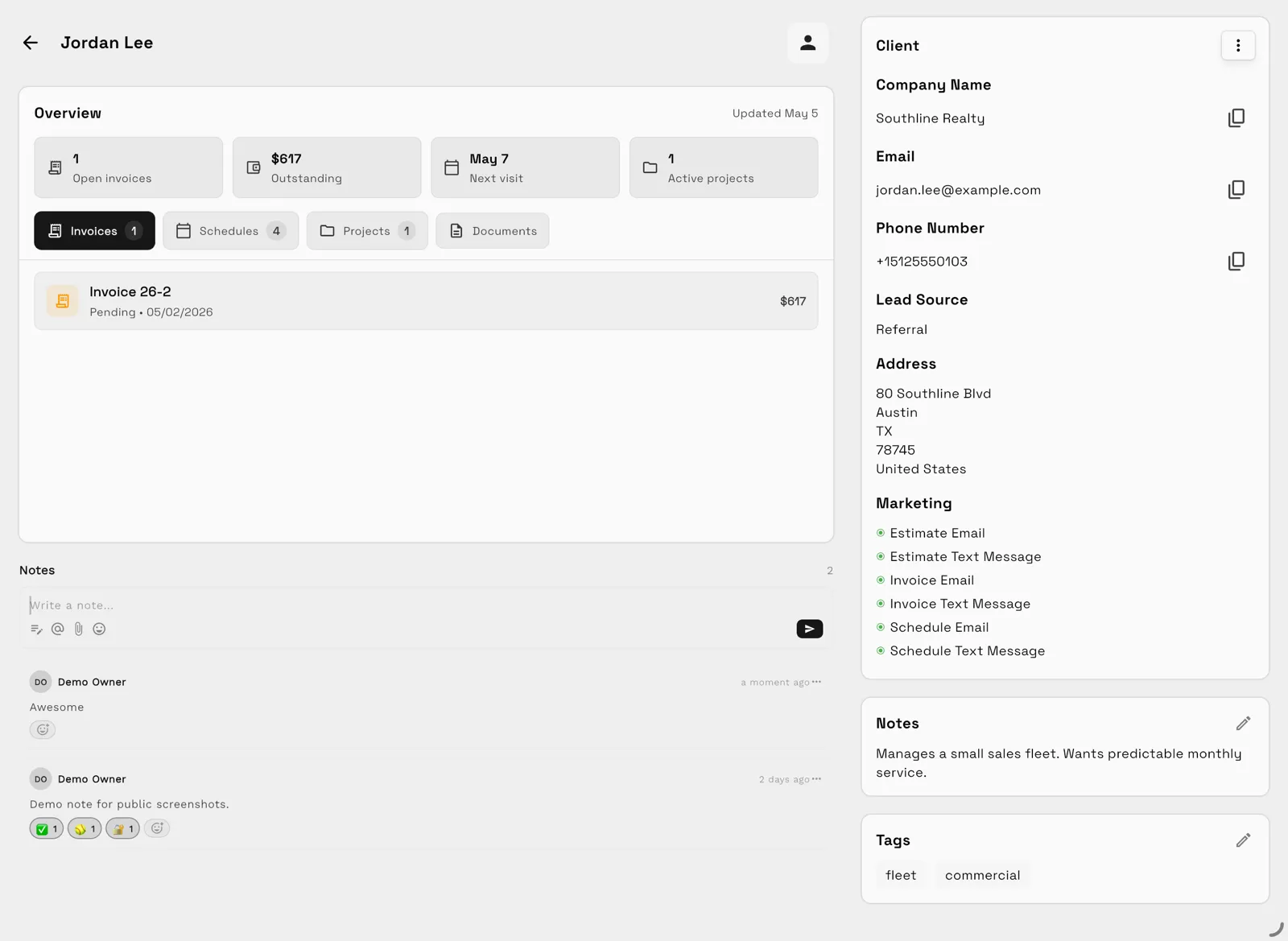
Workspace369 is the client-work side of a box company. It keeps the company record, a proposal built from catalog items, a deposit on acceptance, recurring invoices, retainers and payment schedules, a client portal and file sharing on every plan. For one user, Cadet costs $29 a month ($23.25 billed yearly) and allows 5 active projects; Voyager is $74 ($59.25 billed yearly) with two seats. The screenshot is a demo record, not a customer result.
Limitations: the matrix lists no storefront, subscription checkout, skip or pause portal, or shipping integration, so consumer subscribers stay on a commerce platform. Inventory tracking, stock adjustments, payment plans, online booking and webhooks with the API start at the Specialist plan ($149 monthly, 10 seats). The 14-day trial runs on Cadet through Commander, card required, and Cadet's product catalog is capped at 20 products. Subbly, Cratejoy, Recharge and Skio cover the subscriber side that Workspace369 does not.
Best for: box companies that also sell custom or corporate gift boxes to businesses, with a quote, a deposit, an address list and a delivery schedule per account.
Side-by-side comparison
| Tool | Plan priced | Monthly | Billed yearly | Skip, pause or swap tools | Trial |
|---|---|---|---|---|---|
| Subbly | Subbly | $69 | $621 a year ($51 a month) | Portal for skips, swaps and pauses | 14 days; card not stated |
| Cratejoy | Essentials | $79 | $59 a month | Subscribers manage their own subscriptions (features page) | 14 days (features page); card not stated |
| Recharge | Starter | $99 | Not shown | Portal to add, swap and reschedule | 60 days; card not stated |
| Skio | Scale | $599 | $499 a month | No-code portal and cancel flow builder | No trial offer or length stated (billing FAQ mentions one in passing) |
| Klaviyo | Email, 251-500 profiles | $20 | Not shown | None (email only) | Free plan |
| Workspace369 | Cadet | $29 | $23.25 a month | None | 14 days, Cadet through Commander, card required |
Which tool fits your box business?
| If you mostly need | Start with | Why |
|---|---|---|
| Store, billing, portal and shipping rules in one login | Subbly | Entry plan lists build-a-box, skips, pauses and shipping rules |
| A box-specific platform plus a marketplace | Cratejoy | Built for box sellers, with a listing option |
| A proven subscription layer on Shopify | Recharge | Portal, cancellation flows and payment recovery on Starter |
| Retention automation on Shopify at scale | Skio | Journeys, SMS and cancel flows at one published tier |
| Welcome, skip and win-back email | Klaviyo | Free plan up to 250 profiles, then price by profile count |
| Quotes, deposits and invoices for company orders | Workspace369 | Proposals, deposits, portal and recurring invoices on Cadet |
Workspace369 in action for a corporate gift box order
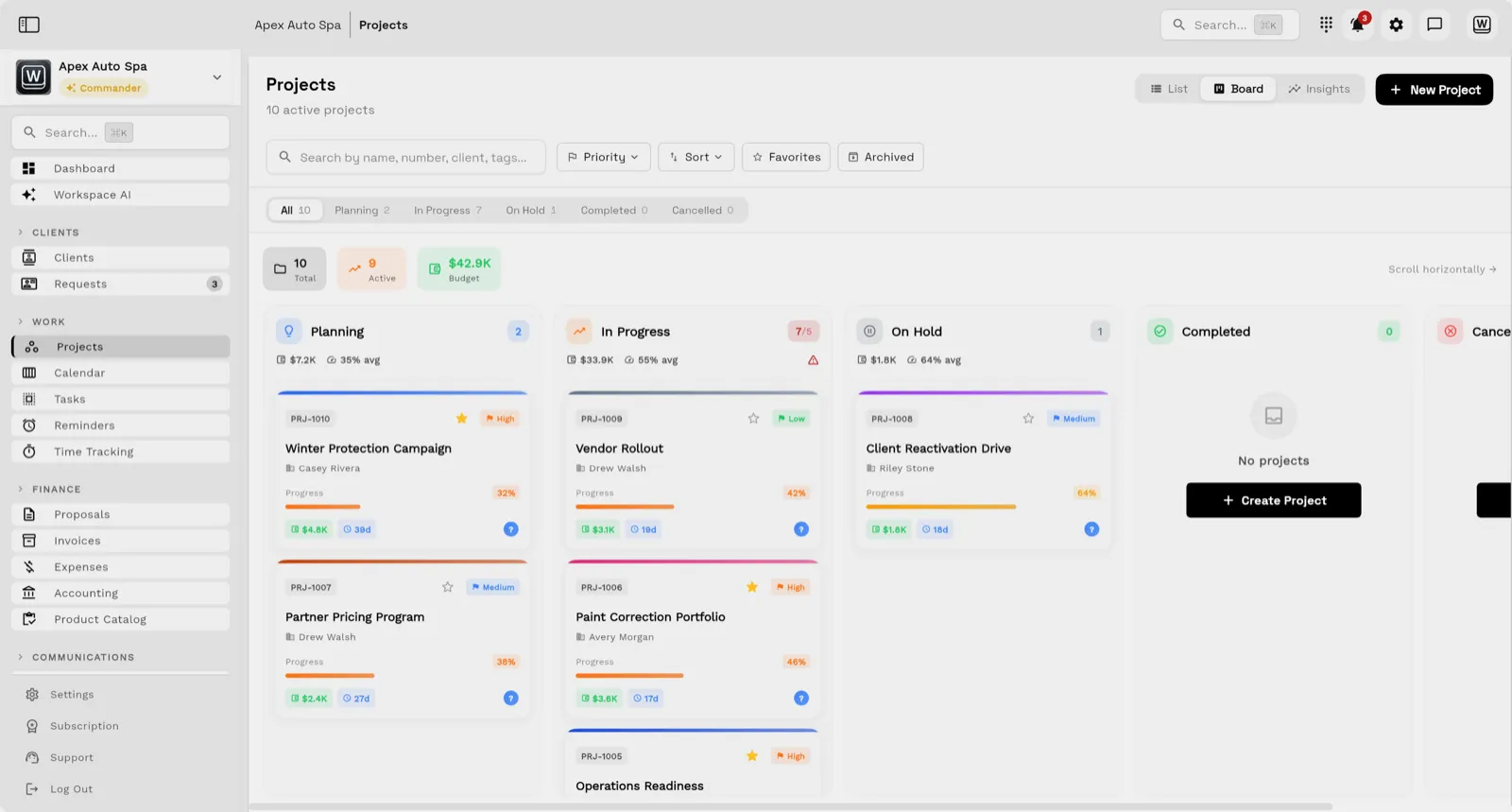
A company that orders 200 holiday boxes is one account with one deadline, not 200 subscribers. The first screenshot is the Workspace369 projects board in a demo workspace with sample data. It has Planning, In Progress, On Hold, Completed and Cancelled columns, and each card shows a project number, priority, client name, progress bar, budget and days left. The gift order would be one card, with curation, packing and delivery as its tasks. Cadet allows 5 active projects at once.
The deposit comes first. You send the buyer a proposal built from your catalog, and the deposit is requested when they accept. The second screenshot, also demo data, is the invoice editor with a live preview: a partly paid invoice with $600.00 taken off the $1,201.58 total, $601.58 still due and a Pay Now button. That is how the balance would look after a gift-order deposit. The buyer can view and pay it in the client portal, and the invoice stays on the same company record as the proposal.
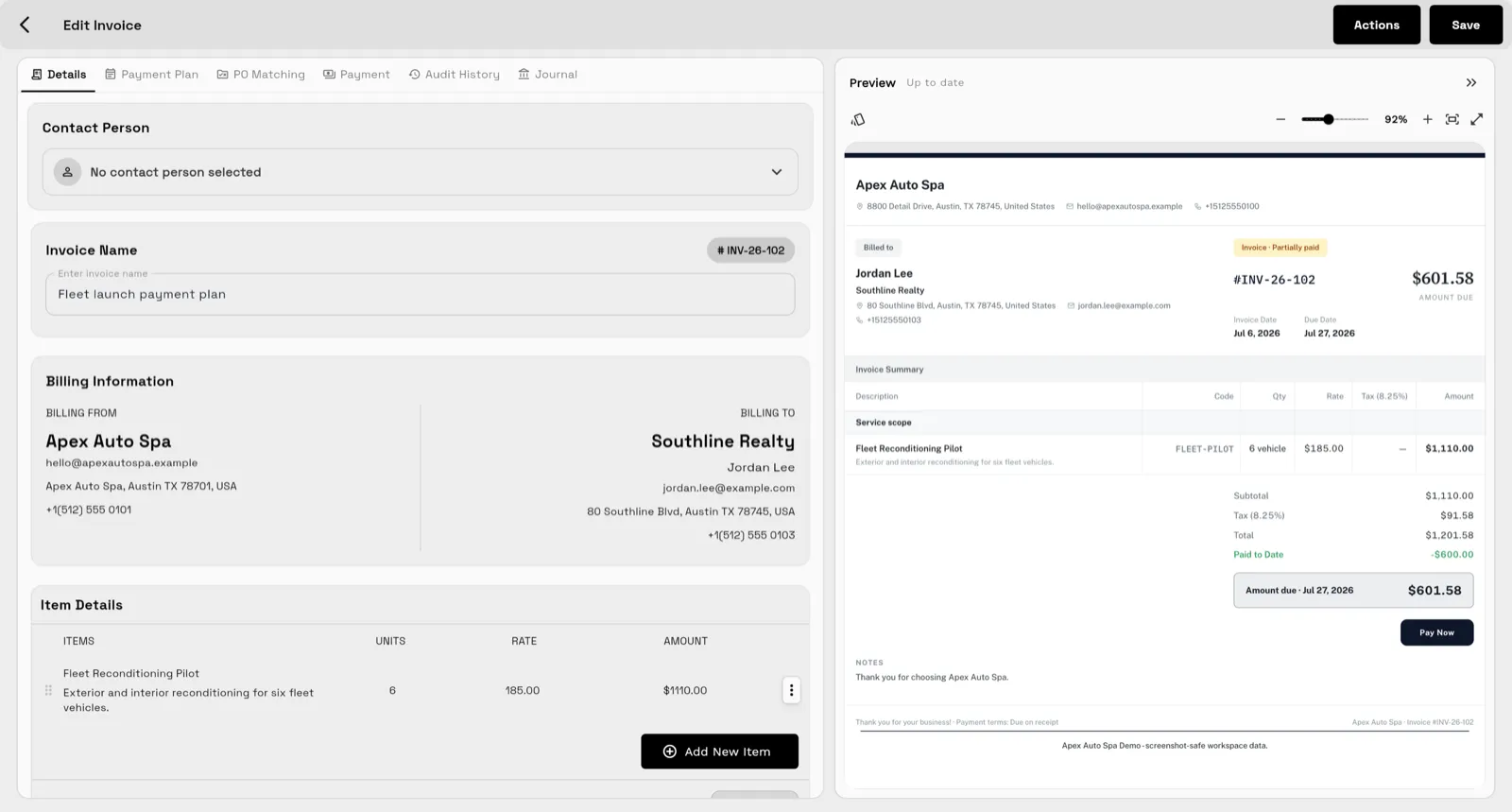
The demo workspace is not a box business. Workspace369 has no storefront, no subscription checkout, no skip or pause portal and no shipping integration, so consumer subscribers stay on a commerce platform. Splitting a balance into instalments (the Payment Plan tab in the screenshot) and inventory tracking start at Specialist.
Run a skip-and-churn test during the trial
Take one fictional subscriber through each tool you shortlist:
- Sign up on the box plan and place the first order.
- Skip the next month from the subscriber portal.
- Swap one product, then move the ship date.
- Make the card fail, and see what email and retry follow.
- Cancel, take the save offer or leave, then reactivate with a win-back offer.
- Check that billing, the ship list and the email list agree at each step.
The best tool keeps the plan, the next ship date and the email in step without a manual fix. If a skip leaves the order on the pick list, that is the gap this exercise exposes.

Keep consumer billing and company orders apart
Subscriber billing and shipping belong in the subscription platform; a corporate order has a different shape. It has one buyer, a negotiated price, a deposit, a list of recipient addresses and a deadline. In Workspace369, a Cadet account holds that as a proposal, a project with tasks for curation and packing, and an invoice. Attachments and file versioning are on every plan, so the buyer's address spreadsheet and logo files stay with the account. If you later want orders to flow in from your storefront, webhooks and the API begin on the Specialist plan, and Workflow Automations can send reminders and follow-ups, with email automations on every plan and SMS steps from Voyager.
When to keep it simple
If you ship a few dozen boxes a month, one subscription platform and a spreadsheet for the occasional company order may be enough. Add a client-work record when more than one corporate account is open at once, or when you cannot say which gifting deposits have been paid. The subscription box companies product page walks through communications and payments in Workspace369; the pricing page lists each plan.
Before importing real accounts, run one full corporate order on demo data and check that your records can be exported.
Sources reviewed for this guide
- Workspace369 pricingPlan matrix read on October 26, 2026 for seats, active projects, recurring invoices, proposals, deposits, inventory, webhooks and trial terms.
- Subbly pricingVendor pricing page read on October 26, 2026 on the monthly and annual views for the $69 plan, the Max plan, included skip, pause and shipping tools, and the 14-day trial.
- Cratejoy pricingVendor pricing page read on October 26, 2026 for Marketplace, Essentials and Advanced prices (paid yearly or monthly). No trial is named on this page.
- Cratejoy featuresFeatures page read October 26, 2026 for the Free 14 Day Trial label (card terms not stated).
- Recharge pricingVendor pricing page read on October 26, 2026 for Starter and Plus prices, the 60-day Starter trial and the feature lists.
- Skio pricingVendor pricing page read on October 26, 2026 for the Scale price on the annual and monthly views and the feature list.
- Klaviyo pricingVendor pricing page read on October 26, 2026 for the free plan limits and the entry email plan ($20 at 251 to 500 profiles, from the page's structured data). Prices at 1,000 profiles and above come from a plan builder that needs JavaScript and could not be read, so the copy says See site.
Workspace369 publishes this documentation-based comparison and is one of the options. It is not an independent ranking or a hands-on benchmark.
Run client follow-up in one workspace.
CRM, inbox, voice, invoicing, payments, projects, files, AI, and workflow automations — connected instead of exported.
14-day free trial. Card required. After the trial: from $29/month. Renews automatically every month until you cancel. Cancel anytime in Settings → Billing.