Best CRM for Print-on-Demand in 2026
Best CRM for print-on-demand: six tools compared on price, customer segments, email, support tickets and custom-order billing, plus a late-parcel test.
We make Workspace369, which is on this list. Weigh our ranking with that in mind.

By Simon Dziak, Founder, Workspace369 · LinkedIn
The best CRM for print-on-demand businesses holds the customer list, sends the emails that bring repeat buyers back and keeps support answers next to the order. Shopify's own tools suit stores already on Shopify, Klaviyo suits richer email and SMS flows, and Omnisend has a low-cost paid tier. Gorgias handles order-status support, and HubSpot gives one free record across teams.
Workspace369 (see its print-on-demand page) comes last of six here because it has no store connector. Related guides cover the best CRM for e-commerce brands and Shopify store owners. To check a product's margin first, use the free profit margin calculator.
Disclosure and method: Workspace369 is the publisher of this page and also one of the six options, and we place it sixth for this reader. What follows is a desk review of public documentation, not a lab test. Each vendor's own page was read on October 26, 2026, so confirm current terms with the vendor before paying.
Key takeaways
- A print-on-demand shop never touches the stock, so the customer list, the email to that list and the support inbox for late parcels are usually worth more than a sales pipeline.
- Shopify's own Messaging gives 10,000 emails a month free, then $1 per 1,000, with customer segments listed on every plan from Basic ($39 monthly, $29 billed yearly).
- Klaviyo is free for 250 active profiles and 500 emails a month, then $20 a month at 500 profiles; Omnisend is free at 250 contacts and $16 a month at 251 to 500.
- Gorgias is support only: Starter is $10 a month for 50 tickets, Basic is $60 monthly or $50 billed yearly for 300 tickets, with a 7-day trial that asks for no payment info.
- Workspace369 Cadet is $29 a month ($23.25 billed yearly) for one user with Proposals, deposits, a portal and invoices, but no store connector. We rank it last of six, for sellers who also quote custom or bulk jobs.
What's inside?
What a CRM for print-on-demand is (and what it is not)How we compared these toolsThe best CRM for print-on-demand businesses in 2026Side-by-side comparisonMatch the tool to your shopWorkspace369 in action for a 60-shirt team orderTrial test: one late parcel and one logo orderKeep production and customer records apartWhen to keep it simple
What a CRM for print-on-demand is (and what it is not)
For a print-on-demand seller, the CRM is the memory of the customer side: who bought which design, who opened your last email, who wrote in about a delayed parcel and who asked for a bigger custom run. It is not the fulfilment layer. A provider such as Printful or Printify prints and ships; we did not review their dashboards, so treat them as production, not as customer software. The risk is three disconnected lists: store customers, an email tool and a support inbox, with nobody able to see all three for one buyer.
How we compared these tools
We checked the same five points on every vendor's own pricing page, as read on October 26, 2026:
- Entry price and the free option, read from the monthly and yearly views where a switch exists.
- Customer segments and email: whether a list can be split by what people bought and emailed on a schedule.
- Support: whether a ticket inbox is on the plan and how many tickets it covers.
- Custom and bulk orders: whether a proposal, deposit and invoice can sit on the buyer record.
- Limits and trial terms: contact, ticket or seat caps, and whether a card is asked for.
We did not test deliverability, speed, support quality or any fulfilment-app sync, and we used no third-party ratings. The order reflects documented fit for a store with a catalog of designs and thousands of small orders.
The best CRM for print-on-demand businesses in 2026
1. Shopify, best for a customer list and email you already own
If the store runs on Shopify, the customer records already exist there. Basic is $39 a month, or $29 a month billed yearly, and its marketing rows list unlimited contacts, customer segments, email campaigns, marketing automations, abandoned-checkout recovery and pay-per-send SMS campaigns. Shopify Messaging is on all plans: up to 10,000 manual or automated emails a month are free, then $1 per 1,000. The pricing FAQ describes a 3-day free trial with no credit card required.
Limitations: this is a store platform, not a helpdesk, so there is no ticket queue for late-parcel emails. It has no proposal, deposit or invoice flow for a custom run; Basic lists up to 3 B2B catalogs, which suits fixed wholesale prices, not a one-off quote. It only helps sellers who sell through Shopify.
Best for: Shopify stores that want segments and email without a second subscription.
2. Klaviyo, best for richer email and SMS flows as the list grows
Klaviyo's pricing page lists a free plan for up to 250 active profiles and 500 email sends a month, plus $5 of mobile messages and $5 of Composer usage. Paid Email is priced on a profile slider: 500 active profiles is $20 a month with 5,000 emails a month. The page lists basic customer segmentation, revenue attribution for campaigns and a Service Helpdesk with ticket management, which we did not price.
Limitations: the price follows active profiles, so a store with a large mailing list pays more even if few people buy. Text messages are priced separately by volume and destination, and a first-month promotion shown on the page is not counted here. It holds no quotes or invoices.
Best for: stores where repeat-buyer emails now bring in a real share of revenue.
3. Omnisend, best for a low-cost paid tier on a small list
Omnisend's free plan is $0 for 250 contacts and 500 monthly emails, with no credit card required. At 251 to 500 contacts, with the three-months-upfront switch off, Standard is $16 a month for 6,000 emails and Pro is $59 a month with unlimited emails and SMS starting at $0.007 each. The page lists segmentation, forms and automation among its features and Shopify among its platforms.
Limitations: the yearly price is not shown on the page; the default view shows a discounted three-month prepayment instead. It is an email and SMS tool, so late-parcel questions and custom quotes need other software. Prices step up with contacts.
Best for: small lists that have outgrown a free plan and need predictable email costs.
4. Gorgias, best for answering where-is-my-order emails
Gorgias is a helpdesk for online stores. Helpdesk-only prices, with AI Agent switched off (the page's default view bundles it): Starter is $10 a month for 50 tickets (monthly billing only), Basic is $60 a month or $50 billed yearly ($600) for 300 tickets, and Pro is $360 or $300 for 2,000 tickets. The page says plans are never priced per agent, and AI Agent is added at an extra price. The trial lasts 7 days and asks for no payment info.
Limitations: it handles support only: no email campaigns, no segments, no proposals or invoices. Ticket caps matter in a holiday spike, and the AI Agent costs extra. A seller with a few dozen emails a month may not need it.
Best for: stores where shipping questions already eat hours every week.
5. HubSpot, best for one free record across sales, service and marketing
HubSpot's free tools are free for up to 2 users, no credit card required, and cover marketing, sales, service, content and data tools. Starter shows a struck-through $20 a month per seat beside lower promotional rates in each billing view, so we treat $20 as the list price in every billing view; it includes 1,000 marketing contacts, and a documented Shopify data sync connects the store. The page also shows lower new-customer prices, which we did not count.
Limitations: HubSpot's knowledge-base article on its Shopify data sync (updated September 30, 2026) lists contacts, products, orders and abandoned checkouts syncing on all plans, but company sync is for Shopify Plus only, Shopify metafields are not supported and custom field mappings need at least Data Hub Starter. Prices are per seat and tiers above Starter are not covered here. It is broader than a small shop needs, and it prices neither email volume nor tickets the way the tools above do.
Best for: founders who want store orders synced into one sales, service and marketing record and may add a wholesale side.
6. Workspace369, best for custom and bulk orders sold by Proposals
Workspace369 is a client-work system, not a store tool. A buyer record carries a Proposal with optional add-on lines, a deposit on acceptance, contracts with e-signature, a client portal and invoices. Cadet costs $29 a month for one user ($23.25 a month on yearly billing) and lists custom fields, public intake forms, a product catalog of up to 20 items and file versioning. The screenshot below is a demo record, not a customer result.
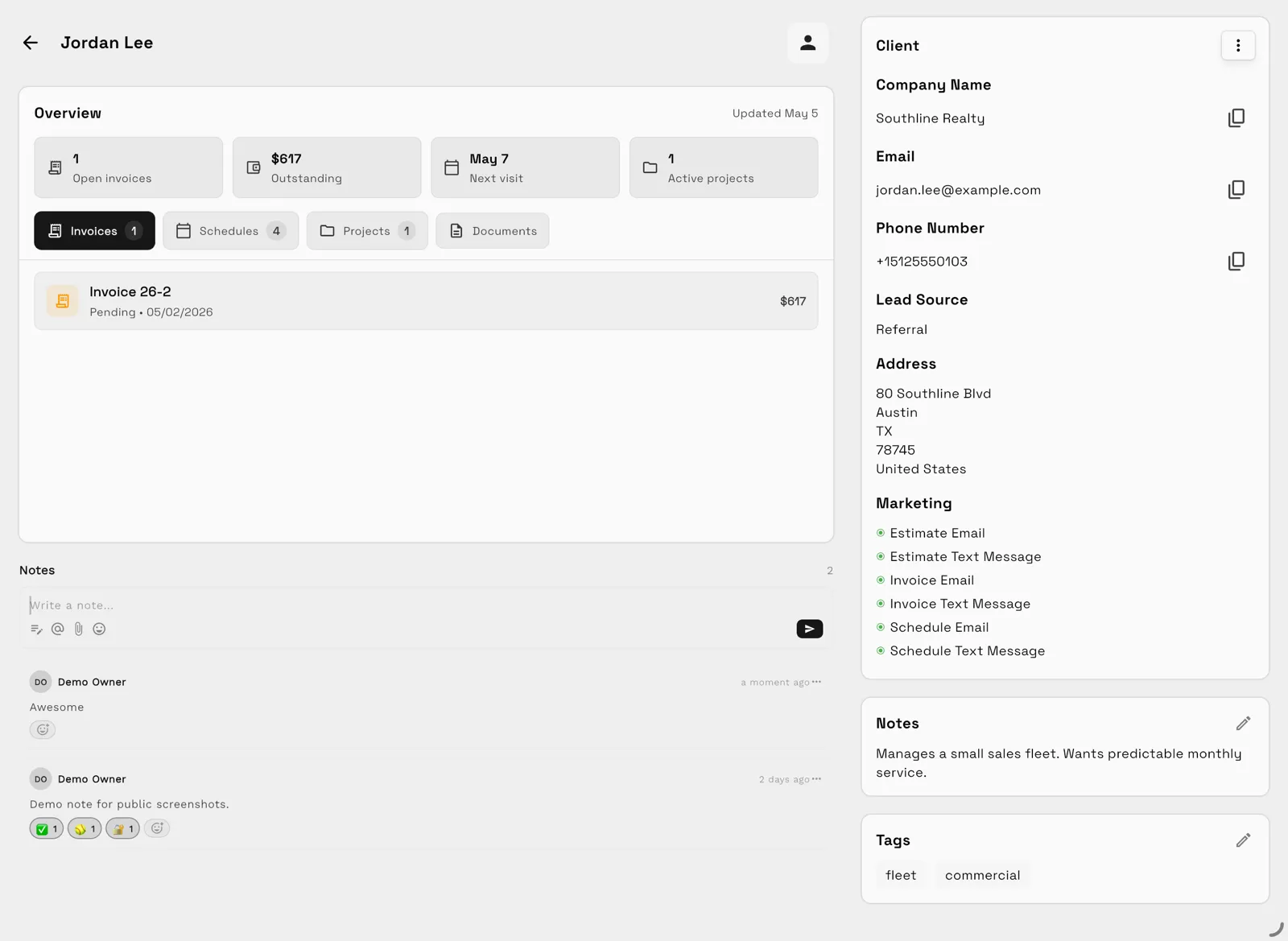
Limitations: the plan matrix lists no store connector, so storefront orders do not appear unless you pass them over via webhooks and the API, which begin on Specialist ($149 monthly, $119.25 on yearly billing, 10 seats). Change orders also start at Specialist. Cadet has one user and 5 active projects; Voyager ($74 a month, $59.25 billed yearly) has two seats. The 14-day trial covers Cadet through Commander, card required. Omnisend ($16 a month at 251 to 500 contacts, or free below that) costs less for plain list email, and Shopify Messaging adds no cost if you already pay for Shopify.
Best for: sellers who take team, event or wholesale jobs and want a Proposal, deposit and invoice in one place.
Side-by-side comparison
| Tool | Plan priced | Monthly | Billed yearly | Segments, email and support on that plan | Limits | Trial |
|---|---|---|---|---|---|---|
| Shopify | Basic | $39 | $29 a month | Segments, email campaigns and automations; Messaging 10,000 emails free | No ticket inbox; up to 3 B2B catalogs | 3 days, no card |
| Klaviyo | Email, 500 profiles | $20 | Not shown | Email flows and basic segmentation; free at 250 profiles | Priced per active profile | Free plan |
| Omnisend | Standard, 251 to 500 contacts | $16 | Not shown | Email with segmentation and automation; 6,000 emails a month | Steps up with contacts | Free plan, no card |
| Gorgias | Basic, helpdesk only (AI Agent off) | $60 | $50 a month | Ticket inbox; Shopify listed among platforms | 300 tickets a month | 7 days, no payment info |
| HubSpot | Starter | $20 per seat | $20 per seat (list) | Free tools for 2 users; Starter adds 1,000 marketing contacts; Shopify data sync documented | Per-seat pricing; companies sync for Plus only | Free tools, no card |
| Workspace369 | Cadet | $29 | $23.25 a month | Proposals, deposits, portal and invoices; no store connector | One user, 5 active projects | 14 days on Cadet through Commander, card required |
Match the tool to your shop
| If you mostly need | Start with | Why |
|---|---|---|
| Customer segments and email with no extra subscription | Shopify | Messaging includes 10,000 emails a month |
| Repeat-buyer flows as the list grows | Klaviyo | Free to 250 profiles, then $20 at 500 |
| A cheap paid email plan on a small list | Omnisend | $16 a month at 251 to 500 contacts |
| Fewer hours on parcel-status emails | Gorgias | Ticket inbox from $10 a month |
| Sales, service and marketing records for free | HubSpot | Free tools for up to 2 users; Shopify data sync documented |
| Proposals, deposits and invoices for custom runs | Workspace369 | Proposals, deposits and invoices on Cadet |
Workspace369 in action for a 60-shirt team order
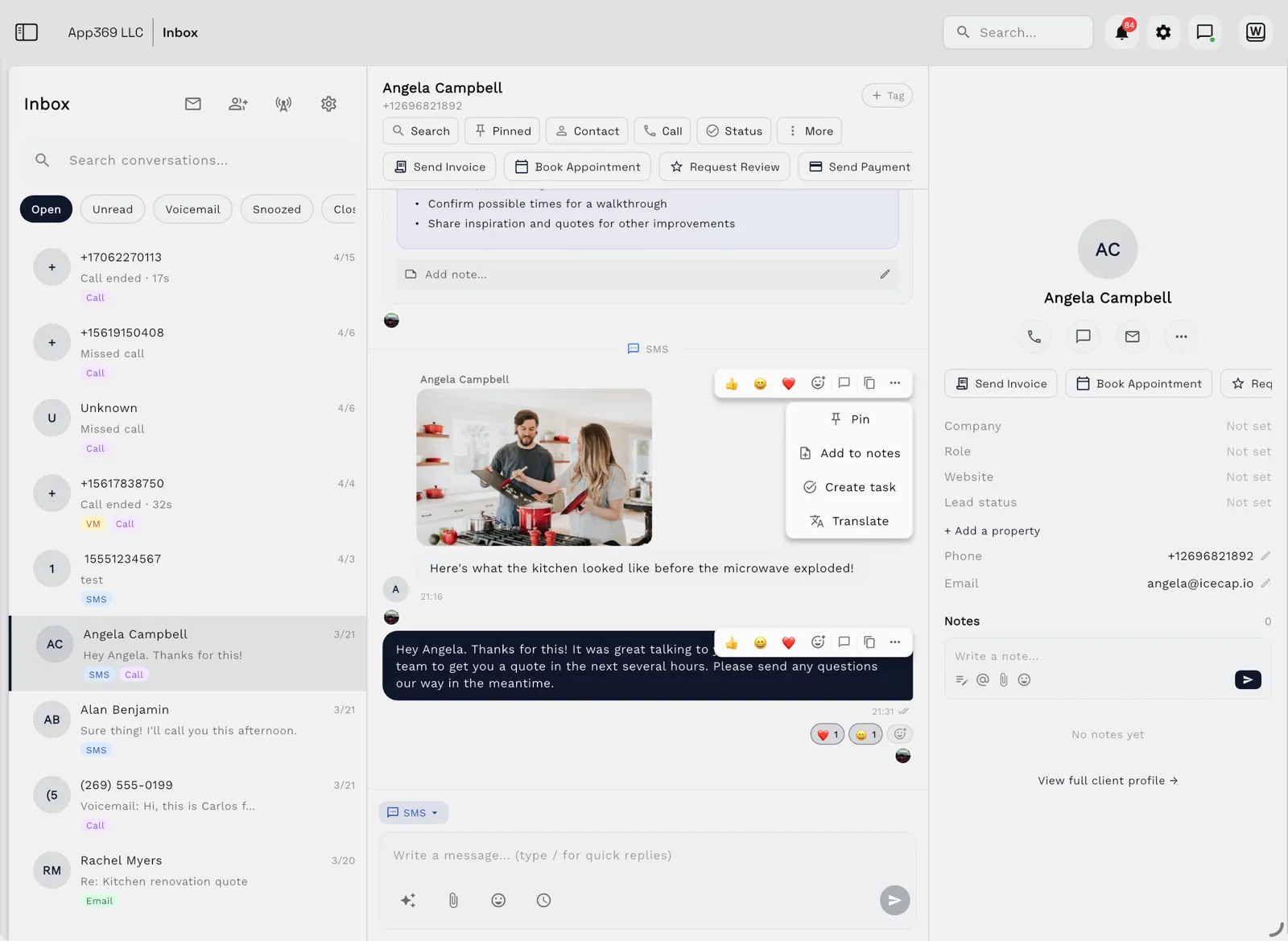
Workspace369 earns its place on the custom side of a print-on-demand shop, where one buyer orders in bulk. The first screenshot is the inbox in a demo workspace with sample data (not a print shop). One conversation shows an SMS thread with a photo, a menu on a message with Create task, and the buyer's details and notes on the right. A message such as "Can you do 60 shirts with our logo by the 14th?" would land there and become a task on that buyer. The communications page covers the inbox; SMS starts at Voyager, and Cadet has the email inbox.
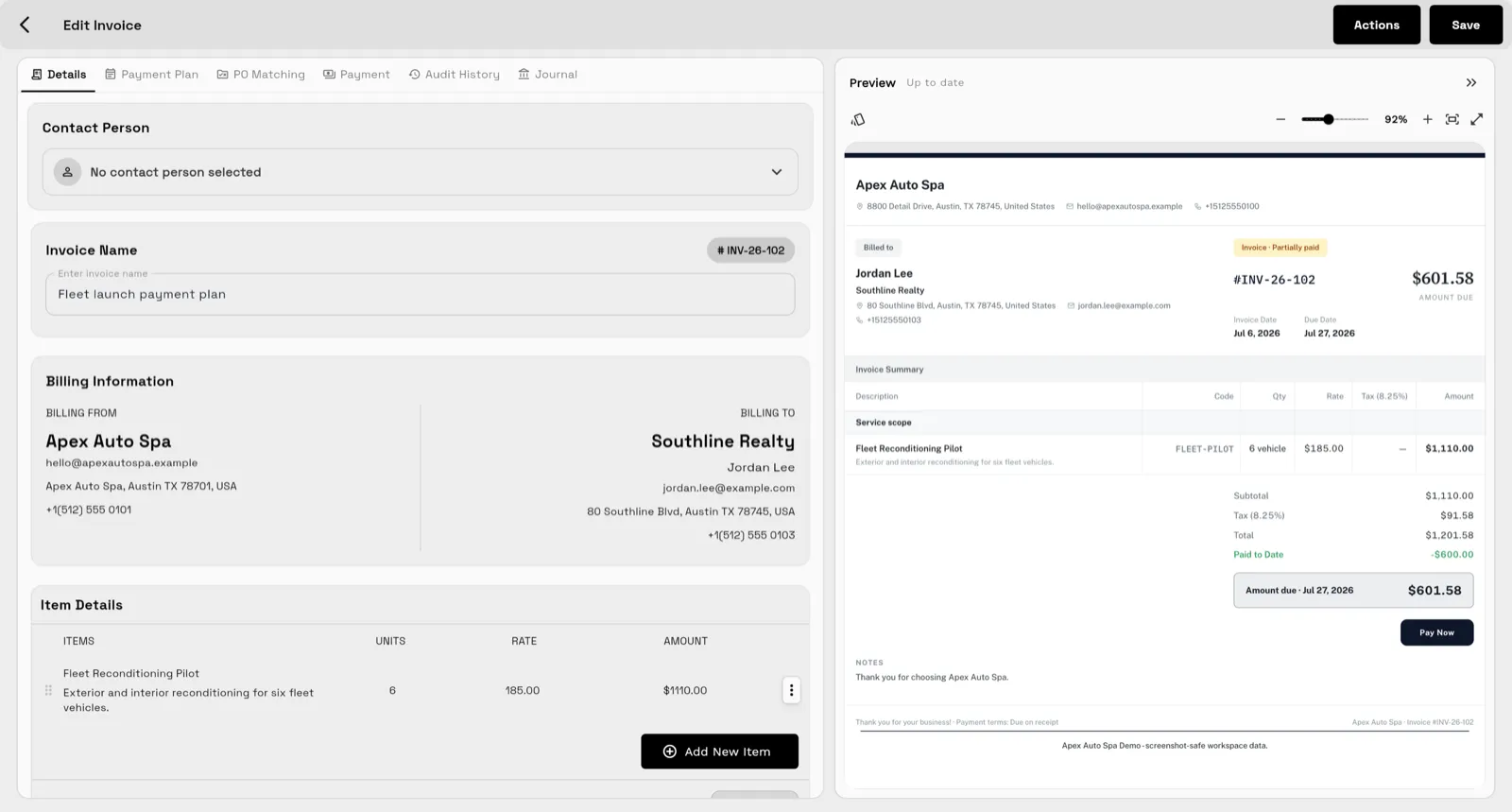
The second screenshot is the invoice editor from a demo workspace, with an invoice marked Partially paid, $600.00 paid to date and $601.58 due. For a team order, the shirts and the setup charge come from your product catalog (up to 20 items on Cadet), the deposit is taken when the buyer accepts the proposal, and the balance invoice goes out when the parcel ships. The buyer pays through online payments.
What it does not do: Workspace369 does not see storefront orders, sync with Printful or Printify, or track parcels, and inventory tracking starts at Specialist. Keep everyday orders in the store.
Trial test: one late parcel and one logo order
Walk two made-up buyers through every tool on your shortlist:
- Create a buyer who bought two designs and add a note about the second order.
- Log a message from that buyer saying the parcel is late, then answer it from the tool.
- Check that the buyer's history, the message and the reply sit together.
- Create a second buyer asking for fifty shirts with their logo.
- Price it, send the Proposal with an artwork proof and take a deposit.
- Invoice the balance and check the deposit is on it.
A good tool answers both buyers without a second login or a retyped address. A bulk order that only fits in a spreadsheet is the gap this exercise is meant to expose.

Keep production and customer records apart
Printing, packing and shipping stay with your fulfilment provider; the CRM should not try to copy them. Change print suppliers and the customer list, email history and support threads should stay put. If you do add Workspace369 for custom runs, file versioning is on every plan, and the pricing page shows what starts at which tier.
When to keep it simple
Should you ship only a few dozen orders a month, the store's customer list, its built-in email and a shared inbox are enough. Add an email specialist when repeat purchases drive sales, a helpdesk when support takes real hours, and a Proposals tool when bulk requests arrive by email. The print-on-demand product page shows how Workspace369 handles contracts and communications. Workflow Automations can send reminders and follow-ups, with email automations on every plan. Sellers on marketplaces can also read the Etsy and handmade guide.
Before you import real customers, run a whole Proposal on demo data and confirm you can export your records.
Sources reviewed for this guide
- Workspace369 plans and pricingMatrix read on October 26, 2026: seat counts, project caps, catalog size, Proposals, deposits, portal, integrations, trial.
- Shopify plansVendor page read October 26, 2026 for Basic on both billing views, marketing rows, B2B catalogs and trial wording.
- Shopify MessagingVendor page read October 26, 2026 for the free monthly email allowance and the overage rate.
- Klaviyo plansVendor page read October 26, 2026: free-plan caps and the Email price at 500 active profiles. A first-month promotion was left out.
- Omnisend pricingVendor page read October 26, 2026 at the 251 to 500 contact tier, with the three-months-upfront switch off to see the monthly price.
- Gorgias plansVendor page read October 26, 2026: helpdesk prices on both views, ticket caps and the trial FAQ.
- HubSpot customer platform pricingVendor page read October 26, 2026: free tools and the struck-through $20 Starter list price. New-customer promotional rates were left out.
- HubSpot Shopify data syncKnowledge-base article, last updated September 30, 2026, read October 26, 2026: synced objects, Shopify Plus company limit, metafields and custom mappings.
Workspace369 publishes this documentation-based comparison and is one of the options. It is not an independent ranking or a hands-on benchmark.
Run client follow-up in one workspace.
CRM, inbox, voice, invoicing, payments, projects, files, AI, and workflow automations — connected instead of exported.
14-day free trial. Card required. After the trial: from $29/month. Renews automatically every month until you cancel. Cancel anytime in Settings → Billing.