Best CRM for Shopify Store Owners in 2026
Best CRM for Shopify store owners: six options compared on price, customer segments, email and SMS, support history and order data, plus a refund test.
We make Workspace369, which is on this list. Weigh our ranking with that in mind.

By Simon Dziak, Founder, Workspace369 · LinkedIn
The best CRM for Shopify store owners keeps customer profiles, purchase-based segments, email and SMS, and support history tied to the order, so a message or a reply is never written blind. For most stores that means Shopify's own segmentation and Messaging first, then Klaviyo, Gorgias or Omnisend as volume grows; Workspace369 (see its Shopify store owners page) comes last of six here because it has no Shopify connector. If you run a wider catalog operation, read the best CRM for e-commerce brands guide too. To check what a promotion does to your margin, use the free profit margin calculator.
Disclosure and method: Workspace369 publishes this guide and is one of the options; we rank it last of six for this reader. It is a documentation-based shortlist, not a hands-on benchmark. Official vendor pages were read on October 19, 2026; confirm current plans with each vendor before you buy.
Key takeaways
- A Shopify store already holds the orders, so the useful CRM questions are which tool segments buyers by what they bought, sends the email or SMS, and keeps support conversations next to the order.
- Shopify's own Messaging sends up to 10,000 emails a month free then $1 per 1,000, and its segmentation is listed with an unlimited number of customers; both come with a Shopify plan ($39, $105 or $399 a month, or $29, $89 and $359 billed yearly).
- Klaviyo lists email at $20 a month for 500 active profiles with 5,000 emails; Omnisend lists Standard at $16 a month billed monthly for 251 to 500 contacts; Gorgias lists helpdesk plans at $10 (Starter, billed monthly only), $60, $360 and $900 a month for 50, 300, 2,000 and 5,000 tickets, or $50, $300 and $750 billed yearly for the last three.
- HubSpot documents a Shopify data sync for contacts, products, orders and abandoned checkouts on all of its plans (companies sync only for Shopify Plus stores), and lists Starter at $20 per seat a month.
- Workspace369 has no Shopify connector in its plan matrix or site copy. We rank it last of six: it fits only store owners who also sell custom, wholesale or business orders by proposal and invoice, from $29 a month for one user.
What's inside?
What a CRM for a Shopify store is (and what it is not)How we compared these toolsThe best CRM for Shopify store owners in 2026Side-by-side comparisonWhich tool fits your Shopify store?Run a repeat-buyer-and-refund test during the trialKeep the store as the source of ordersWhen to keep it simple
What a CRM for a Shopify store is (and what it is not)
For a Shopify store, a CRM is the customer memory around the checkout: who bought what and how often, which group they belong to, which email or text they last received, and what they asked support. Shopify already holds orders and customer profiles, so you are choosing what to add on top, not starting a database. It is not a replacement for the store, the payments or the shipping setup. A deal-pipeline CRM suits a store only when some sales are negotiated rather than bought through the checkout.
How we compared these tools
We checked each option against the same five points, using only the vendor's own pages as read on October 19, 2026:
- Price at a stated size: a plan price, or the cost at a named profile, contact or ticket count.
- Segments built from store data: whether the tool can group customers using orders, carts or custom attributes.
- Email and SMS: whether messages can be sent from the segment, and how SMS is charged.
- Support history and order link: whether conversations sit beside the customer and the order.
- Shopify connection and trial terms: whether Shopify is a listed platform, plus the free plan or trial.
We did not test deliverability, support speed, reliability or app performance, and we did not use review-site ratings. Order reflects documented fit for a store owner who wants customer data, segments, messaging and support tied to orders. Workspace369 ranks below cheaper tools that list segments and messaging because its plan matrix names none of them for storefront data and lists no Shopify connector.
The best CRM for Shopify store owners in 2026
1. Shopify Messaging and segmentation, best as the free starting point
Shopify's segmentation page describes building segments from demographic and behavioral filters, adding custom attributes from customer metafields, and updating segments dynamically as customers change; it lists an unlimited number of customers and templates for repeat buyers, high-value customers and abandoned checkouts. Messaging then sends email and SMS to those lists or segments. The Messaging page lists up to 10,000 emails a month free, then $1 per 1,000 additional emails, with SMS charged separately and available in select countries. Both come with a Shopify plan, listed at $39 a month for Basic, $105 for Grow and $399 for Advanced, or $29, $89 and $359 billed yearly.
Limitations: it works on Shopify data only, so it will not hold a wholesale conversation, a support inbox or a proposal. The pages we read describe email and SMS, not a helpdesk. Flows are simpler than the dedicated marketing tools below.
Best for: store owners who want purchase-based segments and campaigns with no extra subscription.
2. Klaviyo, best for deeper email and SMS flows on customer profiles
Klaviyo's pricing page describes a B2C CRM built around customer profiles. Its free plan lists up to 250 active profiles, 500 email sends a month, $5 of mobile messages a month, basic customer segmentation and a helpdesk with ticket management and a profile shared between service and marketing. In the plan builder, Email is shown at $20 a month for 500 active profiles with 5,000 emails a month, and a US toll-free SMS is shown at $0.01 plus carrier fees per send. The page names Shopify among the ecommerce platforms it connects to.
Limitations: the price rises with active profiles, and SMS is metered on top. A first-month discount was shown on the page; we did not count it. The free tier gives full email support only for the first 60 days.
Best for: stores that send frequent campaigns and automated flows and want segments to follow customer behavior.
3. Gorgias, best for support history beside the Shopify order
Gorgias prices a helpdesk by tickets a month, never per agent. The default monthly view lists Starter at $10 for 50 tickets with 3 seats, Basic at $60 for 300 tickets and Pro at $360 for 2,000 tickets, or $50 and $300 for Basic and Pro billed yearly. Overage is listed at $0.40 per ticket on Starter and Basic and $0.36 on Pro. The comparison table lists Shopify and Shopify Plus on every plan, BigCommerce from Basic and Magento from Pro. The page says AI Agent is on every plan and is paid only when it resolves a conversation. The page's FAQ says the trial lasts 7 days with all features and needs no payment info.
Limitations: it is a support tool, not a marketing or sales CRM, so campaigns and segments live elsewhere. Revenue attribution is listed from Pro. AI Agent charges are on top of these figures. We read the prices from the page data because the cards render client-side.
Best for: stores whose main customer record problem is support conversations that never reach the order.
4. Omnisend, best for e-commerce email and SMS at a small list size
Omnisend's pricing page lists a Free plan with 250 contacts and 500 emails a month, no credit card required. With the three-months-upfront discount switched off, Standard is $16 a month billed monthly for 251 to 500 contacts, with 6,000 emails a month. Pro is described as for high-volume senders adding SMS, and the page lists a new SMS price starting at $0.007 per message. The page offers a free migration of contacts, data and segments and lists Shopify among its supported platforms.
Limitations: billing is by contact count, and the discount view on the page shows lower prices that only apply to the upfront plan. It is a marketing tool, with no helpdesk or order-level support history on the pricing page.
Best for: small stores that want email and SMS flows built for retail with a clear contact-based price.
5. HubSpot, best when sales conversations need a pipeline too
HubSpot's free tools are listed at $0 for up to 2 users with no credit card required. Starter is listed at $20 per seat a month, with Marketing Hub Starter including 1,000 marketing contacts; promotional Starter prices were shown and not used, and the list price was the same in the monthly and annual views. HubSpot's knowledge base documents a Shopify data sync on all products and plans that links contacts to Shopify customers, syncs products, and brings in orders and abandoned checkouts, while company sync is only available for Shopify Plus subscriptions; records sync within 10 minutes of a change. It states that Shopify metafields are not supported by the sync, and custom field mappings need at least Data Hub Starter.
Limitations: price is per seat, and the platform is broad, so setup takes more care than the store-native tools. HubSpot says metafields are not supported in the sync.
Best for: owners who also run wholesale or partner deals and want a sales pipeline alongside synced Shopify customers.
6. Workspace369, best for custom and wholesale work sold by proposal and invoice
If a retailer asks for a bulk run with its own pricing, Workspace369 can hold that deal as one record: a proposal, a contract with e-signature, a deposit, a client portal and invoices. Cadet is $29 a month for one user ($23.25 billed yearly) and lists public intake forms, custom fields, a catalog of up to 20 products, time tracking and email automations on the plan. The screenshot below shows sample data, not a real store.
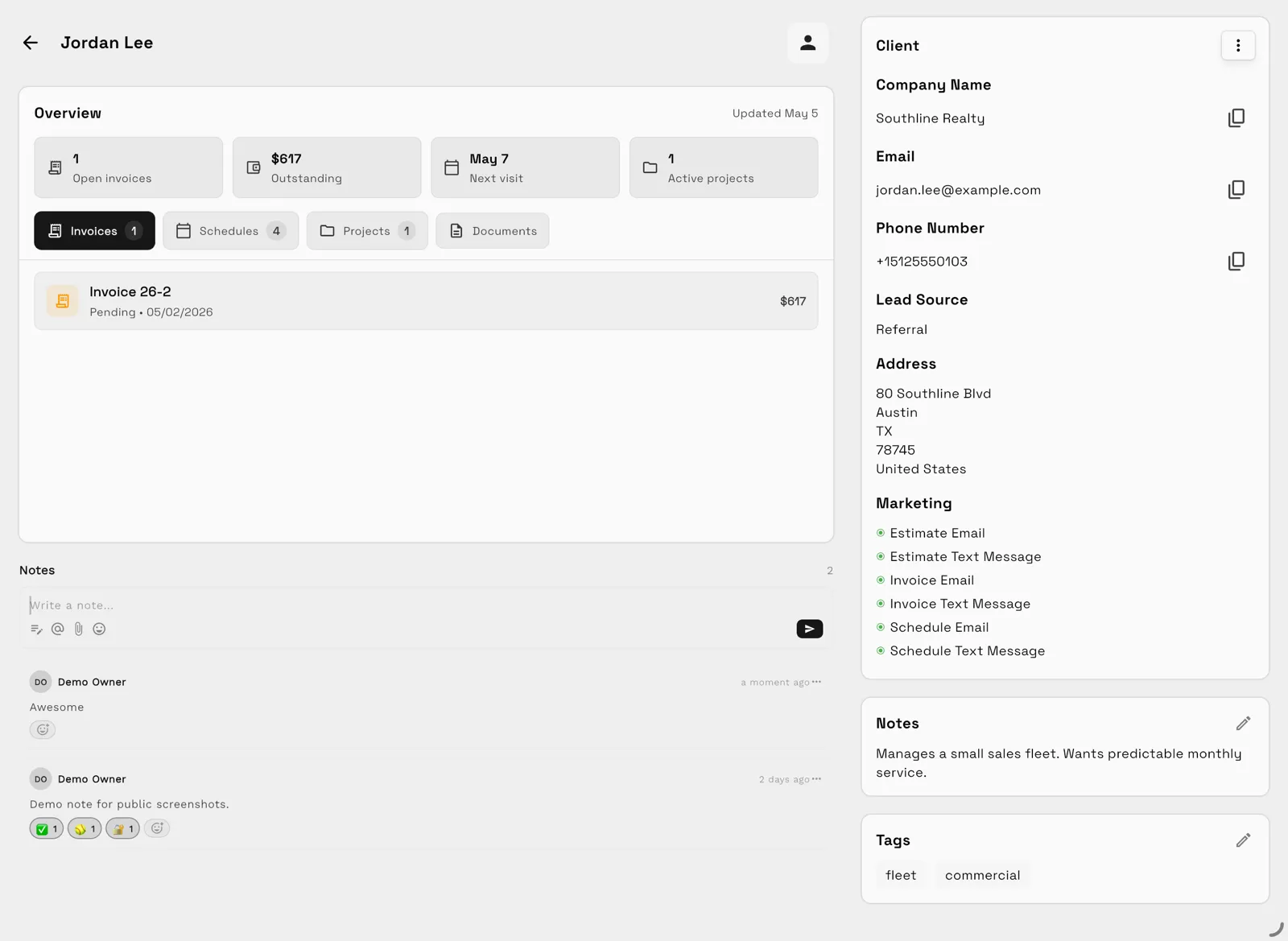
Limitations: we found no Shopify connector, order sync or storefront segment in the plan matrix or the site copy. Webhooks and the API start at Specialist ($149 a month, $119.25 billed yearly, 10 seats), so a connection would be custom work. Inventory tracking and low-stock alerts also start at Specialist, SMS starts at Voyager ($74 a month, $59.25 billed yearly, 2 seats), and Cadet has one user and 5 active projects. The 14-day trial needs a card. Shopify's own tools and Klaviyo cost less to start and are built around store data.
Best for: store owners who also sell custom runs, wholesale or business orders by proposal and invoice, and want those records outside the checkout.
Side-by-side comparison
| Tool | Plan priced | Monthly | Billed yearly | Segments, messaging and support at that plan | Limits | Trial |
|---|---|---|---|---|---|---|
| Shopify | Basic (with Messaging) | $39 | $29 a month | Segments; 10,000 free emails a month; SMS extra | Shopify data only | 3-day free trial |
| Klaviyo | Email, 500 active profiles | $20 | Not shown | Email, segments, SMS metered; helpdesk on free plan | Priced by active profiles | Free plan, 250 profiles |
| Gorgias | Basic helpdesk | $60 | $50 a month | Support tickets, Shopify on every plan | 300 tickets a month | 7-day free trial, no payment info |
| Omnisend | Standard, 251 to 500 contacts | $16 | Not shown | Email and SMS flows; 6,000 emails a month | Priced by contacts | Free plan, no card |
| HubSpot | Starter per seat | $20 | $20 per seat | Shopify data sync, segments, marketing contacts | 1,000 marketing contacts | Free tools, no card |
| Workspace369 | Cadet | $29 | $23.25 a month | Proposals, invoices, portal; no Shopify connector | 1 user, 5 active projects | 14 days, card required |
Which tool fits your Shopify store?
| If you mostly need | Start with | Why |
|---|---|---|
| Segments and campaigns with no extra bill | Shopify Messaging and segmentation | 10,000 free emails a month and segments with every plan |
| Deeper email and SMS flows | Klaviyo | Profile-based flows with a free plan to start |
| Support conversations beside orders | Gorgias | Ticket-based helpdesk with Shopify on every plan |
| Retail email and SMS at a small list | Omnisend | $16 a month for 251 to 500 contacts, Free plan available |
| Wholesale deals plus synced customers | HubSpot | Documented Shopify sync and a sales pipeline |
| Custom or wholesale work by proposal | Workspace369 | Proposals, deposits and invoices outside the checkout |
Run a repeat-buyer-and-refund test during the trial
Use a fictional customer in each tool you shortlist:
- Place a test order twice from the same email address so a repeat buyer exists.
- Build a segment of customers with two or more orders and check that the fictional buyer appears.
- Send that segment an email or text and see where the send is recorded.
- Refund one order and watch what changes on the customer record.
- Log a support request about the refund and check that it shows beside the order.
- Export the customer list and confirm the segment membership comes with it.
The best tool keeps the order, the segment, the message and the conversation on one record without retyping. If the refund or the support request lives in a separate place you must check by hand, that is the gap this test is built to find.

Keep the store as the source of orders
Whatever you add, let Shopify remain the place where orders, refunds and inventory are recorded. Marketing and support tools should read from it, not become a second copy you update by hand. Be careful with consent: segments and messages should respect each customer's marketing choice as captured in the store.
When to keep it simple
If you have a small list and a few support emails a week, Shopify's segments, its Messaging and a shared inbox may be enough. Move to a dedicated tool when you want automated flows by behavior, when support replies take too long to find, or when you sell custom or wholesale work that does not go through the checkout. The Shopify store owners product page shows how Workspace369 handles communications and invoices for that side of the business, and the pricing page has current plans. For nudges after a quote or an unpaid invoice, Workflow Automations can send email or SMS steps, and Cadet includes the email ones.
Use demo data for the first full wholesale order, and confirm you can export the records before you load real customers.
Sources reviewed for this guide
- Workspace369 pricingPlan matrix reviewed October 19, 2026 for seats, active projects, proposals, invoices, inventory, webhooks and API, SMS and trial terms.
- Shopify pricingOfficial pricing page reviewed October 19, 2026 for Basic, Grow and Advanced prices on the yearly and monthly views. Promotional trial pricing was not used.
- Shopify MessagingOfficial page reviewed October 19, 2026 for the 10,000 free emails a month, the $1 per 1,000 rate, and SMS charged separately.
- Shopify segmentationOfficial page reviewed October 19, 2026 for segment filters, custom attributes and use in automations.
- Klaviyo pricingOfficial pricing page reviewed October 19, 2026 in its plan builder for the free plan and email at 500 active profiles. A limited-time first-month offer was not used.
- Gorgias pricingOfficial pricing page reviewed October 19, 2026. The plan cards render client-side, so prices, ticket limits and platform support were read from the page's plan data, monthly and yearly. The FAQ gives the trial length and card terms.
- Omnisend pricingOfficial pricing page reviewed October 19, 2026 for the Free plan and Standard at 251 to 500 contacts with the 3-months-upfront discount switched off.
- HubSpot pricingOfficial pricing page reviewed October 19, 2026 for the free tools and Starter list price. Promotional Starter prices were not used.
- HubSpot Shopify data syncHubSpot knowledge base article last updated September 30, 2026, reviewed October 19, 2026 for the synced objects and sync timing.
Workspace369 publishes this documentation-based comparison and is one of the options. It is not an independent ranking or a hands-on benchmark.
Run client follow-up in one workspace.
CRM, inbox, voice, invoicing, payments, projects, files, AI, and workflow automations — connected instead of exported.
14-day free trial. Card required. After the trial: from $29/month. Renews automatically every month until you cancel. Cancel anytime in Settings → Billing.