Best CRM for Wholesalers & Distributors 2026
Six tools for small wholesalers and distributors compared on price, price lists, customer portals, stock and quotes-to-orders, plus a reorder test.
We make Workspace369, which is on this list. Weigh our ranking with that in mind.

By Simon Dziak, Founder, Workspace369 · LinkedIn
The best CRM for wholesalers and distributors keeps each trade account, its price tier, the quote that became an order and the stock behind it in one place, because the same customers reorder all year. For most readers that means an inventory-led order tool such as Zoho Inventory, inFlow or Odoo; Workspace369 (see its wholesalers and distributors page) comes fourth of six here because it lists no customer price lists or reorder portal. If you make to order instead of resale, read the best CRM for custom manufacturers guide. To check your margin on a price tier first, use the free profit margin calculator.
Disclosure and method: Workspace369 publishes this guide and is one of the options; we rank it fourth of six for this reader. It is a documentation-based shortlist, not a hands-on benchmark. Official vendor pages were reviewed on October 19, 2026. Confirm current plans with each vendor before buying.
Key takeaways
- A wholesale or distribution business lives on repeat accounts, tiered prices and reorders, so inventory-led order tools usually fit better than a sales-pipeline CRM; none of the six here replaces a full ERP.
- Zoho Inventory Standard is $29 a month billed yearly ($39 monthly) per organization for 3 users and lists a customer portal; inFlow starts at $99 a month billed yearly ($129 monthly) for 2 team members, and its B2B portal (Showroom) is an add-on on Lite and Core.
- Odoo Standard lists $31.10 per user a month billed yearly ($38.90 monthly) with CRM, Sales and Inventory apps under one fee, and says customers using the portal are not paying users; implementation help is not included.
- Workspace369 Cadet costs $29 a month ($23.25 billed yearly) for one user and lists catalog-based proposals and invoices, but inventory and change orders start at Specialist ($149 a month, 10 seats), client purchase orders are matched to invoices on every plan, and the plan matrix lists no EDI, customer price lists or reorder portal. We rank it fourth of six.
- Test each tool by cutting a 1,000-unit quote to 800 after acceptance, then repeating the order a month later: the quote, the stock, the invoice and the next order should follow without retyping.
What's inside?
What a CRM for wholesalers and distributors is (and what it is not)How we compared these toolsThe best CRM for wholesalers and distributors in 2026Side-by-side comparisonWhich tool fits your wholesale or distribution business?Run a quantity-cut and reorder test during the trialKeep warehouse allocation in a warehouse toolWhen to keep it simple
What a CRM for wholesalers and distributors is (and what it is not)
For a small wholesaler, the CRM is the account book behind the warehouse: who buys, at what price tier, what was quoted, what shipped, what is unpaid and when they last reordered. It is not a warehouse management system, a freight tool or an EDI gateway. Sales-pipeline CRMs track deals but usually stop at the quote; inventory tools track stock and orders but treat the relationship as an afterthought. The costly gap is between the two, where a quantity changes after acceptance and three records disagree.
How we compared these tools
Every tool got the same five questions, answered only from its vendor's pricing pages as they stood on October 19, 2026:
- Price for a team of three: list price on both billing views, including seat or user limits and any add-on the main feature needs.
- Account and order records: customer records, quotes or sales orders and invoices on the plan priced.
- Reorders and portal: whether the page names a customer portal or B2B portal, and on which plan.
- Stock and purchasing: inventory, locations, purchase orders or a vendor portal, and the plan that unlocks them.
- Setup and trial terms: onboarding fees, implementation help, trial length and whether a card is needed.
Left out: speed, support quality, uptime, barcode scanning, accounting sync, EDI with a real trading partner and any review-site ratings. The order follows documented fit for a small distributor with repeat accounts and physical stock. Workspace369 ranks above Pipedrive and HubSpot because its matrix names catalog-based proposals, invoices with purchase order matching and, from Specialist, inventory tracking, while their pricing pages name no invoices, stock or purchase orders. It ranks below the first three because they name customer price lists or a B2B reorder portal and it does not.
The best CRM for wholesalers and distributors in 2026
1. Zoho Inventory, best for low-cost order management with a customer portal
Zoho Inventory's pricing page lists Standard at $29 a month billed annually ($39 on the Monthly view) per organization, covering 500 orders a month, 3 users and 2 locations, with composite items, dropshipment, backordering and a customer portal. Premium is $79 ($99 monthly) for 3,000 orders, 5 users and 4 locations, and adds a vendor portal, batch and serial tracking and unit-of-measure conversion. A free plan allows 50 orders, 1 user and 1 location. The page's feature menu also names price lists and sales order management.
Limitations: it is an inventory product, not a relationship CRM; the page lists Zoho CRM only as an integration. Extra users can be added at $7.50 a month billed yearly ($9 monthly). The page names a 14-day trial but does not say whether a card is needed, and we did not check what the customer portal shows.
Best for: a small distributor with a few staff that wants orders, stock and price lists for the price of a modest subscription.
2. inFlow, best for stock-heavy distributors that want a branded B2B portal
inFlow lists Lite at $99 a month billed annually ($129 monthly) for 2 team members and 1 location, and Core at $299 ($379) for 5 team members and 5 locations. Every plan includes unlimited products, sales and purchases. Showroom, its B2B portal, is described as a portal on your own domain where customers take orders; it is an add-on on Lite and Core (price not shown on the page) and included on Pro ($499 a month billed annually) and Max. The trial is 14 days with no card.
Limitations: a team of three needs Core, so about $299 a month billed yearly before any Showroom add-on cost, which the page does not show. A $499 one-time onboarding package is optional on Lite and required on Core, Pro and Max. The page does not name quotes, sales orders or customer price lists, and the product is built around inventory rather than relationship history.
Best for: distributors whose main pain is stock across locations and who want customers to place orders themselves.
3. Odoo, best for one system across sales, inventory and purchasing
Odoo's pricing page lists a One App Free plan with one app and no user cap, and a Standard plan at $31.10 per user a month on the Yearly view ($38.90 monthly) that includes all apps, among them Sales, CRM, Inventory, eCommerce and Accounting. Custom is $61.00 ($76.20 monthly) and adds multi-company support, Studio and the external API. The page says customers and suppliers who use the portal are not paying users. A team of three on Standard is $93.30 a month on the Yearly view. We used the struck-through list prices, not the 12-month introductory discount shown beside them.
Limitations: implementation service is listed as not included, so a distributor with messy item data should budget for a partner. The pricing page shows a free-trial button but does not state the trial length or card terms.
Best for: growing distributors that expect to need purchasing, accounting and sales in one database and can fund setup.
4. Workspace369, best for quotes, projects and invoices when stock control is secondary
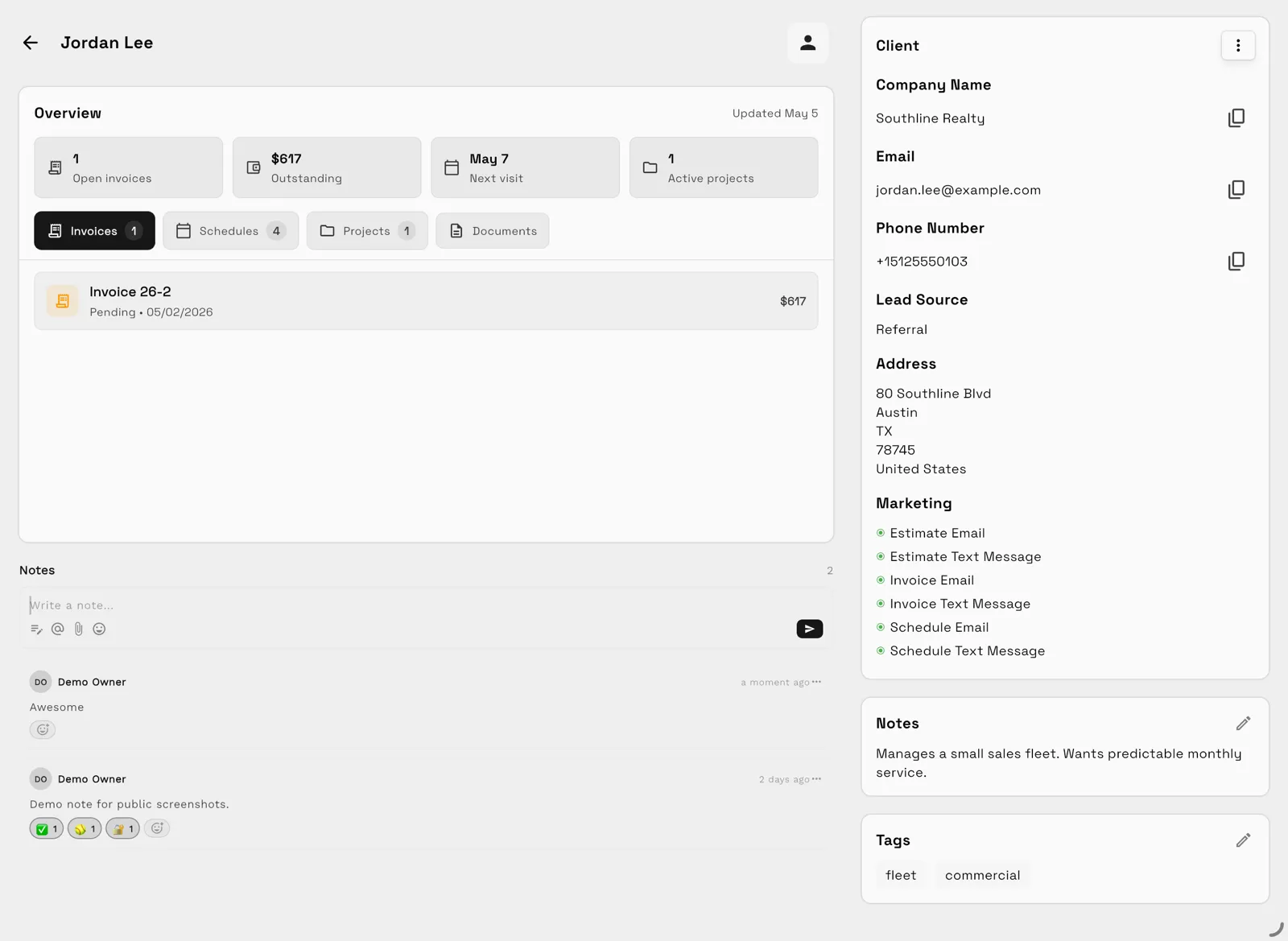
Workspace369 keeps the account record, catalog-based proposals, contracts, deposits, a client portal and invoices together. For one user, Cadet costs $29 a month ($23.25 billed yearly) and lists a product catalog of up to 20 items; Voyager ($74 a month, $59.25 billed yearly, 2 seats) lists no cap. Specialist ($149 a month, $119.25 billed yearly, 10 seats) adds inventory tracking, stock adjustments, low-stock alerts, change orders, proposal revisions, AR aging, webhooks and the API, and basic accounting. The image below is demo data, not a customer outcome.
Limitations: the plan matrix lists no EDI, customer-specific price lists or reorder portal, and inventory is not on Cadet or Voyager, so a three-person stock-holding team needs Specialist. We have not tested whether stock adjusts when an invoice is issued, or how it handles several warehouses. The 14-day trial needs a card. Zoho Inventory costs less and names price lists and a portal.
Best for: wholesalers that sell on negotiated quotes and projects, need change orders and invoices on one record and keep warehouse control elsewhere.
5. Pipedrive, best for managing a rep-led sales pipeline
Pipedrive's pricing page lists Lite at $24 per seat a month billed monthly ($14 billed annually), Growth at $49 ($39), Premium at $79 ($59) and Ultimate at $99 ($79). The comparison table shows a products catalog on all four plans, and quotes, proposals and contracts with e-signatures (the Smart Docs add-on) are included from Premium; on Lite and Growth it is a paid add-on starting at $32.50. Trials run 14 days with no card. Three reps on Premium would be $177 a month billed yearly.
Limitations: the pricing page does not name invoices, stock levels, price lists, purchase orders or a customer portal, so orders and billing would live in another tool. Quotes are included only from Premium.
Best for: wholesalers with a few field or inside reps who mainly need a deal pipeline and quote tracking.
6. HubSpot, best as a free contact list for new accounts
HubSpot's pricing page opens with free tools for up to 2 users and says no credit card is required. Its Starter tier shows a $20 per seat list price in the Pay Monthly, Commit monthly and Pay Annually views, with promotional prices printed beside it that we ignored. The page presents Starter as a bundle of marketing, sales, service, content and data tools, so a wholesaler would be paying for a broad customer platform rather than an order system.
Limitations: the CRM pricing page names no invoices, stock levels, price lists, purchase orders or portal for the tiers priced (HubSpot's menu lists a separate Revenue Hub for CPQ, billing and payments, which we did not price), and it gives no trial terms for Starter. Orders and billing would sit in another tool, and the list price grows with every rep.
Best for: a distributor starting a customer list and email history before it needs a system for orders.
Side-by-side comparison
| Tool | Plan priced | Monthly | Billed yearly | Orders, portal and stock at that plan | Limits | Trial |
|---|---|---|---|---|---|---|
| Zoho Inventory | Standard | $39 per organization | $29 a month | Price lists and sales orders in feature menu; customer portal | 3 users, 500 orders a month | 14 days, card not stated |
| inFlow | Lite | $129 | $99 a month | Unlimited sales and purchases; B2B portal is an add-on | 2 team members, 1 location | 14 days, no card |
| Odoo | Standard | $38.90 per user | $31.10 per user a month | Sales, Inventory and CRM apps; portal users are free | Per user; implementation extra | Free-trial button; length not stated |
| Workspace369 | Specialist | $149 | $119.25 a month | Inventory, catalog proposals, client PO matching; no price lists or reorder portal listed | 10 seats | 14 days, card required |
| Pipedrive | Premium | $79 per seat | $59 per seat a month | Products catalog; quotes with e-signatures from Premium; no stock or invoices named | Per seat | 14 days, no card |
| HubSpot | Starter (list) | $20 per seat | $20 per seat | None named on page | Free tools: up to 2 users | None stated for Starter |
Which tool fits your wholesale or distribution business?
| If you mostly need | Start with | Why |
|---|---|---|
| Orders, price lists and a portal for a small team | Zoho Inventory | Standard names a customer portal for 3 users |
| Customers placing their own orders against live stock | inFlow | Showroom B2B portal, with unlimited sales and purchases |
| Sales, stock and purchasing in one database | Odoo | One per-user fee includes Sales, CRM and Inventory |
| Negotiated quotes, change orders and invoices | Workspace369 | Catalog proposals, change orders and invoices; stock from Specialist |
| A rep pipeline with quotes | Pipedrive | Products catalog on every plan, quotes from Premium |
| A free starting contact list | HubSpot | Free tools for up to 2 users |
Run a quantity-cut and reorder test during the trial
Take one fictional trade account through each tool you shortlist:
- Create the account with a price tier and a bill-to and ship-to contact.
- Quote 1,000 units across three products and have the buyer accept.
- Cut the order to 800 units, and see whether the quote, the stock reservation and the amount due all change.
- Raise a purchase order for the shortfall and check it links back to the account.
- Send the invoice and record a part payment.
- A month later, repeat the order from the account's history and check the price tier carries over.
A good fit holds the quote, stock, invoice and reorder against one account with no retyping. If cutting a quantity means touching three screens, you have found the gap the test exists to expose.

Keep warehouse allocation in a warehouse tool
Picking, bin locations, carrier labels and landed cost belong in a warehouse or ERP system. If you pick a tool without that depth, such as Pipedrive, HubSpot or Workspace369, pair it with a stock system and keep the quote, change record and invoice with the account. In Workspace369, webhooks and the API start at Specialist if you want to link an order or storefront system, and CSV import is on every plan, so test a sample sync before moving real customers.
When to keep it simple
With a dozen accounts, a price-tier spreadsheet plus quote and invoice templates may be enough. Switch once a second person starts taking orders, a price change means editing many files, or nobody can say which accounts are overdue. The wholesalers and distributors product page shows how Workspace369 handles communications and products, and current plan limits are on the pricing page. Reorder nudges and overdue reminders can run through Workflow Automations, where email automations are on every plan.
Before you load real customers, walk one order end to end on demo data and confirm you can export the result.
Sources reviewed for this guide
- Workspace369 pricingPlan matrix as read October 19, 2026, covering seats, catalog limits, inventory, purchase orders, change orders, accounting and trial terms.
- Zoho Inventory pricingVendor pricing read October 19, 2026: Standard to Enterprise prices on the Yearly and Monthly views, user limits, the free plan and the trial.
- inFlow pricingVendor pricing read October 19, 2026: Lite to Max prices on the Annual and Monthly views, team-member limits, the Showroom (B2B Portal) add-on, onboarding and trial terms.
- Odoo pricingVendor pricing read October 19, 2026: the One App Free, Standard and Custom plans on the Yearly and Monthly views and the portal-user rule.
- Pipedrive pricingVendor pricing read October 19, 2026: Lite to Ultimate prices billed monthly and annually, the products catalog row, quotes on Premium and trial terms.
- HubSpot pricingVendor pricing read October 19, 2026: the free tools, the Starter list price and the billing views.
Workspace369 publishes this documentation-based comparison and is one of the options. It is not an independent ranking or a hands-on benchmark.
Run client follow-up in one workspace.
CRM, inbox, voice, invoicing, payments, projects, files, AI, and workflow automations — connected instead of exported.
14-day free trial. Card required. After the trial: from $29/month. Renews automatically every month until you cancel. Cancel anytime in Settings → Billing.