Best CRM for Fitness Coaches in 2026
Best CRM for fitness coaches: six tools compared on price, client limits, workout programming, check-ins, nutrition logging, packages and billing.
We make Workspace369, which is on this list. Weigh our ranking with that in mind.

By Simon Dziak, Founder, Workspace369 · LinkedIn
The best CRM for fitness coaches keeps the workouts, the check-ins, the agreed package and the invoice in step, so a client who pauses for two weeks does not leave old billing or a broken schedule behind. For an online coach, a fitness coaching platform such as Everfit is the closest documented fit. Workspace369 has no workout builder, so it ranks last and suits coaches who sell by proposal around a separate training app. To size a first payment, use the free deposit calculator.
Disclosure and method: Workspace369 publishes this guide and is one of the options. It is a documentation-based shortlist, not a hands-on benchmark. Official vendor pages were reviewed on October 22, 2026, with each billing toggle read in a browser. Check current plans with each vendor before you buy.
Key takeaways
- An online fitness coach needs two jobs covered: delivering training (workouts, check-ins, progress photos, nutrition logging) and running the business (the agreement, the subscription, the invoice and the paused package). Most coaching apps do the first; few do the second well.
- Everfit is the closest documented all-round fit: a free plan for 5 clients with a workout builder and progress photos, and Pro from $19 a month ($16 billed yearly) with booking, forms, food journal and macros tracking. Recurring subscriptions need its Payments & Packages add-on.
- Trainerize, My PT Hub, PT Distinction and TrueCoach all list workout programming and messaging; they differ on client caps, when payments and check-ins start, and whether a card is needed for the trial.
- Workspace369 Cadet is $29 a month ($23.25 billed yearly) for one user with Proposals, contracts, deposits, recurring invoices and a client portal. It has no workout builder, client app check-ins or progress tracking, so it only fits as the business layer next to a coaching app.
- Run one fictional client through a twelve-week program, a pause and a restart in each trial, and check that the schedule, the agreement and the billing all agree.
What's inside?
What a CRM for fitness coaches is (and what it is not)How we compared these toolsThe best CRM for fitness coaches in 2026Side-by-side comparisonWhich tool fits your coaching business?Run a package-pause test during the trialWhen to keep it simple
What a CRM for fitness coaches is (and what it is not)
Online fitness coaches and personal trainers sell coaching subscriptions and programs, deliver workout plans in an app, collect check-ins and progress photos, log nutrition, message clients and bill every month. That work splits in two. The delivery half (workouts, check-ins, habits, meal logging) lives in a coaching app. The business half (who the client is, what they bought, what is paid and what is owed) is the CRM. Some coaching apps now cover both halves in a basic way; general client tools such as Workspace369 cover only the second, with Proposals and contracts on every plan (see pricing). This guide makes no medical or health-outcome claim for any tool. Keep any health-condition records in a system approved for them.
How we compared these tools
We compared each tool on the same five points, using only the vendor's own pricing pages:
- Entry price for one coach, monthly and billed yearly, as listed on October 22, 2026. Where a page shows only one billing view, the table says "Not shown".
- Delivery tools: workout builder, check-ins, progress photos, habit or nutrition logging and messaging, where the page names them.
- Business tools: booking, packages, subscriptions, payments, forms and contracts.
- Hard limits on the entry plan: clients, seats or projects.
- Trial terms: length, and whether the vendor says a card is needed.
We did not test speed, app quality, support or reliability, and we did not use third-party ratings. Exercise.com publishes no prices and asks for a quote, so we left it out of the ranked list.
Why the order is what it is: it reflects documented fit for a solo online coach who delivers training and bills subscriptions. Everfit leads because its pricing page lists a workout builder, progress photos, a food journal and macros tracking, forms, booking and recurring subscriptions (as an add-on) in one place. Trainerize is second for its free start and meal tracking on Grow ($10 a month); My PT Hub is third for payments and bookings on Starter, but Starter caps at 3 clients; PT Distinction is fourth for one feature set at every tier from $19.90, with no yearly price shown; TrueCoach is fifth for a focused workout tool with free automated payments, but Starter caps at 5 active clients. Trainerize and PT Distinction list comparable delivery features below Everfit's paid price. Workspace369 ranks last because its plan matrix has no workout builder, client app check-ins or progress tracking. It is still included for the business half: Proposals, contracts, deposits, recurring invoices and a client portal sit on the $29 Cadet plan.
The best CRM for fitness coaches in 2026
1. Everfit, best all-round platform for delivery and billing
Everfit Starter is free for up to 5 clients and lists a custom exercise library, workout builder, metrics and progress photos, tasks, inbox messaging, and client and coach apps for iOS and Android. Pro starts at $19 a month billed monthly, or $16 a month billed annually, for 5 clients, and adds booking and scheduling, habit coaching, forms and questionnaires, food journal and macros tracking, basic meal plans, an advanced program builder, custom branding and community forums. Studio starts at $105 a month ($88 billed annually) for 50 clients and adds group chat, broadcast messages and an on-demand training portal. The Payments & Packages add-on is $9 a month ($8 billed annually) and lists recurring subscriptions and one-time coaching packages. Pro and Studio list a free trial with no credit card required.
Limitations: the "From" price rises with the number of clients, and subscription billing is a paid add-on. Proposals and contracts are not named on its pricing page.
Best for: coaches who want workouts, progress photos, food logging and booking in one app, and will add payments as an extra.
2. Trainerize, best for a free start and a large feature set
Trainerize Basic is free for 1 client and lists a mobile app for iOS and Android, workout programs and delivery, basic in-app messaging, and habit and lifestyle coaching. Grow is $10 a month billed monthly, or $9 billed annually, for 2 client seats and adds an AI workout builder, custom client programs, client meal and macro tracking, a Trainerize.me profile and integrations with client apps and wearables. Pro 5 is $25 a month billed monthly, or $23 billed annually, for 5 clients, and adds custom exercise videos, consultation forms, advanced messaging and challenges; larger client tiers up to 200 are priced on the page's selector. Stripe Integrated Payments, Advanced Nutrition Coaching, Business Video Coaching and a custom branded app are add-ons. The page says the trial is risk-free with no credit card required.
Limitations: it prices by client seat, so a growing roster steps up in price, and each add-on costs extra. Progress photos and proposals are not named on its pricing page.
Best for: coaches who want to start free and grow into workout programming, meal tracking and challenges.
3. My PT Hub, best for payments and booking on the entry plan
My PT Hub Starter is $25 a month on the flexible monthly view, or $22.50 a month on the annual plan paid monthly, for 3 clients. It lists payment processing, 1-to-1 bookings, habit coaching, metrics and progress photos, chat messaging, 50 workouts and 50 nutrition plans. Premium is $59 a month flexible ($52 on the annual view) and lists unlimited clients, an AI workout builder, group bookings, classes and live streams, automated client check-ins, scheduled and automated messaging, program compliance tracking and community features. Ultimate is $215 a month flexible ($195 annual) and adds concierge support and 5 additional trainers. A custom branded app is a $95 one-time add-on. The 30-day trial says no card details are required.
Limitations: Starter is capped at 3 clients and 50 workouts, and automated check-ins start at Premium. The page names no proposals or contracts.
Best for: coaches who want payments, booking and progress photos from the first plan and a long no-card trial.
4. PT Distinction, best for every feature at one price per client tier
PT Distinction prices monthly only: Basic is $19.90 for 3 clients, Pro is $59.90 for 25 and Master is $89.90 for 50, with extra clients charged $6.00, $2.40 and $1.60 a month. The page lists the same features on every plan: an AI program builder, an AI meal planner for nutrition coaching, assessments, group training, in-app messaging, scheduled email and SMS, automated workflows, habits, and selling packages and taking payments. Custom branded apps start on Pro. The trial is one month, and the page says you can cancel in the first month and pay nothing; it does not state whether a card is needed. We found no yearly price.
Limitations: the Basic plan covers only 3 clients, and the page shows no yearly option. Proposals and contracts are not named.
Best for: coaches who want automation, scheduled messages and package sales without feature tiers.
5. TrueCoach, best for a focused workout and check-in tool
TrueCoach Starter is $29.98 a month billed monthly, or $26.34 a month billed annually, for up to 5 active clients. Standard is $69.98 monthly ($57.99 annually) for 20 clients, and Pro is $164.98 monthly ($136.99 annually) for 50. Every plan lists a program and workout builder, a client management tracker, MyFitnessPal nutrition and habit tracking, a client dashboard, a video exercise library, in-app messaging, free automated payments and progress tracking with graphs. Standard and Pro add wearables data integration, a custom-branded app, advanced habit and nutrition tracking and Zapier automations. The page offers a 14-day free trial with no credit card required.
Limitations: the active-client caps are low for the price, and larger rosters need custom pricing. Booking, forms and proposals are not named on its pricing page.
Best for: coaches who want a focused workout, check-in and tracking tool and have a small roster.
6. Workspace369, best for the business side around a coaching app
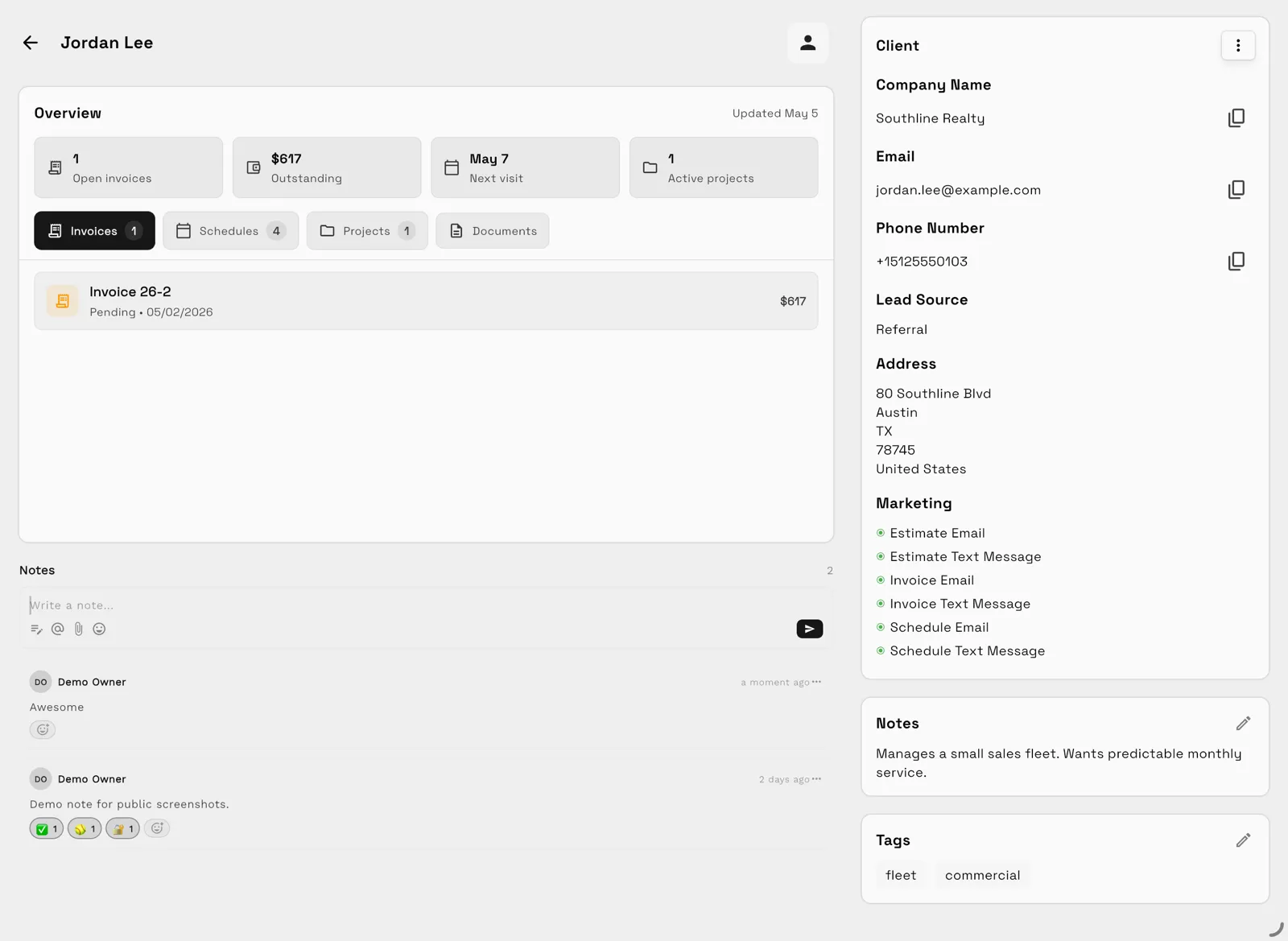
Workspace369 lists client records, public intake forms, a client portal, Proposals with deposit on acceptance, contracts with e-signature, recurring invoices, saved payment methods, retainers and payment schedules, and scheduled messages on every plan. Cadet is $29 a month for one user ($23.25 billed yearly), with email appointment reminders and email automations. The screenshot is a demo record, not a customer result.
Limitations: it has no workout builder, client app check-ins, progress photos or nutrition logging, so clients still need a coaching app. Online booking and payment plans start at Specialist ($149 a month, $119.25 billed yearly). Cadet allows 5 active projects and one seat, and SMS starts at Voyager ($74). The 14-day trial needs a card.
Best for: coaches who sell higher-priced programs by proposal and want contracts, deposits and recurring invoices on one client record next to their training app.
Side-by-side comparison
| Tool | Entry price (monthly) | Billed yearly | Delivery tools on entry plan | Business tools | Main entry-plan limit | Trial |
|---|---|---|---|---|---|---|
| Everfit | Free (Starter); $19 (Pro) | $16 a month (Pro) | Workout builder, progress photos, messaging | Booking and forms on Pro; subscriptions add-on $9 | 5 clients | Free plan; Pro trial, no card |
| Trainerize | Free (Basic); $10 (Grow) | $9 a month (Grow) | Workout programs, habits, messaging; meal tracking on Grow | Stripe payments add-on | 1 client free; 2 on Grow | Risk-free, no card |
| My PT Hub | $25 (Starter) | $22.50 a month | Nutrition plans, habits, progress photos, chat | Payment processing, 1-to-1 bookings | 3 clients | 30 days, no card |
| PT Distinction | $19.90 (Basic) | Not shown | AI program builder, habits, messaging | Packages, payments, scheduled SMS | 3 clients | 1 month, card not stated |
| TrueCoach | $29.98 (Starter) | $26.34 a month | Workout builder, progress tracking, MyFitnessPal | Automated payments | 5 active clients | 14 days, no card |
| Workspace369 | $29 (Cadet, one user) | $23.25 a month | None named | Proposals, contracts, recurring invoices; booking from Specialist ($149) | 5 active projects, 1 seat | 14 days, card required |
Which tool fits your coaching business?
| If you mostly need | Start with | Why |
|---|---|---|
| Workouts, progress photos, food logging and booking in one app | Everfit | Listed on a $19 plan, with a free plan for 5 clients |
| A free start with room to grow | Trainerize | Free Basic plan, then Grow and Pro tiers by client count |
| Payments and booking from the first plan, no card for 30 days | My PT Hub | Payment processing and 1-to-1 bookings on Starter |
| Automation and package sales with no feature tiers | PT Distinction | Scheduled SMS, workflows and package sales on every plan |
| A focused workout and tracking tool for a small roster | TrueCoach | Workout builder, progress tracking and payments on every plan |
| Proposals, deposits and recurring invoices around a separate app | Workspace369 | Proposals, contracts and recurring invoices on Cadet |
Run a package-pause test during the trial
Take one fictional client through the sequence below in each tool you shortlist. The scenario is an exercise, not a customer result.
- Send an intake form and record the client's goals and schedule in the notes.
- Create a twelve-week online program billed monthly, and have the "client" accept it.
- Collect the first payment, or the deposit.
- Assign the first two weeks of workouts and book the first check-in.
- After week four, pause the client for two weeks and move the remaining check-ins and the billing dates.
- Open the client's view and check the schedule, the agreement and what is still owed.
If you run the test, expect the best tool to keep the history, show the new dates and not delete the old invoice.

When to keep it simple
If you coach a handful of clients, a free coaching-app plan and an invoice template can carry you a long way. Move to a client tool when you lose track of which clients are paused, when you chase payments by hand, or when you sell more than one kind of offer. The fitness coaches product page shows how Workspace369 handles Proposals, communications and invoices, and the pricing page has current plans. For the wider field, see the best coaching software comparison.
Before importing real clients, run one full package on demo data and check that your records can be exported.
Sources reviewed for this guide
- Everfit pricingOfficial pricing page reviewed October 22, 2026, with the Bill Monthly and Bill Annually views read in a browser, for prices, client limits, features, add-ons and trial terms.
- Trainerize pricingOfficial pricing page reviewed October 22, 2026, with the Monthly and Annual views read in a browser, for prices, client seats, features and trial terms.
- My PT Hub pricingOfficial pricing page reviewed October 22, 2026, with both billing views read in a browser, for prices, client limits, features and trial terms.
- PT Distinction pricingOfficial pricing page reviewed October 22, 2026 for monthly prices, client limits, features and the free trial; the page shows no yearly option.
- TrueCoach pricingOfficial pricing page reviewed October 22, 2026, with the Monthly and Annually views read in a browser, for prices, active-client limits, features and trial terms.
- Exercise.com pricingOfficial pricing page reviewed October 22, 2026; it lists no prices and asks for a quote, so the tool is not ranked.
- Workspace369 pricingPlan matrix reviewed October 22, 2026.
Workspace369 publishes this documentation-based comparison and is one of the options. It is not an independent ranking or a hands-on benchmark.
Run client follow-up in one workspace.
CRM, inbox, voice, invoicing, payments, projects, files, AI, and workflow automations — connected instead of exported.
14-day free trial. Card required. After the trial: from $29/month. Renews automatically every month until you cancel. Cancel anytime in Settings → Billing.