Best CRM for Insurance Agents in 2026
Best CRM for insurance agents: five CRMs compared on price, renewal follow-up, carrier and AMS links and trial terms, plus a renewal-calendar test.
We make Workspace369, which is on this list. Weigh our ranking with that in mind.

By Simon Dziak, Founder, Workspace369 · LinkedIn
The best CRM for insurance agents tracks prospects, renewals and follow-up, while policies stay in the agency management system. AgencyZoom fits independent agencies that want renewal automation on top of an AMS. Insureio fits life, long-term care and annuity producers. HubSpot fits a free general start, Salesforce Financial Services Cloud fits large brokerages, and Workspace369 fits a general client record.
Workspace369 (see its insurance agents page) comes last of five here because its pricing matrix lists no rater, carrier or AMS connection. For a neighbouring regulated profession, see the best CRM for financial advisors guide. To tidy a renewal nudge first, use the free proposal follow-up generator.
Disclosure and method: Workspace369 publishes this guide and is one of the options; we rank it last of five for this reader. It is a documentation-based shortlist, not a hands-on benchmark. Official vendor pages were reviewed on October 26, 2026. Insurance is regulated, and requirements vary by state and carrier. Nothing here is compliance, licensing or legal advice, so confirm what you can store and send with your agency or compliance team.
Key takeaways
- Insurance agents usually need two systems: an agency management system (AMS) for policies and a CRM for prospects, renewals and follow-up. This guide ranks CRMs only; it does not rank AMS products.
- AgencyZoom lists Essential at $149 a month ($119.20 on its Annually view), with renewal automation starting at Growth ($199, or $159.20 on the Annually view), and says it extends an AMS rather than replacing it.
- Insureio lists Basic at $25 billed monthly with a 30-day free trial, but its pages describe life, long-term care, disability and annuity quoting, so check that it fits your lines.
- HubSpot Sales Hub Starter lists $20 per seat a month and its free tools cover up to 2 users; Salesforce Financial Services Cloud lists $325 to $700 per user per month billed annually.
- Workspace369 Cadet is $29 a month ($23.25 billed yearly) for one user, but its pricing matrix lists no rater, carrier or AMS connection, so we rank it last of five. Its 14-day trial covers Cadet through Commander and needs a card. Compliance rules vary by state and carrier: check with your agency or compliance team.
What's inside?
What a CRM for insurance agents is (and what it is not)How we compared these toolsThe best CRM for insurance agents in 2026Side-by-side comparisonWhich tool fits your insurance agency?Workspace369 in action for a renewal-season follow-upRun a renewal-calendar test during the trialKeep policy records in your policy systemCheck regulation with your own teamWhen to keep it simple
What a CRM for insurance agents is (and what it is not)
A CRM for an insurance agent is the sales and service side of the book: who the prospect is, where the quote stands, when the renewal conversation is due and what was said last. It is not an agency management system. An AMS such as HawkSoft, EZLynx or AgencyBloc is built to hold policy and account records, and we left those out of the ranking because they are a different category, mostly with no public price. Many agencies run both, so the useful question is how well a CRM sits beside your AMS.
How we compared these tools
We compared each tool on the same five points, using only the vendor's own pricing pages as read on October 26, 2026:
- Price at one seat count, with the monthly and yearly figure when the page shows both, and what the price basis is (per user, per agency or unstated).
- Insurance-specific features named on the page, such as renewal automation, an AMS or rater link, or a carrier application flow.
- Follow-up tools: tasks, two-way email or texting, and automation, tied to the plan that lists them.
- Limits: users included, lines of business named and plan gates.
- Trial terms: length, and whether the page says a card is needed.
We only ranked tools with a public price. We did not test speed, support, reliability or mobile apps, did not test any carrier, rater or AMS integration, and did not use third-party ratings. We make no claim about licensing, E&O, carrier appointments, data retention rules or consumer-protection law. Order reflects documented fit for an independent agent running sales and renewals.
The best CRM for insurance agents in 2026
1. AgencyZoom, best for producer pipelines and renewals beside an AMS
AgencyZoom's pricing page, on its Independent tab, lists Essential at $149 a month, Growth at $199 and Pro at $349 on the Monthly view. The Annually view shows $119.20, $159.20 and $279.20 a month, labelled a 20% discount. All plans include up to seven users. Essential lists lead management, task management, sales tracking, referral tracking, an AMS integration and rater integration. Growth adds renewal automation, Google Reviews, and two-way email and texting; Pro adds events automation, a service center and click to call. The AMS integration note says it covers most major agency management systems and that some may cost extra. The page answers "Does this replace my AMS?" with no: it works as an extension to your AMS. A 14-day free trial is offered, and the page says the first payment comes after the trial.
Limitations: renewal automation starts at Growth, not Essential. The page has separate Allstate and Farmers tabs with different plans, so check the tab that matches your agency. We did not test the AMS integration or its coverage of your AMS, and onboarding is described as taking 2 to 4 weeks.
Best for: independent agencies that already run an AMS and want a sales, retention and renewal layer on top.
2. Insureio, best for a low-cost CRM for life and annuity producers
Insureio's pricing page lists Basic at $25, Marketing at $50, Agency Management at $50 and Marketing & Agency Management at $75, each shown as billed monthly, with a 30-day free trial. Basic lists an e-application and drop-ticket solution, unlimited quoting and lead capture widgets, brand profiles and analytics. The pricing page lists quoters for life, simplified issue, final expense, no exam and annuities, and its application page names term life, permanent life, LTC, disability and annuities. Team View is a $5 per team member add-on marked "Coming Soon".
Limitations: the price basis (per user or per agency) is not stated on the pricing page, and no annual view was shown. Property and casualty lines are not named on the pages we read, and the page does not say whether a card is needed for the trial. A footnote also mentions a free EZLife version whose website quoting widgets need a Compulife subscription. We did not check which carriers are covered.
Best for: life, long-term care and annuity producers who want an inexpensive insurance CRM with quoting and application fulfilment.
3. HubSpot Sales Hub, best for a low-cost general CRM with a free start
HubSpot's pricing page lists free tools for up to 2 users with no credit card required, and Sales Hub Starter at a $20 per seat a month list price. Professional lists $90 to $100 per seat a month depending on the billing option, plus a $1,500 one-time onboarding fee. Starter lists 500 calling minutes and up to 50 workflows with restricted triggers and actions. The page also shows a $7 new-customer Starter offer, which we did not use.
Limitations: HubSpot is not built for insurance, so renewal dates, policy lines and carrier links are things you would set up yourself as custom fields or workflows. We did not check which of those need a higher tier. Features that matter at scale sit on Professional, which costs several times Starter per seat and adds the onboarding fee.
Best for: small agencies that want a mainstream CRM, a free start and a large app ecosystem, and can configure it themselves.
4. Salesforce Financial Services Cloud, best for larger agencies with admin capacity
Salesforce's Financial Services Cloud page lists Sales Core at $325 per user per month, Sales Advanced at $500 and Sales Max at $700, all billed annually. Advanced is listed as including Insurance Brokerages, and Max includes the Digital Insurance and Digital Origination add-ons. Core is described as industry-specific data models built on Sales Cloud Core Edition. The page offers a 30-day free trial with no credit card.
Limitations: the price is many times the others for a small team, no monthly view was shown and the Insurance Brokerages inclusion starts at Advanced. It is a platform that usually needs an administrator, and we did not test setup time.
Best for: larger brokerages or multi-office agencies with budget and a Salesforce admin, who want a financial-services data model.
5. Workspace369, best for a general client-work record beside a policy system
Workspace369 keeps the client record, a proposal, contracts with e-signature, a client portal, communications and invoices together. Cadet is $29 a month for one user ($23.25 billed yearly), with 5 active projects, client custom fields, CSV import, email inbox, tasks, appointment reminders and Workflow Automations with scheduled-time triggers and timed waits for up to 3 active workflows. The screenshot is a demo record, not a customer result.
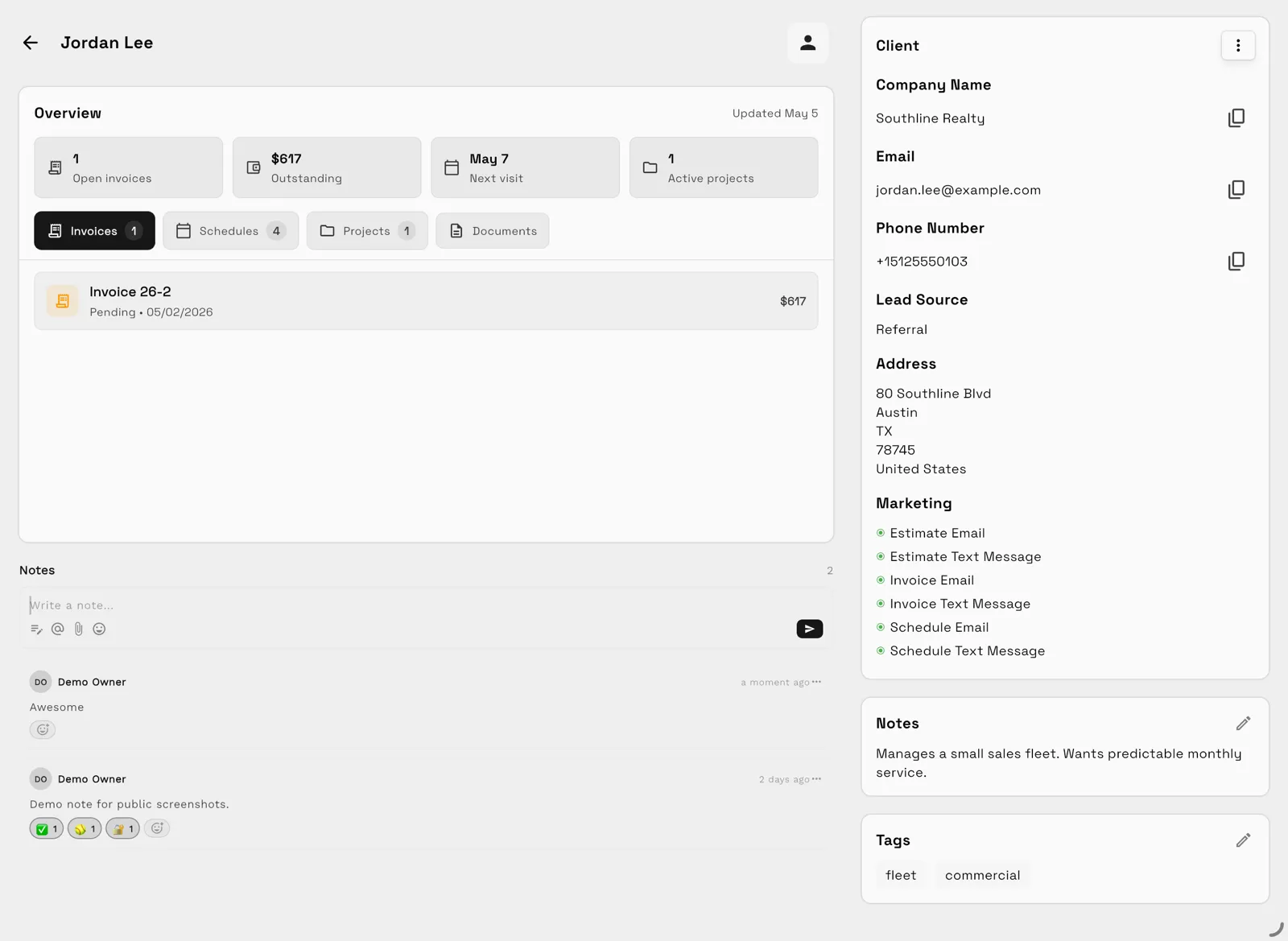
Limitations: the pricing matrix lists no rater, carrier or AMS integration, and no insurance-specific records, so policy data stays in your AMS. Webhooks and API start at Specialist ($149 a month, $119.25 billed yearly, 10 seats). SMS messaging and the shared inbox start at Voyager ($74 a month, $59.25 billed yearly, 2 seats), and extra seats are $10. The matrix's 90-day data retention row means workspace data stays available for 90 days after you cancel. It says nothing about how long your agency must keep policy or client records, so ask your compliance team about that. The 14-day trial covers Cadet through Commander, card required. AgencyZoom and Insureio cost less to start and are built for this work.
Best for: small agencies and independent agents who want proposals, agreements, invoices and follow-up on one general client record, and keep policy data in their AMS.
Side-by-side comparison
| Tool | Plan priced | Monthly | Billed yearly | Insurance items at that plan | Limits | Trial |
|---|---|---|---|---|---|---|
| AgencyZoom | Growth (Independent tab) | $199 | $159.20 a month | Renewal automation, AMS integration, two-way email and texting | Up to 7 users included | 14 days |
| Insureio | Basic | $25 billed monthly | Not shown | E-application and drop-ticket solution, quoting widgets | Price basis not stated | 30 days |
| HubSpot Sales Hub | Starter | $20 per seat (list) | See site | General CRM, 500 calling minutes, up to 50 workflows; no insurance items named | Free tools for 2 users | Free tools, no card |
| Salesforce Financial Services Cloud | Sales Core | Not shown | $325 per user a month | Industry data models; Insurance Brokerages from Advanced ($500) | Per-user pricing | 30 days, no card |
| Workspace369 | Cadet | $29 | $23.25 a month | No rater, carrier or AMS link; webhooks and API from Specialist | 1 user, 5 active projects | 14 days on Cadet through Commander, card required |
Which tool fits your insurance agency?
| If you mostly need | Start with | Why |
|---|---|---|
| A producer and renewal layer beside your AMS | AgencyZoom | Renewal automation and AMS integration are listed, and it says it extends an AMS |
| A low-cost CRM for life and annuity sales | Insureio | Basic is $25 billed monthly, with quoting and application fulfilment |
| A free or cheap general CRM you can configure | HubSpot Sales Hub | Free tools for 2 users and Starter at $20 per seat |
| A financial-services platform and a Salesforce admin | Salesforce Financial Services Cloud | Insurance Brokerages is included from Advanced |
| Proposals, agreements and invoices on one client record | Workspace369 | Contracts, a portal and invoices are on Cadet, with policy data kept in your AMS |
Workspace369 in action for a renewal-season follow-up
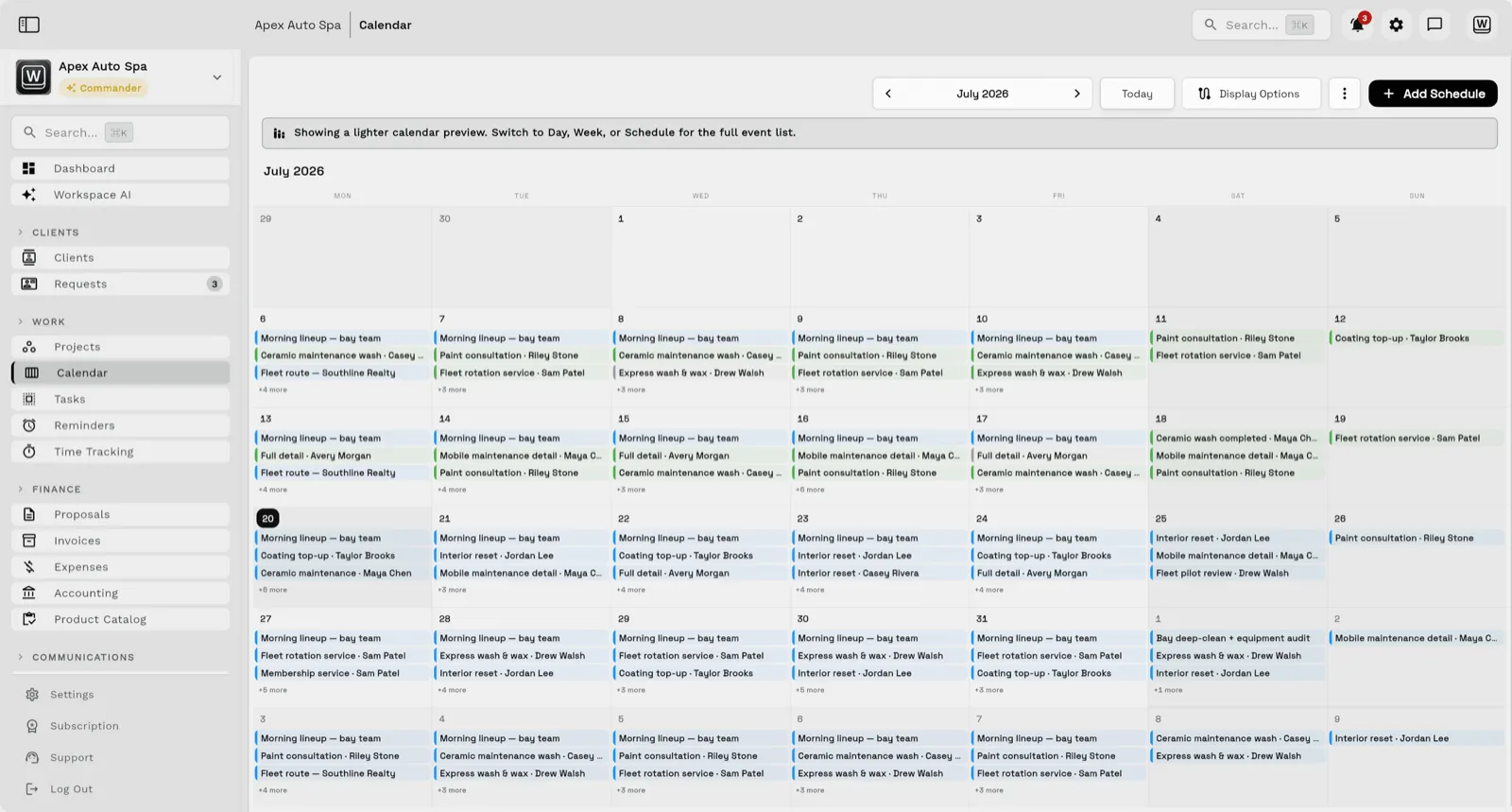
For an agent, the Workspace369 side of a renewal is a dated call, a conversation history and the next task. The first screenshot below is the Workspace369 month calendar in a demo workspace with sample data (an auto-detailing business, not an agency). Each day lists booked items with the client's name, and the left menu has Tasks and Reminders next to the calendar. The schedule page covers the calendar. In your own setup, a renewal review call 60 days out would sit on that calendar, and a Workflow Automation with a scheduled-time trigger and a timed wait could send the reminder email and create the follow-up task.
The second screenshot is the inbox, also from a demo workspace with sample data. One conversation shows a call, an SMS thread, a menu that turns a message into a task, and the client's contact details and notes on the right. That is where a renewal reply would land, with the history beside it. The communications page covers the inbox. SMS and the shared inbox start at Voyager; Cadet has the email inbox and email-only automations.

What it does not do: Workspace369 has no policy records, no rater, no carrier download and no AMS sync, so renewal dates are something you enter yourself or import by CSV. Treat it as the follow-up layer, not the system of record for policies.
Run a renewal-calendar test during the trial
Take three fictional clients through each tool you shortlist, using demo data only:
- Create three clients with renewal dates 30, 60 and 90 days out, and a note on who owns each.
- Set a reminder or automation that prompts the right person before each date.
- Log a call and an email on one client and see whether the history shows on one screen.
- Move one renewal date and check that the reminder moves with it, without retyping.
- Send a follow-up message and a document request, and check where the reply lands.
- Export the three records and see whether you can take your data with you.
The best tool keeps the date, the owner, the history and the next step on one record. If a date change means editing two places, that is the leak this test is built to find.

Keep policy records in your policy system
Policy numbers, coverage details and underwriting data belong in your AMS or carrier system, which is why an AMS such as HawkSoft, EZLynx or AgencyBloc sits outside this ranking. Their pricing pages show no public prices: EZLynx says its price depends on the number of users and products, AgencyBloc lists packages without figures, and HawkSoft's /pricing path returned a 404. If you use Workspace369, webhooks and API from Specialist let you build a connection to a system you choose, and CSV import is on every plan.
Check regulation with your own team
Licensing, carrier appointments, E&O, record retention and consumer-data rules differ by state and carrier, and a vendor's pricing page cannot tell you what applies to your agency. Before you move any client data into a new tool, ask your agency owner or compliance team what you may store, where, for how long and who may see it. Take the same questions to the vendor.
When to keep it simple
If you manage a small book with a handful of renewals a month, your AMS plus a calendar and an email template can carry you a long way. Move to a CRM when a second producer joins, when renewal calls slip through, or when you cannot say which prospects are waiting on you. The insurance agents product page shows how Workspace369 handles client records, and the pricing page has current plans. Contracts are available on every plan.
Before importing real clients, run one full renewal on demo data, check that your records can be exported, and confirm the setup with your compliance team.
Sources reviewed for this guide
- Workspace369 pricingPlan matrix reviewed October 26, 2026 for seats, active projects, automations, scheduled-time triggers, custom fields, CSV import, email and shared inbox, SMS, webhooks and API, data retention and trial terms.
- AgencyZoom pricingOfficial pricing page reviewed October 26, 2026 on the Independent tab for Essential, Growth and Pro on the Monthly and Annually views, the seven included users and the 14-day trial. The Allstate and Farmers tabs show different plans.
- Insureio pricingOfficial pricing page reviewed October 26, 2026 for the Basic, Marketing, Agency Management and combined plans, all shown as billed monthly, and the 30-day free trial. No annual view was shown. The application fulfilment section of the site names term life, permanent life, LTC, disability and annuities.
- HubSpot Sales Hub pricingOfficial pricing page reviewed October 26, 2026 for the Free tools, the Sales Hub Starter $20 list price, Starter calling minutes and workflows, and the Professional price and onboarding fee. The $7 new-customer Starter offer on the page was not used.
- Salesforce Financial Services Cloud pricingOfficial pricing page reviewed October 26, 2026 for Sales Core, Advanced and Max prices, the Insurance Brokerages inclusion and the 30-day free trial. Prices are shown billed annually only.
- AgencyBloc pricingOfficial pricing page reviewed October 26, 2026. It shows package descriptions with no prices.
- EZLynx pricingOfficial pricing page reviewed October 26, 2026. It says pricing depends on user count and products and gives no figures.
- HawkSoftOfficial site reviewed October 26, 2026. The /pricing path returned a 404 and no prices were found.
Workspace369 publishes this documentation-based comparison and is one of the options. It is not an independent ranking or a hands-on benchmark.
Run client follow-up in one workspace.
CRM, inbox, voice, invoicing, payments, projects, files, AI, and workflow automations — connected instead of exported.
14-day free trial. Card required. After the trial: from $29/month. Renews automatically every month until you cancel. Cancel anytime in Settings → Billing.