Best CRM for Recruiters in 2026: ATS vs client-side tools
The best CRM for recruiters & staffing agencies is usually an applicant tracking system with a client CRM built in, because placing candidates is the core job. Recruit CRM, Manatal, Crelate, Zoho Recruit and Loxo do that. Workspace369 is not an ATS, so it ranks last of six and fits one narrow reader, such as a solo retained-search consultant who keeps an ATS. For the wider view, read the best CRM for agencies guide, price a retainer with the free retainer pricing calculator, and see Workspace369's retainers and payment schedules and plans.
Best CRM for recruiters and staffing agencies: six tools compared on price, applicant tracking, client portals and billing, and where Workspace369 fits.
We make Workspace369, which is on this list. Weigh our ranking with that in mind.

By Simon Dziak, Founder, Workspace369 · LinkedIn
Disclosure and method: Workspace369 publishes this guide and is one of the options. It is a documentation-based shortlist, not a hands-on benchmark. Official vendor pages were reviewed on October 22, 2026. Check current plans with each vendor before you buy.
Key takeaways
- Applicant tracking is the core job of recruitment software. Workspace369 is not an ATS: it has no candidate database, job board posting, resume parsing or sourcing, so we rank it last of six for a full-desk recruiter.
- Recruit CRM Pro is $95 per user a month billed yearly ($109 monthly) and Business, with the client-branded Executive Search Report, is $135 ($159 monthly); both meter AI sourcing, job multiposting and SMS through credits.
- Manatal starts at $15 per user a month billed yearly ($19 monthly), the lowest paid entry price among the prices shown in the table, but its page lists no invoicing or retainer billing.
- Workspace369 Cadet at $29 a month ($23.25 billed yearly) fits a solo retained-search consultant who wants proposals, retainers, deposits, time and invoices on the client side, alongside an ATS. It allows 5 active projects and one seat.
- Test with one fictional client and one retained search: send the fee proposal, schedule the instalments, add a mid-search requirement change and invoice the final fee.
What's inside?
What a recruiter CRM is (and what it is not)How we compared these toolsThe best CRM for recruiters in 2026Side-by-side comparisonWhich tool fits your desk?Run a retained-search test during the trialWhen to keep it simple
What a recruiter CRM is (and what it is not)
A recruiter CRM covers two relationships. The first is the hiring company: contacts, the fee agreement, open job orders, conversations and the invoice. The second is the candidate: sourcing, resumes, pipeline stages, submissions and interviews. Tools called ATS plus CRM cover both. A client-work tool covers only the first. If you hold a fee agreement in one app and your candidate pipeline in another, nothing is wrong, as long as the employer record and the candidate record stay clearly separated.
How we compared these tools
We compared each tool on the same five points, using only the vendor's own pricing and product pages:
- Entry price per user, monthly and billed yearly, as listed on October 22, 2026.
- Applicant tracking coverage: candidate database, job posting, resume parsing and sourcing named on the plan.
- Client-side features: client or hiring-manager portals, client-branded reports and invoicing or billing.
- Hard limits on the entry plan: users, jobs, candidates or credits.
- Trial terms: length, and whether the vendor says a card is needed.
We did not test speed, support, data migration, integrations or mobile apps, and did not use third-party ratings. Order reflects fit for a recruiter who places candidates and also invoices clients.
The best CRM for recruiters in 2026
1. Recruit CRM, best for an ATS plus CRM with client-ready reporting
Recruit CRM positions itself as an ATS plus CRM from sourcing to placement, with solution pages for permanent, retained executive search and contract staffing. Pro is $95 per user a month billed yearly ($109 monthly) and lists a hiring manager portal, mailbox and bulk email, a Chrome sourcing extension, two-way email and calendar sync, and 100 credits per user a month. Business is $135 billed yearly ($159 monthly) and adds the Executive Search Report published with client branding, white-labelled pages, multichannel sequences, 10 custom job feeds, the open API and audit logs. Enterprise is $215 billed yearly ($259 monthly). The trial is 30 days; the page does not state card terms.
Limitations: the client-branded Executive Search Report is a Business feature, so Pro buyers do not get it. AI sourcing, job multiposting, SMS and workflow automation consume credits. Invoicing is listed on every plan, and approved contractor timesheets flow into invoices; the page does not say whether an invoice can follow retained-search fee stages such as retainer, shortlist and placement.
Best for: recruiters and agencies who want candidates, job orders and client reporting in one system.
2. Manatal, best for the lowest paid entry price
Manatal lists Professional at $15 per user a month billed yearly ($19 monthly), with up to 15 jobs and 10,000 candidates, unlimited hiring managers, an applicant tracking system, a recruiting CRM, mass emailing and resume parsing. Enterprise is $35 billed yearly ($39 monthly) and removes the job and candidate limits and adds workflow automation. Enterprise Plus is $55 billed yearly ($59 monthly) and adds an open API, a candidate portal and custom permissions. The trial is 14 days and the page says no card is needed.
Limitations: the pricing page lists no invoicing, retainer billing or client-branded fee proposals, so fee billing lives elsewhere. Professional caps jobs at 15.
Best for: small agencies and solo recruiters who need an ATS and a client CRM at the lowest price.
3. Crelate, best for client portals and business development workflows
Crelate lists Essentials at $85 per user a month paid annually, limited to 2 users and 20,000 contacts, with applicant tracking, a recruiting CRM, a job portal, resume parsing and sourcing. Business is $119 per user a month, billed annually or monthly, and adds client and team portals, an AI assistant, reports and email connections. Business Plus is custom and lists business development workflows, automation and sequences. A free trial can be started without talking to sales; the page does not state its length or card terms.
Limitations: the entry plan is capped at two users, and the business development workflows are a custom-priced tier. The page does not name fee invoicing on the plans.
Best for: small search firms who want a client portal with the ATS and are comfortable at $119 per user.
4. Zoho Recruit, best for a free plan and a low-cost upgrade
Zoho Recruit has a Free plan with one active job per recruiter license, then Standard at $25 per recruiter a month billed yearly ($30 monthly) with 10 active jobs, sourcing, resume management, a branded careers site and a hiring pipeline. Enterprise is $50 billed yearly ($60 monthly), with 20 active jobs, AI candidate matching and candidate and staffing portals. The 15-day trial gives Enterprise features and then moves the account to the Free plan; Zoho also lists a 45-day money-back guarantee. Card terms are not stated.
Limitations: active job limits per recruiter license are tight on Standard, and invoicing is not named on the pricing page. Add-ons such as the vendor portal cost extra.
Best for: recruiters who want to start free and add portals only when needed.
5. Loxo, best for AI-assisted sourcing at a higher price
Loxo's Core plan starts at $149 per user a month billed annually and includes a full ATS and recruiting CRM, AI search, unlimited jobs, candidates and companies, pipelines, activities, reporting, email and calendar sync, an MCP connection to your own AI tools, and free migration for teams of three or more seats. Professional adds the 850M-profile Loxo Source and AI agents; its plan price is shown only by demo and it includes 2,500 credits per seat a month. Enterprise is custom. The 7-day trial covers the Professional platform, and the page says no credit card. A monthly price is not shown; annual plans are paid up front.
Limitations: it is the highest published entry price among the five ATS tools, and the pricing page lists no invoicing or fee billing. Most of its value is sourcing and AI agents, which many retained-search consultants do not need.
Best for: agencies that source heavily and will pay for a talent database and AI search.
6. Workspace369, best as the client side beside an ATS
Workspace369 holds the hiring company as a client, with notes, tags and custom fields, a Proposal the employer approves through a public link, retainers and payment schedules, deposits, time tracking, a private client portal and invoices. Cadet is $29 a month for one seat ($23.25 billed yearly) and lists all of these, plus CSV client import and email automations with up to 3 active workflows. The 14-day trial requires a card.
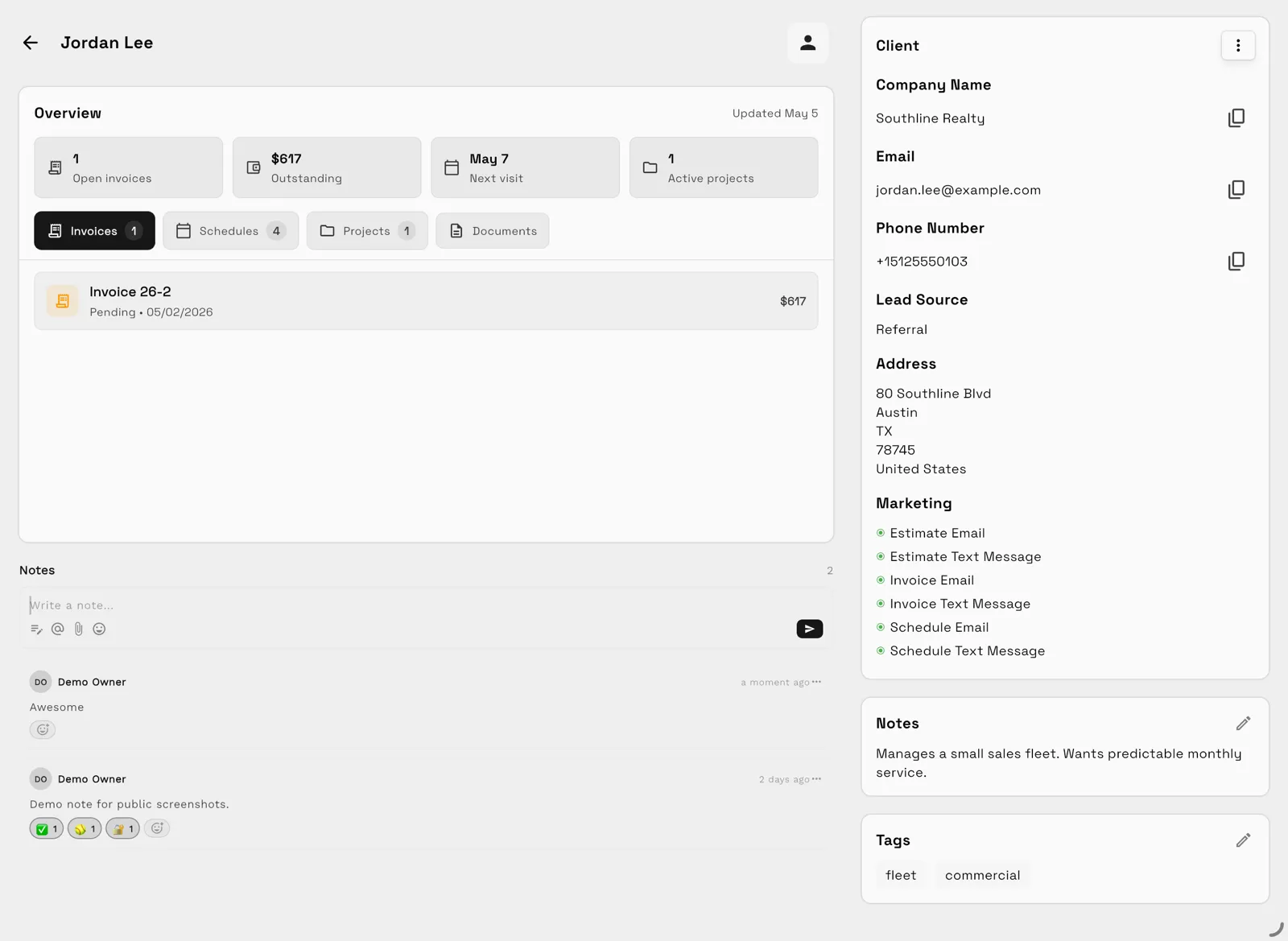
Demo data, not a customer outcome.
Limitations: it is not an ATS. There is no candidate database, job board posting, resume parsing or sourcing, so a recruiter who places candidates still needs one of the five tools above. Cadet allows 5 active projects and one seat; Voyager ($74 a month, two seats included, extra seats $10 a month, calls and texts) removes the project cap, and Specialist ($149 a month, 10 seats) adds payment plans, online booking and expense tracking. Manatal's paid entry price and Zoho Recruit's Free plan are lower for applicant tracking, and Recruit CRM lists invoicing on every plan, with client-facing reports and portals inside the ATS at Recruit CRM and Crelate.
Best for: a solo retained-search consultant or small boutique firm that wants fee proposals, retainers, deposits, time and invoices on the client side, kept beside an ATS.
Side-by-side comparison
| Tool | Entry price (monthly) | Billed yearly | Applicant tracking | Main entry-plan limit | Trial |
|---|---|---|---|---|---|
| Recruit CRM | $109 (Pro) | $95 per user a month | Yes | 100 credits per user a month | 30 days, card not stated |
| Manatal | $19 (Professional) | $15 per user a month | Yes | 15 jobs, 10,000 candidates | 14 days, no card |
| Crelate | Not stated | $85 per user a month (Essentials) | Yes | 2 users, 20,000 contacts | Free trial, length not stated |
| Zoho Recruit | $30 (Standard) | $25 per recruiter a month | Yes | 10 active jobs per license | 15 days, card not stated |
| Loxo | Not shown | $149 per user a month (Core) | Yes | Annual, paid up front | 7 days, no card |
| Workspace369 | $29 (Cadet) | $23.25 a month | No | 5 active projects, 1 seat | 14 days, card required |
Which tool fits your desk?
| If you mostly need | Start with | Why |
|---|---|---|
| Candidates, job orders and client reports in one place | Recruit CRM | Executive Search Report on Business |
| The lowest paid ATS plus CRM | Manatal | $15 per user a month billed yearly |
| A client portal with the ATS | Crelate | Client and team portals on Business |
| To start free and grow | Zoho Recruit | Free plan, portals on Enterprise |
| Heavy AI-assisted sourcing | Loxo | Core ATS plus AI search |
| Fee proposals, retainers and invoices beside an ATS | Workspace369 | Retainers, deposits and invoices from Cadet |
Run a retained-search test during the trial
Take one fictional hiring company through a search in each tool you shortlist:
- Add the company and a hiring manager, and attach the job description.
- Send a fee proposal for a retained search and record its approval.
- Schedule the retainer stages, then invoice the first.
- Change the role requirements mid-search and log the change without overwriting the original agreement.
- Open the client view and check that no candidate details or internal tasks appear.
- Export the company records and check what comes out.
The best tool keeps the agreement, the stages and the invoice on one employer record, and keeps candidate data out of the client view. Set the fee first with the free consulting rate calculator.

When to keep it simple
If you place a few candidates a year, an ATS free plan and an invoice template may be enough. Move to a client-work tool when fee stages, changed mandates and late invoices start to blur across email threads. The recruiters and staffing agencies product page shows how Workspace369 handles communications and retainers, and the pricing page has current plans. Workflow Automations cover reminders and follow-ups.
Before importing real clients, run one full search on demo data and check that your records can be exported.
Sources reviewed for this guide
- Workspace369 pricingPlan matrix reviewed October 22, 2026.
- Recruit CRM pricingOfficial pricing page reviewed October 22, 2026 for monthly and yearly per-user prices, included features and trial terms.
- Manatal pricingOfficial pricing page reviewed October 22, 2026 for yearly and monthly prices, job limits and trial terms.
- Crelate pricingOfficial pricing page reviewed October 22, 2026 for per-user prices, user limits and portal features.
- Zoho Recruit pricingOfficial pricing page reviewed October 22, 2026 for monthly and yearly prices, active job limits and trial terms.
- Loxo pricingOfficial pricing page reviewed October 22, 2026 for the Core price, plan structure and trial terms.
Workspace369 publishes this documentation-based comparison and is one of the options. It is not an independent ranking or a hands-on benchmark.
Run client follow-up in one workspace.
CRM, inbox, voice, invoicing, payments, projects, files, AI, and workflow automations — connected instead of exported.
14-day free trial. Card required. After the trial: from $29/month. Renews automatically every month until you cancel. Cancel anytime in Settings → Billing.