Best CRM for Real Estate Brokerages in 2026
Six tools compared for brokerage owners and team leaders on price at ten users, lead routing, agent reporting, recruiting, transaction links and trial terms.
We make Workspace369, which is on this list. Weigh our ranking with that in mind.

By Simon Dziak, Founder, Workspace369 · LinkedIn
The best CRM for real estate brokerages puts each new lead with the right agent, shows you what happened next, and keeps the roster in one system. Follow Up Boss leads on published team pricing, Lofty offers a broker tier you must request a quote for, Sierra Interactive and Real Geeks add an IDX website, and BoldTrail needs a demo. Workspace369 ranks last: its matrix lists no MLS, IDX website, agent-rule lead routing or transaction management, though its real estate brokerage page covers the client-work side. Solo licensee? Read the best CRM for real estate agents. Tallying subscriptions first? Use the free software stack cost calculator.
Disclosure and method: Workspace369 publishes this guide and is one of the options. It is a documentation-based shortlist, not a hands-on benchmark. Vendor pages were reviewed on October 19, 2026, so confirm current plans with each vendor before buying.
Key takeaways
- A brokerage CRM is judged on who gets each lead and whether you can see what every agent did with it. Follow Up Boss, Lofty, BoldTrail, Sierra Interactive and Real Geeks are built around that. A general client-work CRM is not.
- Follow Up Boss Pro covers 10 users for $499 billed monthly ($416 billed yearly). Round robin, first-to-claim and price or ZIP lead distribution and agent activity reporting are marked on every Follow Up Boss plan.
- Sierra Interactive starts at $299.95 a month billed annually ($359.95 on a 12-month agreement paid monthly, plus a $500 setup fee) for one user, and its Essential package adds advanced lead routing at three users. Real Geeks costs $399 monthly plus a $500 setup fee for two users, with an IDX website included.
- Lofty and BoldTrail publish no prices: Lofty shows Request Pricing on all four plans and BoldTrail asks for a demo. BoldTrail ranks fifth because no feature is tied to a plan on the pages read.
- Workspace369 ranks last. Specialist is $149 a month for 10 seats and Commander $299 for 20, but the matrix lists no MLS or IDX website, no lead routing by agent rules, no transaction management and no recruiting pipeline.
What's inside?
What a CRM for a real estate brokerage is (and what it is not)How we compared these toolsThe best CRM for real estate brokerages in 2026Side-by-side comparisonWhat ten agents costWhich tool fits your brokerage?Run a lead-handoff test during the trialKeep compliance and transactions in their own systemsWhen to keep it simple
What a CRM for a real estate brokerage is (and what it is not)
For a brokerage the CRM is the shared lead desk. It receives inquiries from your websites and portals, hands them to agents by a rule you set, shows the owner who responded and who did not, and keeps the history when an agent leaves. Many brokerages also want the same vendor to supply an IDX website, a recruiting list and a link to the transaction system. A general client-work CRM keeps contacts, tasks, quotes and invoices. It has no MLS feed, no portal lead source and no closing file. Licensing, trust-account and supervision rules differ by state and by brokerage, so you should keep your broker's approved compliance system and take legal advice from a lawyer.
How we compared these tools
Every tool gets the same five checks below, drawn only from the vendor's own pages:
- Price at 10 users, monthly and billed yearly where the page shows both, worked out from the listed per-user and base prices. Where a page shows no price we write See site.
- Lead routing: whether the page names round robin, first-to-claim, rule-based or advanced routing, and on which plan.
- Agent oversight: reporting by agent, activity views, ranking views, shared inboxes and enterprise controls such as single sign-on or an organization structure.
- Website, recruiting and transactions: an IDX website, a recruiting product, deal tracking or a transaction link.
- Contract and trial: setup fees, commitment terms and whether a free trial or only a demo is offered.
What we did not test: speed, support quality, deliverability, mobile apps or how well any tool imports an existing roster. We did not use third-party ratings, and we did not review Chime, Ylopo or Market Leader.
Reasons for the ranking: the order follows documented fit for an owner or team leader. Follow Up Boss is first because all three plans mark round robin, first-to-claim and price or ZIP distribution plus agent activity reporting, and it is the only tool here with a price for every tier. Lofty is second because its page sells Agent, Team, Broker and Enterprise plans with advanced lead routing and team management reporting, and adds single sign-on, white label and a customizable org structure at Enterprise; it shows no price, but it ties features to plans. Sierra Interactive is third: its prices are public and Essential adds advanced lead routing, but its packages top out at five included users with per-user fees beyond that. Real Geeks is fourth because it is built around the IDX website and lead packages, with a two-user base. BoldTrail is fifth because its plan contents and prices were not visible on the pages read: its BackOffice and Recruit product pages list features, but none is tied to a plan, so it cannot outrank tools with published plan details. Workspace369 is last: it gives a large team 10 to 50 seats, roles, a shared inbox and team reports, but no routing by agent rules, no MLS and no transaction management.
The best CRM for real estate brokerages in 2026
1. Follow Up Boss, best for routing leads and holding agents accountable
Follow Up Boss has three plans. Grow costs $69 per user monthly or $58 billed yearly. Pro covers 10 users for $499 billed monthly ($416 billed yearly), with extra users at $49 a month ($41 yearly). Platform is $1,000 a month for 30 users ($833 yearly), with extra users at $20 ($17 yearly). The comparison table marks round robin, first-to-claim and price or ZIP lead distribution, shared automations, automated task assignment, deal tracking and agent activity reporting on all three plans. Pro adds team inboxes, unlimited calling and texting and call reporting; Platform adds teams within teams. Every plan lists unlimited contacts, lead sources and integrations, and a free trial with no contract; the site names it as 14 days.
Limitations: the page lists IDX websites as an integration, not a built-in site, and names no recruiting product. Grow charges extra for calling ($39 per user monthly, $33 yearly), and the page does not say whether the trial needs a card.
Best for: brokerages and team leaders that buy leads, route them across agents and need to see each agent's activity.
2. Lofty, best for brokerages that want broker and enterprise tiers
Lofty sells Lofty Agent, Team, Broker and Enterprise, and every column shows Request Pricing, so the price is See site. The comparison lists a customizable IDX website, an AI-powered CRM with unlimited contacts, mass and automated email and texting, Advanced Lead Routing, Team Management and Reporting on all four plans. Single sign-on, white label and a customizable org structure appear only on Enterprise, and 1:1 onboarding starts at the Team plan. A power dialer, extra text packages and a lead generation service are add-ons. The page offers a demo and lists no free trial.
Limitations: no price is public, so you cannot compare it against the others without a quote. The page does not say which plan suits a given agent count. Its menu lists Transaction Management and Back Office products, but the plan table ties neither to a plan, and no recruiting product is named.
Best for: a brokerage that expects to grow into enterprise controls and is willing to take a quote and a demo first.
3. Sierra Interactive, best for a priced IDX-and-CRM package for small and mid-size teams
Sierra Interactive offers Starter, Essential and Growth packages. On annual pricing they start at $299.95, $399.95 and $599.95 a month; on monthly payments they start at $359.95, $474.95 and $724.95. They include 1, 3 and 5 users. Extra users are $75 each on Starter, $60 each for users 4 to 10 on Essential, and $20 each for users 6 to 10 on Growth, with lower rates above that. Essential lists messaging automations and advanced lead routing; Growth lists advanced reporting, premium website options and expanded messaging, and its CRM rows name an agent ranking view. Setup is $0 on an annual subscription and $500 on a monthly one, and the table shows one MLS feed included. Its FAQ says both options are the same 12-month agreement: paying the full year upfront lowers the effective monthly rate and waives the setup fee, while splitting it into monthly payments carries a one-time $500 setup fee.
Limitations: Starter does not list advanced routing, a dialer is a $100 monthly add-on, and Lead Engage is $199 a month and unavailable on Starter. The page offers a demo and no free trial.
Best for: teams of three to ten agents who want the IDX website, MLS feed and advanced routing priced in one package.
4. Real Geeks, best for a website-first brokerage that also buys leads
Real Geeks Platform costs $399 monthly, with a one-time $500 setup fee and 2 users. Additional users are $25 each for users 3 to 10, $10 for 11 to 40, $5 for 41 to 100 and $1 from 101. An MLS board feed adds $10 monthly per board. The CRM list includes lead routing, lead ponds, call routing, live website chat, and sending agreements through SkySlope. Lead packages are add-ons at $299 for social and $599 each for search and seller leads, and Geek AI Text is $49 monthly, or included at no cost with any lead package. The page asks you to choose a 6-month, 12-month or annual commitment, and all three show the same $399 platform price.
Limitations: the page lists no free trial and offers a demo, and it names no agent ranking view or recruiting product. The monthly cost climbs quickly once lead packages are added.
Best for: brokerages that want website, lead generation and CRM from a single vendor and can afford the monthly bill.
5. BoldTrail, best for an all-in-one stack with recruiting and back office
BoldTrail shows no price, so the figure is See site. Its pricing page asks for your role and team size, from one agent to 1,000 or more, and offers a demo that returns pricing. Its product pages describe three products. The BoldTrail Platform covers IDX websites, a lead engine, a smart CRM, marketing autopilot, listing management and an AI productivity suite. BackOffice lists transaction management with checklists, forms and eSignature, commission automation, accounting, agent management and reporting. Recruit covers recruitment, retention and coaching. Separate pages address agents, teams, brokers and enterprise.
Limitations: none of those pages ties a feature to a named plan or shows a price, only "flexible packages", so we cannot say what each tier includes, whether leads route by rule or what a demo covers. That is why it sits fifth despite the widest product list. No free trial is listed.
Best for: brokerage owners who want recruiting, back office and front office from one vendor and will sit through a demo to get the figures.
6. Workspace369, best for brokerage back-office projects and client billing
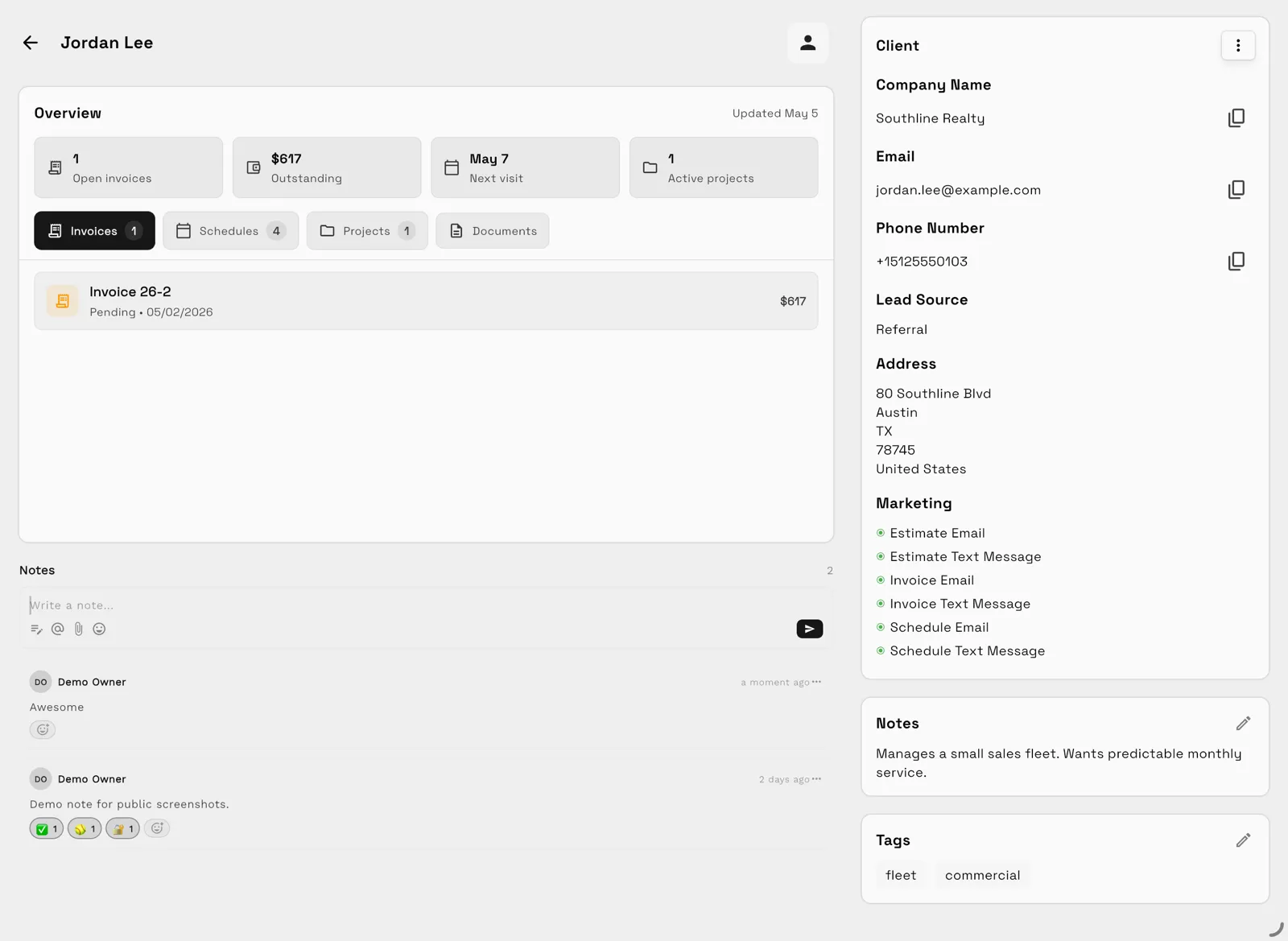
Workspace369 lists client records and custom fields, roles and permissions, client-scoped access, team productivity reports and a client and team activity view on every plan, plus a shared inbox and conversation assignment from Voyager. It also lists Proposals, contracts, a client portal and invoices. Seats scale from one on Cadet ($29 a month, $23.25 billed yearly) to 2 on Voyager ($74, $59.25), 10 on Specialist ($149, $119.25), 20 on Commander ($299, $239.25) and 50 on Enterprise ($699, $559.25), with extra seats at $10 a month from Voyager. Full role-based access control and the file access audit log start at Specialist, and the team workload view at Commander. The screenshot shows demo data, not a customer result.
Gaps: the matrix lists no MLS feed or IDX website, no portal lead integration, no lead routing by agent rules, no transaction management and no recruiting pipeline. Funnels and public intake forms capture leads on every plan, but nothing assigns them automatically. Round-robin scheduling is for bookings and starts at Specialist, and webhooks and the API start there too. Audit trails vary by plan. The 14-day trial needs a card.
Who should not pick it: a brokerage whose agents live on portal leads, need an IDX site or must coordinate closings. Best for: an owner who already has a real-estate CRM and wants the brokerage's own projects, client billing and onboarding checklists in one place.
Side-by-side comparison
| Tool | Entry price (monthly) | Billed yearly | Lead routing and oversight | Website, recruiting, transactions | Main limit | Trial |
|---|---|---|---|---|---|---|
| Follow Up Boss | $69 per user (Grow); $499 for 10 users (Pro) | $58 per user; $416 for 10 users | Round robin, first-to-claim, price or ZIP; agent activity reporting | IDX as an integration; deal tracking; no recruiting named | Calling costs extra on Grow | 14 days, card not stated |
| Lofty | See site | See site | Advanced Lead Routing, team reporting; SSO and org structure at Enterprise | IDX website; transaction and back-office products in the menu, not tied to a plan | No public price | Demo, no trial listed |
| Sierra Interactive | $359.95 plus $500 setup (Starter, 1 user) | $299.95 a month | Advanced lead routing from Essential; Growth reporting | IDX website and 1 MLS feed included | 5 users in the top package | Demo, no trial listed |
| Real Geeks | $399 plus $500 setup | Same price in all term views | Lead routing and lead ponds included | IDX website included; no recruiting named | Lead packages cost extra | Demo, no trial listed |
| BoldTrail | See site | See site | Not stated on the pages read | IDX websites; BackOffice transaction management; Recruit product (none tied to a plan) | Plan contents not visible | Demo, no trial listed |
| Workspace369 | $29 (Cadet, 1 user); $149 for 10 seats (Specialist) | $23.25; $119.25 for 10 seats | Conversation assignment from Voyager; roles and permissions on every plan (full role-based access control from Specialist); no routing by agent rules | None listed | No IDX, MLS, routing or transactions | 14 days, card required |
What ten agents cost
This is our own arithmetic from the listed prices. It leaves out add-ons, MLS feeds and lead packages.
| Tool | Ten users, billed monthly | Ten users, billed yearly | How it is built |
|---|---|---|---|
| Follow Up Boss Pro | $499 a month | $416 a month | 10 users included |
| Sierra Interactive Growth | $824.95 a month plus $500 setup | $699.95 a month | 5 included plus 5 users at $20 |
| Real Geeks | $599 a month plus $500 setup | Same | 2 included plus 8 users at $25 |
| Workspace369 Specialist | $149 a month | $119.25 a month | 10 seats included |
| Lofty and BoldTrail | See site | See site | Quote after a demo |
Which tool fits your brokerage?
| If you mostly need | Start with | Why |
|---|---|---|
| Lead distribution and agent activity reporting at a published price | Follow Up Boss | Round robin, first-to-claim and ZIP rules on every plan, Pro at $499 for 10 users |
| A broker or enterprise tier with SSO and an org structure | Lofty | Four plan columns, Enterprise adds single sign-on and white label |
| An IDX website, MLS feed and routing in one priced package | Sierra Interactive | Essential adds advanced routing; MLS feed and site designs included |
| A website and bought leads from one vendor | Real Geeks | IDX website included, lead packages as add-ons |
| Recruiting and back office alongside the lead tools | BoldTrail | Recruit and BackOffice product pages, though no feature is tied to a plan |
| Back-office projects, client billing and onboarding checklists | Workspace369 | Seats to 50, roles, shared inbox, Proposals and invoices |
Run a lead-handoff test during the trial
Use three fictional agents and one fictional buyer lead in each tool you shortlist. Nothing here is a customer outcome; it is a rehearsal.
- Send a test inquiry from your website form and confirm it lands with its source and is assigned by your rule, not by hand.
- Leave it untouched for the response time you expect and check whether the tool reassigns it or alerts you.
- Ask for a report of the first contact time by agent, and see whether you can pull it without exporting a spreadsheet.
- Move one agent's leads to another agent and check that the messages, notes and tasks stay on each record.
- Add a new fictional agent and see how long it takes to give them a login, the right permissions and a starter checklist.
The tool to keep is the one that completes all five steps without retyping. If you also bill service clients, the free scope-change request builder helps with fee changes.

Keep compliance and transactions in their own systems
Commissions, licensing records, trust accounting and closing files belong in the systems your broker has approved. A CRM should link to them, not replace them, and the vendor pages we read describe transaction links only in general terms. Ask each vendor which transaction system it connects to and how an agent's departure is handled. The real estate brokerage product page shows how Workspace369 handles Proposals, communications and invoices for the work around that, and the pricing page has current plans.
When to keep it simple
A brokerage with a handful of agents and leads from a single source can start with one shared inbox, a spreadsheet of assignments and a calendar. Switch to a real-estate CRM once leads come from several places, replies slow down, or nobody can say who last contacted a lead. Workspace369 helps only if you also want back-office projects and billing beside that system.
Rehearse one whole project on demo data first, and confirm you can export your records before real contacts go in.
Sources reviewed for this guide
- Workspace369 pricingPlan matrix read on October 19, 2026.
- Follow Up Boss pricingPricing page read on October 19, 2026 in its monthly and yearly views; the full feature comparison was read for the plans each feature is marked on.
- Lofty pricingPage read on October 19, 2026. All four plans show Request Pricing, so no price is given. The plan comparison was read for lead routing, team management and enterprise features.
- BoldTrail pricingPage read on October 19, 2026. Pricing comes after a demo request. Product names and features come from the BoldTrail platform, BackOffice and Recruit pages, none of which ties a feature to a plan.
- Sierra Interactive pricingPricing page read on October 19, 2026 with the Annual Pricing and Monthly Pricing views both opened. No free trial is listed.
- Real Geeks pricingPricing page read on October 19, 2026 for the platform price, setup fee, user tiers and add-ons. Each commitment view (6 months, 12 months, annual) showed the same $399 platform price.
Workspace369 publishes this documentation-based comparison and is one of the options. It is not an independent ranking or a hands-on benchmark.
Run client follow-up in one workspace.
CRM, inbox, voice, invoicing, payments, projects, files, AI, and workflow automations — connected instead of exported.
14-day free trial. Card required. After the trial: from $29/month. Renews automatically every month until you cancel. Cancel anytime in Settings → Billing.