Best CRM for Real Estate Agents in 2026
Six tools compared for real estate agents on price, lead capture, drip follow-up, transaction tracking, IDX websites and trial terms. Real-estate CRMs lead.
We make Workspace369, which is on this list. Weigh our ranking with that in mind.

By Simon Dziak, Founder, Workspace369 · LinkedIn
The best CRM for real estate agents catches each lead the minute it arrives, keeps follow-up running and tracks each deal to closing. Follow Up Boss suits agents who want lead capture and distribution, Wise Agent is the low-priced option with transactions, and IXACT Contact suits sphere-of-influence follow-up. Top Producer adds MLS integration, and Real Geeks pairs an IDX website with a CRM.
Workspace369 ranks last here because its matrix lists no IDX website, portal lead integration or transaction management; its real estate agent page shows the client-work side it does cover. If you run a side consulting practice, price it first with the free consulting rate calculator.
Disclosure and method: Workspace369 publishes this guide and is one of the options. It is a documentation-based shortlist, not a hands-on benchmark. Official vendor pages were reviewed on October 26, 2026. Check current plans with each vendor before you buy.
Key takeaways
- A real estate CRM earns its fee on lead capture and follow-up speed. Follow Up Boss, Wise Agent, IXACT Contact, Top Producer and Real Geeks are built around that; a general client-work CRM is not.
- Follow Up Boss Grow is $69 per user a month billed monthly ($58 billed yearly) with lead distribution, Smart Lists and Action Plans. Wise Agent is $49 a month ($42 billed yearly) with transaction management and drip campaigns on its pricing page.
- Real Geeks is $399 a month plus a $500 one-time setup fee, and includes an IDX website. Top Producer Pro is $179 per user a month and lists MLS integration and built-in transaction management.
- Workspace369 Cadet is $29 a month ($23.25 billed yearly) for one user with 5 active projects. The matrix lists no IDX website, no portal lead integrations and no transaction management.
- Workspace369 ranks last here on purpose. It fits an agent who also runs a side service business, such as consulting, and wants that client work in one place.
What's inside?
What a CRM for real estate agents is (and what it is not)How we compared these toolsThe best CRM for real estate agents in 2026Side-by-side comparisonWhich tool fits your situation?Workspace369 in action for a side consulting practiceRun a lead-to-close test during the trialWhen to keep it simple
What a CRM for real estate agents is (and what it is not)
For an agent the CRM is the lead desk. It receives inquiries from your website and listing portals, assigns them, reminds you to call, runs drip email and text sequences, keeps your sphere of influence warm, and tracks each deal from contract to close. A general client-work CRM keeps contacts, quotes, tasks and invoices, but it is not wired to an MLS feed, an IDX search site or a portal lead source, and it has no closing checklist built in. Licensing, disclosure and brokerage compliance rules vary by state and brokerage, so none of these tools replaces your broker's approved system or legal advice.
How we compared these tools
We compared each tool on the same five points, using only the vendor's own pricing pages:
- Entry price, monthly and billed yearly where the page shows both, as listed on October 26, 2026.
- Lead capture and website: whether the page lists lead sources, lead distribution, an IDX or listing website, or MLS integration.
- Follow-up: drip campaigns, action plans, keep-in-touch reminders or automated lead response.
- Transactions: whether the page names transaction management, deal tracking or commission tracking.
- Seats and trial: users included, add-on costs and trial terms, including whether a card is stated.
What we did not test: speed, support, deliverability or mobile apps. We did not use third-party ratings. Lofty and BoldTrail were not ranked because their pages show no prices; Lofty lists an IDX website and advanced lead routing, and BoldTrail gives pricing only after a demo request. We did not review LionDesk.
Why the order is what it is: it reflects documented fit for an agent. Follow Up Boss is first because its Grow plan lists connecting any lead source, customizable lead distribution, Smart Lists and Action Plans, with a 14-day trial. Wise Agent is second and cheaper, listing transaction management, drip campaigns and lead automation in one flat plan, but it uses a shared login for up to 5 team members. IXACT Contact is third and suits agents who work a sphere, with keep-in-touch reminders and a monthly e-newsletter, but it names no transaction management.
Top Producer is fourth: it lists MLS integration with 320+ boards and built-in transaction management, but it ranks below IXACT Contact. Top Producer costs $179 per user a month and its page shows no trial. Real Geeks is fifth because its IDX website and lead packages carry the highest cost.
Workspace369 is last: it adds Proposals, contracts, funnels with lead capture into the CRM, follow-up email flows, subtasks and a client portal on Cadet (SMS starts on Voyager), but its matrix lists no IDX website, portal lead integration or transaction management.
The best CRM for real estate agents in 2026
1. Follow Up Boss, best for lead capture and fast follow-up
Follow Up Boss Grow is $69 per user a month billed monthly and $58 billed yearly. It lists connecting any lead source and website, customizable lead distribution, Smart Lists, Action Plans, calling, texting and email from the app, calendar and email sync, agent and lead source reporting, a mobile app and AI features. Every plan has unlimited contacts, lead sources and integrations. Pro is $499 a month for 10 users billed monthly ($416 billed yearly) and adds unlimited calling and texting, team inboxes and call reporting. The trial is 14 days; the page does not say whether a card is needed.
Limitations: calling is a paid add-on on Grow ($39 per user monthly, $33 billed yearly), the page lists IDX websites only as an integration rather than a built-in site, and transaction management is not named beyond "deal tracking" in its feature comparison.
Best for: solo agents and teams that buy leads or run portals and need every inquiry captured, routed and followed up.
2. Wise Agent, best for a low flat price with transactions included
Wise Agent CRM is $49 a month billed monthly and $42 a month billed annually ($499 a year). Its page lists lead automation, contact and lead management, transaction management, drip campaigns, a team calendar, unlimited document storage, 100 lead enhancement credits, one customizable landing page and 24/7 live support on every plan. Up to 5 team members share one login. The CRM plus WiseSocial plan is $69 monthly ($59 billed annually). The trial is 14 days and the plan is month to month; the page does not say whether a card is needed.
Limitations: extra logins cost $20 a month each, text messaging is an add-on ($11 a month plus an $80 one-time registration fee), and the page names no IDX website.
Best for: solo agents and small teams that want drip campaigns and transaction management at the lowest listed price.
3. IXACT Contact, best for sphere-of-influence follow-up
IXACT Contact is $55 a month billed monthly and $46.75 a month billed annually. It bundles a CRM, email marketing with an automated monthly e-newsletter and drip email campaigns, keep-in-touch reminders for calls and birthdays, an active business area for managing listings and buyers, automated lead capture and nurturing, calendar and task reminders, an agent website with optional IDX listings integration, and a mobile app with Google sync. Teams pay $46.75 for the team leader and $28.90 for each member, billed annually. A free trial is offered; the page shows no length or card terms.
Limitations: Social Stream, text marketing and website add-ons are optional extras, and the page names no transaction management.
Best for: referral-driven agents who win business by staying in front of past clients and their sphere.
4. Top Producer, best for MLS integration and built-in transactions
Top Producer Pro is $179 per user a month. The feature comparison lists unlimited contacts, leads and transactions, MLS integration with 320+ boards, built-in transaction management, commission tracking, unlimited SMS, automated SMS and email lead response and automated drip email campaigns, plus a customizable sales pipeline, a Market Snapshot report with branded MLS data and "just listed" and "just sold" alerts. Pro Teams 5 is $399 a month for up to 5 users. Lead plans start at $479 a month and farming plans at $599, with cost depending on volume.
Limitations: on October 26, 2026 the page showed no billing switch and no trial, and it sends you to a request form for details. A website is a separate $35 per user a month.
Best for: established agents who want MLS data, transaction tracking and a lead plan from one vendor.
5. Real Geeks, best for an all-in-one IDX website and CRM
Real Geeks Platform is $399 a month with a $500 one-time setup fee and includes 2 users, an IDX website, a CRM and marketing automation. Extra users are $25 each for users 3 to 10. Each MLS board feed is $10 a month. Lead packages are add-ons: $299 for social, $599 for search and $599 for seller leads, and Geek AI Text is $49 a month. The 6-month, 12-month and annual views all showed the same $399 price. A demo is offered; no free trial is listed.
Limitations: it is the highest-cost option here before any lead package, and the page shows no free trial.
Best for: agents who want one vendor to supply the website, the leads and the CRM, and who can carry the monthly cost.
6. Workspace369, best for a side service business beside your real estate work
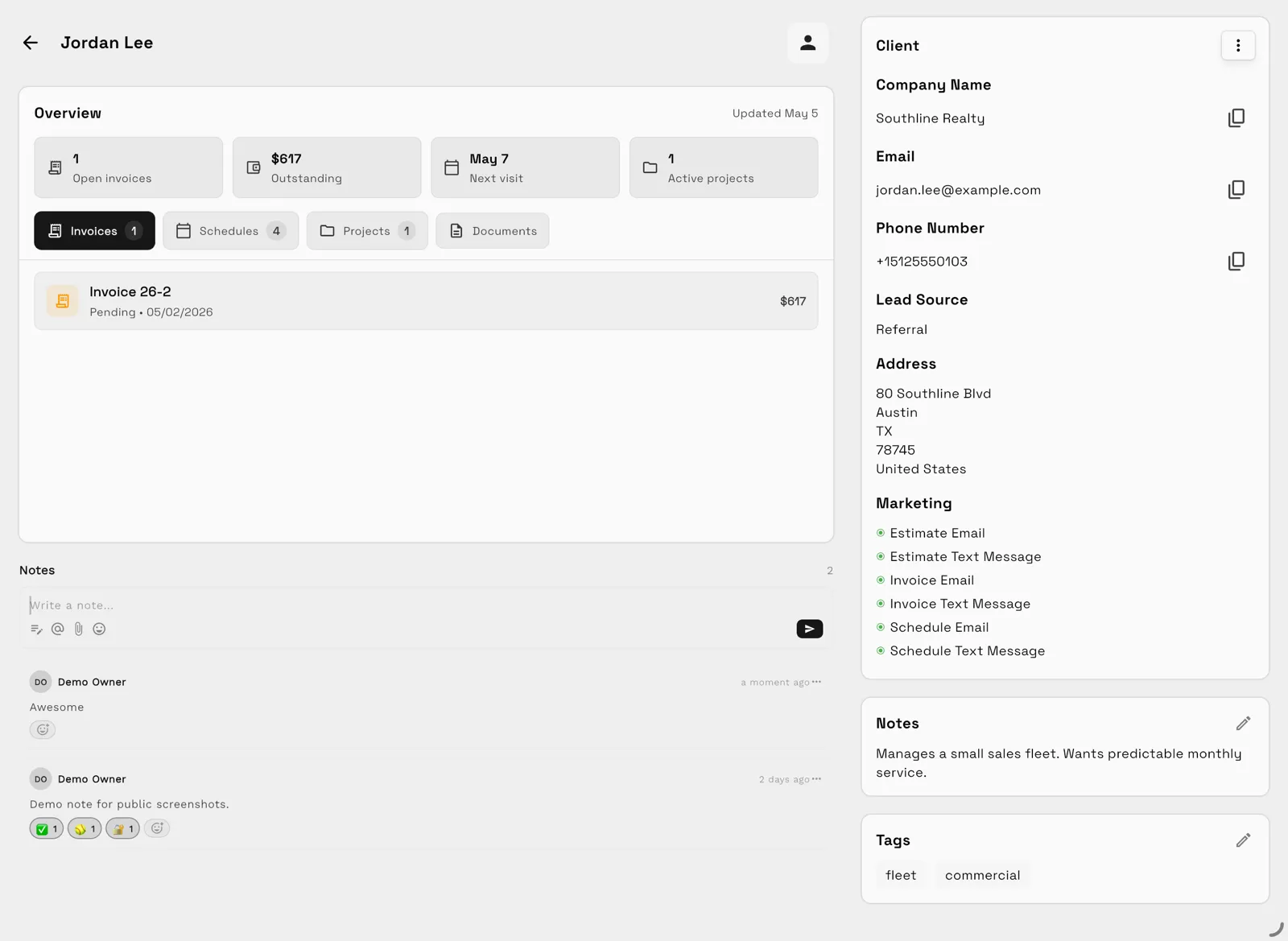
Workspace369 lists client records, lead capture into the CRM through funnels and public intake forms, follow-up email flows, Proposals, contracts with online e-signature, a client portal and invoices on every plan, with SMS follow-up from Voyager. Cadet is $29 a month for one user ($23.25 billed yearly). Every request records whether it came from a form, funnel or page, and forms can capture UTM parameters in hidden fields on every plan; lead-source tagging on clients and SMS start at Voyager, and conditions and timed waits in funnel follow-up flows also start at Voyager. The screenshot is a demo record, not a customer result.
Limitations: the matrix lists no IDX website, no Zillow or Realtor.com lead integration, no MLS feed, no transaction management and no closing checklist, so it cannot replace a real-estate CRM. Cadet allows 5 active projects and one seat, so a busy pipeline of deals would outgrow it; Voyager ($74 a month, $59.25 billed yearly) lifts the project cap and includes 2 seats. Round-robin scheduling and webhooks and API start at Specialist. The 14-day trial covers Cadet through Commander, card required.
Best for: agents who also run a side service business, such as consulting, and want that work's proposals, contracts, files, tasks and invoices in one place.
Side-by-side comparison
| Tool | Entry price (monthly) | Billed yearly | Lead capture and website | Transactions | Main limit | Trial |
|---|---|---|---|---|---|---|
| Follow Up Boss | $69 per user (Grow) | $58 per user a month | Any lead source, lead distribution; IDX websites as an integration | Deal tracking in feature list | Calling is a paid add-on | 14 days, card not stated |
| Wise Agent | $49 (CRM) | $42 a month | One landing page; no IDX named | Transaction management listed | Shared login for 5 members | 14 days, card not stated |
| IXACT Contact | $55 | $46.75 a month | Agent website, optional IDX | Not named | Text and Social Stream are add-ons | Free trial, length not shown |
| Top Producer | $179 per user (Pro) | Not shown | MLS integration, 320+ boards | Built-in transaction management | Website is $35 per user extra | Not shown |
| Real Geeks | $399 plus $500 setup | Same price in all term views | IDX website included | Not named | Lead packages cost extra | Demo, no trial listed |
| Workspace369 | $29 (Cadet, one user) | $23.25 a month | Funnels and intake forms; no IDX | Not listed | 5 active projects, 1 seat | 14 days on Cadet through Commander, card required |
Which tool fits your situation?
| If you mostly need | Start with | Why |
|---|---|---|
| Every portal and web lead captured and routed | Follow Up Boss | Any lead source, lead distribution, Smart Lists and Action Plans |
| The lowest price with transactions and drip included | Wise Agent | $42 billed annually, transaction management and drip campaigns |
| Keeping in touch with past clients and your sphere | IXACT Contact | Keep-in-touch reminders, e-newsletter and drip email |
| MLS data and built-in transaction tracking | Top Producer | MLS integration and transaction management on Pro |
| A website, leads and CRM from one vendor | Real Geeks | IDX website included, lead packages as add-ons |
| Proposals, files and invoices for a side service business | Workspace369 | Contracts, funnels, client portal and invoicing on every plan |
Workspace369 in action for a side consulting practice
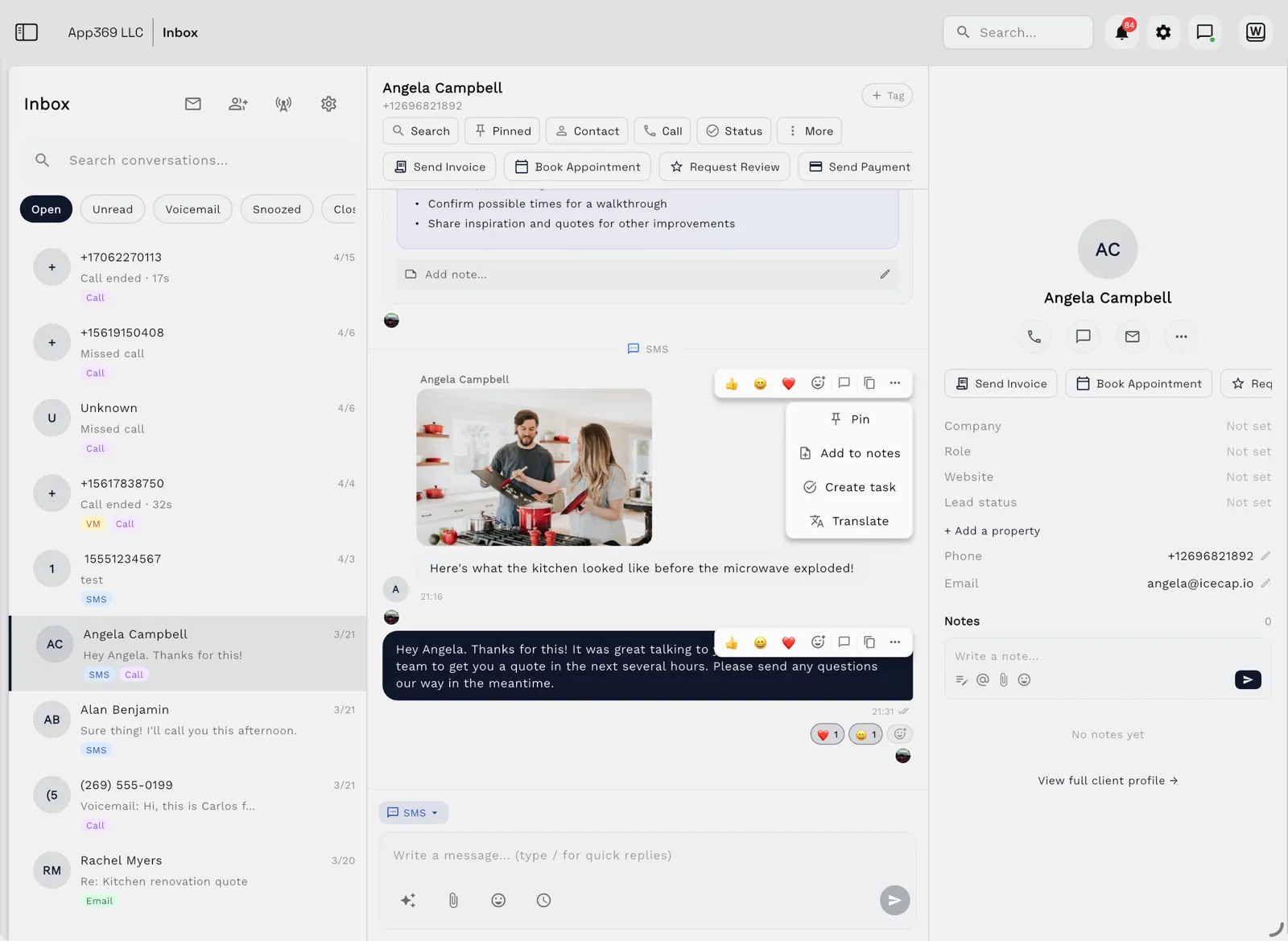
For an agent who also coaches newer agents or consults for builders, Workspace369 holds that side business, not the listings. The first screenshot is the inbox in a demo workspace with sample data (not a brokerage). One conversation shows calls, an SMS thread and a Create task option on a message, with Send Invoice and Book Appointment buttons above the thread and the contact's details and notes on the right. An enquiry for a pricing-strategy session would land there, beside the history. The communications page covers the inbox; SMS and calling start at Voyager.
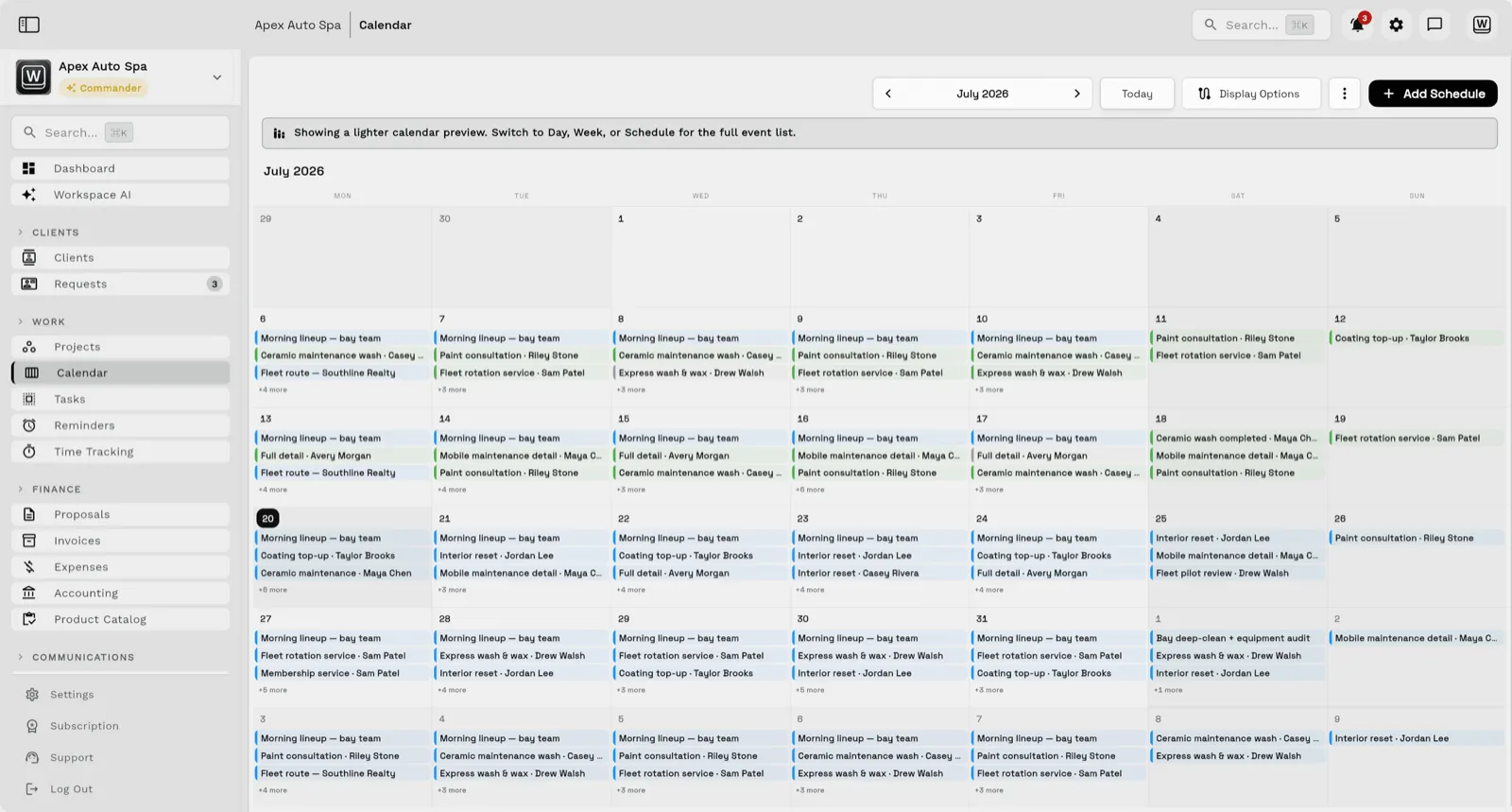
The second screenshot is the month calendar from a demo workspace, with several named bookings on each day. Coaching calls and site visits for the consulting work would sit there as scheduled events, and a Workflow Automation can send the follow-up email after each one. Email automations are on every plan; SMS steps start at Voyager.
What it does not do: there is no IDX website, no portal lead feed, no MLS data and no transaction checklist, so buyer and seller work belongs in a real-estate CRM.
Run a lead-to-close test during the trial
Take one fictional buyer lead through the sequence below in each tool you shortlist. The scenario is an exercise, not a customer result.
- Submit an inquiry through your website form or a test portal lead and check that it lands in the CRM with its source.
- Confirm it is assigned to the right agent and that you get a task or alert within minutes.
- Start a drip sequence of three emails and a text, then pause it when the lead replies.
- Open a deal at the contract stage and add a closing checklist with inspection, appraisal and closing dates.
- Check that the original inquiry, messages, checklist and next follow-up task all show on one record.
If you run the test, the best tool keeps all five on one record and starts the follow-up without you. Draft any change request to a service client with the free scope-change request builder.

When to keep it simple
If you handle a few transactions a year, a spreadsheet, a calendar and a mail merge can carry you. Move to a real estate CRM when leads arrive from several places, when follow-up slips past the first day, or when you work a sphere large enough that you cannot remember who to call. The real estate agent product page shows how Workspace369 handles Proposals, communications and invoices for service work, and the pricing page has current plans. For a consulting practice beside your listings, see the best CRM for consultants. Keep licensing, disclosures and closing documents with your brokerage and the providers who handle them.
Before importing real contacts, run one full client on demo data and check that your records can be exported.
Sources reviewed for this guide
- Workspace369 pricingPlan matrix reviewed October 26, 2026.
- Follow Up Boss pricingOfficial pricing page reviewed October 26, 2026 for monthly and yearly prices, plan features and trial length. Both billing views were opened.
- Wise Agent pricingOfficial pricing page reviewed October 26, 2026 for monthly and annual prices, included features, add-ons and trial length. Both billing views were opened.
- IXACT Contact pricingOfficial pricing page reviewed October 26, 2026 for monthly and annual plan prices and features. Both billing views were opened; the trial length is not shown.
- Top Producer pricingOfficial pricing page reviewed October 26, 2026 for per-user prices and the feature comparison. No billing switch or trial length was visible on the page that day.
- Real Geeks pricingOfficial pricing page reviewed October 26, 2026 for the platform price, setup fee, add-ons and commitment terms. The 6-month, 12-month and annual views all showed the same $399 platform price.
- Lofty pricingOfficial page reviewed October 26, 2026. Every plan shows "Request Pricing", so Lofty is named but not ranked.
- BoldTrail pricingOfficial page reviewed October 26, 2026. Pricing is given after a demo request, so BoldTrail is named but not ranked.
Workspace369 publishes this documentation-based comparison and is one of the options. It is not an independent ranking or a hands-on benchmark.
Run client follow-up in one workspace.
CRM, inbox, voice, invoicing, payments, projects, files, AI, and workflow automations — connected instead of exported.
14-day free trial. Card required. After the trial: from $29/month. Renews automatically every month until you cancel. Cancel anytime in Settings → Billing.