Best CRM for Home Stagers in 2026: Stock and Deposits
Best CRM for home stagers: six tools compared on price, furniture inventory, deposits, proposals and recurring rental billing, plus a date-change test.
We make Workspace369, which is on this list. Weigh our ranking with that in mind.

By Simon Dziak, Founder, Workspace369 · LinkedIn
TapGoods fits stagers who own a warehouse of pieces and need availability by date. Stageforce fits staging companies that want homeowner, realtor and stager roles in one tool. Workspace369 fits stagers whose gap is proposals, deposits and monthly rental invoices, with stock counts from Specialist. Houzz Pro, HoneyBook and Dubsado fit design-led or form-led stagers who track stock elsewhere.
The best CRM for home stagers answers two questions a normal CRM does not: which pieces are free on the install date, and what the client owes for each month the furniture stays. Size a staging deposit with the free deposit calculator. For a general client-work CRM, see the best CRM for freelancers guide.
Disclosure and method: Workspace369 publishes this guide and is one of the options. It is a documentation-based shortlist, not a hands-on benchmark. Official vendor pages were reviewed on October 26, 2026, except Stageforce, whose site blocked our fetch that day; its feature notes are from October 18, 2026. Check current plans with each vendor before you buy.
Key takeaways
- A staging business has three parties on every job (the homeowner, the realtor and you) and a stock of furniture that has to be somewhere on a given date, so a plain contact CRM leaves the hardest part to a spreadsheet.
- TapGoods and Stageforce are built for staging and rental inventory; TapGoods publishes prices (Launch is $19 per user a month billed annually, capped at 30 items); Stageforce keeps its prices on its own site, which blocked our fetch, so check them there.
- Workspace369 tracks inventory, stock adjustments and low-stock alerts only from Specialist ($149 a month, $119.25 billed yearly); recurring invoices, deposits and retainers are on every plan from Cadet ($29 a month).
- Houzz Pro Design is listed at $99 a month for one user, with an annual subscription after the trial, and includes a product library, proposals, invoices and online payments; HoneyBook and Dubsado handle proposals and payment schedules but list no furniture inventory.
- Test each trial with one fictional job: a delayed install date, an added patio, a monthly rental extension and a destage, and check that the proposal, schedule, stock and invoice still agree.
What's inside?
What a CRM for home stagers is (and what it is not)How we compared these toolsThe best CRM for home stagers in 2026Side-by-side comparisonWhich tool fits your staging business?Workspace369 in action for an install-to-destage staging jobRun a date-change test during the trialWhen to keep it simple
What a CRM for home stagers is (and what it is not)
A CRM for home stagers is the business record around a staging job: the homeowner, the listing realtor, the signed scope, the deposit, the install and destage dates, the monthly extension and the invoices. It is not a design-board tool and it is not a truck dispatcher. The inventory question sits between the two: a stager with a warehouse needs to know what is staged where, while a stager who rents pieces per job may only need a list. Decide which you are before you compare prices, because inventory is the feature that most often forces a stager onto a more expensive plan.
How we compared these tools
We compared each tool on the same five points, using only the vendor's own pages:
- Entry price for one person, on monthly and yearly billing where the page shows both.
- Furniture inventory: whether the page documents stock tracking, and from which plan.
- Proposals, deposits and recurring invoices for monthly extensions.
- Hard limits on the entry plan: item caps, minimum users or minimum terms.
- Trial terms: length, and whether a card is stated.
We did not test speed, support, reliability or mobile apps, and we did not use third-party ratings. Order reflects documented fit for a 1-10 person staging business that works with realtors and homeowners. Where a page publishes no price, the table says "See site".
The best CRM for home stagers in 2026
1. TapGoods, best for date-based inventory and rental billing
TapGoods sells software for rental businesses and has a dedicated home staging page. That page documents inventory levels tracked in real time, inventory and orders tracked by date and time, contracts signed electronically, automated invoices and contracts, a customer portal with a shopping cart, and built-in routing (its pricing matrix ticks autobilling from Scale and routing from Grow, and Launch lists Accounting & Payment Collection). Launch is $19 per user a month billed annually ($228 a year) and lists unlimited orders, up to 30 items, inventory tracking and payment collection. Grow is $59 per user a month billed annually and removes the item cap, adds custom proposals, routing and tracking, and item bundles.
Limitations: Launch caps you at 30 items, so a stager with a full warehouse needs Grow. The monthly view shows higher prices ($29 for Launch, $69 for Grow) and its labels vary between "billed monthly" and "billed monthly (annual plan)". After the first 30 days the page sets a minimum subscription of one year, and trials start with a demo booking. It is built for rental operations, so the realtor-and-homeowner relationship is less central than in a staging-specific tool.
Best for: stagers who own and rent out a warehouse of pieces and want availability, contracts and rental invoices in one system.
2. Stageforce, best for the homeowner, realtor and stager triangle
Stageforce describes itself as built exclusively for home staging and design businesses, with account management, inventory management and project management in one platform. Its overview lists a homeowner, realtor and stager account structure with assigned roles, invoicing through a Stripe integration, a view of what you have, where it is and when it is available, QR and RFID tags, selling pieces through an online store, and inventory statuses that run from selected through staged to destaged. That is the destage step most general tools never name.
Limitations: the overview we reviewed on October 18, 2026 showed no prices, trial terms or plan limits. Stageforce has a separate plan page on its site, but the site returned an access error to our fetch on October 26, 2026, so this guide quotes no Stageforce price; check it on stageforce.com. Its home page lists proposals and agreements with e-signature and Stripe invoicing; neither page we read names deposits or recurring invoices, so check those before you commit.
Best for: stagers who want a tool shaped around the staging job itself.
3. Workspace369, best for proposals, deposits and recurring billing around the job
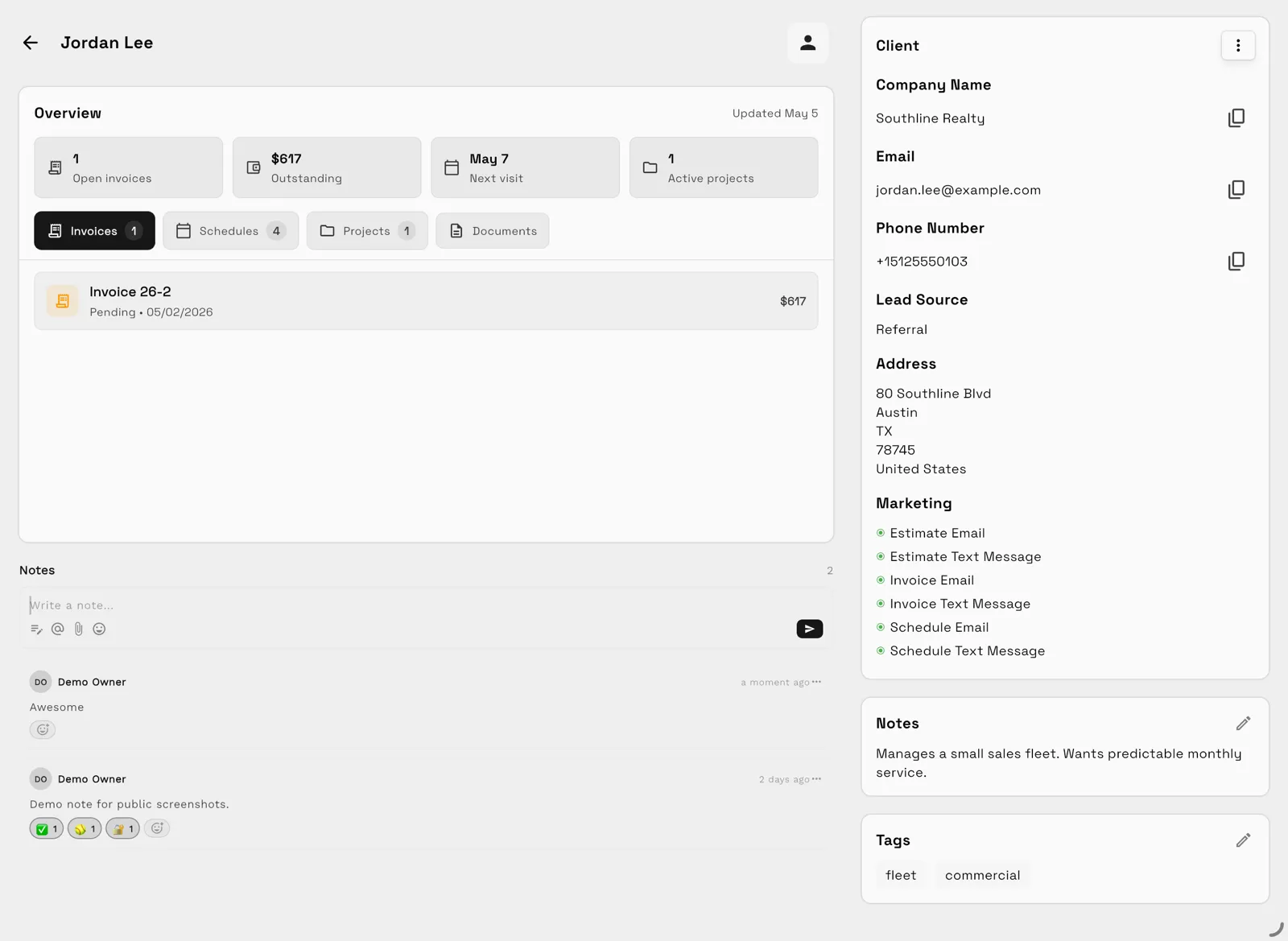
Workspace369 keeps the client record, a proposal the homeowner or realtor approves online, contracts, a client portal, time tracking and invoices together. Deposit on acceptance, retainers and payment schedules, recurring invoices (a monthly extension can repeat until you stop it) and time tracking are on every plan from Cadet, which is $29 a month for one seat ($23.25 billed yearly). Inventory tracking, stock adjustments and low-stock alerts start at Specialist, at $149 a month ($119.25 billed yearly, 10 seats). The screenshot is a demo workspace with sample data, not a customer result.
Limitations: Cadet and Voyager have no inventory, so a stager who wants stock counts pays for Specialist; TapGoods Launch at $19 per user a month billed annually is a lower starting price for inventory, though capped at 30 items. Cadet also allows 5 active projects. Workspace369 does not document date-based rental availability or truck routing, and it has no staging-specific destage statuses, so write those into project tasks. There is a 14-day trial on Cadet through Commander, card required.
Best for: stagers who value the proposal, deposit, portal and invoice side more than item-level rental scheduling, or who run a small stock on Specialist.
4. Houzz Pro, best for a product library and design proposals
Houzz Pro has a page written for home stagers. Design is listed at $99 a month for one user (extra users are $50 a month each) and lists a product clipper and library, selections, mood boards, 3D floor plans, a CRM, proposals, invoices and online payments. The stager page also describes time and expense tracking that adds to invoices. The pricing page offers a 30-day trial, with an annual subscription starting when the trial ends, and a free plan.
Limitations: the stager page says you can "virtually recreate your inventory" in the product library, but it describes images and product details, not stock counts, availability by date or stock adjustments. The $99 figure is for one user and rises with seats. The pages we reviewed do not state whether the trial needs a card.
Best for: stagers who present rooms with mood boards and product selections and want proposals and invoices in the same tool.
5. HoneyBook, best for a polished client flow
HoneyBook Starter is $29 a month billed yearly (see site for the monthly price) and lists unlimited clients and projects, invoices and payments, proposals and contracts, a client portal and up to 2 live lead forms. The feature table lists invoices sent one-time, recurring or on custom schedules, so a monthly extension is possible. Its FAQ gives a 30-day trial with no credit card required.
Limitations: no furniture inventory appears on the pricing page, so stock stays in a spreadsheet. Time tracking is listed on HoneyBook's for-teams page but not in the pricing table, so its plan gate is not stated. Essentials ($49 yearly, $59 monthly) adds unlimited Scheduler sessions (Starter allows 1), automations and the account owner plus up to 2 team members. A staging crew of several people needs Premium ($109 yearly, $129 monthly) for unlimited team members.
Best for: solo stagers with a small stock who care most about the proposal, contract and payment experience for realtors.
6. Dubsado, best for forms and payment schedules
Dubsado lists unlimited clients and projects, invoicing and payment plans, client portals and form templates on both plans, with three extra users free. Starter is $335 a year and Premier is $525 a year (monthly prices load on the pricing page, so see site). Premier adds scheduling, automated workflows, public proposals and time tracking. The trial is 21 days with full Premier access and no card required.
Limitations: Starter has one active lead form and no public proposals, so a staging proposal shared outside a project needs Premier. No inventory is listed on the page, and time tracking is Premier only. Users beyond the three free ones are priced in bands, starting at $25 a month for 4-10 users.
Best for: stagers who want repeatable intake forms and payment schedules and track stock somewhere else.
Side-by-side comparison
| Tool | Entry price (monthly billing) | Billed yearly | Inventory | Main entry-plan limit | Trial |
|---|---|---|---|---|---|
| TapGoods | $29 per user (Launch) | $19 per user a month | Yes, from Launch (30 items) | 30 items; 1-year minimum term | See site (demo first) |
| Stageforce | See site | See site | Yes (documented) | See site | See site |
| Workspace369 | $29 (Cadet) | $23.25 a month | From Specialist ($149 a month) | 5 active projects, 1 seat on Cadet | 14 days on Cadet through Commander, card required |
| Houzz Pro | $99 a month listed (Design) | Annual subscription after the trial | Product library, no stock count | $50 per extra user | 30 days, card not stated |
| HoneyBook | See site | $29 a month (Starter) | Not listed | 2 live lead forms | 30 days, no card |
| Dubsado | See site | $335 a year (Starter) | Not listed | 1 lead form, no public proposals | 21 days, no card |
Which tool fits your staging business?
| If you mostly need | Start with | Why |
|---|---|---|
| Availability of pieces by date and rental invoices | TapGoods | Date-based inventory and automated rental invoices on its home staging page |
| Homeowner, realtor and stager roles with a destage status | Stageforce | Staging-specific account roles and inventory statuses |
| Proposals, deposits and recurring invoices with stock on one plan | Workspace369 | Deposits and recurring invoices from Cadet, inventory from Specialist |
| Product selections and mood boards shown to clients | Houzz Pro | Product library and design proposals on Design |
| Contracts and payment flow for a small stock | HoneyBook | Proposals, contracts and recurring invoices on Starter |
| Intake forms and payment schedules | Dubsado | Forms and payment plans on both plans |
Workspace369 in action for an install-to-destage staging job
A staging job in Workspace369 is one project with dates on the calendar. The first screenshot below is the projects board in a demo workspace with sample data (an auto-detailing demo company, so the names are not staging jobs). Each card shows a stage, a progress bar and a budget, which is where "12 Elm St, vacant stage" would sit between Planning and In Progress. The second is the month calendar from the same demo workspace, with several bookings on each day and a "+ more" link when a day fills up.
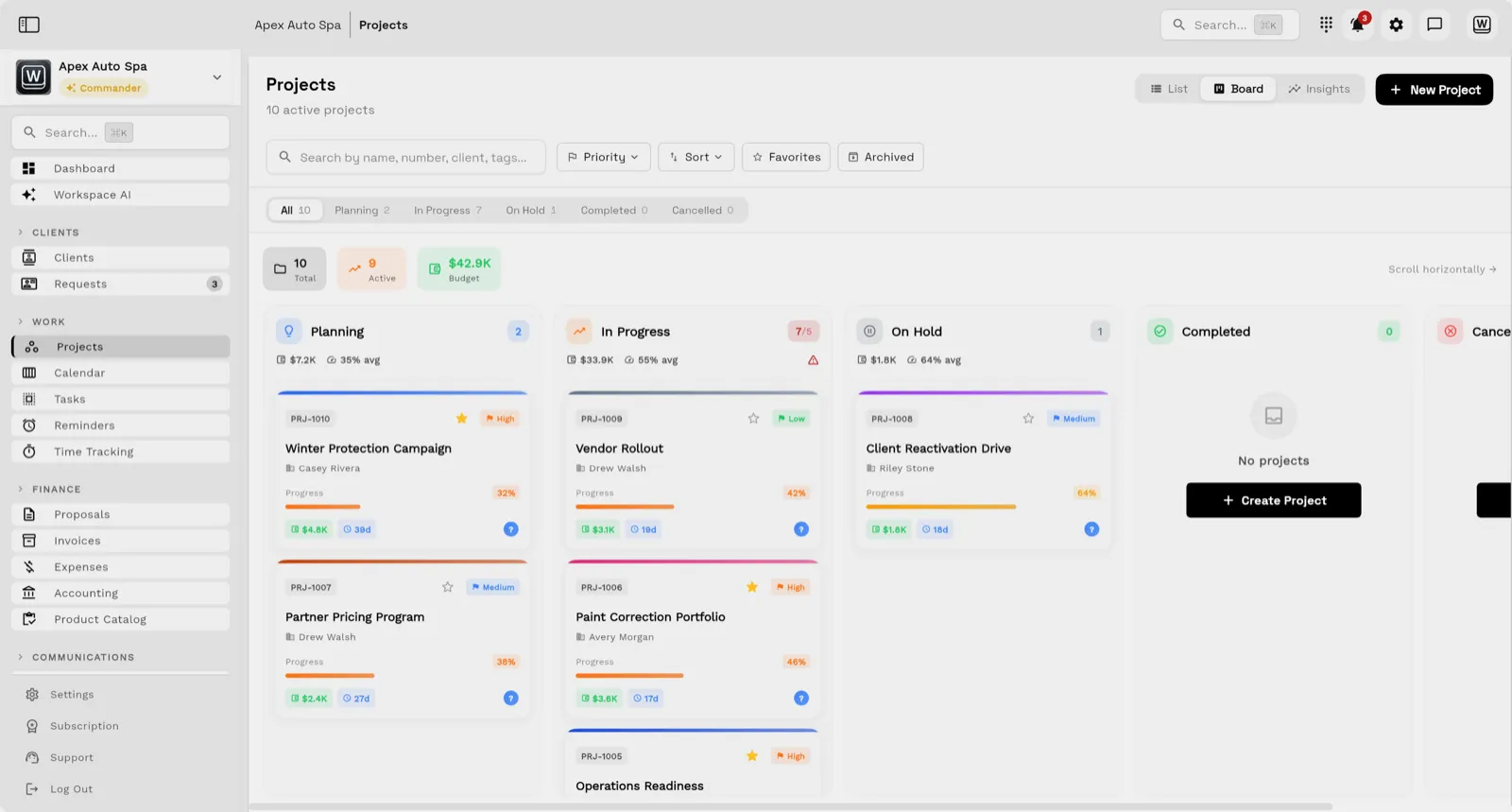
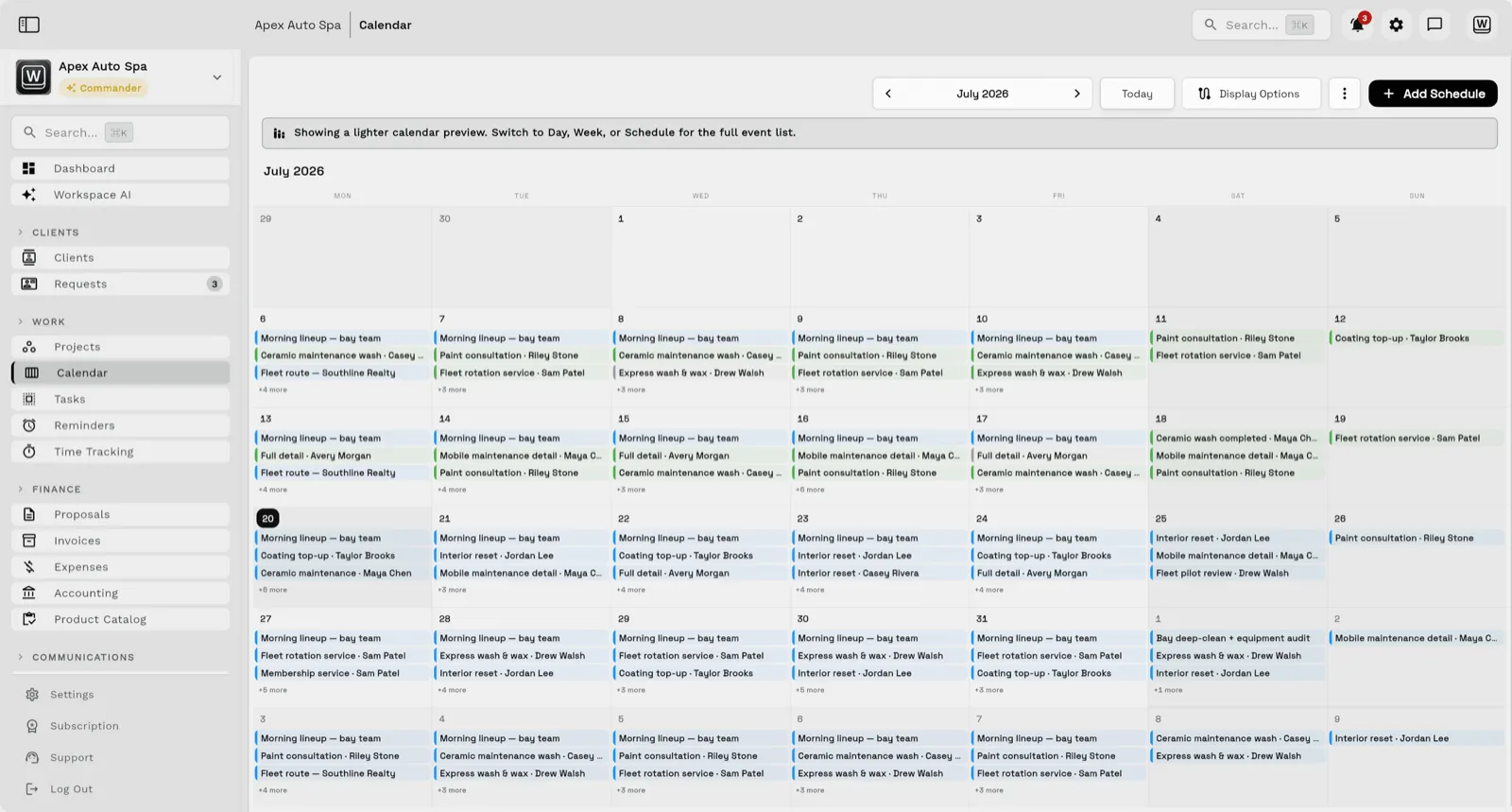
In a real staging job you would send the scope and deposit through Proposals, put the install and destage dates on the schedule, and set the monthly extension as a recurring invoice that stops when you destage. On Specialist, billing a tracked product takes it off the stock, and you adjust counts by hand when pieces come back.
What Workspace369 does not do for a stager: it does not document holding a sofa for a date range or flagging two jobs that claim the same piece on the same dates, and it does not route trucks or give pieces a staged or destaged status. If those are your daily problem, a staging or rental inventory tool fits better.
Run a date-change test during the trial
Take one fictional listing through each tool you shortlist:
- Send a staging proposal with a deposit and have it approved online.
- Reserve or assign five pieces to the install date.
- The realtor delays the install by four days: move the date and check that the stock holds follow.
- Add a patio to the scope with a revised proposal and extra tasks.
- Set the monthly extension as a repeating invoice and stop it at the destage date.
- Mark the pieces returned and see whether the system shows them as free again.
The best tool for you is the one where the schedule, the stock and the invoice all follow step 3 without manual rework. Draft the added-room request with the scope-change request builder.

When to keep it simple
If you stage a few listings a year and rent from a furniture partner, a shared calendar, a spreadsheet of pieces and an invoice template can carry you. Move to a tool when two jobs claim the same sofa, when a realtor's date change breaks your schedule, or when you chase monthly extensions by hand. The home stagers product page shows how Workspace369 handles proposals, communications and invoices; the pricing page has current plans. Workflow Automations can create tasks and send reminders for install and destage dates, with email automations on every plan. Before importing real clients, run one full job on demo data and check that your records can be exported.
Sources reviewed for this guide
- Workspace369 pricingPlan matrix reviewed October 26, 2026 for inventory, deposits, recurring invoices and plan limits.
- TapGoods pricingOfficial pricing page reviewed October 26, 2026 for Launch, Grow and Scale prices, item limits and cancellation terms.
- TapGoods home staging softwareOfficial product page reviewed October 26, 2026 for inventory, contracts, invoicing and routing claims.
- Stageforce overviewOfficial product page reviewed October 18, 2026 for staging workflow features. It returned an access error to our fetch on October 26, 2026.
- Stageforce home pageOfficial home page reviewed October 18, 2026 for proposals with e-signature and Stripe invoicing. It returned an access error to our fetch on October 26, 2026.
- Houzz Pro pricingOfficial pricing page reviewed October 26, 2026 for plan prices, seats and trial terms.
- Houzz Pro software for home stagersOfficial page reviewed October 26, 2026 for the product library, proposals and time tracking.
- HoneyBook pricingOfficial pricing page reviewed October 26, 2026 for yearly and monthly prices, features and trial terms.
- HoneyBook for teamsOfficial page reviewed October 26, 2026; it lists time tracking, which the pricing table does not show.
- Dubsado pricingOfficial pricing page reviewed October 26, 2026 for yearly prices, plan limits and trial terms.
- Dubsado time tracking help articleHelp center article checked October 26, 2026: time tracking is on the Premier plan.
Workspace369 publishes this documentation-based comparison and is one of the options. It is not an independent ranking or a hands-on benchmark.
Run client follow-up in one workspace.
CRM, inbox, voice, invoicing, payments, projects, files, AI, and workflow automations — connected instead of exported.
14-day free trial. Card required. After the trial: from $29/month. Renews automatically every month until you cancel. Cancel anytime in Settings → Billing.