Best CRM for Mortgage Brokers in 2026
Best CRM for mortgage brokers: four priced CRMs compared on price, loan-system sync, borrower portals and contract terms, with quote-only tools named apart.
We make Workspace369, which is on this list. Weigh our ranking with that in mind.

By Simon Dziak, Founder, Workspace369 · LinkedIn
The best CRM for mortgage brokers is usually one built for loans. BNTouch fits a mortgage-only team that wants campaigns and an application page, Jungo fits brokers who want a loan-system sync on Salesforce, and HubSpot fits a free general start. Workspace369 fits a simple client record while the loan file lives elsewhere.
Workspace369 (see its mortgage brokers page) comes last of four because it lists no loan-system sync, loan application page or mortgage campaigns. Mortgage lending is regulated and requirements vary, so check any tool with your compliance team. To size the whole stack first, use the free software stack cost calculator.
Disclosure and method: Workspace369 publishes this guide and is one of the options; we rank it last of four for this reader. It is a documentation-based shortlist, not a hands-on benchmark. Official vendor pages were reviewed on October 26, 2026, except BNTouch's pricing page, which blocked automated reading that day. Check current plans with each vendor before you buy.
Key takeaways
- A mortgage-specific CRM is usually the better fit for a broker, because loan-system sync, a borrower application page and mortgage drip campaigns come with it; a general client-work tool does not list them.
- BNTouch is a mortgage-only CRM; its pricing page blocked automated reading on October 26, 2026, so its per-user price, contract terms and trial are See site.
- Jungo lists Jungo Lite at $96 per user a month billed annually ($119 billed monthly) and the Bundle at $125 ($149), with an annual minimum contract and a one-time setup fee of $249 or $299.
- Workspace369 Cadet is $29 a month ($23.25 billed yearly) for one user with a client portal, proposals, contracts and invoices (14-day trial on Cadet through Commander, card required), but it lists no loan-system sync, no loan application page and no mortgage campaigns. We rank it last of four for this reader.
- Mortgage lending is regulated and requirements vary, so confirm any tool with your compliance team; this guide makes no compliance claims beyond quoting vendor pages.
What's inside?
What a CRM for mortgage brokers is (and what it is not)How we compared these toolsThe best CRM for mortgage brokers in 2026Side-by-side comparisonWhich tool fits your brokerage?Workspace369 in action for a borrower document chaseRun a document-chase test during the trialWhat we did not rank, and whyKeep lending decisions in your lending systemWhen to keep it simple
What a CRM for mortgage brokers is (and what it is not)
A CRM for a mortgage broker is the relationship side of the business: the borrower inquiry, the referral partner who sent it, the follow-up after a rate quote, the reminder to chase a missing document and the past clients you contact again. It is not a loan origination system, a pricing engine or a compliance tool. The loan file, the credit decision and the required disclosures live in your lending systems, and a CRM should hand off to them rather than replace them. Mortgage-specific CRMs add a loan-system sync and borrower tools; general tools leave that to you.
How we compared these tools
We compared each tool on the same five points, using only the vendor's own pricing pages as read on October 26, 2026:
- Price model: per user per month, the monthly and yearly views where the page shows both, and any setup fee.
- Loan-system link: whether the page lists a loan-system sync or integration at that plan.
- Borrower-facing tools: application page, portal, document collection and texting listed at that plan.
- Contract terms: minimum term, trial and whether the entry price covers a single user.
- Fit for a small brokerage: what one to ten users pay and what has to be added.
Only tools with a public price are ranked; BNTouch stays in from our October 19 reading, although its page blocked us on October 26. We did not test speed, support, reliability or mobile apps, did not verify any integration, and did not evaluate compliance, data-security or licensing features. We use no third-party ratings. Order reflects documented fit for a broker who owns the borrower relationship before and after the loan file. HubSpot ranks above Workspace369 because it has free tools for 2 users and a larger app ecosystem; both list no loan-system sync, and Workspace369 adds a client portal, contracts and invoices from Cadet.
The best CRM for mortgage brokers in 2026
1. BNTouch, best for a mortgage-only CRM with a published per-user price
BNTouch's pricing page blocked automated reading on October 26, 2026, so its per-user prices, user tiers, record limits, contract terms and trial terms are See site. From our October 19 reading, it lists mortgage, partner and recruiting pipeline automation, email and social marketing, SMS and voice automation, a point-of-sale with an online 1003 and portals, and a large library of pre-built mortgage campaigns. Confirm each of those on the vendor page.
Limitations: we could not re-check the price, whether it offers a free trial or what the contract requires, so ask for a demo and get those in writing. Loan-system integrations are listed under a custom-priced Enterprise tier, and the Integrations group in the CRM column did not name specific loan systems, so ask which ones you can connect. We did not review what its reporting and compliance feature group covers.
Best for: brokers and small teams who want one mortgage CRM with campaigns and an application page and are happy to start from a demo.
2. Jungo, best for a Salesforce-based mortgage CRM with loan-system sync
Jungo is sold as a mortgage CRM on Salesforce. On the Annually view, Jungo Lite is $96 per user a month and the Jungo Bundle is $125; on the Monthly view they are $119 and $149. Lite lists drip campaigns, a lead intake form, an agent portal, interest-rate emails and integrations with Homebot, Floify, BombBomb and Mortgage Coach. The Bundle adds LOS Sync, a round-robin lead app and Jungo SMS; the page words its text-messaging benefits as getting approved for A2P 10DLC and automated opt-outs.
Limitations: every contract is annual for a minimum of one year, even when billed monthly, and there is a one-time setup fee of $249 or $299 for Lite and $299 for the Bundle depending on the view. Loan-system sync is not on Lite. Each integration needs its own account with the partner. Enterprise is a custom offer.
Best for: brokers who want a mortgage CRM with a loan-system sync and are comfortable with a one-year commitment.
3. HubSpot Sales Hub, best for a general CRM with a free tier
HubSpot's Sales Hub pricing page lists free tools for up to 2 users with no credit card required. The Starter tier shows a list price of $20 per seat a month, with a $7 price also displayed that we did not use. Professional lists $90 to $100 per seat a month depending on the billing option, plus a required one-time onboarding fee of $1,500.
Limitations: it is a general CRM, so the page lists no loan-system sync, no application page and no mortgage campaigns. A mortgage setup means custom properties and your own process. Features and credits change by tier, so read the tier you would actually buy.
Best for: a broker who wants a low-cost general CRM and is willing to build the mortgage pipeline and handoff themselves.
4. Workspace369, best for a simple client record when the loan file lives elsewhere
Workspace369 keeps the borrower record, public intake forms, a client portal, proposals, contracts with e-signature, file attachments and invoices together. Cadet is $29 a month for one user ($23.25 billed yearly) with 5 active projects; Voyager is $74 ($59.25 billed yearly) for two seats and adds lead-source tagging on clients, a shared inbox and SMS (every request records whether it came from a form, funnel or page on every plan). The screenshot is a demo record, not a customer result.
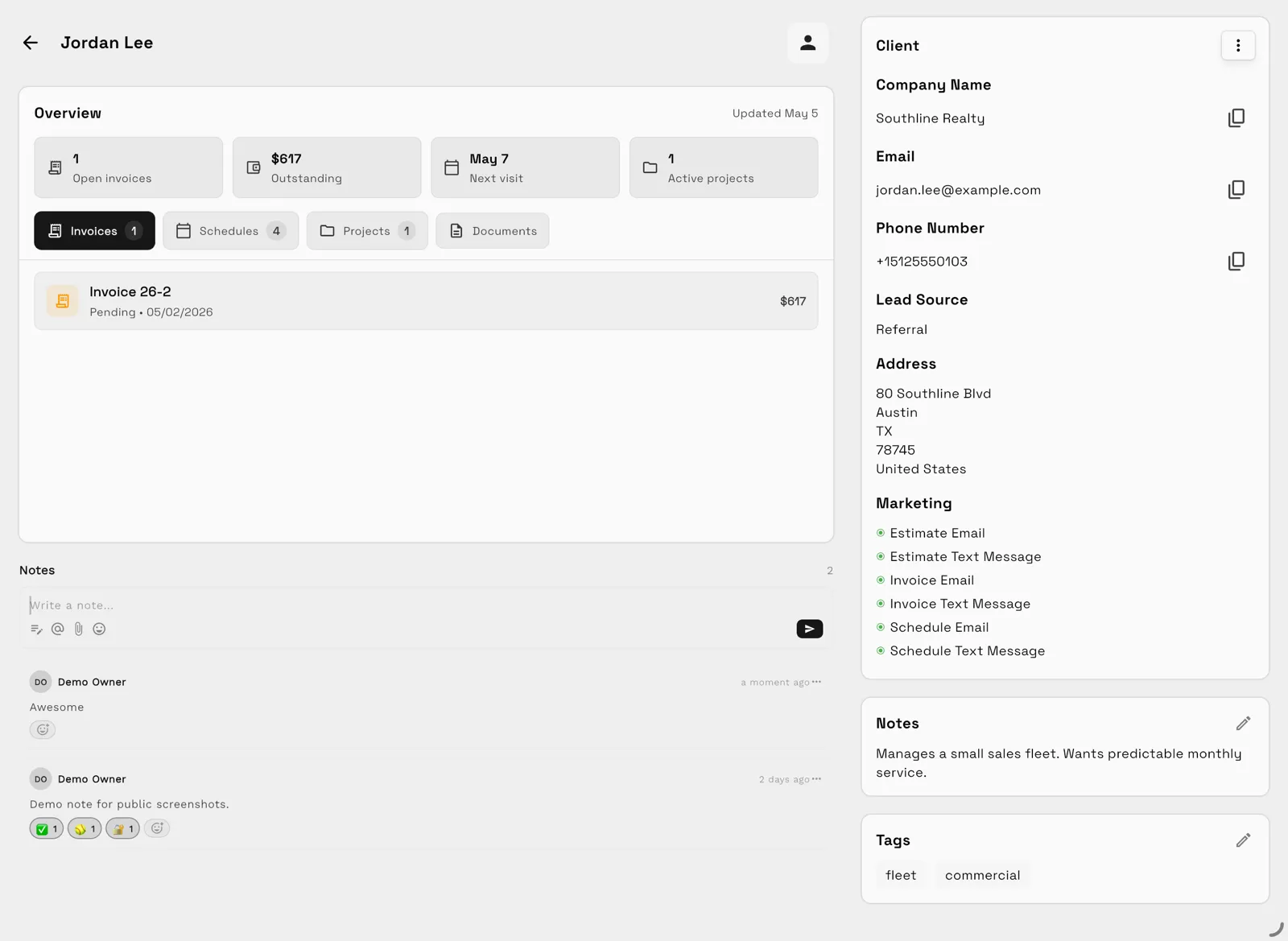
Limitations: the plan matrix lists no loan-system sync, no loan application or 1003 page, no rate alerts and no mortgage campaign library. Webhooks and the API start at Specialist ($149 a month, $119.25 billed yearly, 10 seats). Online booking also starts at Specialist. The 14-day trial covers Cadet through Commander, card required. BNTouch and Jungo are built for this work, and HubSpot has a free tier.
Best for: a solo broker or small team that wants intake forms, a client portal, follow-up automations and invoices on one record, and runs the loan file in a separate system.
Side-by-side comparison
| Tool | Plan priced | Monthly | Billed yearly | Mortgage features listed at that plan | Limits | Trial |
|---|---|---|---|---|---|---|
| BNTouch | CRM | See site | See site | Mortgage pipeline, campaigns, point-of-sale with online 1003 (October 19 reading); LOS integrations on Enterprise | See site | See site; demo |
| Jungo | Jungo Lite | $119 per user | $96 per user | Lead intake form, agent portal, partner integrations; no LOS Sync | Annual minimum contract; $249 or $299 setup | Free demo |
| HubSpot | Sales Hub Starter | $20 per seat (list) | See site | None listed; general CRM | Free tools for up to 2 users | Free tools, no card |
| Workspace369 | Cadet | $29 | $23.25 a month | None; intake forms and client portal | 1 user, 5 active projects | 14 days on Cadet to Commander, card required |
Which tool fits your brokerage?
| If you mostly need | Start with | Why |
|---|---|---|
| A mortgage-only CRM with campaigns and an application page | BNTouch | Mortgage pipeline and point-of-sale listed; get the price from the vendor |
| A loan-system sync on a Salesforce base | Jungo | LOS Sync is in the Bundle; annual contract |
| A free general CRM to start | HubSpot | Free tools for 2 users, no card |
| A simple record plus proposals and invoices | Workspace369 | Intake forms, portal, contracts and invoices on Cadet |
| A quote-only enterprise platform | Total Expert, Surefire or Shape | Prices not published; ask for a quote |
Workspace369 in action for a borrower document chase
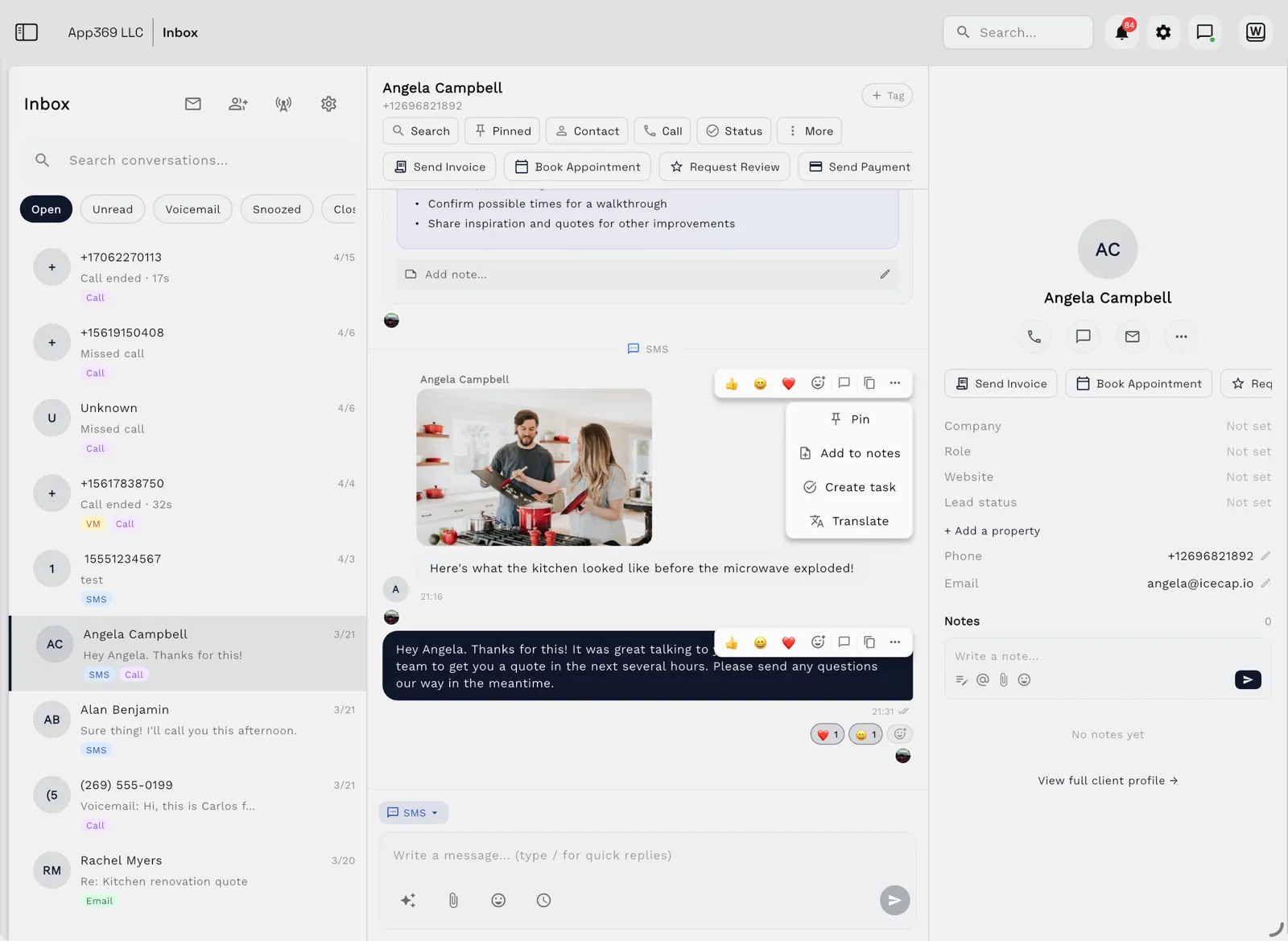
For a broker, the Workspace369 side is the borrower conversation and the follow-up, not the loan file. The first screenshot is the inbox in a demo workspace with sample data (a home-services conversation, not a borrower). It shows an SMS thread with a message menu offering Create task, buttons to send an invoice or book an appointment, and the contact's details and notes on the right. A missing-document reminder would be a text or email sent from that thread, with a task created from the message. SMS starts at Voyager; Cadet has the email inbox. The communications page covers the inbox.
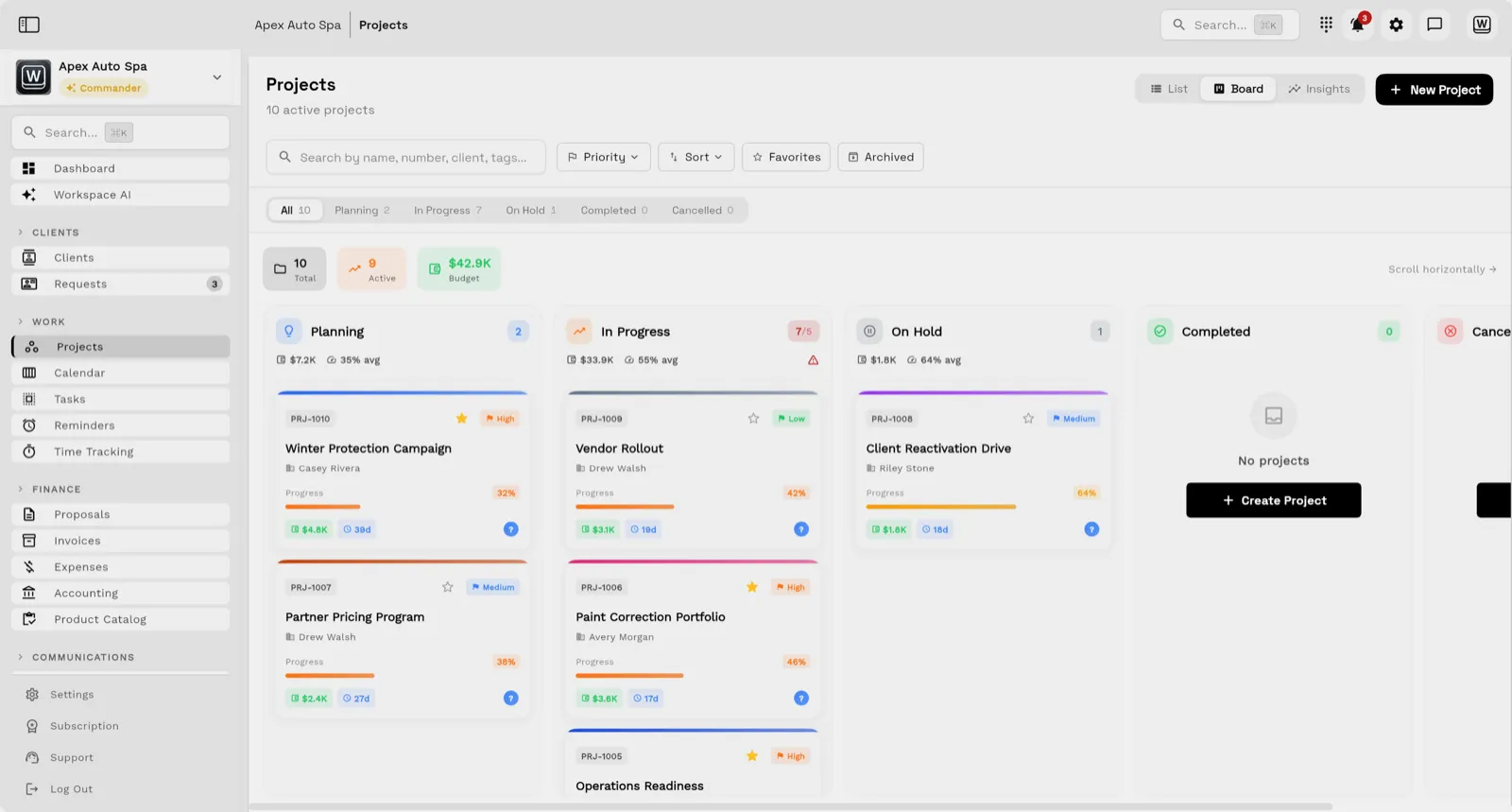
The second screenshot is the projects board in the same kind of demo workspace. Cards sit in Planning, In Progress, On Hold and Completed columns with progress bars and due-day counters. A broker could name the stages of a file this way (for example, waiting on documents) and use Workflow Automations to remind the borrower, but the stages and reminders are yours to build.
What it does not do: Workspace369 has no loan application or 1003 page, no loan-system sync and no mortgage campaign library, and we make no claim about how it fits mortgage regulation. Keep credit reports and loan files in your approved lending systems and use it as the relationship layer.
Run a document-chase test during the trial
Take one fictional borrower through each tool you shortlist, using sample data only:
- Capture the inquiry from a web form and assign it to a loan officer.
- Book a call and send a reminder before it.
- Request two sample documents and see where the borrower sends them.
- Leave one document missing and check that a reminder goes out.
- Hand the file to your loan system and note what you had to retype.
- Check that a second user sees only the borrowers you assigned.
The best tool keeps the contact, the follow-up and the handoff on one record without retyping. If a missing document means a manual email and a spreadsheet, that is the gap this test is built to find. Keep real credit reports and financial records in your approved lending systems.

What we did not rank, and why
These tools came up for this reader, but we could not read a public price, so we did not rank them:
- Shape: the pricing page shows Core, Complete and Enterprise with Get a Quote and Talk to Sales buttons and no figures on either billing view.
- Surefire: the ICE Mortgage Technology product page lists no price.
- Total Expert: its pricing path returned a 404 and the site points to a demo booking.
- Whiteboard CRM: we could not load an official site to read.
- Floify: a loan point-of-sale rather than a CRM. Its pages that loaded offered a demo and no price, and Jungo lists it as an integration.
- Salesforce: Financial Services Cloud lists Sales Core at $325 per user a month billed annually, but it is a general financial-services platform with no mortgage product named on the page, so we did not rank it.
Ask each vendor for a quote and compare it with the per-user prices above.
Keep lending decisions in your lending system
Mortgage lending is regulated, and requirements vary by state, license and how you handle borrower data. We make no claim that any tool here meets a specific rule; the only vendor compliance wording we quote is what Jungo's pricing page says about text opt-outs. Ask your compliance team what a CRM must support before you load real borrower records. In Workspace369, file versioning is on every plan, and webhooks and the API start at Specialist if you want to connect another system.
When to keep it simple
If you handle a few files a month, an intake form, a client portal and an invoice template may be enough, and a free tier such as HubSpot's costs nothing to test. Move to a mortgage CRM when several loan officers share leads, when you want a loan-system sync, or when you cannot say which borrowers are waiting on a document. The mortgage brokers product page shows how Workspace369 handles communications and contracts, and the pricing page has current plans. Workflow Automations can send reminders, with email automations on every plan. For adjacent trades, see the guides for real estate agents and financial advisors.
Before importing real borrowers, run one inquiry on demo data and check that your records can be exported.
Sources reviewed for this guide
- Workspace369 pricingPlan matrix reviewed October 26, 2026 for seats, active projects, client portal, contracts, public intake forms, email automations, SMS, file versioning, webhooks and API, online booking and trial terms.
- BNTouch pricing and featuresOfficial pricing page could not be read on October 26, 2026: it returned a bot-protection page to plain requests. Prices, record limits, contract terms and trial terms are See site. Feature descriptions are from our October 19, 2026 reading and should be confirmed on the vendor page.
- Jungo pricingOfficial pricing page reviewed October 26, 2026 for Jungo Lite and Jungo Bundle on the Annually and Monthly views, plus the setup fees and contract terms.
- HubSpot Sales Hub pricingOfficial pricing page reviewed October 26, 2026 for free tools for up to 2 users, Sales Hub Starter at a $20 per seat list price, and Professional at $90 to $100 per seat plus the $1,500 onboarding fee. The $7 Starter price shown alongside was not used.
- Shape pricingOfficial pricing page reviewed October 26, 2026 with the Annual and Monthly switch; no price is shown, only Get a Quote and Talk to Sales.
Workspace369 publishes this documentation-based comparison and is one of the options. It is not an independent ranking or a hands-on benchmark.
Run client follow-up in one workspace.
CRM, inbox, voice, invoicing, payments, projects, files, AI, and workflow automations — connected instead of exported.
14-day free trial. Card required. After the trial: from $29/month. Renews automatically every month until you cancel. Cancel anytime in Settings → Billing.