Best interior design software in 2026: studio fees and sourcing
Four tools for small interior design studios compared on product sourcing, purchase orders, proposals and invoicing, with prices from official pages.
We make Workspace369, which is on this list. Weigh our ranking with that in mind.

By Simon Dziak, Founder, Workspace369 · LinkedIn
The best interior design software for a studio that sources product handles the clipper, purchase orders, procurement and invoices on one client project. Studio Designer ranks first here for that job, with DesignFiles close behind. Workspace369 ranks third and fits studios that earn design fees and do not resell product, as the interior design software page explains. Quoting a design fee? Use the free estimate template.
Disclosure and method: Workspace369 publishes this guide and is one of the options. It is a documentation-based shortlist, not a hands-on benchmark. Official vendor pages were reviewed on October 21, 2026. Houzz Pro's pricing pages would not load when we checked, so it is not ranked. Check current plans with each vendor before you buy.
Key takeaways
- Interior design software for a studio that sources and resells product needs a product clipper, purchase orders, procurement tracking and invoices tied to the client project.
- Studio Designer ranks first here: its pricing page lists procurement, purchase orders, a general ledger and a client portal from $69 per user a month billed yearly.
- Workspace369 matches client purchase orders to invoices, with discrepancy checks, on every plan, but does not offer a web product clipper. It fits design-fee and service-led studios that sell proposals, deposits, retainers and hours, from $29 a month.
- DesignFiles and Programa list product clippers and mood boards; DesignFiles lists purchase orders on its Full Service plan, while Programa does not state them.
- Test each tool with one room: clip five products, build a quote, raise a purchase order, bill the deposit and open the client view.
What's inside?
What interior design software is (and what it is not)How we compared these toolsThe best interior design software in 2026Side-by-side comparisonWhich interior design software fits your studio?Run a one-room test during the trial or demoWhen to choose a different tool
What interior design software is (and what it is not)
Interior design software runs the business around the design: the client record, the proposal, the product schedule, supplier orders, the invoice and the client's view of progress. It is not a rendering or drafting tool, and it is not a generic CRM. A studio that buys furniture on a client's behalf needs sourcing and procurement. A studio that sells design time by the hour, the room or the retainer needs proposals, deposits and billing. The two jobs overlap less than most lists admit. The interior design software page shows the fee-led approach.
How we compared these tools
Best CRM for Interior Designers & Architects 2026: Scope, Projects & Billing

We compared each tool on the same five points, using only the vendor's own pricing and product pages:
- Product sourcing: a web clipper or product library named on the page.
- Procurement: purchase orders, order tracking or supplier handling.
- Proposals and mood boards: client proposals or quotes, and design boards.
- Invoicing and accounting: invoices, deposits, retainers, QuickBooks or a ledger.
- Price, seats and trial terms, including whether a card is stated.
We did not test speed, support, reliability, accounting accuracy or migration effort, and we did not use third-party ratings. Order reflects documented fit for a small studio that sources and resells product, with Workspace369 placed where its listed features honestly sit.
The best interior design software in 2026
1. Studio Designer, best for studios that run purchasing and the books together
Studio Designer's pricing page lists three per-user plans: Essentials at $69 a month billed yearly ($79 monthly), Professional at $79 ($89) and Premier at $109 ($119). All plans list procurement, a client portal, a full general ledger and StudioPay. Purchase orders, proposals and invoices are standard on Essentials and advanced on the higher plans. The product library, inventory, a custom document editor and calendar management start at Professional. A trial is not stated; the page offers a demo, and sign-up schedules a call of about 15 minutes. On the one-room test, check the order-to-invoice chain first, since that is what the listed procurement and ledger features target.
Limitations: no self-serve trial is stated, it is priced per user, and Essentials does not list the product library or inventory. It does not name mood boards on the pricing page.
Best for: studios that buy product for clients and want procurement, billing and accounting in one system.
2. DesignFiles, best for designers who want mood boards, a clipper and purchase orders
DesignFiles lists an e-Design plan at 55 a month and a Full Service plan at 75 a month, with extra users at $30 a month; the page does not show a currency symbol on the plan prices. It offers a 90-day money-back guarantee and a free account with no credit card required. Full Service lists purchase orders, quotes, requests for quotes, invoices and retainers, a time tracker, financial reporting and a QuickBooks integration, and both plans list a product clipper. The home page names a mood board editor and a 3D floor planner.
Limitations: the plans page does not state client proposals, and a trial for paid plans is not stated. Enterprise pricing is by request.
Best for: residential designers and decorators who want boards, floor plans, product sourcing and purchase orders in one tool.
3. Workspace369, best for fee-led studios that do not resell product
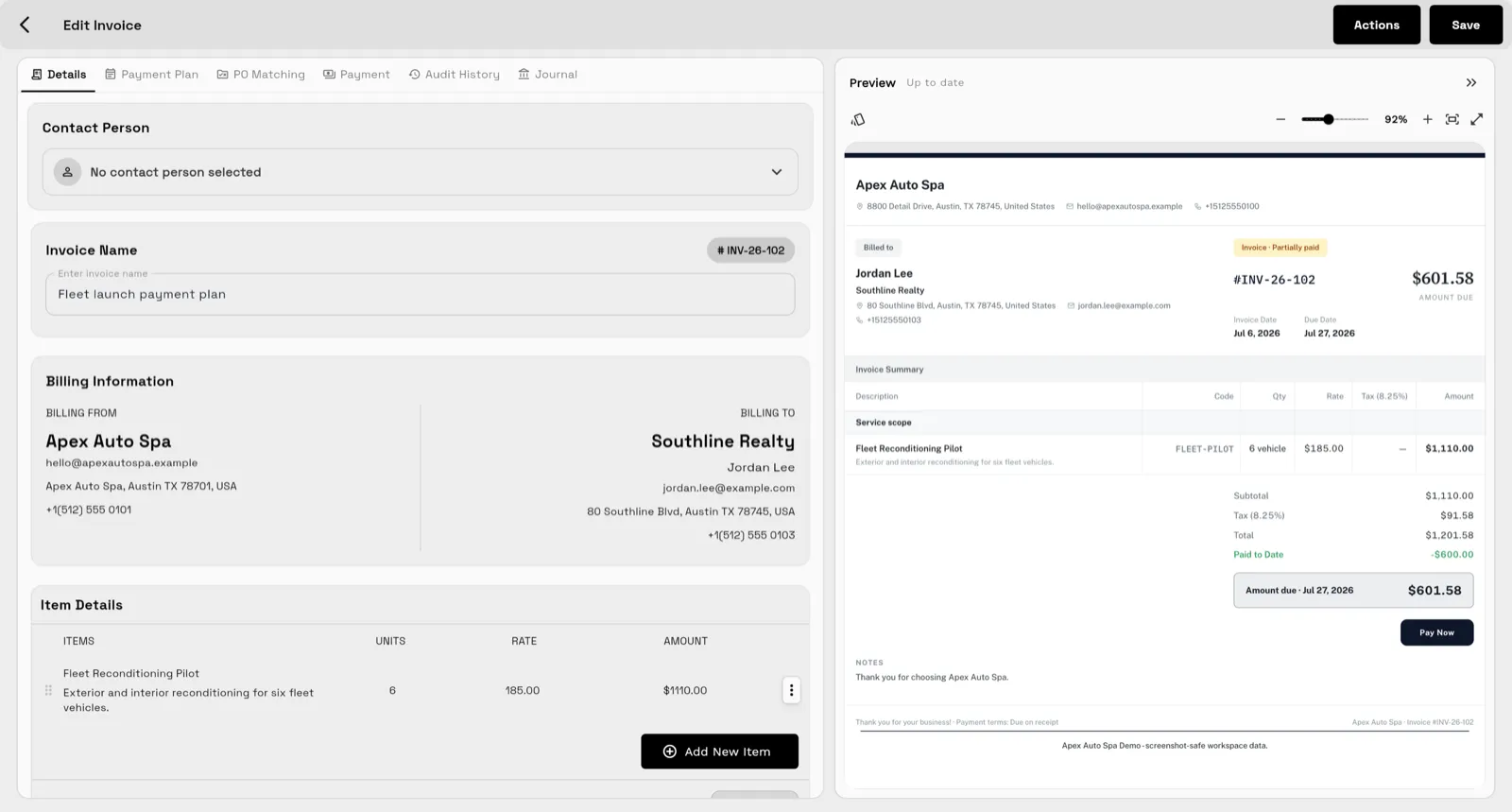
Workspace369 suits studios that earn design fees. Cadet costs $29 a month ($23.25 billed yearly) for one seat and includes catalog-based proposals that clients approve and sign by public link, deposits on acceptance, a branded client portal, time tracking, retainers and recurring invoices, and online card payments through Stripe. An overdue-payment automation sends reminders 1, 3, 7, 14 and 30 days after the due date. The screenshot above is a demo invoice, not a customer result. A product catalog is capped at 20 items on Cadet. Inventory tracking, expenses and receipt capture, payment plans, AR aging, project profitability and basic accounting start at Specialist ($149, 10 seats).
Limitations: it does not list a web product clipper, order tracking or mood boards. Credit notes are coming soon, Cadet is one seat and up to 5 active projects, and the 14-day trial needs a card.
Best for: studios that sell design packages, hourly work or retainers, and mostly lose time on proposals, deposits and follow-up rather than on ordering product.
4. Programa, best for modern product sourcing at a single flat price
Programa's pricing page lists one Pro plan at $71 a month with one seat and unlimited projects, plus $31 a month per additional seat. The page shows a monthly and annual toggle without an annual price. It offers a 7-day trial and states that no credit card is required. The site lists a web clipper that turns a product URL into a spec, procurement for ordering and delivery, FF&E schedules, mood boards, product quotes, and invoicing and payments in the same system.
Limitations: the pages reviewed do not state purchase orders or client proposals, and the annual price is not shown. A flat plan means every studio pays the same regardless of need.
Best for: product-led studios that want sourcing, boards and invoicing at a fixed price with a trial that needs no card.
Side-by-side comparison
| Tool | Price shown | Sourcing and orders | Boards and proposals | Main limit | Trial |
|---|---|---|---|---|---|
| Studio Designer | $69 to $109 per user a month, billed yearly | Procurement, purchase orders | Proposals; boards not named | No trial stated | Demo and sign-up call |
| DesignFiles | 55 and 75 a month, plus $30 per extra user | Clipper, purchase orders on Full Service | Boards named; proposals not stated | Paid trial not stated | Free account, no card |
| Workspace369 | $29, $74 or $149 a month (1, 2, 10 seats) | Catalog, inventory and client PO matching | Proposals by link; no boards | No clipper or orders | 14 days, card required |
| Programa | $71 a month, $31 per extra seat | Clipper, procurement | Boards and quotes; proposals not stated | Purchase orders not stated | 7 days, no card |
Which interior design software fits your studio?
| If you mostly need | Start with | Why |
|---|---|---|
| Purchasing, procurement and a ledger | Studio Designer | Purchase orders, procurement and general ledger on every plan |
| Boards, floor plans and purchase orders | DesignFiles | Mood board editor, clipper and Full Service purchase orders |
| Proposals, deposits and retainers for design fees | Workspace369 | All on Cadet at $29 a month, client PO matching included |
| Sourcing and invoicing at a flat price | Programa | Clipper, procurement and invoicing, 7-day trial |
Run a one-room test during the trial or demo
Feature lists look alike. Take one real room through each tool you shortlist:
- Add the client and the project, with a design fee.
- Clip or enter five products with costs and markup.
- Build the client proposal or quote from them.
- Raise a purchase order or supplier order for one item.
- Bill the deposit and send the invoice.
- Open what the client sees and check that the invoice and its status match.
- Count how many times you retyped a price.
If you run the test, expect the sourcing tools to handle steps 2 to 4 directly and Workspace369 to handle steps 1, 3, 5 and 6 with the order raised outside it. That gap is the buying signal. The free deposit calculator can check what deposit a proposal should ask for.

When to choose a different tool
If you order product for clients, track deliveries or need a general ledger, choose Studio Designer, DesignFiles or Programa before Workspace369. If your studio sells design packages or hourly time and clients buy product themselves, start with Workspace369 and add a design canvas for boards. A tool that cannot raise a purchase order is fine only if you never need to.
Whichever tool you trial, finish the test with one project before you import the rest, and confirm you can export your records if you leave. Compare current Workspace369 plans on the pricing page.
Sources reviewed for this guide
- Workspace369 pricingPlan matrix reviewed October 21, 2026.
- Studio Designer pricingOfficial pricing page reviewed October 21, 2026 for per-user prices, features and demo wording.
- DesignFiles plansOfficial plans page reviewed October 21, 2026 for prices, features and money-back wording.
- DesignFilesOfficial site reviewed October 21, 2026 for mood boards, floor planner and card wording.
- Programa pricingOfficial pricing page reviewed October 21, 2026 for price, seats, trial and card wording.
- ProgramaOfficial site reviewed October 21, 2026 for web clipper, procurement, mood boards and invoicing.
Workspace369 publishes this documentation-based comparison and is one of the options. It is not an independent ranking or a hands-on benchmark.
Run client follow-up in one workspace.
CRM, inbox, voice, invoicing, payments, projects, files, AI, and workflow automations — connected instead of exported.
14-day free trial. Card required. After the trial: from $29/month. Renews automatically every month until you cancel. Cancel anytime in Settings → Billing.