Best CRM for email marketing agencies in 2026: intake to retainer
Best CRM for email marketing agencies: six client-work tools compared on price, plan limits, onboarding intake and recurring billing, plus a trial test.
We make Workspace369 and list it first here. Weigh our ranking with that in mind, and if another tool fits you better, use it.

By Simon Dziak, Founder, Workspace369 · LinkedIn
The best CRM for email marketing agencies handles the work around the campaigns: onboarding a new client, agreeing a monthly retainer, tracking approvals and sending the recurring invoice. For small agencies that want that on one client record, our pick is Workspace369. Dubsado suits form-heavy onboarding, Moxie a low-cost all-in-one, Productive larger teams that plan capacity, and HubSpot's free CRM lead tracking only. Starting a new retainer? Try the free retainer pricing calculator first.
Disclosure and method: Workspace369 publishes this guide and is one of the options. It is a documentation-based shortlist, not a hands-on benchmark. Official vendor pages were reviewed on October 22, 2026. Check current plans with each vendor before you buy.
Key takeaways
- An email agency CRM manages the client side: onboarding intake, retainer scope, approvals and recurring billing. The campaigns themselves are sent from the platform each client uses, such as Klaviyo or Mailchimp.
- Workspace369 fits small email agencies that want intake forms, proposals, projects, a client portal and recurring invoices on one record from $29 a month; Cadet is capped at 5 active projects and one seat.
- Dubsado is strong for questionnaires and onboarding workflows, and HoneyBook for booking and paying new clients; both list a client portal on their entry plans.
- Moxie lists invoicing, proposals and a form builder from $10 a month billed yearly, with its white-labeled portal on Pro; HubSpot's free CRM tracks leads but not billing.
- Run one fictional client through onboarding, a first campaign approval and a monthly invoice in each trial, and count how often you retype a detail.
What's inside?
What an email agency CRM is (and what it is not)How we compared these toolsThe best CRM for email marketing agencies in 2026Side-by-side comparisonWhich tool fits your email agency?Run a client onboarding test during the trialKeep the reporting cadence on scheduleWhen to keep it simple
What an email agency CRM is (and what it is not)
An email agency CRM is the agency's record of each client relationship: the intake answers, the agreed scope, the files and approvals, and what the client owes. It is not an email sending platform. Your clients' campaigns go out from tools like Klaviyo or Mailchimp, and that does not change. It is also not a sales pipeline built for forecasting. This guide covers the operations around your retainers; for a general agency view, see the best CRM for agencies guide.
How we compared these tools
We compared each tool on the same five points, using only the vendor's own pricing and product pages:
- Entry price, as listed on October 22, 2026, and per seat where the vendor prices that way.
- Onboarding intake: forms or request capture that can turn into a project.
- Recurring billing coverage on the entry plan, plus proposals and invoicing.
- Client portal on the entry plan, for assets, approvals and status.
- Hard limits and trial terms: forms, seats, features held back, trial length and card requirement.
We did not test deliverability, sending, reporting accuracy or support, and we did not use third-party ratings. Order reflects fit for a small email agency that onboards clients through a form and bills monthly.
The best CRM for email marketing agencies in 2026
1. Workspace369, best for small agencies that onboard by form and bill by retainer
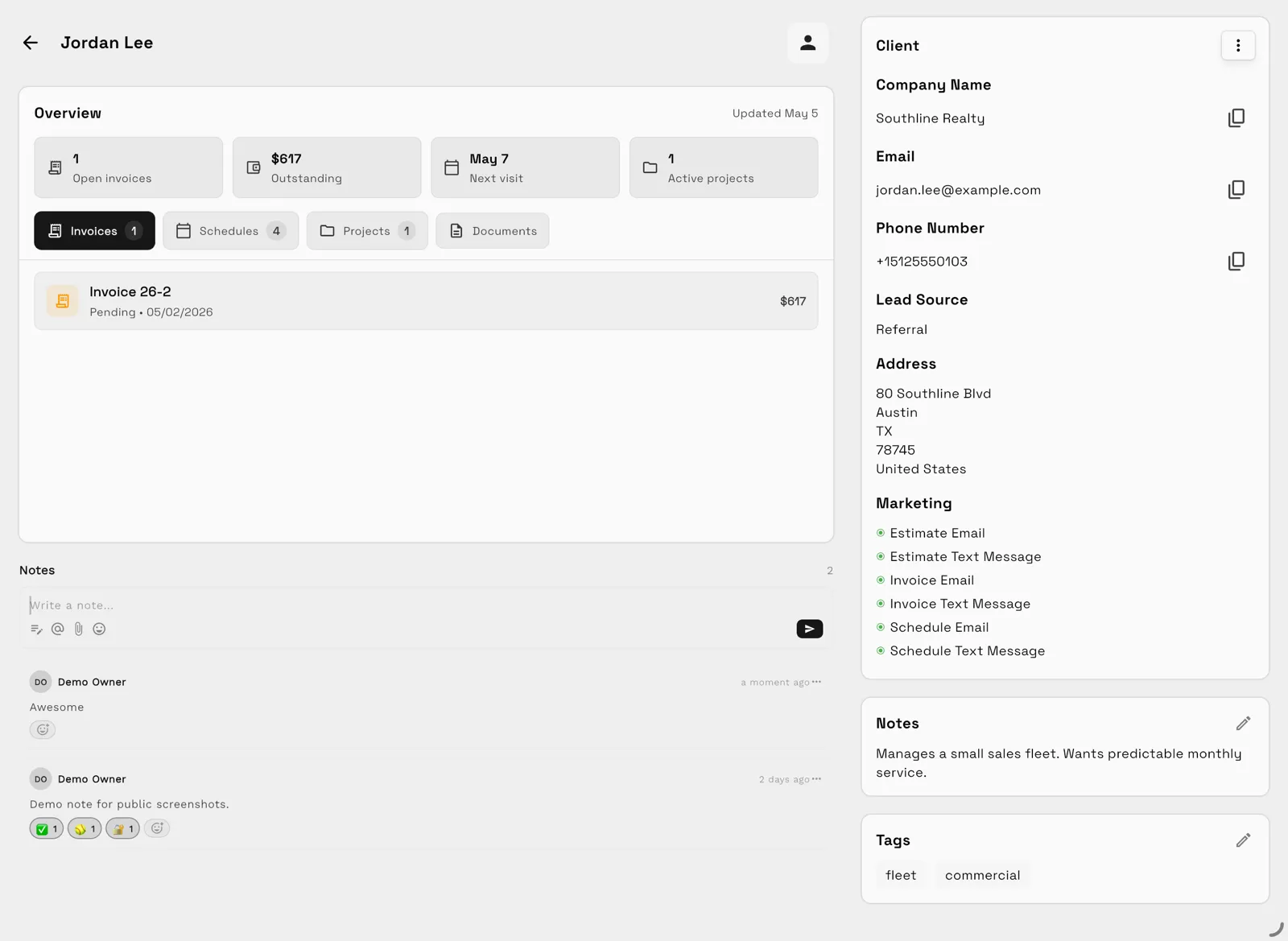
Workspace369 lists public intake forms, request tracking and request-to-project conversion on every plan, so an onboarding answer can become a project with tasks. The same record holds proposals accepted by public link, a client portal, time tracking, retainers and recurring invoices, and invoices paid online through Stripe. All of that is on Cadet at $29 a month for one seat (see all plans; $23.25 a month billed yearly). Portal visitors do not use a team seat. The screenshot is demo data, not a customer result.
Limitations: Cadet runs up to 5 active projects and one seat; Voyager ($74 a month, 2 seats) removes the project cap and adds the shared inbox, SMS and calls. The documentation we reviewed does not describe a campaign-results reporting tool for clients, so keep reporting in your email platform. The 14-day trial needs a card.
Best for: email agencies of one to ten people who want onboarding, scope, portal and recurring invoices in one place.
2. Dubsado, best for detailed onboarding questionnaires and workflows
Dubsado's pricing page lists Starter at $335 a year and Premier at $525 a year. Both include invoicing and payment plans, client portals, unlimited projects and clients, and three extra users free. Premier adds automated workflows and public proposals. A 21-day trial of Premier with no card is stated. If you run the onboarding test, expect its forms and workflows to handle a long intake questionnaire well.
Limitations: Starter has one lead capture form and no automated workflows or public proposals. The page does not list recurring invoices separately from payment plans, and monthly prices are not shown.
Best for: agencies with a fixed, repeatable onboarding process who will build it once and pay yearly.
3. Moxie, best for a low-cost all-in-one
Moxie Starter is $12 a month, or $10 billed yearly, and lists client management, projects, invoicing, proposals and contracts, time tracking, a form builder and meeting schedulers. Pro is $25 a month ($20 billed yearly) and adds a white-labeled client portal, workflow automations and client request management. If you run the onboarding test, expect the form and the proposal to fit Starter, with clients waiting for Pro to get a portal.
Limitations: the portal and automations start at Pro. The page does not mention recurring invoices or retainers, and the page says all plans start with a free trial without stating whether a card is needed.
Best for: solo email consultants who want forms, proposals and invoices at the lowest monthly price.
4. HoneyBook, best for booking and paying new clients
HoneyBook Starter is $29 a month billed yearly and lists invoices and payments, proposals and contracts, a client portal and up to 2 live lead forms; invoicing on one-time, recurring or custom schedules is mentioned on the page. It offers a 30-day trial with no card required. If you run the onboarding test, the proposal, contract and first payment fit its flow.
Limitations: automations, unlimited Scheduler sessions and up to 10 lead forms start at Essentials ($49 a month billed yearly; Starter allows 1 session). The page does not list time tracking or task boards for delivery.
Best for: solo agency owners who sell packaged retainers and want a clean sign-and-pay flow.
5. Productive, best for capacity and margin across many retainers
Productive's pricing page lists budgeting, resource planning, project management, time tracking and reporting from Essential, shown at $10 per user a month billed yearly ($12 monthly; its 10-user example is $100 a month). Professional is $25 per user a month billed yearly ($29 monthly) and adds recurring budgets, billable time approvals and invoicing integrations. A 14-day free trial with no card is stated in its sign-up form. If you run the onboarding test, expect strong planning but check how intake and client access work, because the page is built around planning and profitability rather than client-facing onboarding. Its fit grows with the number of retainers you juggle at once.
Limitations: the pricing page does not list intake forms, a client portal, proposals or built-in invoicing, and recurring budgets and invoicing integrations start at Professional.
Best for: agencies of ten or more people balancing capacity and profit across retainers.
6. HubSpot free CRM, best for free lead and deal tracking
HubSpot's free CRM has no expiry and needs no card, with up to two users and 1,000 contacts, deal pipelines, a form builder and email marketing tools, per its product page. The Starter Customer Platform is listed at $20 per seat a month, with limited-time offers for new customers. If you run the onboarding test, expect it to capture the lead and the form; delivery, approvals and the retainer invoice need other tools. It works as a lead record beside a delivery tool, not as the place where retainers are run.
Limitations: the product page does not list projects, invoicing or a client portal.
Best for: agencies that mainly need to track leads and already have delivery and billing tools.
Side-by-side comparison
| Tool | Entry price | Billed yearly | Client portal on entry plan | Main entry-plan limit | Trial |
|---|---|---|---|---|---|
| Workspace369 | $29 a month (Cadet) | $23.25 a month | Yes | 5 active projects, 1 seat | 14 days, card required |
| Dubsado | $35 (Starter) | $335 a year (Starter) | Yes | 1 lead form, no workflows | 21 days, no card |
| Moxie | $12 a month (Starter) | $10 a month | No (Pro) | No portal or automations | 14 days, no card |
| HoneyBook | $36 (Starter) | $29 a month (Starter) | Yes | 2 live lead forms | 30 days, no card |
| Productive | $12 per user (Essential) | $10 per user | Not listed | No forms or portal listed; recurring budgets need Professional | 14 days, no card |
| HubSpot | Free | Free | Not stated | 2 users, 1,000 contacts | Free plan, no card |
Which tool fits your email agency?
| If you mostly need | Start with | Why |
|---|---|---|
| Onboarding form to project to recurring invoice | Workspace369 | Intake forms, portal and retainers on every plan |
| A long, branching onboarding questionnaire | Dubsado | Forms and workflows on Premier ($55 a month, $525 a year) |
| The cheapest all-in-one | Moxie | Forms, proposals and invoices from $10 a month billed yearly |
| Signed, paid package sales | HoneyBook | Proposals, contracts and payments on every plan |
| Capacity planning across a team | Productive | Budgets and resource planning |
| Free lead tracking | HubSpot free CRM | Free with 2 users and 1,000 contacts |
Run a client onboarding test during the trial
Take one fictional client through the first month in each tool you shortlist:
- Submit the intake form as the "client" with platform, list source and approver details.
- Send a proposal for a monthly retainer and accept it by link.
- Turn it into a project with a setup, first campaign and monthly review task.
- Upload sample email creative and record the segment and creative approval.
- Set up the monthly recurring invoice.
- A day later, find the whole history by searching the client's name.
If you run the test, expect the gaps to show at step 1 and step 5. Note where you have to re-enter an answer from the intake form; that is the cost you will pay every month.

Keep the reporting cadence on schedule
Retainers go stale when the monthly report slips. Whichever tool you pick, put the report as a recurring task on each client project and tie it to the invoice date. In Workspace369, Workflow Automations offer 53 triggers and a pre-made payment follow-up template that sends reminders 1, 3, 7, 14 and 30 days after an invoice is due; Cadet allows 3 active email-only workflows, and SMS steps start at Voyager. See the client onboarding checklist for agencies for what to collect up front.
When to keep it simple
If you have two or three clients and your email platform's own tools plus a spreadsheet cover the rest, you can wait. Move to a CRM when onboarding details get scattered across threads, when you cannot say who is unbilled this month, or when approvals are hard to find. Compare current plans on the pricing page.
Before you import a real client, finish one onboarding month on demo data and check that you can export your records.
Sources reviewed for this guide
- Workspace369 pricingPlan matrix reviewed October 22, 2026.
- Dubsado pricingOfficial pricing page reviewed October 22, 2026 for yearly prices, limits and trial terms.
- HoneyBook pricingOfficial pricing page reviewed October 22, 2026 for plans, lead forms and trial terms.
- Moxie pricingOfficial pricing page reviewed October 22, 2026 for Starter and Pro features and prices.
- HubSpot CRMOfficial product page reviewed October 22, 2026 for free CRM limits and Starter pricing.
- HubSpot pricingOfficial pricing page reviewed October 22, 2026 for the Starter list price ($20 per seat) and limited-time new-customer offers.
- Productive pricingOfficial pricing page reviewed October 22, 2026 for Essential and Professional prices, features and trial terms.
Workspace369 publishes this documentation-based comparison and is one of the options. It is not an independent ranking or a hands-on benchmark.
Run client follow-up in one workspace.
CRM, inbox, voice, invoicing, payments, projects, files, AI, and workflow automations — connected instead of exported.
14-day free trial. Card required. After the trial: from $29/month. Renews automatically every month until you cancel. Cancel anytime in Settings → Billing.