Best CRM for Voice-over Artists 2026: Usage-Based Quotes
Six tools for freelance voice actors compared on price, plan limits, usage-option quotes, contracts, booking and invoicing. None is built for voice work.
We make Workspace369 and list it first here. Weigh our ranking with that in mind, and if another tool fits you better, use it.

By Simon Dziak, Founder, Workspace369 · LinkedIn
The best CRM for voice-over artists keeps the script, the usage terms, the quote, the contract, the deposit, every pickup and the invoice on one client record, so a changed usage term becomes a priced change. For voice actors who quote usage as selectable options, our pick is Workspace369. Moxie and Plutio are the cheaper routes to session booking, and HoneyBook suits a ready-made booking flow. For the broader comparison across freelance trades, see the best CRM for freelancers. To price a usage extension first, use the free scope-change request builder.
Disclosure and method: Workspace369 publishes this guide and is one of the options. It is a documentation-based shortlist, not a hands-on benchmark. Official vendor pages were reviewed on October 19, 2026. Check current plans with each vendor before you buy.
Key takeaways
- A voice-over CRM should hold the script, the usage terms, the quote, the contract, the deposit, every pickup and the invoice on one client record, so a changed usage term becomes a priced change instead of a favor.
- Workspace369 Cadet is $29 a month ($23.25 billed yearly) for one user. It lists Proposals with optional add-on lines, deposit on acceptance, contracts, time tracking and invoices on every plan; online booking starts at Specialist, and Cadet allows 5 active projects.
- Moxie Starter ($12 a month, $10 billed yearly) and Plutio Core ($19 a month, $190 billed yearly) both list proposals, contracts, invoices and scheduling on the entry plan, which makes them the cheaper route to session booking.
- HoneyBook lists the Scheduler on every plan (1 session on Starter) but needs Essentials ($59 a month, $49 billed yearly) for unlimited sessions; Dubsado needs Premier ($55 a month, $525 billed yearly) for scheduling and public proposals; Bonsai needs Essentials ($25 a month, $19 billed yearly) for invoices.
- None of the six records audio, delivers files as a studio would, or enforces a usage term. Test one fictional client through a usage upgrade and a pickup in each trial.
What's inside?
What a CRM for voice-over artists is (and what it is not)How we compared these toolsThe best CRM for voice-over artists in 2026Side-by-side comparisonWhich tool fits your voice-over business?Run a usage-upgrade and pickup test during the trialWhen to keep it simple
What a CRM for voice-over artists is (and what it is not)
A CRM for a voice actor is the business side of the work: who the client is, what you quoted, which usage terms they chose, what you delivered, how many pickups they have used and what is still unpaid. It is not a recording or editing tool, a file-delivery studio, a rights-enforcement service or a casting marketplace. Platforms such as Voice123 and Backstage are where some leads come from, so they are left out here. Audio stays in your studio tools. The CRM holds the paperwork around it, so that when an agency adds a tag or a national run months later, the original quote, the terms and the invoice are one click away.
How we compared these tools
We compared each tool on the same five points, using only the vendor's own pricing and home pages:
- Entry price for one person, monthly and billed yearly, as listed on October 19, 2026.
- Quote chain on the entry plan: proposals or quotes, contracts, and invoices, plus deposits where the page names them.
- Session booking: which plan lists a scheduler or online booking.
- Hard limits on the entry plan: active clients, projects, seats or lead forms.
- Trial terms: length, and whether the vendor says a card is needed.
We did not test speed, support, reliability or mobile apps, and did not use third-party ratings. No tool is voice-specific. Order reflects documented fit for a voice actor who prices usage as options and wants quote, deposit, contract, logged pickups and file versions on one record. Session booking is weighed separately: Workspace369 lists it only from Specialist, while Moxie, Plutio, Bonsai Essentials and HoneyBook list it on cheaper plans.
The best CRM for voice-over artists in 2026
1. Workspace369, best for usage-option quotes with pickups on one record
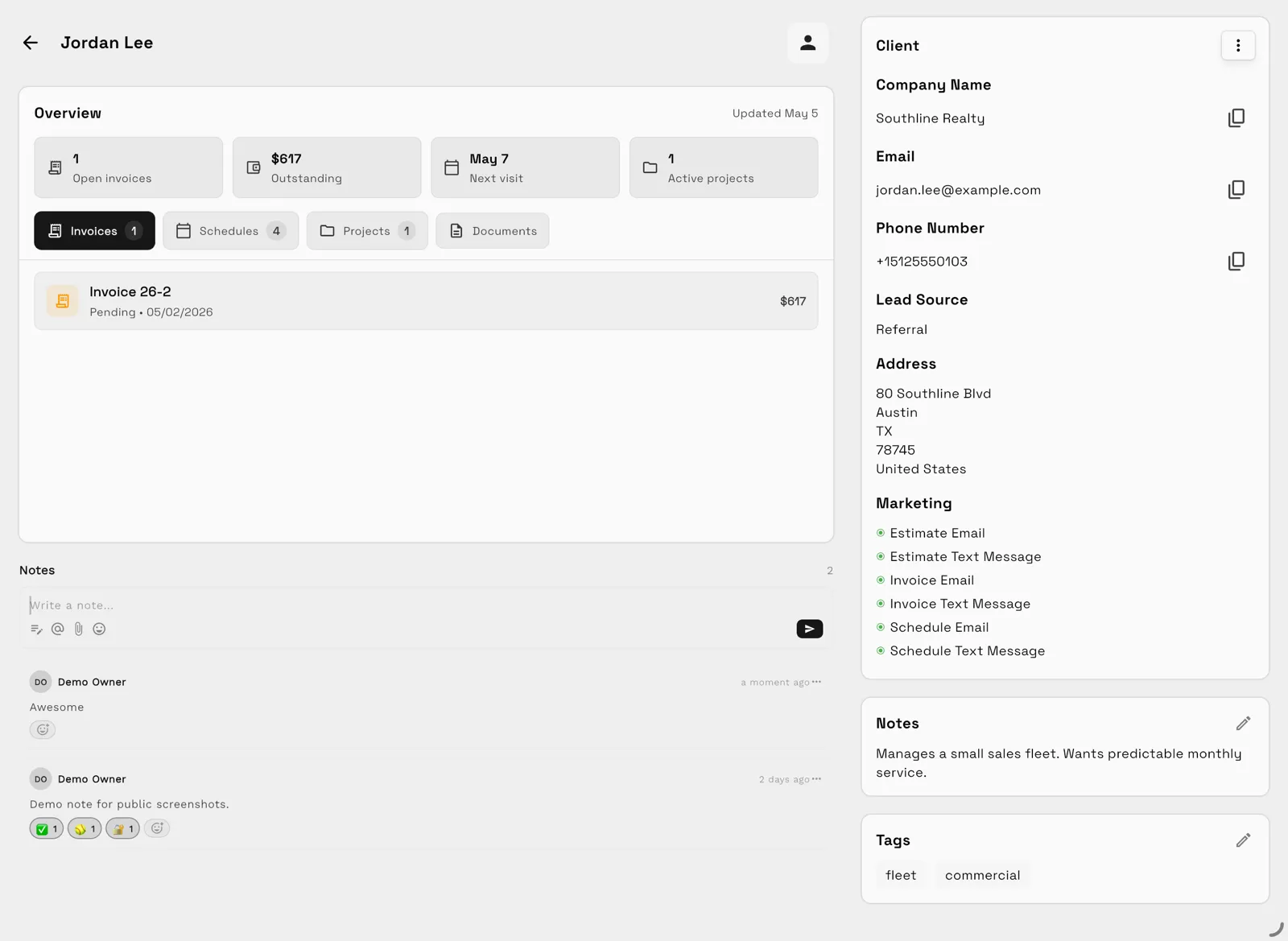
Workspace369 lists Proposals with optional and add-on line items on every plan, so each usage option (for example web only, or broadcast for a stated term) is a line the client ticks when they accept. Deposit on acceptance, contracts the client signs online, proposal-to-invoice conversion, custom fields for the usage term, time tracking and file versioning are listed on Cadet, which is $29 a month for one user ($23.25 billed yearly). The client portal shows invoices, payments, files and project status. The screenshot is a demo record, not a customer result.
Limitations: Cadet allows 5 active projects (archived projects do not count) and one seat. Online booking starts at Specialist ($149 a month, $119.25 billed yearly), as do change orders and proposal revision history, so on Cadet or Voyager you share your calendar by hand. Cadet costs more than Moxie, Plutio and Bonsai Essentials, which each list a scheduler. It will not enforce a usage term or track an end date for you. The 14-day trial needs a card.
Best for: solo voice actors with up to five active jobs who price usage as options and want quote, deposit, contract, pickups and invoice on one record.
2. HoneyBook, best for a ready-made inquiry-to-booking flow
HoneyBook Starter is $36 a month, or $29 a month billed yearly, and lists unlimited clients and projects, invoices and payments, proposals and contracts, a calendar, a client portal and up to 2 live lead forms. The feature table lists the Scheduler on all three plans: 1 session on Starter, unlimited sessions from Essentials ($59 a month or $49 a month billed yearly), which also adds automations, SMS reminders and up to 2 team members. It also lists services and pricing guides where clients make selections, payment plans and autopay on all three plans. The FAQ gives a 30-day trial with no credit card required.
Limitations: unlimited Scheduler sessions need the Essentials price, well above the entry plans of Moxie and Plutio. Time tracking is not listed on the pricing page, so billable pickup hours need a separate tool. Starter allows only 2 live lead forms.
Best for: voice actors who want clients to inquire, sign and pay from one flow and will pay Essentials for booking.
3. Moxie, best for the lowest-priced plan with scheduling
Moxie Starter is $12 a month, or $10 a month billed yearly ($120 charged annually). Its pricing page lists client and project management, invoicing and payments, proposals, quotes and contracts, time tracking, a sales pipeline, a form builder, meeting schedulers and a universal calendar and inbox on Starter. The page title gives a 14-day free trial; card terms are not stated there. Among the six, Starter is the lowest-priced plan that lists proposals, contracts, invoices and a scheduler together, on both billing views. Pro is $25 a month ($20 billed yearly) and adds the white-labeled client portal, custom domain and workflow automations.
Limitations: the page does not name optional line items or deposits, so check that a usage option can be ticked by the client before you rely on it. The white-labeled portal and automations start at Pro.
Best for: newer voice actors who want quotes, contracts, time and bookings cheaply and will chase updates by hand.
4. Plutio, best for every module at a solo price
Plutio lists projects, invoices, proposals, contracts, time tracking, scheduling, forms and a client portal on every plan. Core is $19 a month, or $190 a year when billed yearly, with 100 GB of storage. The trial is 7 days and the page says no card is required; during the trial you get up to 3 active clients. Core allows 9 active clients and no contributors, so count the agencies and direct clients you serve at once. Pro is $49 a month ($490 a year) with unlimited active clients and 30 contributors.
Limitations: Core is solo only, with 500 workflow actions and 500 AI credits included, and white-label is a $9 a month add-on. A busy voice actor with more than nine live clients moves to Pro, which is above the other entry plans in this guide.
Best for: a solo voice actor with a small, steady roster who wants every module from day one.
5. Bonsai, best for hourly pickups billed per user
Bonsai prices per user. Basic is $15 a month ($9 billed yearly) with time tracking, tasks, unlimited projects and a CRM, but not invoices. Essentials, at $25 a month ($19 billed yearly), adds invoices and payments, proposals and contracts, forms, scheduling, the client portal and expense tracking. The trial runs 7 days, after which Bonsai asks you to choose a plan and enter card details, so trial Essentials rather than Basic. Elite is $59 a month ($49 billed yearly) with a three-user minimum, so it only matters if you hire.
Limitations: custom fields, client tasks and messaging start at Premium ($39 a month, $29 billed yearly), so a usage-term field means a higher plan. Optional line items and deposits are not named on the plan list.
Best for: voice actors who bill pickups by the hour and may add an engineer or producer later.
6. Dubsado, best for form-heavy onboarding
Dubsado Starter is $35 a month or $335 a year ($27.92 a month) when billed yearly. Premier is $55 a month or $525 a year. Starter lists unlimited clients and projects, invoicing and payment plans, form and email templates, client portals and one active lead capture form. Scheduling, automated workflows and public proposals start at Premier. Contracts are on Starter, and Dubsado's help center puts time tracking on Premier only. The trial is 21 days with Premier access and no card.
Limitations: session booking and public proposals both need Premier, which costs more than every other entry plan in this guide. Three extra users are free, then bands start at $25 a month.
Best for: voice actors who run a detailed onboarding questionnaire for each direct client and will build the forms once.
Side-by-side comparison
| Tool | Entry price (monthly) | Billed yearly | Quote, contract and invoice on entry plan | Session booking | Main entry-plan limit | Trial |
|---|---|---|---|---|---|---|
| Workspace369 | $29 (Cadet, one user) | $23.25 a month | Proposals with add-ons, deposit, contracts, invoices | Specialist ($149 monthly) | 5 active projects, 1 seat | 14 days, card required |
| HoneyBook | $36 (Starter) | $29 a month | Proposals, contracts, invoices | 1 session on Starter; unlimited from Essentials ($59 monthly, $49 yearly) | 2 live lead forms | 30 days, no card |
| Moxie | $12 (Starter) | $10 a month | Proposals, quotes, contracts, invoices | Meeting schedulers on Starter | White-labeled portal and automations on Pro | 14 days, no card |
| Plutio | $19 (Core) | $190 a year | Proposals, contracts, invoices | Schedulers on Core | 9 active clients, solo | 7 days, no card |
| Bonsai | $25 (Essentials; Basic $15 has no invoices) | $19 per user a month | Proposals, contracts, invoices | Scheduling on Essentials | Per user; custom fields at Premium | 7 days, card to continue |
| Dubsado | $35 (Starter) | $335 a year | Invoices on Starter; public proposals on Premier | Premier ($55 monthly, $525 yearly) | 1 active lead form | 21 days, no card |
Which tool fits your voice-over business?
| If you mostly need | Start with | Why |
|---|---|---|
| Usage options on the quote, with deposit, contract and pickups on one record | Workspace369 | Optional line items, deposit and contracts on every plan |
| Inquiry, signature and payment in one client flow | HoneyBook | Proposals, contracts and a 1-session Scheduler on Starter; unlimited sessions on Essentials |
| Quotes, contracts, invoices and scheduling at the lowest price | Moxie | $12 a month ($10 billed yearly) with a scheduler listed |
| Every module for a handful of clients | Plutio | All core features on Core, capped at 9 active clients |
| Hourly pickups and invoices, billed per user | Bonsai | Time tracking from Basic, invoices from Essentials |
| Detailed onboarding questionnaires | Dubsado | Form templates on Starter, workflows on Premier |
Run a usage-upgrade and pickup test during the trial
Take one fictional client through the sequence below in each tool you shortlist. The scenario is an exercise, not a customer result.
- Build a quote with a base session fee and two usage options, such as web only and a regional broadcast term, that the client can choose between.
- Collect the deposit when the client accepts, and send the contract with the usage terms in it.
- Create the project, attach the script, and log two pickups as tasks or time entries.
- Months later, the client asks to extend the term. Send a new quote or change request and an invoice for the extension.
- Open the client record and check that the original quote, contract, files, pickups and both invoices are linked together.
If you run the test, the best tool keeps all five on one client record and lets you find the original terms in seconds. Draft the change request with the free scope-change request builder and set your rate with the hourly rate calculator.

When to keep it simple
If you have a handful of steady clients, a quote template, a contract template and an invoicing app can carry you. Move to a client-work tool when usage extensions start to overlap, when you cannot find what term a client bought last year, or when pickups arrive faster than you can price them. The voice-over artists product page shows how Workspace369 handles Proposals, contracts, communications and invoices, and the pricing page has current plans. On Specialist, change orders record a scope change against the original agreement.
Before importing real clients, run one full job on demo data and check that your records can be exported.
Sources reviewed for this guide
- Workspace369 pricingPlan matrix reviewed October 19, 2026.
- Moxie pricingOfficial pricing page reviewed October 19, 2026 for yearly and monthly prices, plan features and the trial length in the page title.
- Plutio pricingOfficial pricing page reviewed October 19, 2026 for monthly and yearly prices, client limits, included features and trial terms.
- Bonsai pricingOfficial pricing page reviewed October 19, 2026 for monthly and yearly per-user prices, plan features and trial terms.
- HoneyBook pricingOfficial pricing page reviewed October 19, 2026 for monthly and yearly prices, plan features and trial terms.
- Dubsado pricingOfficial pricing page reviewed October 19, 2026 for monthly and yearly prices, plan features, users and trial terms.
- Dubsado home pageOfficial home page reviewed October 19, 2026 for its feature list, which includes time tracking and reports.
Workspace369 publishes this documentation-based comparison and is one of the options. It is not an independent ranking or a hands-on benchmark.
Run client follow-up in one workspace.
CRM, inbox, voice, invoicing, payments, projects, files, AI, and workflow automations — connected instead of exported.
14-day free trial. Card required. After the trial: from $29/month. Renews automatically every month until you cancel. Cancel anytime in Settings → Billing.