Best CRM for Event Venues in 2026: holds, BEOs, deposits
Best CRM for event venues: six tools compared for wedding barns and small venues on date holds, BEOs, floor plans, deposits, payment schedules and prices.
We make Workspace369, which is on this list. Weigh our ranking with that in mind.

By Simon Dziak, Founder, Workspace369 · LinkedIn
The best CRM for event venues is one that protects the calendar first: an inquiry becomes a tour, a dated hold with an expiry, a proposal with packages, a deposit and an event order, without two couples being promised the same Saturday. For a wedding barn or small event space that sells dates, tools built for venues fit best, led by Perfect Venue and Planning Pod. Workspace369 covers the client paperwork but not the date calendar, so we place it last. To size your deposit first, use the free deposit calculator. For the wider category, see our guide to the best event planning software.
Disclosure and method: Workspace369 publishes this guide and is one of the options. It is a documentation-based comparison, not product testing. Official vendor pages were reviewed on October 23, 2026, a second check after October 18, including the collapsed FAQ answers in each page's source. Every price was unchanged; the one new detail is Tripleseat's FAQ, which now says add-ons are priced individually. Check current plans with each vendor before you buy.
Key takeaways
- A venue CRM has to protect the calendar first: an inquiry becomes a tour, a dated hold with an expiry, a proposal with packages, a deposit and an event order. Tools built for venues document that chain; general client tools document only part of it.
- Perfect Venue has a free plan (CRM, BEOs, proposals, payments and the events calendar) and lists Professional at $199 a month per location billed yearly ($239 monthly), with a 14-day trial and no card; Tripleseat starts at $375 per venue per month.
- Planning Pod documents date holds with a deadline and reminder, BEOs and floor plans but publishes no price, and Event Temple says it starts as low as $249 a month on a 1-year minimum paid annually.
- Workspace369 Cadet ($29 a month, $23.25 billed yearly) covers inquiry forms, Proposals, deposits, retainers and payment schedules and the client portal, but it has no availability calendar by space, no date holds, no BEO builder and no floor plans, so it ranks last for a venue that sells dates.
- Before you pay, run one fictional Saturday wedding through each trial: hold, tour, proposal, deposit, balance schedule and event order, and see whether a second inquiry for the same date is warned or blocked.
What's inside?
What a CRM for event venues is (and what it is not)How we compared these toolsThe best CRM for event venues in 2026Side-by-side comparisonWhich tool fits your venue?Run a date-hold test during the trialWhen to keep it simple
What a CRM for event venues is (and what it is not)
A CRM for a single-location venue holds the inquiry, the tour, the date and space you promised, the package the client chose, the deposit and balance schedule, and the event order your staff and caterer work from. It is not a general contact list, and it is not a ticketing or wedding-planner tool. The deciding question is whether the tool knows about dates and spaces. If it only stores contacts and documents, the calendar lives in a separate app or a spreadsheet, and a hold can quietly expire or collide with a new inquiry. Many small venues accept that and pair a client tool with a calendar; the sections below show what each option documents.
How we compared these tools
We compared each tool on the same five points, using only the vendor's own pages:
- Entry price, in the yearly and monthly billing views where both are shown, as listed on October 23, 2026, and what the price covers (per location, per venue or per user).
- Date handling: holds, a booking calendar, conflict or double-booking warnings.
- Venue documents: BEOs or event orders, floor plans, proposals and contracts.
- Money: online deposits, payment reminders and balance schedules.
- Trial terms: length, and whether the vendor says a card is needed.
We did not test speed, support, reliability or mobile apps, and did not use third-party ratings or testimonials. Order reflects documented fit for a single-location venue of 1 to 15 staff that sells dated spaces.
The best CRM for event venues in 2026
1. Perfect Venue, best for small venues that want a published price and BEOs
Perfect Venue is event software for restaurants, venues and hospitality groups that brings inquiries, proposals, BEOs, payments and email together. Its pricing page lists Professional at $199 a month per location billed yearly ($239 with monthly billing) and Premium at $299 a month per location billed yearly ($339 monthly); Enterprise is quoted on request. The pages describe a centralized booking calendar that syncs with Google Calendar, automatically generated BEOs and proposals, a guest portal, online deposits and an Express Book option where guests see availability and pay a deposit. The FAQ states a 14-day free trial with no credit card and a 30-day money-back guarantee on paid plans. Perfect Venue also has a free plan: its pricing FAQ says "Yes. The free plan includes CRM, BEOs, proposals, payments, and the events calendar." All users are included, so staff count does not change the price.
Limitations: the pages we reviewed do not mention date holds with an expiry date, so ask how a tentative date is shown. ACH is not on Professional. Multi-day events and custom documents appear on the Enterprise card.
Best for: one-location venues that want BEOs, proposals and deposits at a published price.
2. Planning Pod, best for date holds with expiry dates and floor plans
Planning Pod documents the most venue-specific date handling of the six. Its booking calendar page describes holds on tentative dates for leads who need time to decide, with a deadline date and a reminder for when the hold expires, alerts for time or space conflicts, an embedded availability calendar and lead intake form for your website, and floor plan templates attached to each space. It also lists proposals, online contracts with electronic signatures, invoicing, payment reminders and auto-payments for installments, and banquet event orders. Venues can set up unlimited spaces such as ballrooms, foyers and banquet halls.
Limitations: the site shows no public pricing page, so the price is "See site" and you need a demo to compare cost. It is a broad platform with many tools, so a one-person venue may configure more than it needs. Its comparison page says both platforms "are cloud-based with free trials", but trial length and card terms are not published.
Best for: venues that sell several spaces, need holds that expire and want floor plans in the sales process.
3. Tripleseat, best for a fuller venue platform at a higher price
Tripleseat's packages page says it starts at $375 per venue per month, with all users and integrations included and no paywalled tiers. Its navigation lists proposals, contracts, BEOs, an inquiry inbox, a guest portal, payments, floor plans, direct booking and a venue marketplace. The packages are Tripleseat, Tripleseat plus Direct Book, Tripleseat plus Floor Plans (2D and 3D diagramming, aimed at wedding venues that sell on layout) and Tripleseat Hotels (room blocks and multi-day events). Its FAQ says every customer gets a dedicated onboarding specialist. Demos are the path in; the page shows no self-serve trial.
Limitations: $375 per venue per month is the highest published starting price in this guide, and its FAQ says add-ons such as Floor Plans and Direct Book are priced individually, so the starting price covers the platform alone. Ask for the add-on prices. We could not confirm holds or conflict warnings from the pages we reviewed. A one-room barn may not use what it pays for.
Best for: busier venues or multi-space properties that want proposals, BEOs, floor plans and a guest portal in one platform.
4. Event Temple, best for tracking leads, holds and bookings on one calendar
Event Temple's pricing page says "starting as low as $249 per month" with a custom quote, billed annually. Its venue CRM page describes one calendar for leads, holds and bookings, banquet event orders, multi-day and multi-space events, invoices that clients pay online, digital signatures on contracts, a lead pipeline, built-in email and reports. The FAQ says you can try it before you buy.
Limitations: there is a minimum 1-year term, all prices are based on annual payment, and additional fees depend on setup and data import, so the first-year cost is higher than the headline. Trial length and card terms are not stated. It is built for venues managing many events, so a seasonal barn may find it heavy.
Best for: venues with a sales team and steady event volume that are comfortable with an annual contract.
5. HoneyBook, best for a venue that sells packages like a service business
HoneyBook is a general client tool, and venues use it for inquiries, proposals, contracts, invoices and payments. Starter is $29 a month billed yearly ($36 billed monthly) with unlimited clients and projects, a client portal, a calendar and up to 2 live lead forms. Essentials is $49 billed yearly ($59 monthly) and adds unlimited Scheduler sessions (Starter allows 1), automations, up to 2 team members and the Prismm floor plan integration; Premium is $109 billed yearly ($129 monthly) with unlimited team members. The page lists payment plans and scheduled invoices, and a free trial of 30 days with no credit card required.
Limitations: Essentials and Premium list a Prismm integration for 2D and 3D event floor plans, but the pricing page lists no date holds, space calendar or BEOs, so it fits small venues that manage the date separately. Lead-form and team-member limits step up by plan.
Best for: very small venues or planners that need polished proposals and payments at a lower price than a venue platform and can keep dates in another calendar.
6. Workspace369, best for the paperwork around a booking, not the date calendar
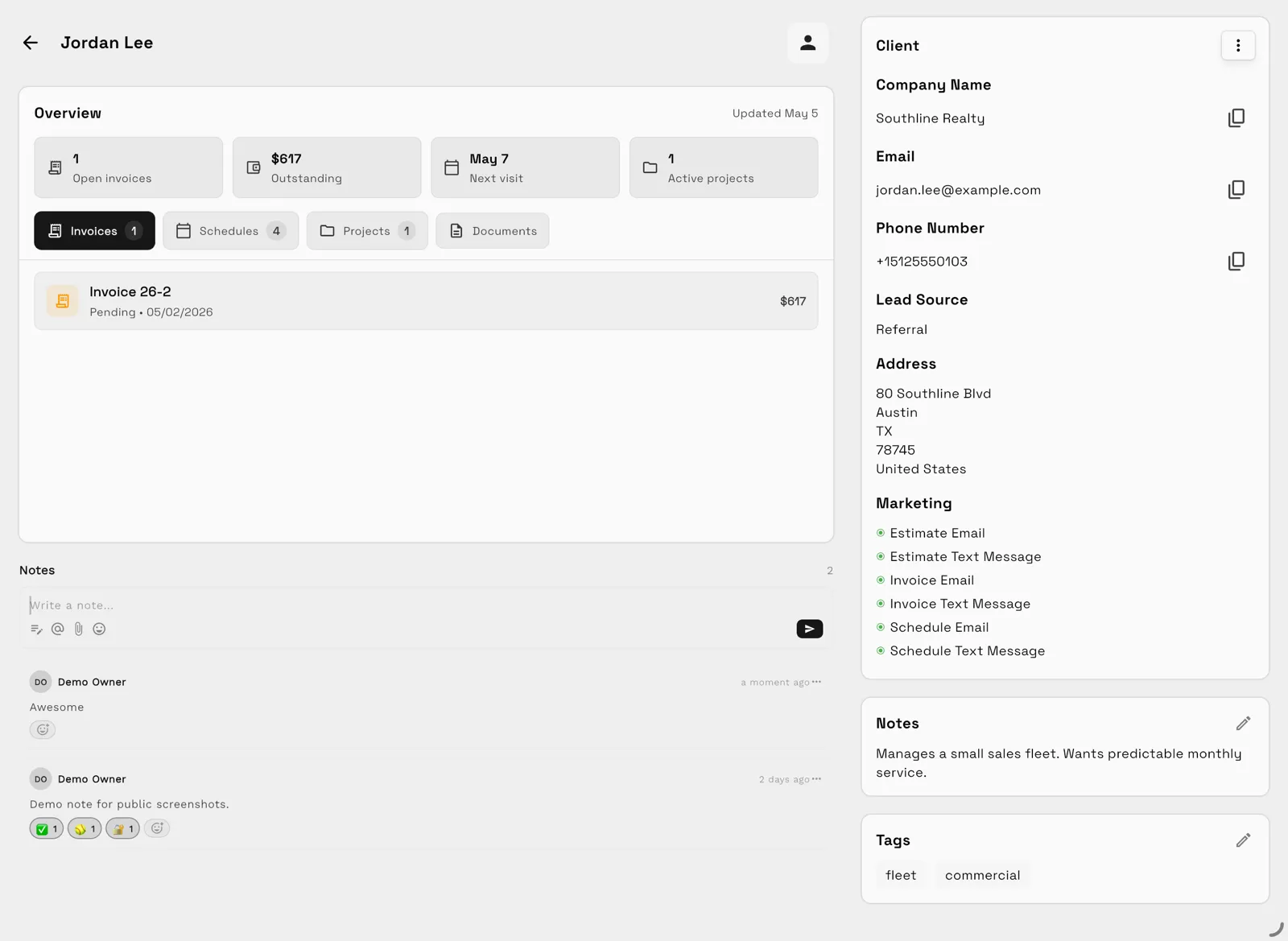
Workspace369 handles the client side of a venue: public intake forms for inquiries, a client record, Proposals with catalog-based packages and online approval, deposits on acceptance, retainers and payment schedules, a private client portal and invoices, with communications in one inbox. Cadet is $29 a month for one seat ($23.25 billed yearly). Online booking pages, which could take tour requests, and payment plans start at Specialist ($149 a month, 10 seats). The screenshot is a demo record, not a customer result.
Limitations: Workspace369 has no availability calendar with date holds by space, no BEO builder and no floor plans. You could track a hold as a project stage and a task with a due date, but nothing stops a second inquiry for the same Saturday. Cadet allows one seat and 5 active projects, so a busy season needs Voyager ($74 a month, 2 seats, unlimited projects) or Specialist. Perfect Venue, Planning Pod, Tripleseat and Event Temple all document more of the venue workflow. The 14-day trial needs a card.
Best for: small venues with one coordinator that already run the calendar elsewhere and want proposals, deposits, balance schedules and a client portal in one place.
Side-by-side comparison
| Tool | Entry price, billed yearly | Entry price, billed monthly | Date holds, BEO, floor plans (as documented) | Main limit | Trial |
|---|---|---|---|---|---|
| Perfect Venue | Free plan (CRM, BEOs, proposals, payments, calendar) or $199 per location (Professional) | $239 per location (Professional) | Calendar and BEOs; holds not stated | No ACH on Professional | 14 days, no card |
| Planning Pod | See site | See site | Holds with expiry, BEOs, floor plans | No public price | Free trial; length and card terms not stated |
| Tripleseat | $375 per venue (starting price) | Not stated | BEOs; floor plans as a separately priced add-on; holds not stated | Highest starting price here; add-ons extra | Demo |
| Event Temple | From $249 (annual) | Not offered; annual payment | Holds on calendar, BEOs; floor plans not stated | 1-year minimum term | Not stated |
| HoneyBook | $29 (Starter) | $36 | Floor plans via Prismm integration (Essentials+); no holds or BEOs listed | No space calendar; 2 lead forms on Starter | 30 days, no card |
| Workspace369 | $23.25 (Cadet) | $29 | None | 1 seat, 5 active projects; no date calendar | 14 days, card required |
Which tool fits your venue?
| If you mostly need | Start with | Why |
|---|---|---|
| BEOs, proposals and deposits at a published price | Perfect Venue | Free plan, or $199 per location billed yearly (Professional); 14-day trial without a card |
| Holds that expire, plus floor plans for several spaces | Planning Pod | Documents hold deadlines, conflict alerts and floor plan templates |
| A fuller platform with a guest portal and floor plans | Tripleseat | Starts at $375 per venue per month, all users included; add-ons priced separately |
| One calendar for leads, holds and bookings | Event Temple | From $249 a month on an annual term |
| Package proposals and payments with dates kept elsewhere | HoneyBook | $29 a month billed yearly, 30-day trial |
| Proposals, deposits, schedules and a portal around your own calendar | Workspace369 | Deposits and payment schedules on every plan; no date holds |
Run a date-hold test during the trial
Take one fictional Saturday wedding through each tool you shortlist:
- Enter an inquiry from the website form and book a tour.
- Place a hold on the date and space with an expiry, then see whether the hold shows on the calendar.
- Send a proposal with a package and add-ons, and have the client accept it.
- Take the deposit and set the balance schedule, then check that reminders go out.
- Enter a second inquiry for the same date and space, and note whether the tool warns you or blocks it.
- Produce the event order or run sheet your staff and caterer would use.
If a tool cannot warn you at step 5, the date calendar is your responsibility. Set the deposit percentage with the free deposit calculator before you build the proposal.

When to keep it simple
If you host a handful of events a year, a shared calendar, a proposal template and an invoice with a deposit line can carry you. Move to a venue tool when you juggle more than one live hold, when you lose track of who owes a balance, or when your caterer asks for the same details twice. The event venues product page shows how Workspace369 handles Proposals, communications and invoices, and the pricing page lists current plans. Workflow Automations can send inquiry replies and balance reminders, with email automations on every plan.
Before importing real clients, run one full booking on demo data and check that your records can be exported.
Sources reviewed for this guide
- Workspace369 pricingPlan matrix reviewed October 23, 2026.
- Perfect Venue pricingOfficial pricing page reviewed October 23, 2026 for per-location prices in the yearly and monthly views, trial terms and plan features.
- Planning Pod booking calendarOfficial product page reviewed October 23, 2026 for date holds, BEOs and floor plans; the site shows no public pricing page.
- Tripleseat packagesOfficial packages page reviewed October 23, 2026 for the starting price and package options.
- Event Temple pricingOfficial pricing page reviewed October 23, 2026 for the starting price, contract term and billing terms.
- HoneyBook pricingOfficial pricing page reviewed October 23, 2026 for yearly and monthly plan prices, features and trial terms.
Workspace369 publishes this documentation-based comparison and is one of the options. It is a review of vendor pages, not product testing, and Workspace369 is ranked last for this reader.
Run client follow-up in one workspace.
CRM, inbox, voice, invoicing, payments, projects, files, AI, and workflow automations — connected instead of exported.
14-day free trial. Card required. After the trial: from $29/month. Renews automatically every month until you cancel. Cancel anytime in Settings → Billing.