Best CRM for Party & Event Rentals in 2026
Best CRM for party and event rental companies: six tools compared on price, date availability, online booking, delivery routing, deposits and contracts.
We make Workspace369, which is on this list. Weigh our ranking with that in mind.

By Simon Dziak, Founder, Workspace369 · LinkedIn
The best CRM for party and event rental companies is the one that knows which tent, table or bounce house is free on which date, then carries the quote, deposit, contract and delivery through to the invoice. Rental-specific tools lead for that: Goodshuffle Pro for event and linen rentals, Booqable for the lowest entry price with live availability, and InflatableOffice for inflatable fleets. Workspace369 ranks last here because it has no date-based availability or delivery routing; its rental company page shows the client-work side it does cover. For the wider comparison across freelance trades, see the best CRM for freelancers. To size a booking deposit first, use the free deposit calculator.
Disclosure and method: Workspace369 publishes this guide and is one of the options. It is a documentation-based shortlist, not a hands-on benchmark. Official vendor pages were reviewed on October 19, 2026. Check current plans with each vendor before you buy.
Key takeaways
- A rental company needs software that knows which item is free on which date. Goodshuffle Pro, Booqable, Event Rental Systems and InflatableOffice are built around that; a general client-work CRM is not.
- Goodshuffle Pro Lite is $39 a month and lists unlimited inventory items and conflict detection to avoid double bookings. Delivery routing and digital pull sheets start on Standard ($99 a month billed yearly, $139 billed monthly).
- Booqable Start is $29 a month billed yearly ($35 billed monthly) and lists real-time availability, a ready-made booking page with live availability, quotes, contracts and invoices, with unlimited inventory and orders on every plan.
- Workspace369 Cadet is $29 a month ($23.25 billed yearly) for one user with 5 active projects. Inventory tracking and stock adjustments start at Specialist ($149 a month) and the matrix does not list date-based availability or delivery routing.
- Workspace369 ranks last here on purpose. It fits a rental company that already runs bookings in rental software and wants the client paperwork, files, tasks and invoices in one place.
What's inside?
What a CRM for rental companies is (and what it is not)How we compared these toolsThe best CRM for party and event rental companies in 2026Side-by-side comparisonWhich tool fits your rental company?Run a late-change test during the trialWhen to keep it simple
What a CRM for rental companies is (and what it is not)
For a rental company the CRM is the booking system. It holds the customer, the items they reserved for a date, the deposit, the signed agreement, the delivery and pickup slot and the final invoice. A general client-work CRM keeps contacts, quotes and invoices but treats an item as a line of text, so it cannot tell you the 20x40 tent is already out on Saturday. That check is what separates rental software from a client tool. Damage waivers, insurance and sales tax rules are specific to your state and carrier, so none of these tools replaces advice from your insurer or accountant.
How we compared these tools
We compared each tool on the same five points, using only the vendor's own pricing pages:
- Entry price, monthly and billed yearly where the page shows both, as listed on October 19, 2026.
- Date availability: whether the page lists conflict detection, real-time availability or overbooking prevention.
- Customer booking: whether the page lists an online storefront or booking page.
- Delivery and routing: whether the page lists pull sheets, route planning or a driver app.
- Quote chain and trial: quotes, contracts, deposits and invoices on the entry plan, plus trial terms.
What we did not test: speed, support, reliability or mobile apps. We did not use third-party ratings. TapGoods was not included because its pricing page was down for maintenance when we checked.
Why the order is what it is: it reflects documented fit for a rental company. Goodshuffle Pro is first because its $39 Lite plan lists conflict detection and unlimited inventory, and its Standard plan adds pull sheets and AI Auto Route, built around event rentals such as tents, linens and furniture. Booqable is second and cheaper at entry, with a ready-made booking page and live availability, but its delivery tools are a separate module. Event Rental Systems is third because it lists a storefront, route planning and a driver app on Standard, but shows no trial or billing options. InflatableOffice is fourth: it is built for inflatable and party rental fleets, though its price rises with inventory size. Rentman is fifth and suits equipment and crew planning more than consumer storefronts. Workspace369 is last: it adds Proposals with optional add-on lines, deposit on acceptance, contracts, file versioning, subtasks and a client portal on Cadet, but its matrix lists inventory tracking only from Specialist and no date-based availability or delivery routing.
The best CRM for party and event rental companies in 2026
1. Goodshuffle Pro, best for event, tent and linen rentals
Goodshuffle Pro Lite is $39 a month and lists unlimited projects, quotes and contracts, unlimited inventory items, one account owner and conflict detection to avoid double bookings. Standard is $99 a month billed yearly ($139 billed monthly) and adds one limited user, digital pull sheets for fulfillment, AI Auto Route for dispatch and a dedicated onboarding specialist. The page lists quick sign and pay proposals, packages, pools and subrentals, and buffer time between rentals. The trial is 7 days; the page does not say whether a card is needed.
Limitations: extra full users cost $39 a month each on Lite and $49 on Standard ($59 billed monthly), and the client portal is marked coming soon. Routing needs Standard. The page does not name a damage waiver.
Best for: event rental companies with tents, tables, linens and décor that deliver with their own trucks and crew.
2. Booqable, best for the lowest price with live availability
Booqable Start is $29 a month billed yearly ($35 billed monthly). It lists order and inventory management, quotes, contracts and invoices, real-time availability tracking, website integration with live availability, a ready-made booking page and product bundles, and every plan includes unlimited inventory and orders. Grow is $69 a month billed yearly ($87 billed monthly) and adds five extra users, e-signatures, downtime scheduling and API access; Scale is $149 billed yearly ($187 billed monthly). The page lists per-order and per-product security deposits, and a Deliveries add-on at $9 a month with flat or mileage-based rates. The trial is 14 days and the FAQ says no credit card is needed.
Limitations: e-signatures start at Grow, the website builder is an add-on, and the page lists delivery routing as an integration rather than a built-in routing tool.
Best for: small rental companies that want a customer-facing booking page with live stock at the lowest entry price.
3. Event Rental Systems, best for a storefront plus route planning
Event Rental Systems lists plans starting at $79.95 a month for Launch (under 10 items), $149.95 for Standard, $249.95 for Pro and $399.95 for Elite. Launch lists online booking with payments, a basic website with storefront and checkout, customer notifications and inventory tracking. Standard adds route planning, a driver app with digital signatures, CRM tools, quotes and a website editor. Pro adds advanced pricing rules and fees, and Elite adds client portals.
Limitations: the page says "starting at" without a billing switch, so the monthly and yearly cost is not shown, and no trial length is listed. Book a demo to confirm what your inventory size costs.
Best for: companies that want a branded storefront and driver routing from one vendor and are comfortable with a demo-led purchase.
4. InflatableOffice, best for bounce house and inflatable fleets
InflatableOffice prices by inventory size: Basic is $124 a month for up to 35 items, Plus is $164 for up to 100 and Elite is $264 for up to 250, with $25 per additional 50 items. The page says every plan gets all features, including online booking and payments, and a basic CRM is included. The listed plan prices include the $39 Website and API module, which the page calls optional but needed for most. Workers, CRM, multi-location and vendor add-ons cost $50 to $65 a month each. A Starter plan lists up to 10 items at $39 a month, but the page presents it as part of a limited-time offer, so we do not use that offer as a price.
Limitations: the cost climbs with your item count and add-ons, no trial length is shown, and we found no monthly and yearly switch.
Best for: inflatable, bounce house and party rental companies with a growing fleet that want one purpose-built system.
5. Rentman, best for equipment, crew and project rentals
Rentman shows a $39 a month platform fee for CRM, projects, tasks, file sharing and a mobile app, plus inventory plans of $19 (Standard) or $25 (Pro) per power user a month in its monthly US-dollar view. Quoting and invoicing is a $9 per power user add-on and equipment tracking is $9. Basic users are free. Paying yearly takes 8% off the first year, which makes the platform fee $35.88 a month. The trial is 30 days and the page says no credit card is required.
Limitations: it is built around event technology, projects and crew rather than consumer rental storefronts, and the page lists no booking page for customers. A one-person team already pays $58 a month before quoting.
Best for: companies that rent production equipment, staging or lighting and schedule crews around each job.
6. Workspace369, best for client paperwork, files and tasks beside your rental software
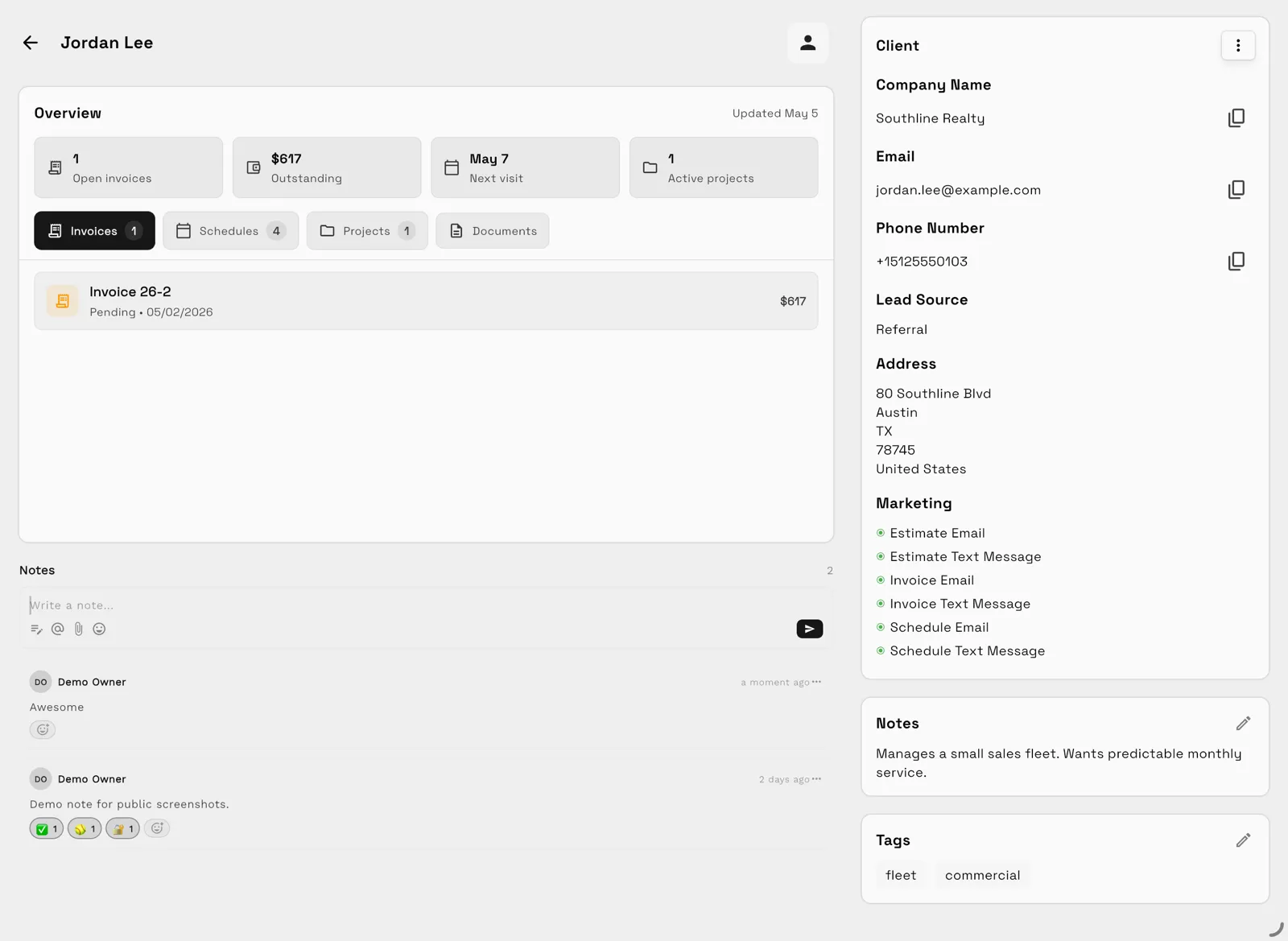
Workspace369 lists Proposals with optional and add-on line items on every plan, so a table linen upgrade is a line the client ticks. Deposit on acceptance, contracts the client signs online, proposal-to-invoice conversion, public intake forms, file versioning, subtasks, time tracking and a client portal are listed on Cadet, which is $29 a month for one user ($23.25 billed yearly). Two-way Google Calendar sync works on every plan. The screenshot is a demo record, not a customer result.
Limitations: inventory tracking, stock adjustments and low-stock alerts start at Specialist ($149 a month), and the matrix does not list availability by date, so it cannot stop a double booking. It has no delivery routing or pull sheets. Cadet allows 5 active projects and one seat; Voyager ($74 a month, $59.25 billed yearly) lifts the project cap and includes 2 seats. Online booking, change orders and webhooks and API start at Specialist. The 14-day trial needs a card.
Best for: companies that already run availability in rental software and want one record for the proposal, contract, files, tasks and invoice of each event.
Side-by-side comparison
| Tool | Entry price (monthly) | Billed yearly | Date availability | Customer booking and delivery | Main entry-plan limit | Trial |
|---|---|---|---|---|---|---|
| Goodshuffle Pro | $39 (Lite) | $39 a month (Standard $99) | Conflict detection on Lite | Pull sheets and AI Auto Route on Standard ($139 monthly) | 1 account owner | 7 days, card not stated |
| Booqable | $35 (Start) | $29 a month | Real-time availability on Start | Ready-made booking page; Deliveries add-on ($9 a month) | E-signatures from Grow ($87 monthly) | 14 days, no card |
| Event Rental Systems | From $79.95 (Launch) | See site | Inventory tracking on Launch | Storefront on Launch; route planning and driver app on Standard | Under 10 items on Launch | Not shown |
| InflatableOffice | $39 list (Starter, 10 items) or $124 (Basic, 35 items) | Not shown | Inventory management by item tier | Online booking and payments | Cost rises with item count | Not shown |
| Rentman | $39 platform fee plus $19 per power user | $35.88 platform fee, first year | Inventory availability over projects | No customer booking page listed | Quoting add-on $9 per power user | 30 days, no card |
| Workspace369 | $29 (Cadet, one user) | $23.25 a month | Not listed; inventory from Specialist | Online booking from Specialist; no routing | 5 active projects, 1 seat | 14 days, card required |
Which tool fits your rental company?
| If you mostly need | Start with | Why |
|---|---|---|
| Tents, linens and décor with delivery crews | Goodshuffle Pro | Conflict detection, pull sheets and AI Auto Route |
| The lowest price with live stock on a booking page | Booqable | $29 billed yearly, real-time availability, quotes and contracts |
| A storefront and driver app from one vendor | Event Rental Systems | Storefront on Launch, route planning on Standard |
| Bounce houses and a growing fleet | InflatableOffice | Built for party rental, priced by item count |
| Staging, lighting or AV with crews | Rentman | Inventory over projects and crew planning |
| Proposals, files and invoices beside rental software | Workspace369 | Optional lines, deposit on acceptance and file versioning on every plan |
Run a late-change test during the trial
Take one fictional wedding through the sequence below in each tool you shortlist. The scenario is an exercise, not a customer result.
- Build a quote for tables, chairs and a 20x40 tent, with a linen upgrade as an optional add-on.
- Collect the deposit when the client accepts, and send the contract.
- Reserve the items for the event date and check that a second order for the same tent is blocked.
- Two weeks before the event the client adds 40 chairs and a larger tent. Update the order and the invoice, then check stock for that date.
- Open the customer record and check that the original quote, contract, delivery slot and both invoices are linked together.
If you run the test, the best tool keeps all five on one record and refuses a conflicting reservation. Draft the change request with the free scope-change request builder.

When to keep it simple
If you rent out a few items to a handful of customers a month, a shared calendar, a quote template and an invoicing app can carry you. Move to rental software when two orders compete for the same item, when delivery days need a route, or when customers expect to book online. The party and event rental product page shows how Workspace369 handles Proposals, communications and invoices, and the pricing page has current plans. On Specialist, change orders record a scope change against the original agreement. Keep insurance, damage waivers and tax decisions with the providers who handle them.
Before importing real customers, run one full event on demo data and check that your records can be exported.
Sources reviewed for this guide
- Workspace369 pricingPlan matrix reviewed October 19, 2026.
- Goodshuffle Pro pricingOfficial pricing page reviewed October 19, 2026 for monthly and yearly-billed prices, plan features and trial length. Both billing views were opened.
- Booqable pricingOfficial pricing page reviewed October 19, 2026 for monthly and yearly-billed prices, plan features and trial length. Both billing views were opened.
- Event Rental Systems pricingOfficial pricing page reviewed October 19, 2026 for starting prices and plan features. No billing switch or trial length is shown. An inventory-size selector does not change the displayed prices.
- InflatableOffice pricingOfficial pricing page reviewed October 19, 2026 for monthly prices by inventory size and add-ons. Promotional prices are not used.
- Rentman pricingOfficial pricing page reviewed October 19, 2026 in its monthly and yearly views in US dollars for the platform fee, inventory plans and add-ons.
Workspace369 publishes this documentation-based comparison and is one of the options. It is not an independent ranking or a hands-on benchmark.
Run client follow-up in one workspace.
CRM, inbox, voice, invoicing, payments, projects, files, AI, and workflow automations — connected instead of exported.
14-day free trial. Card required. After the trial: from $29/month. Renews automatically every month until you cancel. Cancel anytime in Settings → Billing.