Best CRM for Florists in 2026: proposals, stems, deposits
Six tools for event and wedding florists compared on price, recipe and stem costing, proposals with deposits, client portals and invoicing.
We make Workspace369, which is on this list. Weigh our ranking with that in mind.

By Simon Dziak, Founder, Workspace369 · LinkedIn
The best CRM for florists depends on how you price events. If you cost arrangements from recipes and stem counts, a florist-built tool such as Details Flowers Software or Curate comes first. If your gap is the client side (the consultation, the deposit, the design-day tasks and the invoice), a client-work tool such as Workspace369 covers it. For the wider event-business view, see the best event planning software guide; this one stays on the florist's own workflow. To size the deposit before you quote, use the free deposit calculator.
Disclosure and method: Workspace369 publishes this guide and is one of the options. It is a documentation-based shortlist, not a hands-on benchmark. Official vendor pages were reviewed on October 23, 2026, a second check after October 18, including the collapsed FAQ answers in each page's source. Every price was unchanged. HoneyBook's comparison table now confirms payment plans and autopay on every plan, and Curate's FAQ and feature table disagree on recipes (noted below). Check current plans with each vendor before you buy.
Key takeaways
- Florist-built tools such as Details Flowers Software and Curate are the safer first look if you price events from recipes and stem counts; a general client-work CRM covers the client, deposit, task and invoice side around the design.
- Details Flowers lists a 7-day free trial, a stem counter and unlimited recipe storage on every subscription, and extra users at $25 a month; plan prices sit in a PDF, so confirm them with the vendor.
- Curate lists recipes, shopping lists and purchase orders on Growth and Partnership only, not Basic, and shows no prices on its pricing page.
- Workspace369 Cadet is $29 a month ($23.25 billed yearly) for one seat and 5 active projects; it has deposits and proposals approved online but no flower recipes or stem costing.
- HoneyBook Starter is $36 a month ($29 billed yearly) and Dubsado Starter is $35 a month ($335 billed yearly); both are general client tools with no stem costing.
What's inside?
What a CRM for florists is (and what it is not)How we compared these toolsThe best CRM for florists in 2026Side-by-side comparisonWhich tool fits your floral business?Run a palette-change test during the trialWhen to keep it simple
What a CRM for florists is (and what it is not)
A CRM for florists is the business side of the studio: who the client is, what you quoted, what deposit they paid, which version they approved, what is due on the event day and what is still unpaid. It is not a point-of-sale system for a walk-in shop, a delivery router or a wholesale ordering tool. Everyday retail orders and wedding or event orders need different things. A retail order closes in one phone call, while an event order runs for months through a consultation, a proposal, a deposit, revisions and a balance. This guide is about the second kind. A tool that holds the contact but leaves the proposal, the deposit and the recipe cost in three other places makes every palette change a retyping job.
How we compared these tools
We compared each tool on the same five points, using only the vendor's own pages:
- Entry price for one person, monthly and billed yearly, as shown on October 23, 2026. Where a page shows no price, the table says so.
- Recipe and stem costing: whether the tool builds recipes, counts stems or produces shopping lists.
- Proposals and deposits: whether a client can approve a proposal online, and whether payments and deposits are listed.
- Client-facing pieces: portal, contracts or forms.
- Trial terms: length, and whether the vendor states a card is needed.
We did not test speed, support, reliability or mobile apps, and did not use third-party ratings or review-site prices. Order reflects fit for a florist who sells weddings and events by proposal and costs them from recipes. Workspace369 has no recipe tool, so it sits below the three florist-built options.
The best CRM for florists in 2026
1. Details Flowers Software, best for costing events from recipes
Details Flowers Software is built for florists and designers. Its plans page lists, on every subscription, a stem counter, unlimited recipe storage, thousands of pre-loaded products, automated pricing and markup tools and three free proposal templates. Its home page describes turning a design into a proposal with built-in margins that the client signs, and its FAQs describe a Design Board for mood boards and online invoicing for payments. The plan prices are not on the page: it links a pricing PDF, so confirm them with the vendor. The FAQs say Business and Professional plans include one user and extra users are $25 a month, and that annual billing typically saves $300 a year.
Limitations: no price is visible on the web page, so you cannot compare cost without the PDF or a call. The FAQs say users cannot import items themselves, and the vendor's import service is $2 per item. It is built around events and recipes, not general client work such as a task board or hourly time tracking.
Best for: wedding and event florists who want recipe-based costing and proposals in one tool. The FAQs list a free 7-day trial and do not state a card requirement.
2. Curate, best for florists who also run a larger event team
Curate's pricing page shows three plans, Basic, Growth and Partnership, with a monthly and an annual toggle (annual is labelled 2 months free) and "Let's Chat" instead of prices. All three list proposals with a client portal and payment, and contracts with e-signatures. Recipes, forms, production notes, purchase orders, shopping lists and linked line items start at Growth; Basic lists none of them. Curate also sells apps such as rentals, staffing and an AI assistant.
Limitations: no prices are shown, so you need a demo to compare cost. The feature table marks recipes from Growth, although the pricing FAQ says all plans include recipe creation, so ask which applies to Basic. The page does not state trial or card terms. It is built for event businesses broadly, so a small studio may use only part of it.
Best for: studios with a team that want recipes, shopping lists and purchase orders on one platform.
3. Floranext, best for a shop that also sells weddings
Floranext sells a website, a point of sale and a Wedding Manager, and an All in One bundle. Its home page says the Wedding Manager includes stem counting so every wedding stays profitable, and its pricing page lists the Wedding Manager as beautiful proposals, floral shopping lists, cost and profitability management, a photo gallery and deposits and payments. It shows no prices on the page and no trial terms beyond a "Try Free" button. The page also says you earn 100% of every order with no per-order commissions, that products can be mixed and matched, and that it offers dedicated onboarding. Read those as the vendor's own claims and ask what each product costs.
Limitations: no prices are visible, and the pages do not say how the Wedding Manager handles recipes or a client portal. It suits a florist who also runs retail orders more than a studio that sells only events.
Best for: flower shops that take walk-in and phone orders and also sell weddings.
4. Workspace369, best for the client, deposit and task side
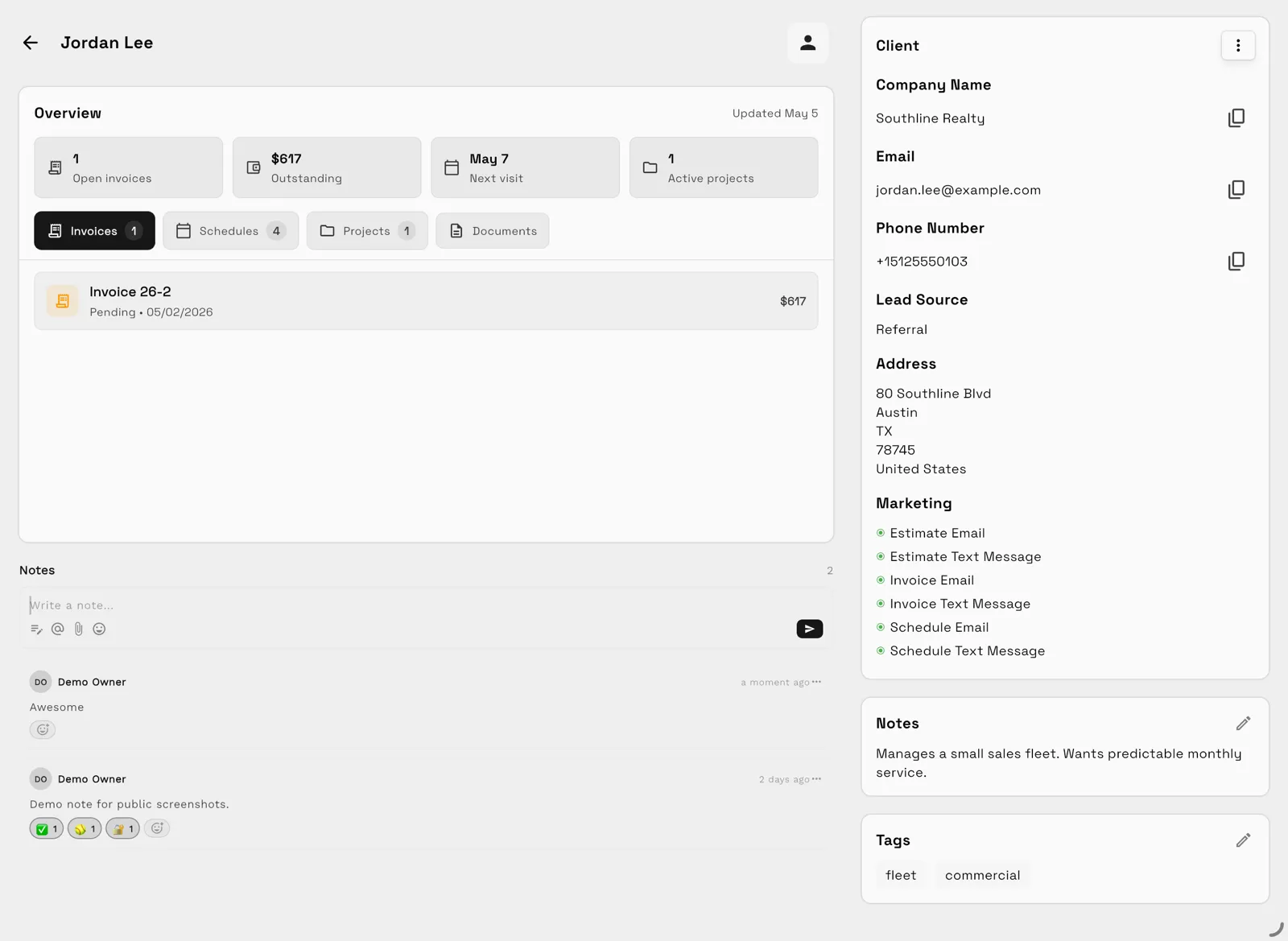
Workspace369 puts the client record, a proposal the client approves online with a deposit due on acceptance, a client portal, tasks, time tracking for design hours, files with versioning and invoices in one place. Cadet is $29 a month for one person ($23.25 billed yearly). Public intake forms, retainers and payment schedules, and a proposal that converts to an invoice are on every plan. Proposals can carry catalog line items, with up to 20 products on Cadet. The screenshot is a demo record, not a customer result.
Limitations: it has no flower recipes, stem counter or shopping lists, so a florist who costs from recipes will still need a florist tool or a spreadsheet. Details Flowers and Curate are more specialised for that. Cadet allows 5 active projects and one seat; Voyager ($74 a month, two seats) lifts the project cap. Inventory tracking, online booking for consultations, payment plans and proposal revisions with version history start at Specialist ($149 a month); on Cadet, a palette change means sending a new proposal. The 14-day trial needs a card.
Best for: florists who already cost stems elsewhere and want the consultation-to-invoice record, with deposits and tasks, in one place.
5. HoneyBook, best for packaged services sold by proposal
HoneyBook's pricing page shows Starter at $36 a month, or $29 a month billed yearly, with proposals, contracts, invoices, a client portal, a calendar and up to 2 live lead forms. Its comparison table lists payment plans and autopay on every plan, Starter included. Essentials is $59 a month ($49 billed yearly) and adds automations, unlimited Scheduler sessions (Starter allows 1) and up to 2 team members; Premium is $129 ($109 billed yearly). The page says all plans start with a free trial, and its FAQ describes 30 days with no credit card.
Limitations: it has no recipe costing or stem counts, and Starter allows one Scheduler session.
Best for: florists who sell fixed packages and want a polished proposal-to-payment flow, and cost flowers elsewhere.
6. Dubsado, best for form-heavy onboarding
Dubsado's pricing page shows Starter at $35 a month or $335 billed yearly, and Premier at $55 a month or $525 billed yearly. Starter lists unlimited projects and clients, invoicing and payment plans, form and email templates and client portals, with one active lead capture form. Public proposals, scheduling and automated workflows start at Premier. Premier also lists a bookkeeping integration, a Zapier integration and unlimited lead capture forms. Its FAQ lists a 21-day free trial that gives access to the Premier plan, with no credit card info required.
Limitations: public proposals need Premier, and Starter has one lead form. It has no recipe costing or stem counts.
Best for: florists who want detailed intake questionnaires and email templates and are comfortable paying yearly.
Side-by-side comparison
| Tool | Entry price (monthly) | Billed yearly | Recipes or stem costing | Proposals and deposits | Trial |
|---|---|---|---|---|---|
| Details Flowers Software | See site (pricing PDF) | See site | Yes, stem counter and recipes on every plan | Proposals; payments through online invoicing | 7 days, card not stated |
| Curate | See site | See site | Recipes from Growth, not Basic | Proposals with portal and payment on all plans | Not stated |
| Floranext | See site | See site | Stem counting, shopping lists and cost management in Wedding Manager | Proposals; deposits and payments listed | Not stated |
| Workspace369 | $29 (Cadet) | $23.25 a month | No | Proposals approved online; deposit on acceptance, all plans | 14 days, card required |
| HoneyBook | $36 (Starter) | $29 a month | No | Proposals and contracts; payment plans on every plan | 30 days, no card |
| Dubsado | $35 (Starter) | $335 a year | No | Payment plans on Starter; public proposals on Premier | 21 days, no card |
Which tool fits your floral business?
| If you mostly need | Start with | Why |
|---|---|---|
| Costing events from recipes and stem counts | Details Flowers Software | Stem counter and unlimited recipes on every plan |
| Recipes, shopping lists and purchase orders for a team | Curate | Listed from the Growth plan |
| A shop with retail orders and weddings | Floranext | Website, point of sale and Wedding Manager |
| Consultation, deposit, tasks and invoice on one record | Workspace369 | Deposit on acceptance and time tracking from Cadet |
| Fixed event packages with a polished flow | HoneyBook | Proposals, contracts and payment plans on Starter |
| Detailed intake questionnaires | Dubsado | Forms and templates, public proposals on Premier |
Run a palette-change test during the trial
Take one fictional wedding through each tool you shortlist:
- Record the consultation notes and venue details on the client record.
- Build a proposal with a deposit due on acceptance, and send it for approval.
- After approval, change the palette from pastels to jewel tones and issue a revised proposal.
- Add a task for the design day and attach the new mood board.
- Send a follow-up message about the revision and attach the new price.
- Turn the approved proposal into the final invoice and export the client's records.
The best tool keeps the signed version, the revision, the messages and the invoice on one client record, and the invoice total matches the last approved proposal. Any mismatch is the leak this test is built to find. If a client goes quiet on a proposal, draft a nudge with the free proposal follow-up generator.

When to keep it simple
If you take a few weddings a year, a recipe spreadsheet, a proposal template and an invoice template can carry you a long way. Move to a dedicated tool when a palette change forces you to retype prices in three places, when you cannot say which version the client approved, or when you chase balances by hand. The florists product page shows how Workspace369 handles proposals, communications and invoices, and the pricing page has current plans. Workspace369 also supports Workflow Automations for reminders and follow-ups, with email automations on every plan.
Before importing real clients, run one full event on demo data and check that your records can be exported.
Sources reviewed for this guide
- Workspace369 pricingPlan matrix reviewed October 23, 2026.
- Details Flowers plans and pricingOfficial pricing page reviewed October 23, 2026 for included features; plan prices are in a PDF the page links to. Trial, user and annual-plan terms come from the official FAQs page, https://info.detailsflowers.com/faqs.
- Curate pricingOfficial pricing page reviewed October 23, 2026 for plan names and the feature comparison; no prices are shown.
- Floranext pricingOfficial pricing page reviewed October 23, 2026 for the Wedding Manager feature list; no prices are shown. Home page (floranext.com) reviewed the same day for stem counting.
- HoneyBook pricingOfficial pricing page reviewed October 23, 2026 for monthly and yearly prices, plan features and sign-up terms.
- Dubsado pricingOfficial pricing page reviewed October 23, 2026 for monthly and annual prices, plan features and trial terms.
Workspace369 publishes this documentation-based comparison and is one of the options. It is not an independent ranking or a hands-on benchmark.
Run client follow-up in one workspace.
CRM, inbox, voice, invoicing, payments, projects, files, AI, and workflow automations — connected instead of exported.
14-day free trial. Card required. After the trial: from $29/month. Renews automatically every month until you cancel. Cancel anytime in Settings → Billing.