Best CRM for Live Bands in 2026
Seven tools compared for wedding bands, corporate bands and solo performers on price, package add-ons, deposits, contracts and date availability.
We make Workspace369, which is on this list. Weigh our ranking with that in mind.

By Simon Dziak, Founder, Workspace369 · LinkedIn
Check Cherry fits wedding and event bands that book by date and sell packages with add-ons, since its pricing page lists an Availability Manager. HoneyBook fits soloists who want one polished inquiry-to-payment flow. Workspace369 fits band leaders who run each booking as a project with tasks and files. BandHelper covers setlists and member finances.
The best CRM for live bands keeps the quote, deposit, contract and invoice on one record per date. To size a booking deposit first, use the free deposit calculator. For the wider comparison across freelance trades, see the best CRM for freelancers.
Disclosure and method: Workspace369 publishes this guide and is one of the options. It is a documentation-based shortlist, not a hands-on benchmark. Official vendor pages were reviewed on October 26, 2026. Check current plans with each vendor before you buy.
Key takeaways
- A band CRM should hold the inquiry, the package quote with add-ons such as ceremony music, the deposit, the signed contract and the invoice on one record per date, so a late extra set becomes a priced change instead of a favor.
- Check Cherry is the only tool here whose pricing page lists an Availability Manager (so you are never double-booked), packages and add-ons, and Entertainment Production as an industry. Standard is $29 a month billed yearly ($348; $39 billed monthly) and counts 30 upcoming bookings.
- Workspace369 Cadet is $29 a month ($23.25 billed yearly) for one user and lists Proposals with optional add-on lines, deposit on acceptance, contracts and file versioning, but allows 5 active projects. A busy wedding season needs Voyager ($74 a month, $59.25 billed yearly) for unlimited projects, and online booking starts at Specialist.
- HoneyBook Starter is $29 a month billed yearly (monthly price: see site) with unlimited clients and projects, proposals, contracts, invoices and a client portal. Its Scheduler is 1 session on Starter and unlimited from Essentials ($49 a month billed yearly).
- None of the seven manages band-member payouts or music licensing as a documented feature on its pricing page. BandHelper ($3.75 a month for one user on Pro) covers setlists, stage plots and band finance, so pair it with a client-facing tool.
What's inside?
What a CRM for live bands is (and what it is not)How we compared these toolsThe best CRM for live bands in 2026Side-by-side comparisonWhich tool fits your band?Workspace369 in action for a wedding-season band calendarRun a last-minute-change test during the trialWhen to keep it simple
What a CRM for live bands is (and what it is not)
A CRM for a band or entertainer is the business side of the gig: who booked you, which package and add-ons they chose, what deposit they paid, whether the contract is signed, which rider or stage plot you sent and what is still unpaid. It is not a setlist app, a music-licensing service or a payroll tool. Those stay with your band software, licensing provider and accountant. The CRM holds the paperwork around the performance, so when a client adds an extra set a week before the wedding, the original quote, the agreement and the invoice are one click away.
How we compared these tools
We compared each tool on the same five points, using only the vendor's own pricing pages:
- Entry price for one person, monthly and billed yearly, as listed on October 26, 2026. Where a monthly price only loads in the browser, we say "see site".
- Quote chain on the entry plan: proposals or packages, contracts and invoices, plus add-ons and deposits where the page names them.
- Date availability and booking: whether the page lists an availability manager, scheduler or online booking.
- Hard limits on the entry plan: bookings, active projects, seats or lead forms.
- Trial terms: length, and whether the vendor says a card is needed.
What we did not test: speed, support, reliability or mobile apps. We did not use third-party ratings.
Why the order is what it is: it reflects documented fit for a band that sells dated, packaged events. Check Cherry is first because its page names an Availability Manager, packages, add-ons, contracts with e-signatures and Entertainment Production as an industry, which Workspace369 cannot match on date availability. HoneyBook is second because it lists unlimited clients and projects on its $29 entry plan. Workspace369 is third: Cadet adds file versioning, subtasks and time tracking that neither Check Cherry's nor HoneyBook's pricing page names, but it caps active projects at 5, has no date-availability check, and online booking starts at Specialist. Bonsai Essentials ($19 per user billed yearly) is cheaper and lists proposals, contracts, invoices, scheduling and a portal; it ranks below Workspace369 only because its plan list names no plan gate for deposits (its contracts page describes deposit capture) and no optional add-on lines or date availability, and it is a general freelancer suite.
The best CRM for live bands in 2026
1. Check Cherry, best for dated events with packages, add-ons and availability
Check Cherry is built for event businesses, and its FAQ names DJs, photo booth companies and entertainment companies. Standard is $29 a month billed annually ($348 a year) and its feature list names online booking, proposals and quotes, contracts with e-signatures, invoices, packages and add-ons, an Availability Manager, a client portal, questionnaires, lead forms, staff scheduling and a calendar sync. Billed monthly, Standard is $39 a month (the page shows a $120 yearly saving). The trial is 14 days with no card, and the page lists a 60-day money-back guarantee.
Limitations: Standard counts 30 upcoming bookings and 2 admin accounts, so a band with a full wedding calendar may need Growth ($59 a month billed annually, 100 bookings; see site for the monthly price). Automated texts need your own Twilio account. It lists no setlist or song-request tools.
Best for: wedding and corporate bands that book by date, sell packages with add-ons and want availability checked for them.
2. HoneyBook, best for a general creative-business client flow
HoneyBook Starter is $29 a month billed yearly and lists unlimited clients and projects, invoices and payments, proposals and contracts, a calendar, a client portal and up to 2 live lead forms. Its feature table lists the Scheduler on every plan: 1 session on Starter, unlimited sessions from Essentials ($49 a month billed yearly), which also adds automations, SMS reminders and lets the account owner add up to 2 team members. The FAQ gives a 30-day trial with no credit card required.
Limitations: the Scheduler books client sessions, such as a tasting or a planning call, rather than showing which event dates your band is free; the page names no availability manager. Unlimited Scheduler sessions need Essentials. Monthly-billed prices load in the browser, so see the site for them.
Best for: bands and soloists who want inquiry, signature and payment in one polished flow and can manage dates on their own calendar.
3. Workspace369, best for gig prep tasks, files and one record per booking
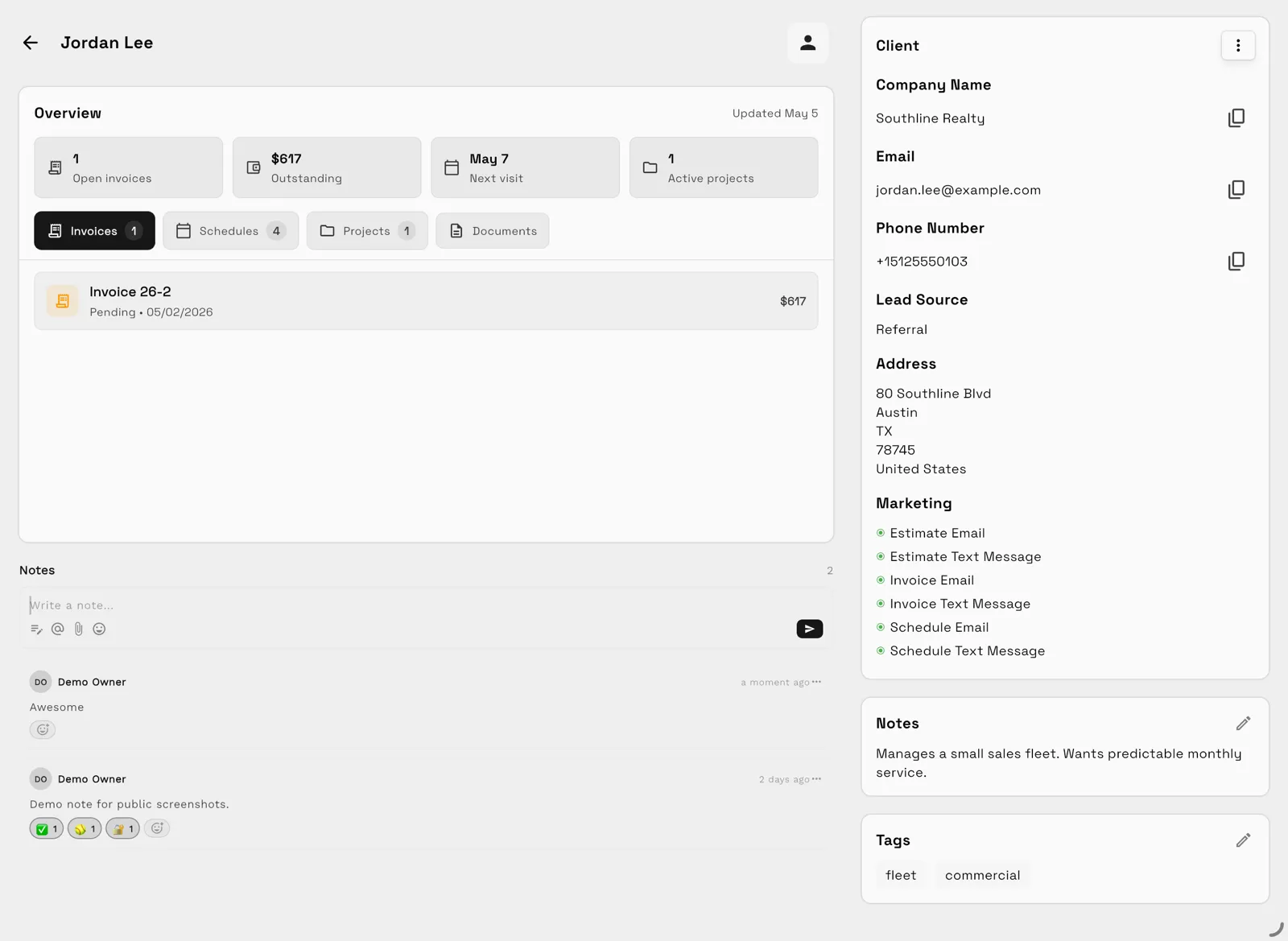
Workspace369 lists Proposals with optional and add-on line items on every plan, so ceremony music or an extra set is a line the client ticks when they accept. Deposit on acceptance, contracts the client signs online, proposal-to-invoice conversion, public intake forms with an embeddable form builder, file versioning, subtasks, time tracking and split payments are listed on Cadet, which is $29 a month for one user ($23.25 billed yearly). Clients get a client portal, and two-way Google Calendar sync works on every plan. The screenshot is a demo workspace with sample data, not a customer result.
Limitations: Cadet allows 5 active projects (archived projects do not count) and one seat, so a band with more than five live bookings needs Voyager ($74 a month, $59.25 billed yearly) for unlimited projects. Online booking starts at Specialist ($149 a month), and there is no date-availability check for inquiries; the intake form collects a requested date but you check your calendar yourself. There are no setlist or song-request features beyond form fields. The 14-day trial covers Cadet through Commander and needs a card.
Best for: band leaders who run each booking as a small project with a task list, rider and stage-plot files and a deposit, and who accept checking dates by hand.
4. Gigwell, best for touring acts and agencies booking venues
Gigwell Artist Essentials is $49 a month billed annually for one user (the monthly-billed price loads in the browser, so see site). It lists unlimited bookings, an embeddable press kit with a booking form, a template library with e-sign, a 250-capacity venue database, online payments, calendar integration and travel itineraries. Talent buyers see your availabilities and send inquiries into the artist CRM. A one-time $99 setup fee applies when billed monthly.
Limitations: it targets artists, agents and talent buyers rather than private-event clients, and the page names no proposals with add-ons, deposits or client portal. It states no trial length. The Agency plan on the main pricing page adds unlimited artists, customizable contracts and an itinerary builder, which suits a manager more than a single band.
Best for: touring and venue-circuit acts that book through talent buyers and agents.
5. Bonsai, best for time-billed work and a per-user price
Bonsai prices per user. Basic is $15 a month ($9 billed yearly) with time tracking and a CRM but not invoices. Essentials, at $25 a month ($19 billed yearly), adds invoices and payments, proposals and contracts, scheduling (1 event type) and a client portal. The trial runs 7 days, after which Bonsai asks you to choose a plan and enter card details.
Limitations: deposits, optional add-on lines and date availability are not named on the plan list. Custom fields and client messaging start at Premium ($39 a month, $29 billed yearly), and Elite ($59 a month, $49 billed yearly) has a three-user minimum, so it only matters if you hire staff. Bonsai is a general freelancer suite rather than an events tool, so you would build your own package structure.
Best for: entertainers who also bill hourly work such as lessons, workshops or hosting.
6. Dubsado, best for form-heavy onboarding
Dubsado Starter is $335 a year and Premier is $525 a year. Monthly prices load in the browser, so see site. Starter lists unlimited clients and projects, invoicing and payment plans, form and email templates, client portals and one active lead capture form, and Dubsado's own product summary lists contracts with e-signatures on Starter. Scheduling, automated workflows and public proposals start at Premier. The trial is 21 days with Premier access and no credit card is required.
Limitations: public proposals and scheduling both need Premier, which costs more than the entry plans of most tools here. Proposals on Starter are sent inside a project. The pricing table does not list add-on lines or date availability.
Best for: bands that send a detailed planning questionnaire to each couple and will build the forms once.
7. BandHelper, best for setlists, stage plots and band finances
BandHelper is band-management software, not a client CRM. Pro for a solo user is $3.75 a month or $32 a year and lists repertoire, schedule, contacts, finance, checklists, stage plots and a practice log. The home page says band members can view their earnings, you can send gig invitations and stage plots to venues, and you can generate invoices. The trial is 30 days with full functionality, and the page says no payment info is needed unless you subscribe. The Plus tier ($3 a month, $24 a year) adds event scheduling with availability requests to band members but drops finance, checklists and stage plots, and the multi-user tiers raise the price for a whole band, so check the tier that matches your member count. Bands often use it for the music side while a second tool carries the client paperwork.
Limitations: it lists no proposals, add-on packages, e-signature contracts, client portal or online booking, so it cannot replace a client-facing tool.
Best for: bands that need setlists, stage plots and member finances, paired with one of the tools above.
Side-by-side comparison
| Tool | Entry price (monthly) | Billed yearly | Quote, contract and invoice on entry plan | Date availability / booking | Main entry-plan limit | Trial |
|---|---|---|---|---|---|---|
| Check Cherry | $39 (Standard) | $29 a month ($348 a year) | Proposals, packages and add-ons, contracts, e-signatures, invoices | Availability Manager and online booking on Standard | 30 upcoming bookings, 2 admin accounts | 14 days, no card |
| HoneyBook | See site (Starter) | $29 a month | Proposals, contracts, invoices | 1 Scheduler session on Starter; unlimited from Essentials ($49 yearly) | 2 live lead forms | 30 days, no card |
| Workspace369 | $29 (Cadet, one user) | $23.25 a month | Proposals with add-ons, deposit, contracts, invoices | Online booking from Specialist ($149 monthly) | 5 active projects, 1 seat | 14 days (Cadet through Commander), card required |
| Gigwell | See site (Artist Essentials, plus $99 setup fee) | $49 a month | Template library with e-sign, online payments | Embeddable booking form and calendar integration | 1 user; $99 one-time setup fee if billed monthly | Not stated |
| Bonsai | $25 (Essentials; Basic $15 has no invoices) | $19 per user a month | Proposals, contracts, invoices | Scheduling on Essentials (1 event type) | Per user; custom fields at Premium | 7 days, card to continue |
| Dubsado | See site (Starter) | $335 a year | Contracts and invoices on Starter; public proposals on Premier | Scheduling on Premier ($525 a year) | 1 active lead form | 21 days, no card |
| BandHelper | $3.75 (Pro, Solo) | $32 a year | No proposals or contracts; invoices generated | Band-member availability requests from Plus; no client booking | Band-management module, not a client CRM | 30 days, no payment info |
Which tool fits your band?
| If you mostly need | Start with | Why |
|---|---|---|
| Date availability, packages and add-ons for events | Check Cherry | Availability Manager, packages and add-ons on Standard |
| Inquiry, signature and payment in one polished flow | HoneyBook | Unlimited clients and projects on the $29 entry plan |
| A task list, rider files and deposit per booking | Workspace369 | Optional lines, deposit on acceptance and file versioning on every plan |
| Booking through talent buyers and agents | Gigwell | Booking form, e-sign templates and itineraries |
| Hourly lessons or hosting alongside gigs | Bonsai | Time tracking from Basic, invoices from Essentials |
| Detailed couple questionnaires | Dubsado | Form templates on Starter, workflows on Premier |
| Setlists, stage plots and member finances | BandHelper | Repertoire, finance and stage plots on Pro |
Workspace369 in action for a wedding-season band calendar
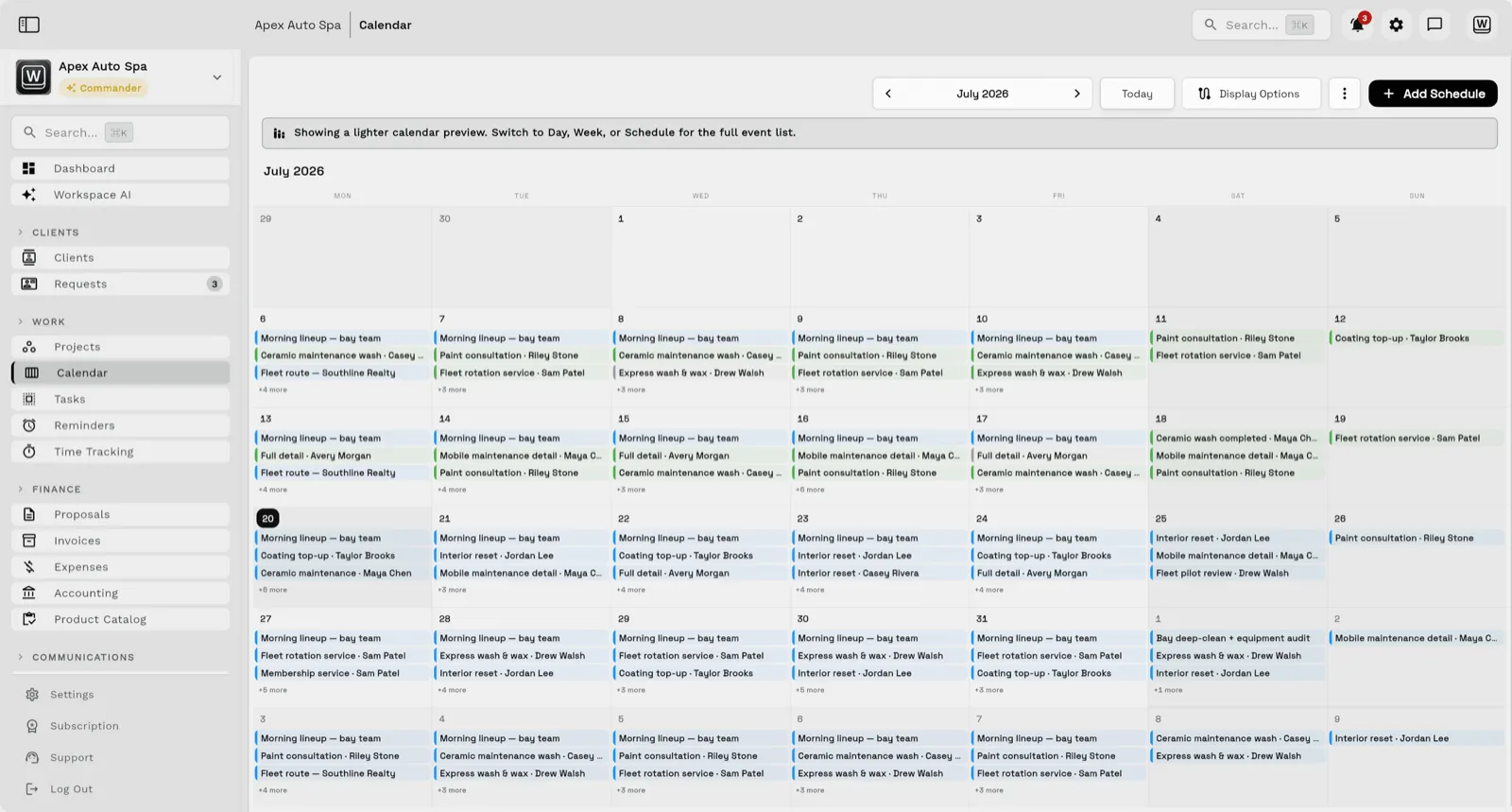
For a band leader, a busy season is a stack of dated bookings that each need a quote, a deposit, a rider and a load-in plan. The first screenshot below is the Workspace369 projects board in a demo workspace with sample data. It shows Planning, In Progress and On Hold columns, with each project card carrying its progress and budget. In a band's account, each wedding or corporate date would be one card, moving from Planning to In Progress once the deposit lands. The second screenshot is the month calendar from the same demo workspace, with several scheduled items on each day.
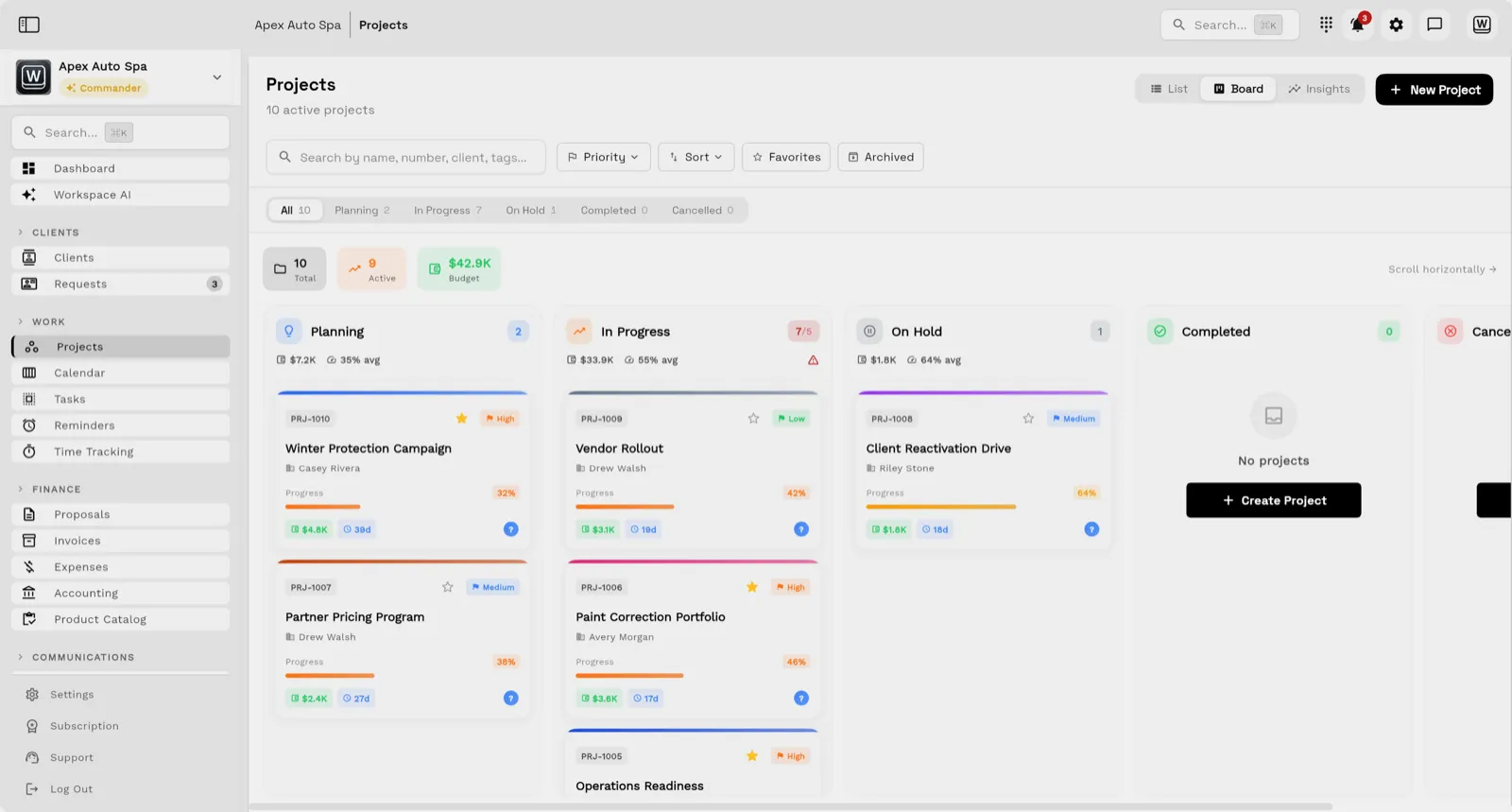
The flow for one booking: send the package through Proposals with ceremony music as an optional line, take the deposit when the client accepts, then keep the stage plot and rider on the project with file versioning so the latest version is the one you send. Put the load-in and sound check on the schedule, which syncs both ways with Google Calendar.
What it does not do for a band: the calendar shows what you scheduled, but nothing warns you when a new inquiry asks for a date you already hold. There are no setlists, song libraries or band-member payouts, and Cadet allows 5 active projects, so a full season needs Voyager. The demo workspace is not a band business.
Run a last-minute-change test during the trial
Take one fictional wedding through the sequence below in each tool you shortlist. The scenario is an exercise, not a customer result.
- Build a quote for a three-hour band package, with ceremony music as an optional add-on the client can choose.
- Collect the deposit when the client accepts, and send the contract with the rider and load-in times.
- Create the booking, attach the stage plot, and add tasks for the sound check and the song-request form.
- A week before the event the client adds an extra set and changes the venue contact. Update the record, send a priced change and issue a separate invoice for the extra set.
- Open the client record and check that the original quote, contract, files, conversation log and both invoices are linked together.
If you run the test, the best tool keeps all five on one record and lets you find the original terms in seconds. Draft the change request with the free scope-change request builder.

When to keep it simple
If you play a few dates a month, a quote template, a contract template and an invoicing app can carry you. Move to a client-work tool when add-ons and date changes start to overlap, when you cannot find what a client agreed to last year, or when late set changes arrive faster than you can price them. The live bands and entertainers product page shows how Workspace369 handles Proposals, communications and invoices, and the pricing page has current plans. On Specialist, change orders record a scope change against the original agreement. Keep payroll, tax and music licensing with the providers who handle them.
Before importing real clients, run one full job on demo data and check that your records can be exported.
Sources reviewed for this guide
- Workspace369 pricingPlan matrix reviewed October 26, 2026.
- Check Cherry pricingOfficial pricing page reviewed October 26, 2026 for yearly-billed prices, the monthly saving shown per plan, booking limits, features and trial terms.
- HoneyBook pricingOfficial pricing page reviewed October 26, 2026 for yearly-billed prices, plan features, Scheduler limits and trial terms. Monthly prices load in the browser, so check them on the page. Promotional prices are not used.
- Gigwell pricingOfficial pricing page and Artist Essentials page reviewed October 26, 2026 for the Artist Essentials yearly-billed price, features and setup fee. The monthly-billed price loads in the browser, so check it on the page.
- Bonsai pricingOfficial pricing page reviewed October 26, 2026 for monthly and yearly per-user prices, plan features, scheduling limits and trial terms.
- Dubsado pricingOfficial pricing page and LLM info page reviewed October 26, 2026 for annual prices, plan features, contracts on Starter and trial terms. Monthly prices load in the browser, so check them on the page.
- BandHelper pricingOfficial pricing page and home page reviewed October 26, 2026 for Solo monthly and yearly prices, plan modules and trial terms.
Workspace369 publishes this documentation-based comparison and is one of the options. It is not an independent ranking or a hands-on benchmark.
Run client follow-up in one workspace.
CRM, inbox, voice, invoicing, payments, projects, files, AI, and workflow automations — connected instead of exported.
14-day free trial. Card required. After the trial: from $29/month. Renews automatically every month until you cancel. Cancel anytime in Settings → Billing.