Best CRM for Masterminds in 2026
Five tools compared for paid masterminds on price, application forms, contracts, payment plans, cohort delivery and renewals. Workspace369 ranks first.
We make Workspace369 and list it first here. Weigh our ranking with that in mind, and if another tool fits you better, use it.

By Simon Dziak, Founder, Workspace369 · LinkedIn
The best CRM for masterminds follows a member from application and interview to a signed agreement, a payment plan, a cohort seat and a renewal, all on one record. For the paperwork around a high-ticket seat, our pick is Workspace369. HighLevel suits operators who want funnels, calendars and community in one subscription, and Kajabi or Circle suit the delivery side. For the sibling case of one-to-one programs, see the best CRM for high-ticket coaching programs. The free deposit calculator sizes the first payment.
Disclosure and method: Workspace369 publishes this guide and is one of the options, so treat the order as a documented-fit judgment, not a hands-on benchmark. Each vendor's own pricing page, including its billing toggle where it has one, was reviewed on October 23, 2026. Confirm current plans with the vendor before you commit.
Key takeaways
- A mastermind CRM has to carry a member from application and interview to a signed agreement, a payment plan, a cohort seat and a renewal on one record. Calls and hot seats usually run in a video tool or, with Circle, in its live rooms.
- Workspace369 Cadet costs $29 a month ($23.25 on yearly billing) for one user and lists intake forms, a hosted funnel, Proposals approved and signed through a public link, deposits, contracts with e-signature, retainers and payment schedules, and a client portal. Its separate payment plans row and online booking begin on Specialist at $149 a month.
- HighLevel Starter runs $97 a month, or $970 a year, with a feature list that includes pipelines, booking calendars, forms, funnels, courses and communities. Its pricing page never names contracts, proposals or payment plans.
- Kajabi Basic is $179 a month ($143 billed yearly) with a community and checkout; live cohort courses start at Growth ($249 a month, $199 billed yearly). Circle Professional is $89 a month on annual billing with community, courses, live events and payments.
- Dubsado Starter ($35 a month, $335 a year) lists invoicing with payment plans and client portals, but scheduling and public proposals need Premier. Only Circle lists live rooms (15 participants on Professional); the other four do not host the call, so keep a video tool for them and test one fictional member end to end.
What's inside?
What a CRM for masterminds is (and what it is not)How we compared these toolsThe best CRM for masterminds in 2026Side-by-side comparisonWhich tool fits your mastermind?Run a cohort-switch test during the trialProduct in action: one member from deposit to cohortWhen to keep it simple
What a CRM for masterminds is (and what it is not)
A mastermind is a paid, small-group program: applicants are screened, a cohort starts together, members meet on calls and hot seats, and many renew for a second term. The CRM is the record behind that. It keeps what an applicant wrote, who interviewed them, which terms they signed, how much of the fee has been paid, which cohort they sit in and when the renewal conversation is due. It is not a video room, a community feed or a course player. Those stay in your calls tool and community platform, though Circle lists live rooms and streams of its own. When a member asks to move cohorts or skip an installment, the answer should be one click away rather than spread over a form tool, a payment page and a spreadsheet.
How we compared these tools
We checked each tool against the same five questions, using only the vendor's own pricing pages and, for Workspace369, its plan matrix:
- Entry price, in the monthly and the yearly view. Where a page shows only one view, the table says so.
- Application intake: which plan lists forms, funnels or a booking calendar for the interview step.
- Agreement and money: whether the page names contracts, proposals, deposits and payment plans, and from which plan.
- Cohort delivery: whether it hosts a community, courses or live cohorts.
- Trial terms: length, and whether a card is stated.
We did not test speed, support or mobile apps, and we used no third-party ratings. Ranking follows documented fit for an operator who screens applicants and sells a high-ticket seat on installments. Workspace369 is first because its matrix is the only one of the five that names, in one place, intake forms, a hosted funnel that captures leads into the CRM, plus request-to-client conversion for intake-form requests, Proposals with public approval and signing, deposits, contracts with e-signature, retainers and payment schedules, and a client portal. It loses on delivery and on price: HighLevel, Kajabi and Circle host community or courses, and its payment plans row starts at Specialist.
The best CRM for masterminds in 2026
1. Workspace369, best for the application, agreement and payment-plan record
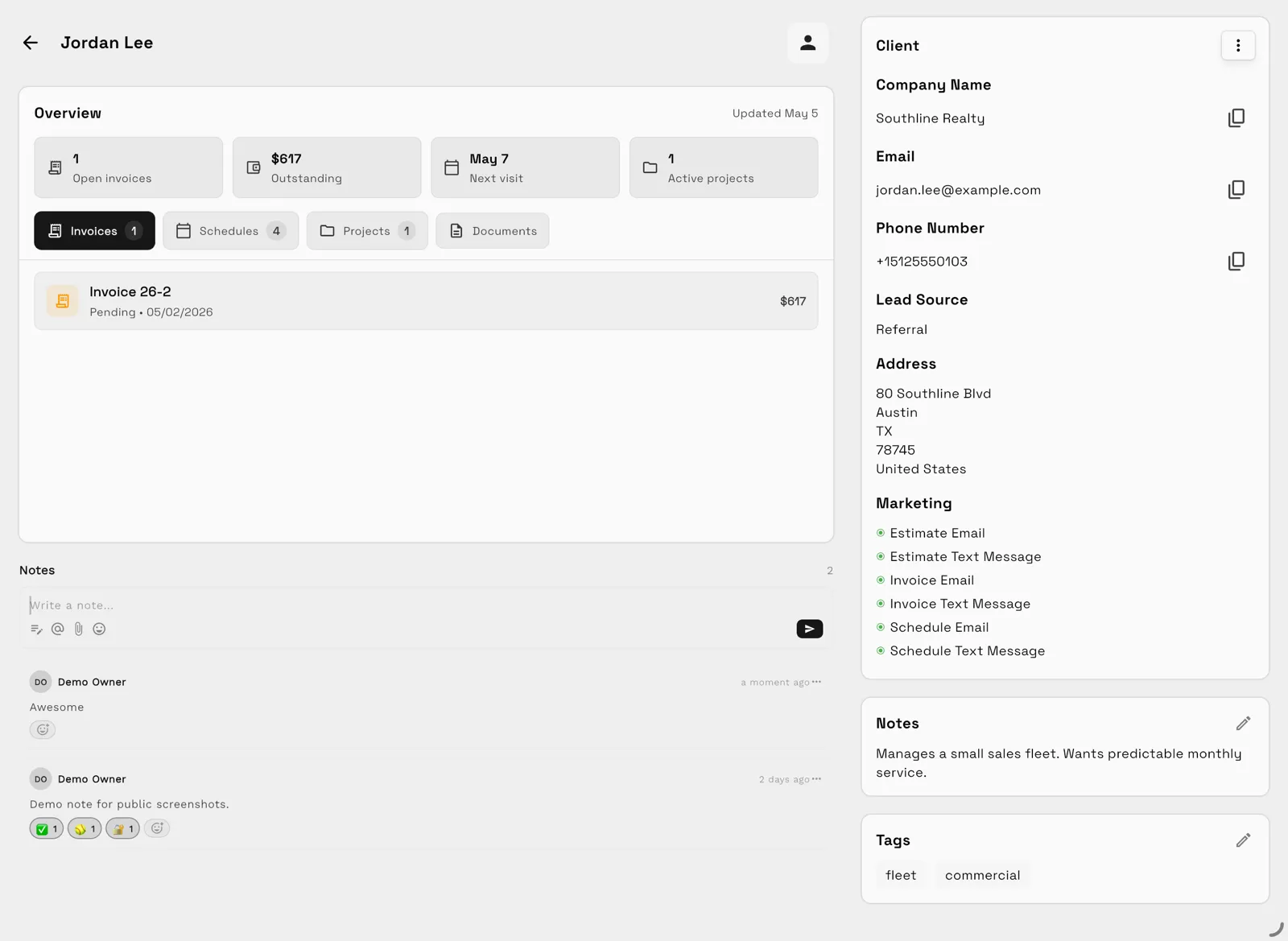
Workspace369 lists public intake forms, a drag-and-drop form builder and a hosted funnel with lead capture into the CRM on every plan. An applicant who passes the interview gets a Proposal the member can approve and sign through a public link, with a deposit, and contracts with online signing cover the agreement text. The accepted proposal converts to an invoice in one step. Retainers, payment schedules, recurring invoices, saved payment methods and late-payment reminders are on Cadet, priced at $29 a month for one user ($23.25 billed yearly). Members get a client portal, and each cohort can be a project with stages and tasks. The screenshot above is demo data, not a customer outcome.
Limitations: it hosts no calls, community or courses. The separate payment plans row, online booking, availability rules and proposal revision history start at Specialist ($149 monthly, $119.25 a month on a yearly plan), so interview booking on Cadet or Voyager means sharing your calendar by hand. Cadet allows 5 active projects, 1 live funnel, 100 funnel leads a month and one seat; Voyager has 2 seats, unlimited projects, 3 live funnels and 500 leads a month. A card is required to start the 14-day trial.
Best for: operators with a few cohorts who want the application, signed terms, installments and renewal on one record and will run delivery elsewhere.
2. HighLevel, best for funnels, calendars and community in one subscription
HighLevel Starter is $97 a month, or $970 a year; the page has a Monthly and a "Save with annual" switch. The feature list names CRM and pipelines, a website and funnel builder, forms, surveys and quizzes, booking calendars, workflow automation, payments and invoicing, courses and communities. Starter includes 3 sub-accounts with no per-user charge. The trial is 14 days free; HighLevel's CRM page says a credit card is required, and billing starts automatically afterwards unless you cancel.
Strengths: the application funnel, the interview calendar, follow-up automation and a community can all sit in one subscription, and a branded client portal app is available as an add-on.
Limitations: the pricing page names no contracts, proposals, e-signature or payment plans, so confirm in the trial that the agreement and installment step works for you. Usage-based charges apply to email and SMS, calling and the AI tools beyond the plan price, and the branded client portal app is $49 a month per sub-account. Expect setup time.
Best for: operators who want one subscription to run the application funnel, the interview calendar, follow-up and a community, and who will accept paying for usage.
3. Kajabi, best for cohort courses with checkout
Kajabi Basic is $179 a month, or $143 a month billed annually ($1,716 charged yearly), with 5 products, 2,500 contacts, 1 community, 2 admin users, courses and coaching, landing pages and funnels, and checkout and payments built in. Live cohort courses, where everyone starts together and moves on a schedule, are a Growth feature ($249 a month, $199 billed yearly, 25,000 contacts). Every plan carries a 30-day money-back guarantee, and the page says Kajabi takes no revenue share.
Strengths: curriculum, community, email and checkout live in one product, which suits a mastermind with a fixed program. Annual billing saves $432 a year on Basic, and contacts scale in blocks.
Limitations: the page names no contracts, proposals, payment plans or booking calendar, so the interview and the signed terms live in other tools. Cohorts need the higher plan, and the free trial is offered without a stated length or card requirement.
Best for: masterminds that deliver a structured curriculum on a schedule and want checkout, community and cohort release in one place.
4. Circle, best for the member community and live events
Circle Professional is $89 a month; the page states its prices are based on annual billing and shows no monthly toggle. It lists community, courses, live events, a member directory, rich member profiles, reporting, payments, a custom domain and mobile apps, with no member cap. The comparison table gives live streams 100 attendees and live rooms 15 participants on Professional, and the trial is 14 days with no credit card required. Business is $199 a month and adds workflows, custom profile fields, APIs and an MCP connection.
Strengths: it is the only tool of the five that hosts the call itself, in live rooms or streams, next to the community, and members get iOS, Android and desktop apps. A mastermind that wants hot seats and between-call discussion in one place can run both.
Limitations: it is a community platform, not a CRM. The page names no contracts, proposals, pipeline or payment plans, workflows are a Business feature, and the Email Hub for broadcasts is an optional add-on charged on top of the plan.
Best for: masterminds whose members meet in a private space between calls and who keep sales and contracts in another tool.
5. Dubsado, best for onboarding forms and installment invoices on a low plan
Dubsado Starter is $35 a month or $335 a year, and Premier is $55 a month or $525 a year; the pricing page has a monthly and an annual view. Starter lists unlimited clients and projects, invoicing and payment plans, form and email templates, client portals, a calendar connection and one active lead capture form. Scheduling, automated workflows, public proposals and multiple lead captures start at Premier. The trial is 21 days with Premier access and no card.
Limitations: contracts are named in its product copy and menu, though the plan table has no contracts row, and public proposals and booking both need Premier. One lead form on Starter limits separate applications per program. It hosts no community or courses.
Best for: a single-offer mastermind on a tight budget that needs installment invoices and a portal and can run the interview calendar elsewhere.
Side-by-side comparison
| Tool | Entry price (monthly) | Billed yearly | Application and agreement | Cohort delivery | Main limit | Trial |
|---|---|---|---|---|---|---|
| Workspace369 | $29 (Cadet, 1 user) | $23.25 per month | Intake forms, funnel, Proposals with public signing, deposits, contracts; payment plans from Specialist | None | Booking and payment plans row from Specialist; Cadet: 5 active projects, 1 live funnel, 100 funnel leads a month | 14 days, card required |
| HighLevel | $97 (Starter) | $970 per year | Forms, funnels, calendars, payments and invoicing; no contracts named | Courses and communities | Usage charges; 3 sub-accounts | 14 days, card required |
| Kajabi | $179 (Basic) | $143 per month | Checkout and funnels; no contracts named | Community on Basic; live cohorts from Growth | 2,500 contacts on Basic | 14 days, card not stated |
| Circle | Not shown (annual billing only) | $89 per month | Payments; no contracts named | Community, courses, live events and rooms | Workflows and custom profile fields from Business | 14 days, no card |
| Dubsado | $35 (Starter) | $335 per year | Payment plans and portal; booking and public proposals on Premier | None | 1 lead form on Starter | 21 days, no card |
Which tool fits your mastermind?
| If you mostly need | Start with | Why |
|---|---|---|
| Application, signed terms and installments on one record | Workspace369 | Forms, Proposals, contracts, deposits and payment schedules on every plan |
| One subscription for funnel, calendar and community | HighLevel | Forms, funnels, booking calendars, courses and communities listed |
| A scheduled curriculum with checkout | Kajabi | Live cohort courses on Growth, checkout built in |
| A private space and live sessions for members | Circle | Community, live events and payments on Professional |
| Low-cost installment invoices and a portal | Dubsado | Payment plans and client portals on Starter |
Run a cohort-switch test during the trial
Walk one made-up member through these steps in every tool on your shortlist. It is an exercise, not a case study.
- Submit an application through the tool's form, then book the interview.
- Send the offer with a deposit and the balance schedule, and have the member sign the agreement.
- Record the first two installments, and let the third one go late.
- Move the member to the next cohort and add a renewal date to the record.
- Open the member record and confirm that the answers, terms, payments and cohort sit together.
The best tool keeps all five visible without opening a second app. Draft the change with the free scope-change request builder if a member asks for different terms mid-program.
Product in action: one member from deposit to cohort
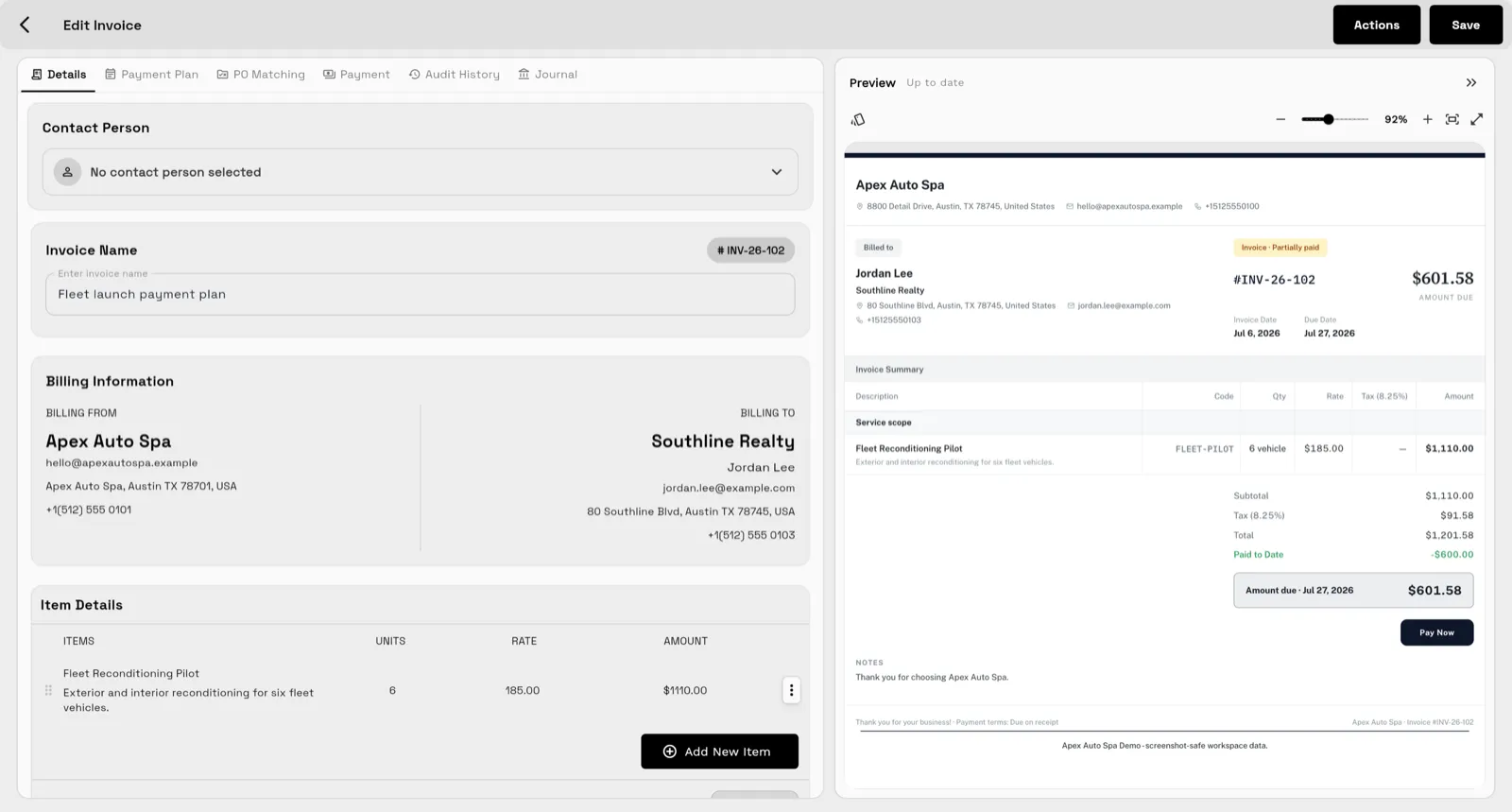
Here is how the Workspace369 side of that test looks with demo data. The screenshots show a fictional workspace, not a customer result. A mastermind seat is a Proposal with a deposit; once the member accepts, the balance is written as an invoice, and on Specialist and above the invoice carries a payment plan tab with each installment tracked.
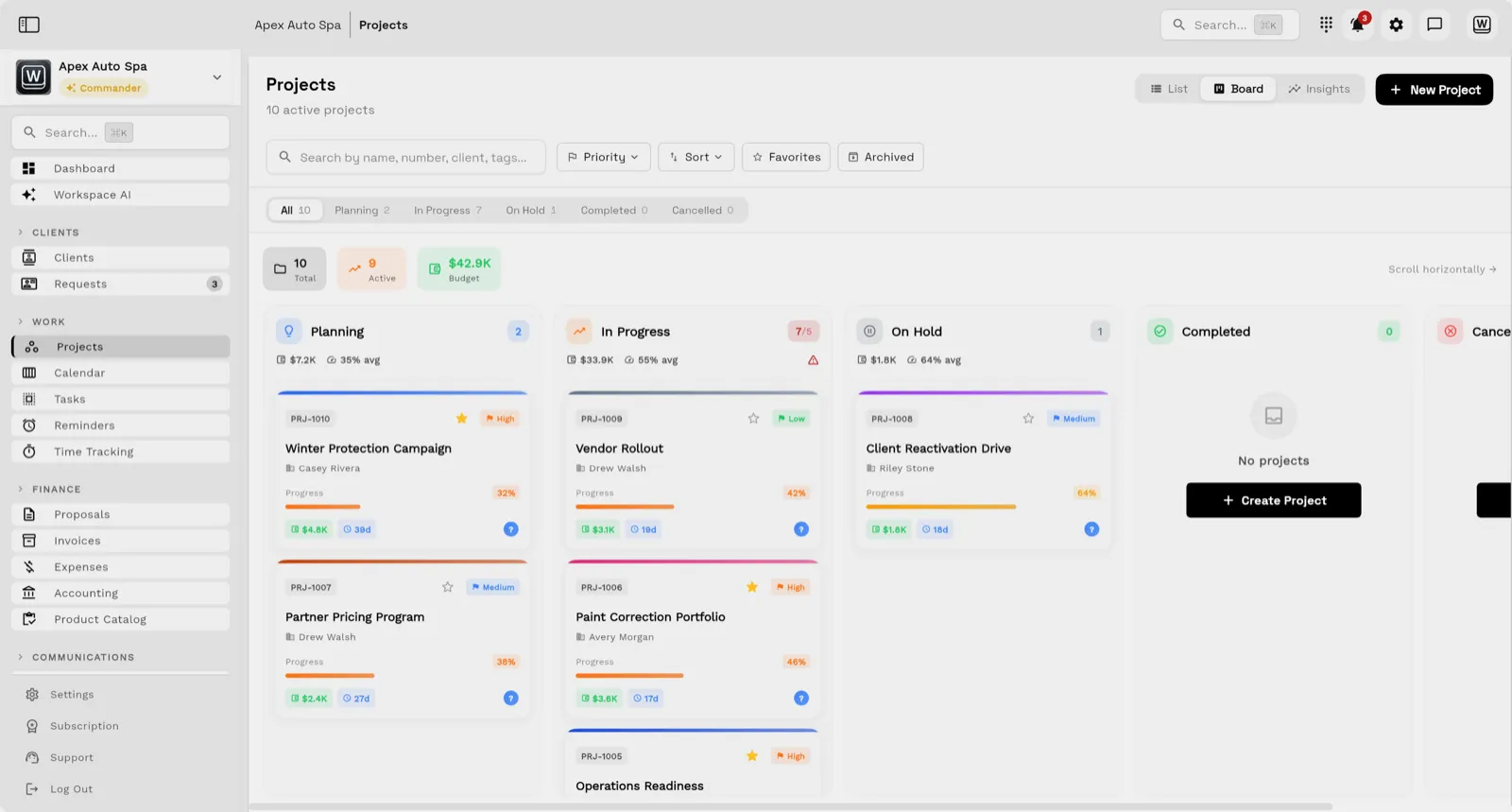
Each cohort can be a project with stages, so moving a member between cohorts is a change on the record, not a new spreadsheet row. The board below is demo data, and the invoices and client portal pages cover the rest.

When to keep it simple
If you run one cohort of six to ten members, an application form, an agreement template and a payment link can carry you. Move to a client-work tool when installments overlap across cohorts, when you cannot answer what a member agreed to last term, or when renewals depend on your memory. The masterminds product page walks through Workspace369's approach to Proposals, communications and invoices; current plans are on the pricing page. On Specialist, change orders record an altered scope against the original agreement. Keep calls, hot seats and community chat in the tools built for them. Our guide to the best CRM for membership communities covers the platform side.
Before you import real members, enroll one demo member from start to finish and check that you can export the records.
Sources reviewed for this guide
- Workspace369 pricingPlan matrix reviewed October 23, 2026.
- HighLevel pricingVendor page, both billing views, reviewed October 23, 2026: plan prices, trial, feature list and metered charges.
- Kajabi pricingVendor page, both billing views, reviewed October 23, 2026: plan prices, contact caps, cohort courses and trial wording.
- Circle pricingVendor page reviewed October 23, 2026: plan prices, feature list and trial terms.
- Dubsado pricingVendor page, both billing views, reviewed October 23, 2026: plan prices, features, lead forms and trial terms.
Workspace369 publishes this documentation-based comparison and is one of the options. It is not an independent ranking or a hands-on benchmark.
Run client follow-up in one workspace.
CRM, inbox, voice, invoicing, payments, projects, files, AI, and workflow automations — connected instead of exported.
14-day free trial. Card required. After the trial: from $29/month. Renews automatically every month until you cancel. Cancel anytime in Settings → Billing.