Best CRM for Solo and Small Law Firms in 2026
Seven tools for solo and small law firms compared on price, trust accounting, intake, conflict checking and billing, plus a fictional-matter test for the trial.
We make Workspace369, which is on this list. Weigh our ranking with that in mind.

By Simon Dziak, Founder, Workspace369 · LinkedIn
The best CRM for solo and small law firms is usually legal practice management: MyCase for trust accounting on a published entry price, CosmoLex for billing and trust ledgers, Clio for a widely used matter platform and PracticePanther for a portal on every plan. Workspace369 fits only advisory work that holds no client funds and needs proposals, contracts, a portal and invoices together.
Workspace369 (see its law firms page) comes last of seven here because it has no trust accounting, conflict checks or legal-specific billing. For the wider decision, start with the best CRM for consultants guide. To size a retainer first, use the free retainer calculator.
Disclosure and method: Workspace369 publishes this guide and is one of the options; we rank it last of seven for this reader. It is a documentation-based shortlist, not a hands-on benchmark, and not legal or ethics advice. Official vendor pages were reviewed on October 26, 2026; Clio's page blocked our fetch, so its details date from October 19 and its price is See site. Check current plans with each vendor before you buy.
Key takeaways
- Law firms usually need legal practice management (matters, trust accounting, legal billing, conflict checks), not only a client-work CRM, so legal-specific tools lead this list.
- MyCase lists Basic at $50 per user a month billed annually ($60 monthly) with trust accounting, time entry and invoicing on the plan; CosmoLex lists Launch at $49 per user a month (the page says yearly billing saves $120 per user), with LEDES billing on Core. PracticePanther lists Solo at $49 per user a month on its annual view, but a trust ledger only with Business Pro.
- Clio blocked our fetch on October 26, 2026, so its price is See site; on October 19 its page listed trust and operating account reconciliation on Starter and a portal from Core.
- Smokeball and Lawmatics do not publish prices on the pages we read, and Lawmatics lists a three-user minimum on Essential and Premium, which matters for a solo practitioner.
- Workspace369 Cadet is $29 a month ($23.25 billed yearly) for one user with time tracking, contracts with e-signature, a client portal and invoices, and a 14-day trial on Cadet through Commander (card required), but it has no trust accounting, conflict checking or legal billing. We rank it last of seven and it fits only practices that do not hold client funds.
- Test each tool with a fictional matter: intake, a conflict search, an engagement agreement, tracked time, an invoice and a client portal login. For trust-account needs, check your state bar's trust-account rules and the vendor's documentation.
What's inside?
What a CRM for a law firm is (and what it is not)How we compared these toolsThe best CRM for solo and small law firms in 2026Side-by-side comparisonWhich tool fits your firm?Workspace369 in action for an advisory engagement on a monthly retainerRun a fictional-matter test during the trialKeep trust work in legal softwareWhen to keep it simple
What a CRM for a law firm is (and what it is not)
For a law firm, the CRM job is the front of the practice: who inquired, whether the firm can take them on, the engagement, the matter, the time and the bill. Legal practice management tools add legal-specific pieces such as matters, trust ledgers, conflict tracking and legal billing formats. A general client-work CRM keeps records, proposals, a portal and invoices but not those. If your practice holds client funds, check your state bar's trust-account rules before picking any tool.
How we compared these tools
We compared each tool on the same five points, using only the vendor's own pages as read on October 26, 2026 (Clio: October 19):
- Price and billing view: the entry plan, per user, and whether monthly and annual prices are shown.
- Trust accounting and legal billing: which plan lists trust ledgers or LEDES billing.
- Intake and conflicts: intake forms, lead management and conflict checking, and the plan that includes them.
- Client access and documents: portal, e-signature and document handling on the entry plan.
- Limits and trial terms: user minimums, seat counts and whether a card is needed.
What we did not test: speed, support, security, court-rule calendaring or mobile apps. We did not use third-party ratings.
Why the order is what it is: MyCase ranks first because it shows both annual and monthly prices, lists trust accounting on its entry plan and offers a no-card trial. Clio ranks second because, as of our October 19 read, it listed trust and operating account reconciliation on Starter, but its portal and intake sat on higher plans and we could not re-read its page on October 26. CosmoLex follows with the clearest legal billing detail (LEDES on Core and Pro). CosmoLex lists a client portal and retainers on its $49 Launch plan, which Clio's Starter did not on October 19, so a firm that needs a portal before trust reconciliation may prefer CosmoLex. PracticePanther is fourth: its prices and portal are clear, but a trust ledger appears only with Business Pro. Order reflects documented fit for a solo or small firm.
The best CRM for solo and small law firms in 2026
1. MyCase, best for an all-in-one entry plan with published prices
MyCase's pricing page lists Basic at $50 per user a month billed annually ($60 monthly), Pro at $100 ($120) and Advanced at $130 ($150). Basic lists case and contact management, time entry, invoicing and trust accounting, online payments, customizable reporting, unlimited document storage and a limited client portal. Pro adds unlimited e-signature and document generation, automated workflows, client intake forms and a legal CRM, and two-way texting. Advanced adds Conflict Check Tracking and split billing. The page lists a 10-day trial with no credit card required. MyCase Accounting is listed at $39 per user a month on Pro and Advanced.
Limitations: intake forms and the legal CRM start on Pro, and conflict check tracking on Advanced, so the entry plan is not the whole job. The portal on Basic is labeled limited, and per-user pricing adds up as staff are added.
Best for: solo and small firms that want matters, time, billing and trust accounting in one account, with a published price.
2. Clio, best for trust reconciliation on the entry plan
Clio's pricing page returned HTTP 403 to our fetch on October 26, 2026, so its price is See site and the rest of this entry is what the page listed when we read it on October 19. It listed four plans: Starter, Core, Signature and Elite, with Starter shown as starting at $49 per user and no billing period stated. Starter listed legal accounting built in, time and expense tracking, online client payments and reconciliation of trust and operating accounts. Core, Signature and Elite were "Get pricing". Core added AI billing and a secure client portal; Signature added custom roles and permissions, kanban matter stages and multi-currency or split bills; Elite added Clio Grow for online intake forms and scheduling, which was also listed as an add-on. Matter and contact management, calendaring, tasks, unlimited document storage and mobile apps were listed on all four plans, and the page offered a free trial with no length stated.
Limitations: we could not re-check the price, billing period or trial length, so confirm them with Clio directly. As of October 19 the client portal started at Core and intake at Elite or as an add-on, and Core, Signature and Elite had no public price.
Best for: solo and small firms that want a legal practice management tool with trust reconciliation on the entry plan and are fine getting a quote for the upper plans (confirm current terms first).
3. CosmoLex, best for billing and trust accounting on the entry plan
CosmoLex's pricing page has a Monthly and Yearly toggle and lists Launch at $49 per user a month, Core at $99 and Pro at $129, and says "Save $120 per user with yearly". The text we read does not say which view those figures belong to, so treat the monthly and yearly split as See site. Launch lists time tracking and invoicing, flexible billing and retainers, online payments, trust accounting and ledgers, compliance reporting, matter management and a client portal. Bank reconciliation, LEDES and split billing, matter budgets, and lead capture and intake start on Core. The page says to start for free with no credit card needed, with no trial length stated.
Limitations: bank reconciliation, intake, matter budgets, online scheduling and the general ledger sit on higher plans, and a CRM add-on is sold separately. The page says the trial is limited to a single bank feed connection and does not include the CRM or LexShare/LexSign.
Best for: small firms for whom billing and trust ledgers matter most and who can step up to Core for bank reconciliation and LEDES.
4. PracticePanther, best for a low per-user price when a trust ledger can wait
PracticePanther's pricing page lists Solo at $49 per user a month on its annual view ($59 on the monthly view; the page says annual billing saves $120 per user a year), Essential at $69 ($79), Business at $89 ($99) and Business Pro at $114 ($124). Contact and matter management, billable time and expense tracking, a secure client portal, unlimited data storage and mobile apps are listed on every plan. Solo adds internal chat, native ePayments, document templates and task and event workflows. Intake forms, native e-signature, two-way texting and LEDES billing start on Business. The Trust Account Ledger and the PantherAccounting Plus trust accounting package are listed only with Business Pro. The page offers a 7-day trial and says no credit card is needed.
Limitations: the entry plan has no trust accounting, so a firm that holds client funds has to pay for Business Pro, which at $114 per user is more than twice the Solo price. Intake forms and e-signature need Business. Prices are per user, so they rise with each staff member.
Best for: small firms that want matters, time and a client portal at a low per-user price and either hold no client funds or will step up to Business Pro.
5. Smokeball, best for document-heavy practices that want quote-based plans
Smokeball's pricing page shows four plans, Bill, Boost, Grow and Prosper+, with "Get pricing" buttons instead of prices, and says pricing depends on users, plan, contract term and add-ons. Bill lists invoicing, time and expense tracking, online payments, trust accounting and reporting, and accounting integrations. Boost adds client and matter management, a client portal, e-signature and Microsoft 365 Word and Outlook integration; Prosper+ adds lead management and inquiry intake. An Intake add-on is listed for Boost and Grow. The page offers a demo, not a free trial.
Limitations: no price is shown, so you cannot compare cost without a quote. Intake and lead management sit on higher plans or an add-on, and the client portal and e-signature start at Boost.
Best for: firms that work in Microsoft 365 documents and are happy to get a personalized quote.
6. Lawmatics, best for lead intake and follow-up on top of practice management
Lawmatics' pricing page lists Essential, Premium and Enterprise by custom quote. Essential lists 500 contacts, client intake, lead management, calendaring, custom forms, e-signature and task management. Premium adds workflow and marketing automation, SMS and MMS, round-robin scheduling, advanced conflict checking and email marketing. The comparison table shows a 3-user minimum on Essential and Premium and 5 on Enterprise. A Time & Billing add-on (time tracking, invoicing and payments) is sold through the sales team, and the site navigation names integrations with Clio, MyCase, Smokeball and PracticePanther. The page also promoted a free first month on October 26.
Limitations: no public price, billing is a separate add-on, and the three-user minimum makes it a poor fit for a one-person practice. It is built around client acquisition, so most firms pair it with a practice management tool.
Best for: firms of three or more that win clients through marketing and want intake automation and conflict checking.
7. Workspace369, best for non-litigation advisory practices that hold no client funds
Workspace369 keeps client records, time tracking, a proposal, contracts with e-signature, a client portal and invoices together. Cadet is $29 a month for one user ($23.25 billed yearly) and lists public intake forms, time tracking that flows into invoices, contracts and e-signature, retainers and payment schedules, deposits, file versioning and the client portal on the plan. The screenshot is a demo record, not a customer result.
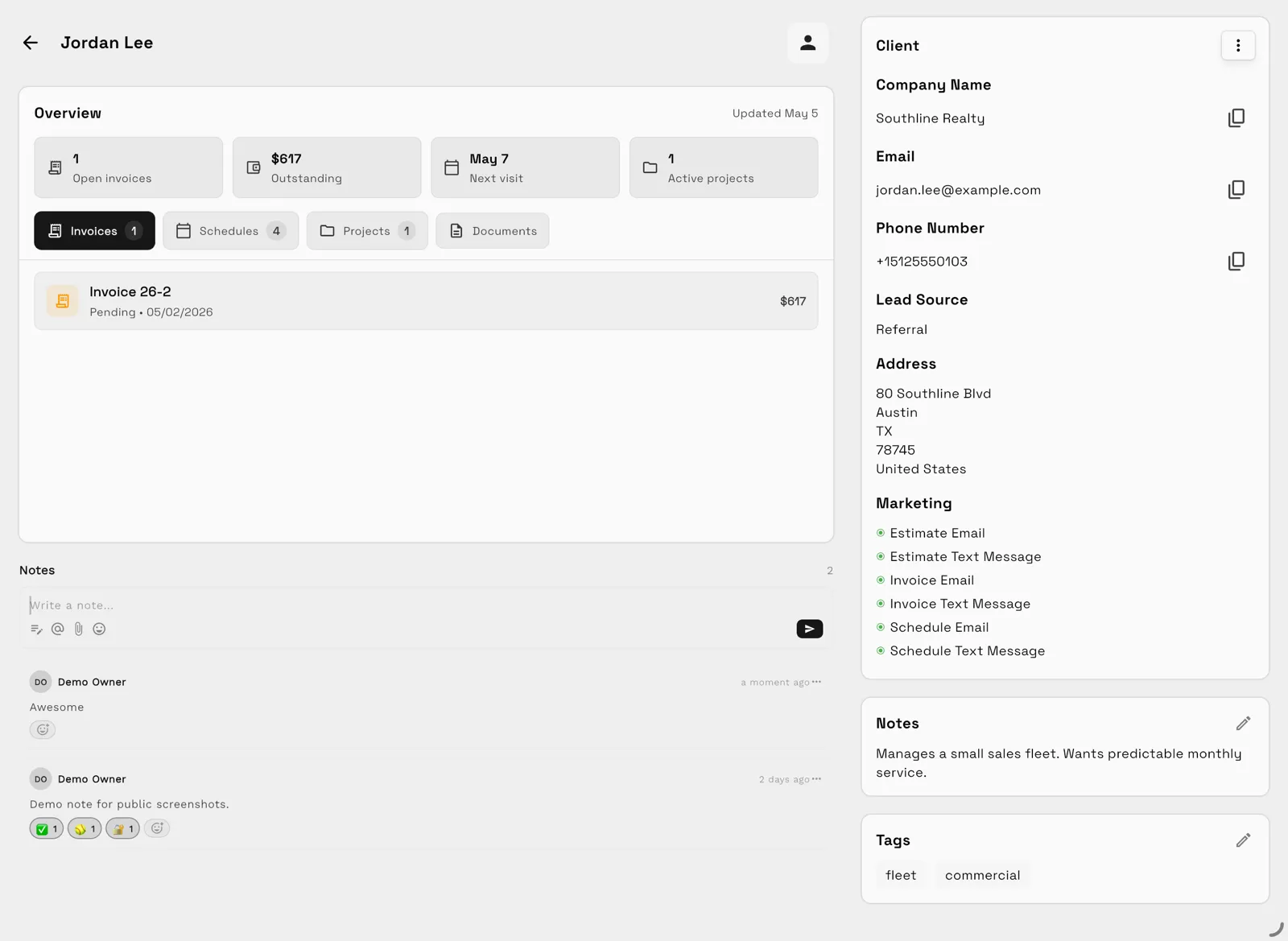
Limitations: it has no trust accounting, no conflict checking, no matter-specific features and no legal billing formats such as LEDES. Retainers and payment schedules are general billing features, not trust ledgers. Cadet has one user and 5 active projects; Voyager ($74 a month, $59.25 billed yearly) gives two seats. The trial is 14 days on Cadet through Commander, card required. MyCase and CosmoLex cover legal billing and trust accounting from their entry plans.
Best for: advisory or consulting-style practices that do not hold client funds, want a general client record, and keep matter and trust work in legal software, if they need it.
Side-by-side comparison
| Tool | Plan priced | Monthly | Billed yearly | Trust, intake and conflicts at that plan | Limits | Trial |
|---|---|---|---|---|---|---|
| MyCase | Basic | $60 per user | $50 per user a month | Trust accounting; intake forms start on Pro, conflict tracking on Advanced | Limited portal on Basic | 10 days, no card |
| Clio | Starter | See site | See site | Per our October 19 read: trust and operating reconciliation on Starter; portal from Core; intake via Clio Grow on Elite or as an add-on | Core, Signature and Elite were quote-based | Free trial, length not stated |
| CosmoLex | Launch | See site | See site ($49 per user shown; yearly saves $120) | Trust accounting and ledgers; bank reconciliation, LEDES and intake on Core and Pro | Single bank feed in trial | Free start, no card; length not stated |
| PracticePanther | Solo | $59 per user | $49 per user a month | Client portal on every plan; trust ledger only on Business Pro; intake forms and LEDES on Business | Trust ledger needs Business Pro ($114 per user yearly) | 7 days, no card |
| Smokeball | Bill | See site | See site | Trust accounting on Bill; intake as add-on or Prosper+ | Quote-based | Demo, no trial listed |
| Lawmatics | Essential | See site | See site | Intake and basic conflict checking; billing is an add-on | 3-user minimum, 500 contacts | Free first month offer on page |
| Workspace369 | Cadet | $29 | $23.25 a month | No trust accounting or conflict checks | 1 user, 5 active projects | 14 days, Cadet through Commander, card required |
Which tool fits your firm?
| If you mostly need | Start with | Why |
|---|---|---|
| One account with trust accounting and a published price | MyCase | Trust accounting, time entry and invoicing on Basic |
| Trust reconciliation on the entry plan, quote for upper plans | Clio | Starter listed trust and operating reconciliation on October 19; portal from Core |
| Billing, LEDES and trust reconciliation | CosmoLex | Trust ledgers on Launch; bank reconciliation and LEDES on Core and Pro |
| A low per-user price with a portal on every plan | PracticePanther | Portal on Solo; trust ledger only on Business Pro |
| Microsoft 365 documents and a quote | Smokeball | Microsoft 365 Word and Outlook integration on Boost |
| Marketing-led intake and conflict checks | Lawmatics | Intake automation, 3-user minimum |
| Advisory work with no client funds | Workspace369 | Time, contracts, portal and invoices on Cadet |
Workspace369 in action for an advisory engagement on a monthly retainer
Take a small firm that gives non-litigation advice on a monthly retainer and holds no client funds. The first screenshot is the projects board in a demo workspace with sample data: Planning, In Progress and On Hold columns, with project cards showing progress, budget and days left. Each retained client would be one card, with the engagement as its tasks. On Cadet up to 5 projects can be active at once.
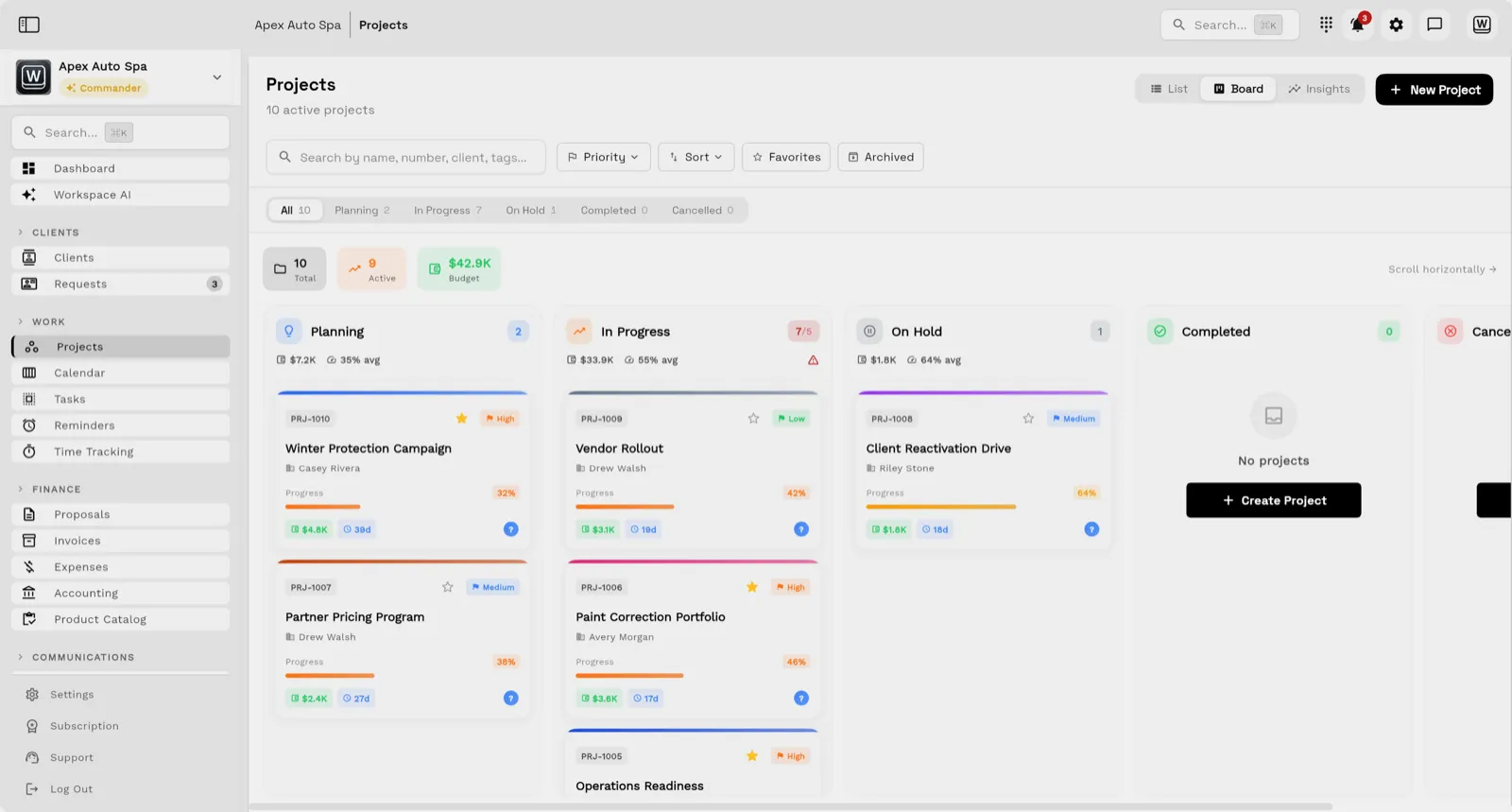
The engagement starts with a proposal and a contract signed by e-signature, and the retainer, deposit and payment schedule sit under retainers and recurring billing. Hours go into time tracking and flow into the invoice. The second screenshot, also demo data, is the invoice editor with a live preview of a partly paid invoice: the paid amount is taken off the total and a Pay Now button shows the balance. The client sees the same invoice in the client portal.
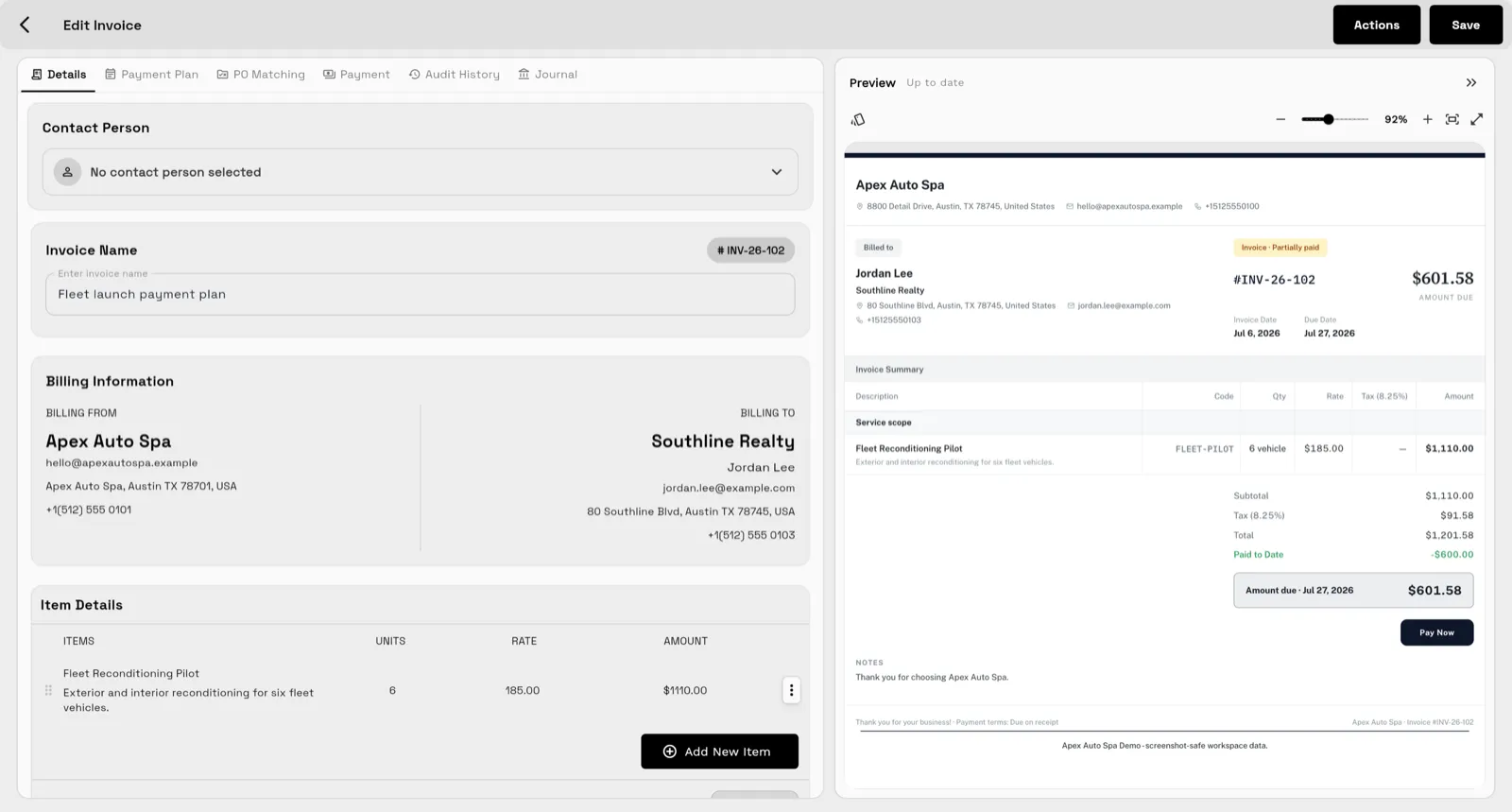
The demo workspace is not a law firm. Workspace369 has no trust ledger, no conflict search, no matter-specific records and no LEDES billing, so a retainer here is a general billing feature and not a client-funds account. Splitting a balance into instalments (the Payment Plan tab in the screenshot) starts at Specialist.
Run a fictional-matter test during the trial
Take one fictional client through each tool you shortlist:
- Capture an inquiry through an intake form and record the source.
- Run a conflict search for the new party, if the tool offers one.
- Send an engagement agreement for e-signature.
- Track time against the matter and turn it into an invoice.
- Log in as the client and check what they can see.
- If you hold client funds, see how the tool shows them, and check your state bar's trust-account rules.
The best tool keeps the inquiry, the matter, the time and the invoice on one record, without retyping. If a step needs a second tool and manual copying, that is the leak this test is built to find.

Keep trust work in legal software
Trust accounting, conflict checks and court-specific calendaring belong in a tool that documents them. If you pick a tool without them, such as Workspace369, pair it with legal software and keep sensitive matter records in the system your firm approves. In Workspace369, CSV import is on every plan, and webhooks and the API start at Specialist if you want to connect another system.
When to keep it simple
If you take on a few advisory clients a year and never hold client funds, an engagement template, a time log and an invoice template can carry you a long way. Move to a dedicated legal tool when you hold client funds, when conflicts need a searchable record, or when intake volume outgrows a spreadsheet. The law firms product page shows how Workspace369 handles communications, contracts and invoices, and the pricing page has current plans. Workflow Automations can send reminders and follow-ups, with email automations on every plan.
Before importing real clients, run one full matter on demo data and check that your records can be exported.
Sources reviewed for this guide
- Workspace369 pricingPlan matrix reviewed October 26, 2026 for seats, active projects, time tracking, contracts, portal, invoicing, retainers, payment plans and trial terms.
- MyCase pricingOfficial pricing page reviewed October 26, 2026 for Basic, Pro and Advanced prices on the annual and monthly views, the plan features and the 10-day no-card trial.
- CosmoLex pricingOfficial pricing page reviewed October 26, 2026 for the Launch, Core and Pro prices ($49, $99, $129 per user a month), the $120 yearly saving, the plan feature table and the no-card start. The text we read does not say which billing view the prices belong to, so monthly and yearly figures are See site.
- PracticePanther pricingOfficial pricing page reviewed October 26, 2026 for Solo, Essential, Business and Business Pro prices on the annual and monthly views, plan features and the 7-day no-card trial.
- Smokeball pricingOfficial pricing page reviewed October 26, 2026 for plan contents (Bill, Boost, Grow, Prosper+), the Microsoft 365 integrations and the demo offer. Prices are quote-based on the page.
- Lawmatics pricingOfficial pricing page reviewed October 26, 2026 for plan contents, the three-user minimum on Essential and Premium (five on Enterprise), the Time & Billing add-on and the free-first-month offer. Pricing is by custom quote.
- Clio pricingOfficial pricing page last read October 19, 2026 for plan contents, the Starter price and the free trial; on October 26, 2026 the page returned HTTP 403 to our fetch, so those details were not re-checked and the price is shown as See site.
Workspace369 publishes this documentation-based comparison and is one of the options. It is not an independent ranking or a hands-on benchmark, and it is not legal advice.
Run client follow-up in one workspace.
CRM, inbox, voice, invoicing, payments, projects, files, AI, and workflow automations — connected instead of exported.
14-day free trial. Card required. After the trial: from $29/month. Renews automatically every month until you cancel. Cancel anytime in Settings → Billing.