Best CRM for Tattoo Studios in 2026
Best CRM for tattoo studios: six tools compared for studios and chair-renting artists on price, deposits, consent forms, commissions and multi-session pieces.
We make Workspace369, which is on this list. Weigh our ranking with that in mind.

By Simon Dziak, Founder, Workspace369 · LinkedIn
The best CRM for tattoo studios is usually a tattoo-built tool: Tattoogenda for a multi-artist studio with consent forms and deposits, Venue for a chair renter who wants to start free, and Tattoodo Books for artists who take requests in Instagram DMs. Workspace369 fits only custom pieces priced as projects, with a Proposal, deposit, contract and invoices on one record.
Square suits a general booking tool with contracts, and GlossGenius suits renters who want waivers. See the tattoo studios solution page for Workspace369, the best CRM for freelancers for other trades, and the free deposit calculator to size your deposit first.
Disclosure and method: Workspace369 publishes this guide and is one of the options. It is a documentation-based shortlist, not a hands-on benchmark. Official vendor pages were reviewed on October 26, 2026 (Square's per-plan feature table was not re-read, see sources). Check current plans with each vendor before you buy.
Key takeaways
- A tattoo studio needs the request, reference images, deposit, release form and every session of a piece on one client record. Three of the six tools here are built for tattooing; the other three are general tools.
- Tattoogenda lists a consent-form and Ink Passport flow, deposits, tattoo project management and POS from $20 a month ($220 a year) on its US price view, with the whole team included and a 14-day trial that needs no card. Its plans are €45 and €89 a month on its non-US price view.
- Venue (Solo and Studio at $0 a month) and Tattoodo Books (free to join) cost the artist nothing up front: Venue has a booking link, custom form and deposits, and Tattoodo Books turns Instagram requests into briefs and deposits.
- Workspace369 Cadet is $29 a month ($23.25 billed yearly) for one user. It lists intake forms, Proposals with optional add-ons, deposit on acceptance, contracts, file versioning and a client portal on every plan, but online booking starts at Specialist ($149) and it has no tattoo-specific consent flow, POS or commission split. The 14-day trial runs on Cadet through Commander, card required.
- Square Appointments (Free, then $49 a month) and GlossGenius ($28 a month, $24 billed yearly) both list online booking on their entry plans, with deposits listed for each; GlossGenius needs Gold ($56 monthly) for Forms & Waivers and Platinum ($168 monthly) for customizable commissions.
What's inside?
What a CRM for a tattoo studio is (and what it is not)How we compared these toolsThe best CRM for tattoo studios in 2026Side-by-side comparisonWhich tool fits your studio?Workspace369 in action for a multi-session custom pieceRun a multi-session test during the trialWhen to keep it simple
What a CRM for a tattoo studio is (and what it is not)
For a tattoo shop, the CRM is the memory behind the chair: who asked for what, which references they sent, what price you agreed, which deposit counts toward the piece, whether the release form came back, and how many sessions are left. It is not a design tool, a flash catalogue, a sterilisation log or a medical record. The same person may ask for a sleeve in March, a touch-up in September and a cover-up two years later, so the record has to outlive any single appointment. It also has to cope with people who share a roof but not a wallet, because many artists rent a chair and keep their own clients.
How we compared these tools
Each tool was checked against the same five points on its own pages:
- Entry price, monthly and billed yearly where the page shows both. For a four-artist studio the figure is the cheapest plan that covers all four.
- Request to deposit: a booking or request form that takes reference images, and a deposit that is paid before the date is held.
- Release and consent paperwork: whether the page names consent forms, waivers or signed contracts, and on which plan.
- Multi-session pieces and money split: project records, packages or recurring sessions, and commission or booth-rent handling.
- Trial terms: length and whether a card is mentioned.
Speed, support, uptime and mobile apps were not tested, and no third-party ratings were used. Order follows documented fit for a studio owner or chair renter. The three tattoo-built tools lead because their pages name requests, deposits and, for Tattoogenda, consent forms and project management. Square comes next because its entry plan lists deposits, contracts and a project workspace. Workspace369 ranks fifth, above GlossGenius, because its matrix names a project-style chain (intake forms, Proposals with optional add-ons, deposit on acceptance, contracts, retainers and payment schedules, file versioning, client portal) that GlossGenius does not name on its pricing page. GlossGenius wins on booking, waivers and booth-renter accounts, so a shop that mainly wants those should reverse the order.
The best CRM for tattoo studios in 2026
1. Tattoogenda, best for a multi-artist studio that wants it all tattoo-specific
Tattoogenda is built around the studio. The pricing page shows two plans: Expert at $20 a month or $220 a year, plus $0.13 per SMS, and Ultimate at $50 a month or $550 a year. That is the dollar view; the same page shows €45 and €89 a month (€495 and €979 a year) for other regions. Expert lists a calendar for resident artists, guest artists and reception, tattoo project management, booking links for every service, deposits that are collected and chased automatically, consent forms and Ink Passports, reminders, no-show tools, payments with POS and full customer history. The page says the whole team is included, however big it grows. Ultimate adds one inbox for email, Instagram, WhatsApp and Facebook, and turns a message into a project with the reference-image request filled in.
Limitations: the pricing page names no proposal or price-document feature and no commission split, and it lists SMS as a per-message extra. The Ultimate inbox is a paid step up.
Best for: studios with several artists and guests who want the calendar, deposits, consent forms and POS in one tattoo-built system. The 14-day trial says no credit card is needed.
2. Venue, best for chair renters who want to start free
Venue is made for artists who manage their own books. The Solo plan is $0 a month: a booking link with a custom form, built-in chat, flash uploads and deposits and checkout by card, Affirm and Klarna. Solo Pro is $50 a month. The Studio plan is $0 a month with a shared calendar and auto-assigned requests; Studio Pro is $150 a month with an auto-split to all artists and up to five residents or guests, then $35 a month per extra active artist. The first studio month is free.
Limitations: the pricing page names no consent form, release form or contract, and subscriptions are set up by contacting the team. The page says payroll with automatic commission split is still planned.
Best for: a self-booking artist, or a small shop of self-employed renters, who wants deposits and a booking form without a monthly subscription.
3. Tattoodo Books, best for artists who take requests in Instagram DMs
Tattoodo Books is a booking and payments app that answers requests inside Instagram. It is free to join, with no monthly subscription. Completed forms arrive as a brief that includes preferred dates, and the template asks for size, placement, style, references, budget and timeline, with questions you can add, remove or reorder. Deposits or full payments are requested and paid inside the Instagram thread, with card, Apple Pay, Klarna and Affirm, instalments for larger pieces and automatic reminders before sessions.
Limitations: the page names no calendar, studio plan, release form or contract, so it is an intake and deposit tool rather than a studio system.
Best for: solo artists whose clients arrive through Instagram and who want complete briefs and deposits before replying.
4. Square Appointments, best general tool for shops that want booking and contracts at $0
Square Appointments lists Free at $0 a month per location, Plus at $49 and Premium at $149, with a 30-day trial on Plus and Premium. Its feature list names online booking, unlimited staff calendars, appointment deposits, prepayments with automatic contracts, invoice deposits, contracts with templates and e-signature, a project workspace for files, invoices, estimates, contracts and notes, class booking and packages, and tip pooling with commissions tracking. Plus adds cancellation policies, multi-staff booking and a waitlist.
Limitations: nothing on the page is tattoo-specific, and the page names no client portal or file-version history. Which plan holds commissions tracking is not re-read here, so check the plan table.
Best for: a shop that wants a booking calendar, deposits and signed contracts from $0 and will build its own tattoo forms.
5. Workspace369, best for custom pieces priced as a project
Workspace369 is a client-work system, not a tattoo tool. Cadet costs $29 monthly for a single user, or $23.25 a month when billed yearly. It lists public intake forms with a drag-and-drop builder, Proposals with optional add-on lines, deposit on acceptance, contracts clients sign online, retainers and payment schedules, file management with versioning, project stages and a client portal. A cover-up Proposal with an optional second session and a deposit that counts toward the total fits that chain. The screenshot below uses demo data, not a real customer.
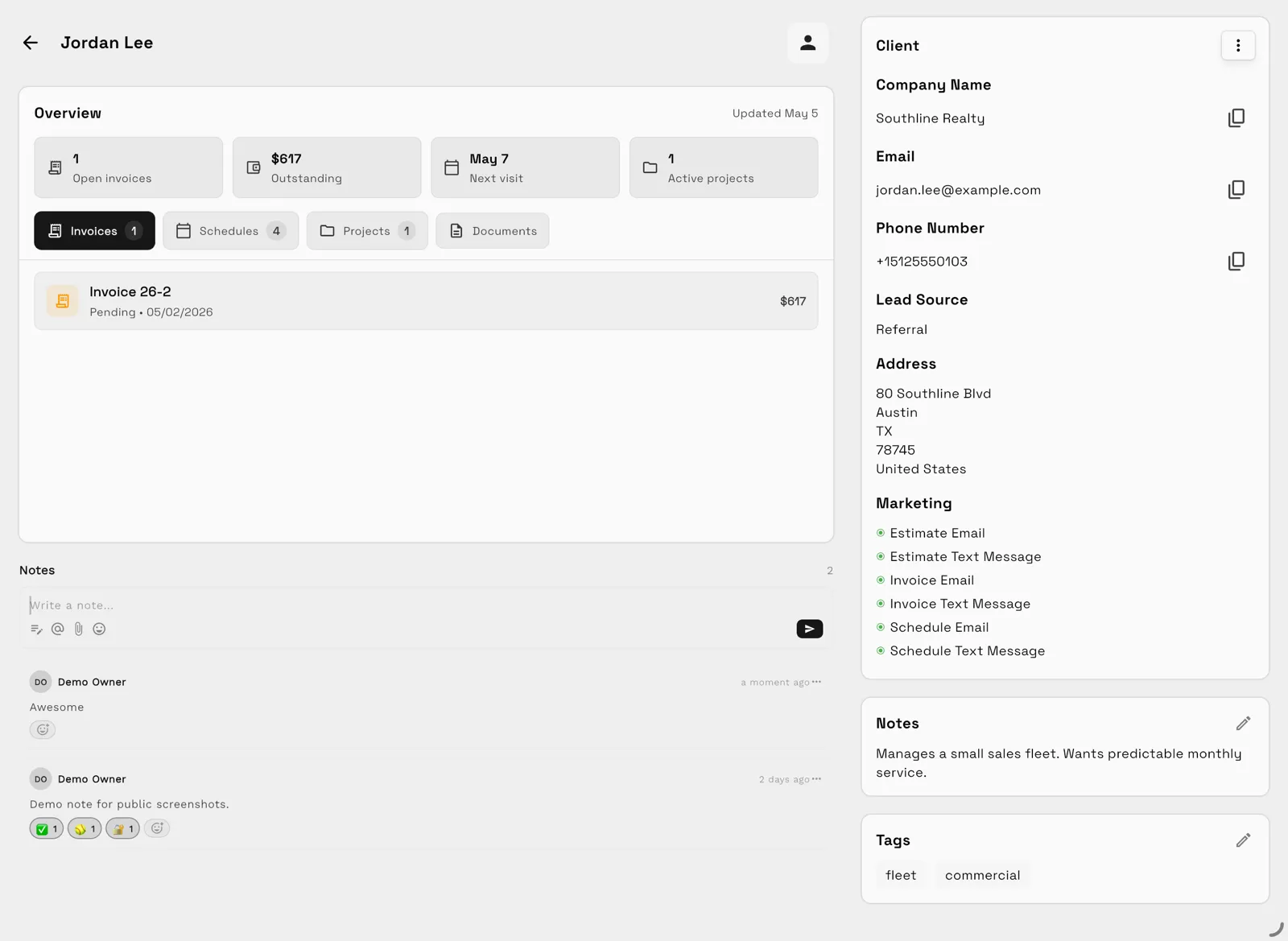
Limitations: Cadet allows 5 active projects and one seat. Online booking, change orders and proposal revision history start at Specialist ($149 monthly, or $119.25 billed yearly), and a team needs Voyager ($74, two seats) at least. It has no POS, no commission or booth-rent split and no tattoo-specific consent flow, and the matrix does not name a file-upload field on forms, so test the reference-image step. The 14-day trial runs on Cadet through Commander, card required. Tattoogenda and Square cost less and include a booking calendar.
Best for: an artist or small shop that sends large custom pieces as Proposals and wants the design files, deposit, contract and invoices together.
6. GlossGenius, best for chair renters who want waivers and separate payouts
GlossGenius has a Tattoo & Piercing page and three plans. Standard is $28 a month ($24 billed annually), Gold $56 ($48) and Platinum $168 ($148). The comparison table lists deposits, cancellation and no-show policies and card-on-file policies for the Beauty & Wellness plans. Forms & Waivers and time tracking start at Gold, which is for up to 9 staff, and customizable commissions are on Platinum. The table also lists separate bank accounts for booth renters; confirm which plan holds them. The FAQ gives a free 14-day trial on any plan with no credit card.
Limitations: the pricing page names no proposals, project records or client portal, and the waivers need Gold and renter payouts are tier-gated.
Best for: a shop of renters that wants booking, waivers and separate payouts in one salon-style tool.
Side-by-side comparison
| Tool | Entry price (monthly) | Billed yearly | Deposits and release paperwork | Booking calendar | Main limit | Trial |
|---|---|---|---|---|---|---|
| Tattoogenda | $20 (Expert, US view); €45 elsewhere | $220 a year | Deposits; consent forms and Ink Passports | Calendar for residents, guests and reception | No proposal feature named; SMS extra | 14 days, no card |
| Venue | $0 (Solo) | Not applicable | Deposits; no release form named | Booking link; shared calendar on Studio | Studio Pro $150 for auto-split | Studio: first month free |
| Tattoodo Books | $0, free to join | Not applicable | Deposits; no release form named | Not named on page | Intake and deposits only; no calendar or release form | None; free |
| Square Appointments | $0 (Free); Plus $49 | Not shown | Deposits; contracts with signatures | Online booking site | Not tattoo-specific | 30 days on paid plans |
| Workspace369 | $29 (Cadet, one user) | $23.25 a month | Deposit on acceptance; contracts clients sign online | Specialist ($149 monthly) | 5 active projects; no POS or commission split | 14 days, Cadet through Commander, card required |
| GlossGenius | $28 (Standard) | $24 a month | Deposits; Forms & Waivers from Gold ($56) | Booking website (Standard) | Waivers need Gold; commissions Platinum | 14 days, no card |
Which tool fits your studio?
| If you mostly need | Start with | Why |
|---|---|---|
| One system for artists, guests, consent forms and deposits | Tattoogenda | Calendar, consent forms, deposits and POS on one plan |
| A free start for a self-booking artist | Venue | $0 Solo plan with a booking link, custom form and deposits |
| Instagram requests turned into paid bookings | Tattoodo Books | Request form with references, then deposit, inside the DM |
| A booking calendar and signed contracts at the lowest price | Square Appointments | Booking, deposits and contracts listed on Free |
| Proposals with optional add-ons, deposits and design files on one record | Workspace369 | Proposals, deposit on acceptance, contracts and file versioning on Cadet |
| Waivers and separate payouts for renters | GlossGenius | Forms & Waivers and renter accounts from Gold |
Workspace369 in action for a multi-session custom piece
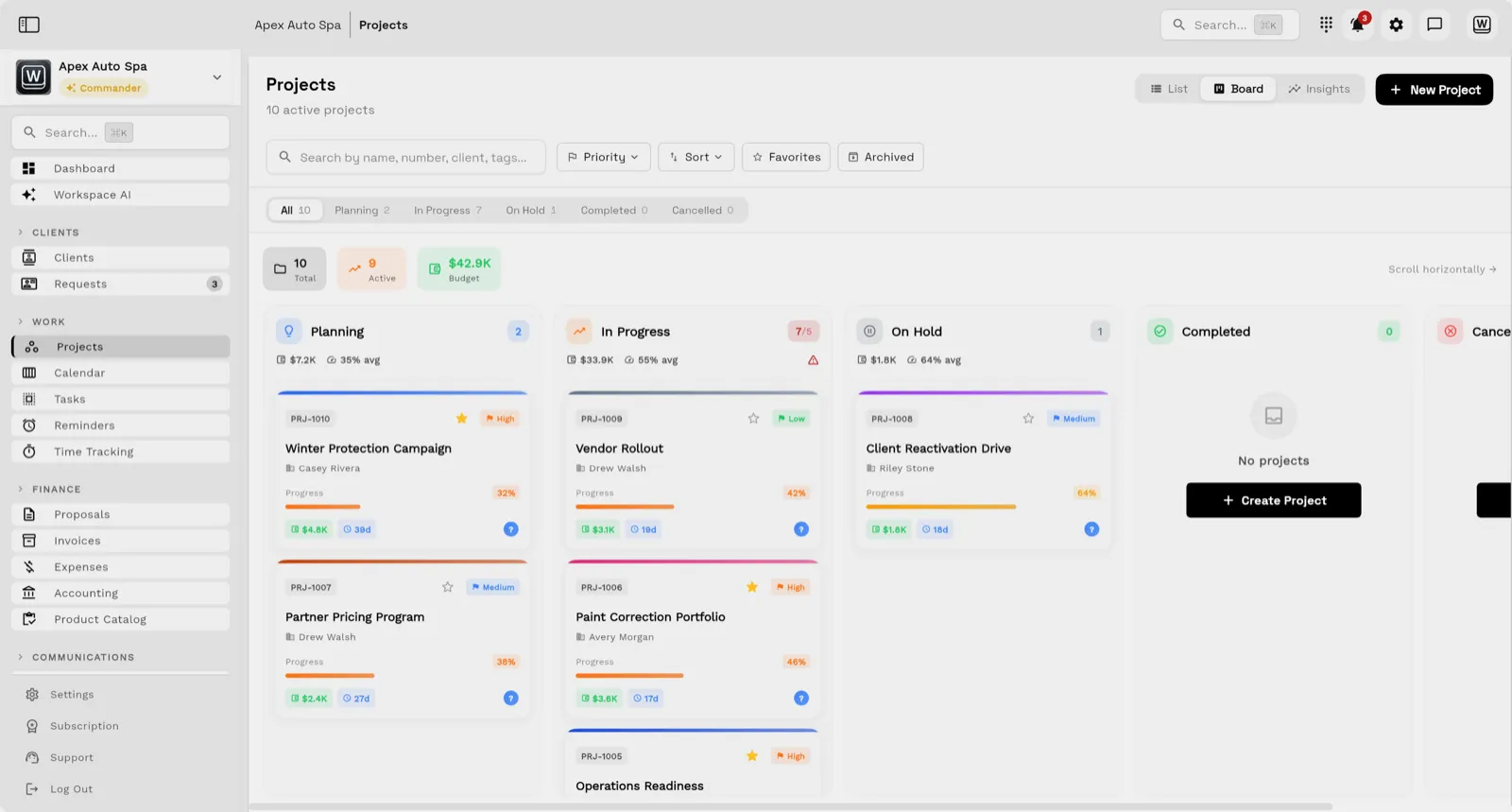
For a large custom piece, the job is one record, not one appointment. The first screenshot is the Workspace369 projects board in a demo workspace with sample data, with Planning, In Progress and On Hold columns and project cards showing progress, budget and a day count. A piece such as "Back piece, three sessions and a touch-up" would sit there as one card, with the design files attached and each session as a task. On Cadet up to 5 projects can be active at once.
The deposit comes first. You send the client a Proposal with the price and optional add-ons such as a second session, and the deposit is taken when they accept. The second screenshot, also demo data, is the invoice editor with a live preview: a partly paid invoice with the paid amount taken off the total, an amount due and a Pay Now button. That is how a final-session balance would look after the deposit. The signed contract, which you can use for your own release form, and the invoices stay on the same client record.
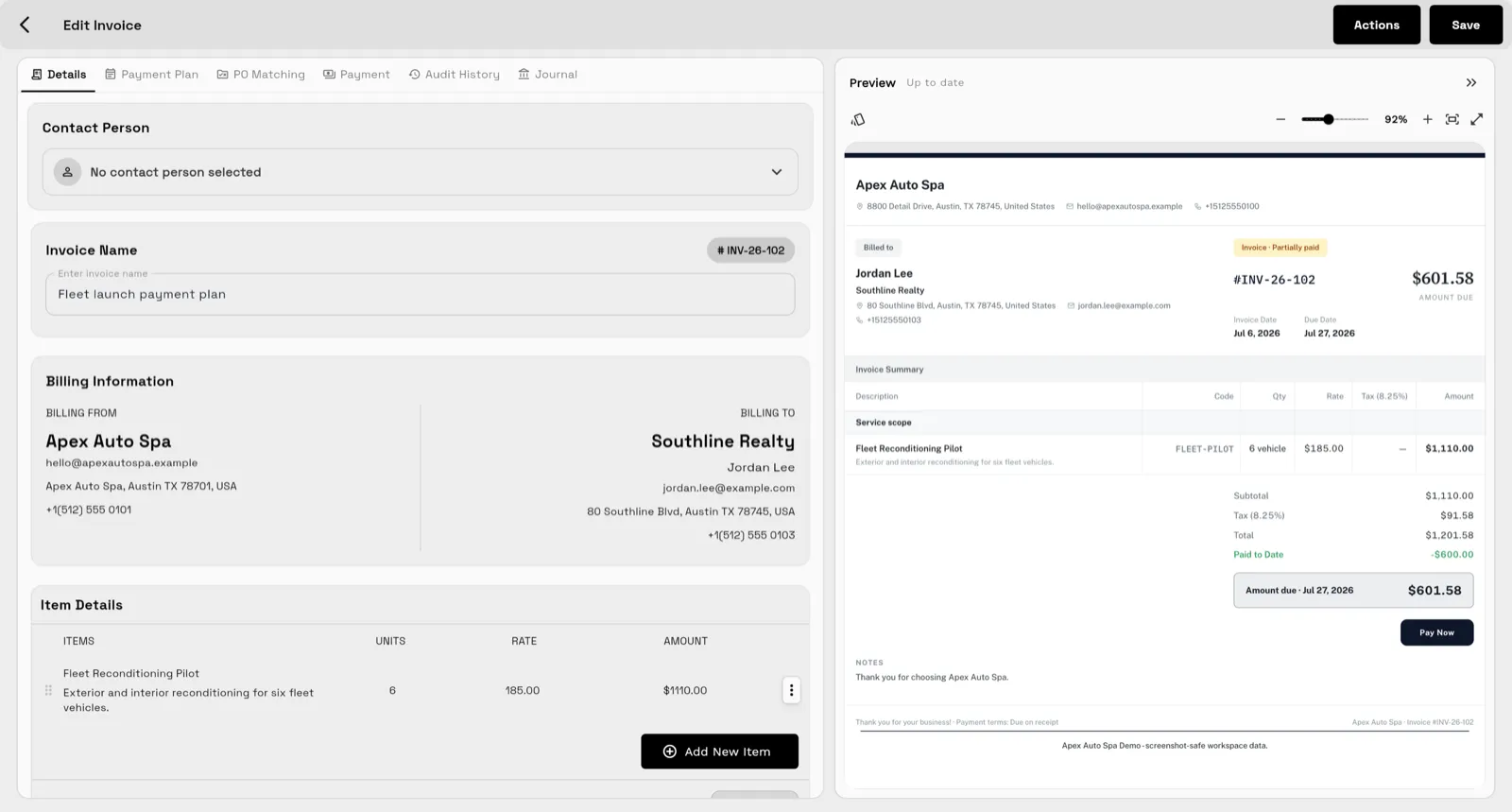
The demo workspace is not a tattoo studio. Workspace369 has no POS, no commission or booth-rent split and no tattoo-specific consent flow, and the matrix does not name a file-upload field on forms, so test the reference-image step. Online booking and payment plans (the Payment Plan tab in the screenshot) start at Specialist.
Run a multi-session test during the trial
Put a made-up client through these steps in each shortlisted tool. It is a thought exercise, not a customer outcome.
- Receive a request for a large back piece with three reference images, a placement and a budget.
- Send a price with a deposit that counts toward the total, and collect it before holding the first date.
- Send your own release form and confirm it is stored against the client.
- Book three sessions and a touch-up, then move one session and see whether the deposit and notes follow.
- Split the final payment between the artist and the shop, and look at the single client record.
The tool that suits you keeps all five steps on a single record and shows the balance still owed.

When to keep it simple
If you tattoo alone and every client books by message, a booking app with deposits may be all you need. Add a client-work system when pieces run over several sessions, when the price changes after the first consultation, or when nobody remembers which terms a client accepted earlier. For Workspace369, see how the tattoo studios page covers Proposals, communications and invoices; the pricing page has the current plans. Specialist also adds change orders, which tie a scope change to the original agreement. Keep your release form, aftercare notes and health records in whatever your local rules require.
Run one full job on demo data before you import real clients, and confirm you can export your records.
Sources reviewed for this guide
- Workspace369 pricingPlan matrix reviewed October 26, 2026 for plans, seats, online booking, Proposals, deposits, contracts, file versioning and trial terms.
- Tattoogenda pricingOfficial pricing page reviewed October 26, 2026 for both currency views (the page shows dollars or euros by browser region), plan features and the 14-day no-card trial. Its feature table shows different monthly figures from its plan cards, so confirm the price on the page before buying.
- Venue pricingOfficial pricing page reviewed October 26, 2026 for plan prices, studio features, the auto-split and the studio first-month-free answer.
- Tattoodo BooksOfficial product page with a pricing section and FAQ, reviewed October 26, 2026 for what the artist pays, payment methods and booking-form fields.
- Square Appointments pricingOfficial pricing page reviewed October 26, 2026 for the $0, $49 and $149 per-location prices and the 30-day trial on Plus and Premium. The feature descriptions were read in the page's server HTML; which plan holds each one is not re-read here, and the page's own plan table is the check.
- GlossGenius pricingOfficial pricing page reviewed October 26, 2026 in both the monthly and annual views, for plan prices, the Forms & Waivers, time tracking and commission rows, and the 14-day no-card trial. The deposit and booth-renter rows did not render clearly, so tiers for those are unconfirmed.
Workspace369 publishes this documentation-based comparison and is one of the options. It is not an independent ranking or a hands-on benchmark.
Run client follow-up in one workspace.
CRM, inbox, voice, invoicing, payments, projects, files, AI, and workflow automations — connected instead of exported.
14-day free trial. Card required. After the trial: from $29/month. Renews automatically every month until you cancel. Cancel anytime in Settings → Billing.