Best CRM for Growth Agencies in 2026: Retainers & Reports
Six tools for small growth and growth-operator agencies compared on price, plan limits, retainers, client portals and reporting, plus a client-blocker test.
We make Workspace369 and list it first here. Weigh our ranking with that in mind, and if another tool fits you better, use it.

By Simon Dziak, Founder, Workspace369 · LinkedIn
The best CRM for growth / growth-operator agencies keeps the client, the retainer, the experiment tasks, the client-side blockers and the invoice on one record, while raw experiment data and ad metrics stay in your analytics tools. For small agencies that want that in one place, our pick is Workspace369. Moxie suits a low-cost solo plan, ClickUp experiment boards, Productive resource and budget planning, and GoHighLevel agencies that resell funnels. To price a monthly package first, use the free retainer pricing calculator.
Disclosure and method: Workspace369 publishes this guide and is one of the options. It is a documentation-based shortlist, not a hands-on benchmark. Official vendor pages were reviewed on October 17, 2026; Productive's page was re-read on October 19, 2026. Check current plans with each vendor before you buy.
Key takeaways
- A growth agency CRM should hold the client, the retainer, the experiment tasks, the client-side blockers and the invoice on one record. Raw experiment data and ad metrics stay in your analytics and ad tools.
- Workspace369 Cadet at $29 a month ($23.25 billed yearly) lists retainers, recurring invoices, time tracking, dashboards and reports, a client portal and funnels; it is capped at 5 active projects and one seat, and webhooks and the API start at Specialist ($149 a month).
- Moxie Starter ($12 a month, $10 billed yearly) is a low-cost entry for one person with proposals, time and invoices; the white-labeled portal and automations start at Pro. ClickUp Core ($9 a user billed yearly) suits experiment boards and time tracking, with no client portal named.
- Productive suits agencies that plan resources and budgets, but lists a three-seat minimum. GoHighLevel starts at $97 a month for 3 sub-accounts and suits agencies that resell funnels and SMS, with usage-based charges.
- Run one fictional client through a test where an experiment is blocked by the client sales team, and check that the task, the file, the note and the invoice all sit on the same record.
What's inside?
What a CRM for growth agencies is (and what it is not)How we compared these toolsThe best CRM for growth agencies in 2026Side-by-side comparisonWhich tool fits your agency?Run a client-blocker test during the trialWhen to keep it simple
What a CRM for growth agencies is (and what it is not)
A CRM for a growth or growth-operator agency is the business side of the engagement: who the client is, what retainer and test cadence you agreed, which tasks wait on the client, what you sent and what is unpaid. It is not an experimentation platform, an ad dashboard or a product analytics tool. A typical stall is a test that is ready but waits on the client's sales team to call the leads. If that dependency lives in an email thread, the next test slips and nobody can say whose move it is.
How we compared these tools
We compared each tool on the same five points, using only the vendor's own pricing and product pages:
- Entry price for one person, monthly and billed yearly, as listed on October 17, 2026.
- Retainer, time and billing coverage on that plan: time tracking, recurring invoices or retainers, and invoicing.
- Client-facing pieces: client portal, proposals, and tasks or projects the client can see.
- Hard limits on the entry plan: seats, sub-accounts, projects, or usage-based charges.
- Trial terms: length, and whether the vendor says a card is needed.
We did not test speed, support, reliability, reporting depth or mobile apps, and did not use third-party ratings. Order reflects fit for a small agency that sells retainers and wants client work and billing in one place. HubSpot is a partial tool for this job and is placed last.
The best CRM for growth agencies in 2026
1. Workspace369, best for small agencies that bill retainers
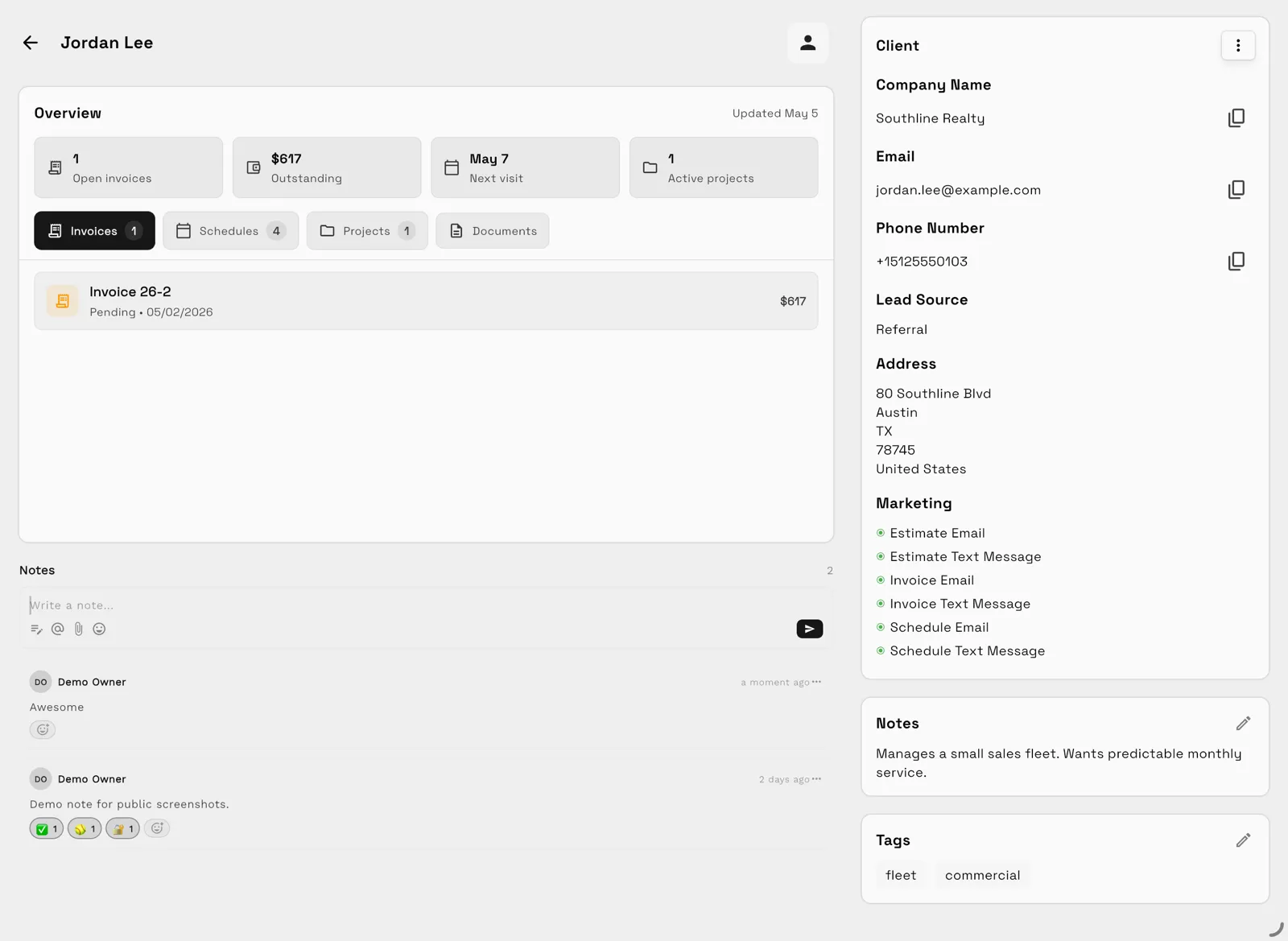
Workspace369 puts the client record, a proposal the client approves online, a retainer, tasks, time tracking, a private client portal, dashboards and reports, and invoices in one place. Cadet is $29 a month for one person ($23.25 billed yearly) and lists retainers, recurring invoices, billable time that turns into invoice lines, funnels that capture leads into the CRM, and email automations with simulated test runs. The screenshot is a demo record, not a customer result.
Limitations: Cadet allows 5 active projects and one seat, and 1 live funnel. Voyager ($74 a month, 2 seats) adds SMS and calls and 3 live funnels; webhooks and the API start at Specialist ($149 a month, 10 seats). It is not a place for raw experiment data, and it has no experiment-specific views, so keep test results in your analytics stack. The 14-day trial needs a card.
Best for: small growth agencies, from one operator to a handful of people, who sell retainers and want client records, portal and invoicing without extra apps.
2. Moxie, best for a low-cost solo plan
Moxie's Starter plan is $12 a month, or $10 a month billed yearly, and lists client and project management, invoicing and payments, proposals, quotes and contracts, time tracking, a sales pipeline, a form builder and meeting schedulers. The page title mentions a 14-day free trial; card terms are not stated there. Pro is $25 a month ($20 billed yearly) and adds the white-labeled client portal, custom domain, workflow automations and API integrations. Teams is $40 a month ($32 billed yearly) for up to five team members.
Limitations: the white-labeled portal and automations start at Pro, so client updates are manual on Starter. Recurring billing is not named on the page, so check it before you plan a retainer.
Best for: solo operators who want proposals, time and invoices cheaply and can chase client updates by hand.
3. Productive, best for agencies that plan resources and budgets
Productive is built for agencies and consultancies that plan people, budgets and profitability. Essential lists $10 per user a month billed yearly ($12 monthly) and Professional $25 yearly ($29 monthly), a saving of up to 17% for yearly billing (checked October 19, 2026). The page lists a 14-day free trial with no credit card required, and a minimum of three seats on every plan. Essential includes budgeting, resource planning, project and task management, time tracking, reporting and API access. Sales CRM appears in the product menu, and the plan table shows one pipeline on Essential.
Limitations: the three-seat minimum makes it costly for a solo operator, and no client portal is named on the pricing page. Retainer invoicing and recurring budgets start at Professional.
Best for: agencies of three or more that need resource planning, budgets and profitability reporting around retainers.
4. ClickUp, best for experiment boards and sprints
ClickUp has a free plan with unlimited tasks, Kanban boards, sprint management, docs and a calendar view. Core is $9 a user a month billed yearly ($12 monthly) and adds native time tracking (a trial on Free), goals, Gantt charts and guests with permission control. Business is $17 a user billed yearly ($25 monthly) and adds advanced dashboards, webhooks, resource management and 10,000 automations a month. The free plan says no credit card is required. That makes it a strong home for an experiment backlog.
Limitations: the pricing page does not name a CRM, a client portal, proposals or invoicing, so those pieces need another tool. Storage on the free plan is 60MB.
Best for: agencies that run many tests and want boards, sprints and goals, paired with a lighter tool for clients and billing.
5. GoHighLevel, best for agencies that resell funnels and SMS
HighLevel's Starter is $97 a month ($970 billed yearly) with 3 sub-accounts, unlimited contacts and users, and lists CRM and pipelines, dashboards and reporting, workflow automation, funnels, email and SMS marketing, booking calendars and payments and invoicing. Unlimited is $297 a month for unlimited sub-accounts. The page offers a 14-day free trial on any plan. Usage-based charges apply to email, SMS, calling and AI features, and a branded client portal app is an add-on at $49 a month per sub-account.
Limitations: it is a platform for building and managing client accounts, not a light record of retainers and hours; time tracking is not named on the pricing page. Plan usage costs before you resell.
Best for: agencies that build funnels and run SMS and email for clients, and want to resell the platform.
6. HubSpot CRM, best as a free contact list
HubSpot's free CRM says it is free for up to 2 users, with 1,000 contacts, no time limit and no credit card required. Free lists 10 dashboards with 50 reports each. Starter is $20 per seat a month at list price, with limited-time offers for new customers. On the pricing page, Starter bundles the Marketing, Sales, Service, Content and Data Hub Starter tools with 1,000 marketing contacts and 500 HubSpot Credits. The page does not mention a free trial for Starter.
Limitations: the pricing page does not name retainers, time tracking, a client portal or invoicing, so it covers contacts, deals and reports only.
Best for: an agency that only needs a free contact and deal list, or that sells its own services through HubSpot and keeps delivery elsewhere.
Side-by-side comparison
| Tool | Entry price (monthly) | Billed yearly | Time tracking on entry plan | Main entry-plan limit | Trial |
|---|---|---|---|---|---|
| Workspace369 | $29 (Cadet) | $23.25 a month | Yes | 5 active projects, 1 seat | 14 days, card required |
| Moxie | $12 (Starter) | $10 a month | Yes | No portal or automations | 14 days, no card |
| Productive | $12 a user (Essential) | $10 a user | Yes | 3-seat minimum | 14 days, no card |
| ClickUp | $12 a user (Core) | $9 a user | Yes (Core) | No client portal named | Free plan, no card |
| HighLevel | $97 (Starter) | $970 a year | Not named on page | 3 sub-accounts, usage charges | 14 days, card required |
| HubSpot CRM | $0 (Free) | Starter $20 a seat at list price | Not listed | 2 users, 1,000 contacts | None stated, no card on Free |
Which tool fits your agency?
| If you mostly need | Start with | Why |
|---|---|---|
| Retainers, portal, reports and invoices together | Workspace369 | Retainers, recurring invoices and the portal from Cadet |
| A low-cost plan with proposals, time and invoices | Moxie | $10 a month billed yearly; portal and automations at Pro |
| Resource planning and budgets for a team | Productive | Budgeting and resource planning on Essential, 3 seats minimum |
| An experiment backlog with sprints | ClickUp | Boards and sprints on the free plan, time tracking from Core |
| Reselling funnels, SMS and email | HighLevel | Funnels, CRM and automation under sub-accounts |
| Only a free contact list | HubSpot CRM | Free for up to 2 users |
Run a client-blocker test during the trial
Take one fictional client through a month in each tool you shortlist:
- Create the client, record the retainer and send the scope as a proposal or brief the client approves.
- Create a project for a test, with a task that says the client sales team must follow up on the leads before the next test.
- Share that task with the client and have a second person, acting as the client, upload a feedback file.
- Record a note confirming receipt, then log time against the test.
- Set a reminder or automation for the task, and run it as a test.
- Invoice the month and export the client's records.
The best tool keeps the task, the file, the note, the time and the invoice on one client record. If any step needs a second app, price that in. Write the scope change in writing with the free scope-change request builder and set your rate with the hourly rate calculator.

When to keep it simple
If you run two or three retainers, a shared board, a timer and an invoice template can carry you a long way. Move to a client-work tool when a test stalls because a client task is buried in email, when you cannot say what you agreed three months ago, or when you chase late payments by hand. The growth agency product page shows how Workspace369 handles proposals, communications and invoices, and the pricing page has current plans. Workspace369 also supports Workflow Automations for reminders and follow-ups, with email automations on every plan.
Before importing real clients, run one full month on demo data and check that your records can be exported.
Sources reviewed for this guide
- Workspace369 pricingPlan matrix reviewed October 17, 2026.
- Moxie pricingOfficial pricing page reviewed October 17, 2026 for Starter, Pro and Teams prices, features and the 14-day trial.
- Productive pricingOfficial pricing page reviewed October 19, 2026 for per-user prices, seat minimum and trial terms.
- ClickUp pricingOfficial pricing page reviewed October 23, 2026 for Free, Core and Business prices and features.
- HighLevel pricingOfficial pricing page reviewed October 17, 2026 for plan prices, sub-accounts, add-ons and trial terms.
- HubSpot CRM pricingOfficial pricing page reviewed October 18, 2026 for the free CRM limits and Starter seat prices.
Workspace369 publishes this guide and is one of the options. It is a documentation-based comparison, not a benchmark test.
Run client follow-up in one workspace.
CRM, inbox, voice, invoicing, payments, projects, files, AI, and workflow automations — connected instead of exported.
14-day free trial. Card required. After the trial: from $29/month. Renews automatically every month until you cancel. Cancel anytime in Settings → Billing.