Best CRM for Influencer Agencies in 2026: Briefs and Payouts
Six tools for small influencer marketing agencies compared on price, brand proposals, briefs, approvals and invoicing, plus a brief-change test.
We make Workspace369 and list it first here. Weigh our ranking with that in mind, and if another tool fits you better, use it.

By Simon Dziak, Founder, Workspace369 · LinkedIn
For a small influencer agency that wants the brand proposal, creator brief, brief changes, approval and invoice on one record, Workspace369 fits. Productive fits teams of three or more that plan budgets and capacity. HoneyBook fits creative studios that sell with contracts. Creator search and payouts belong in a creator platform such as GRIN.
This guide compares six options for the best CRM for influencer marketing agencies. To price a retainer first, use the free retainer pricing calculator. For the wider decision, start with the best agency management software guide.
Disclosure and method: Workspace369 publishes this guide and is one of the options. It is a documentation-based shortlist, not a hands-on benchmark. Official vendor pages were reviewed on October 26, 2026. Check current plans with each vendor before you buy.
Key takeaways
- An influencer agency CRM should hold the brand proposal, the creator brief, every brief change, the brand approval and the invoice on one record; it does not find creators, track social metrics or pay creators.
- Workspace369 Cadet at $29 a month ($23.25 billed yearly) lists proposals, contracts with e-signature, projects, file versioning, a client portal and invoices for one user; change orders for brief changes start at Specialist ($149 a month, 10 seats). It has no creator discovery, creator payouts or social reporting.
- Productive is stronger for budgets and resourcing: Essential is $10 per user a month billed yearly ($12 monthly) with a three-seat minimum. HoneyBook Starter is $29 a month billed yearly (see its site for monthly prices) and suits creative studios that sell with proposals and contracts.
- Bonsai Essentials lists a client portal and retainer invoices at $19 per user a month billed yearly; HubSpot Starter lists at $20 per seat and invoices are on every HubSpot plan, but its current quotes tool and e-signature need Revenue Hub Professional.
- Creator search and payouts belong in a creator platform such as GRIN (Starter $200 a month); test each CRM by changing a brief after the creator has started and checking that the change, the approval and the invoice stay on one record.
What's inside?
What a CRM for influencer agencies is (and what it is not)How we compared these toolsThe best CRM for influencer marketing agencies in 2026Side-by-side comparisonWhich tool fits your influencer agency?Workspace369 in action for a multi-creator brand campaignRun a mid-campaign brief-change test during the trialKeep creator sourcing and results in their own toolsWhen to keep it simple
What a CRM for influencer agencies is (and what it is not)
A CRM for an influencer marketing agency is the business side of a campaign: which brand is the client, what deliverables and dates you agreed, which creators are assigned, what the latest approved brief says, who approved each draft and what is still unpaid. It is not a creator database, a social analytics dashboard or a payout system. Workspace369 does not find creators, track follower or engagement figures or pay creators. If a tool stores contacts but leaves the brief and billing to other apps, a mid-campaign change on a Tuesday becomes unpaid work.
How we compared these tools
We compared each tool on the same five points, using the vendors' own pricing pages as read on October 26, 2026, plus HubSpot's help center where its pricing page was silent:
- Entry price and the price of the plan that covers proposals, a client portal and invoices, monthly and billed yearly, per user where the vendor prices that way.
- Brand-side records: proposals, contracts, files, a client portal and invoices, including retainers.
- Brief and scope control: a way to record a changed brief, version files and price extra work.
- Seat limits and minimums that change the price for a team of one to five.
- Trial terms: length, and whether the vendor says a card is needed.
We did not test speed, support, reliability or mobile apps, did not test any social-platform integration, and did not use third-party ratings. Order reflects documented fit for a small agency that runs brand campaigns and finds creators elsewhere.
The best CRM for influencer marketing agencies in 2026
1. Workspace369, best for small agencies running brand campaigns end to end
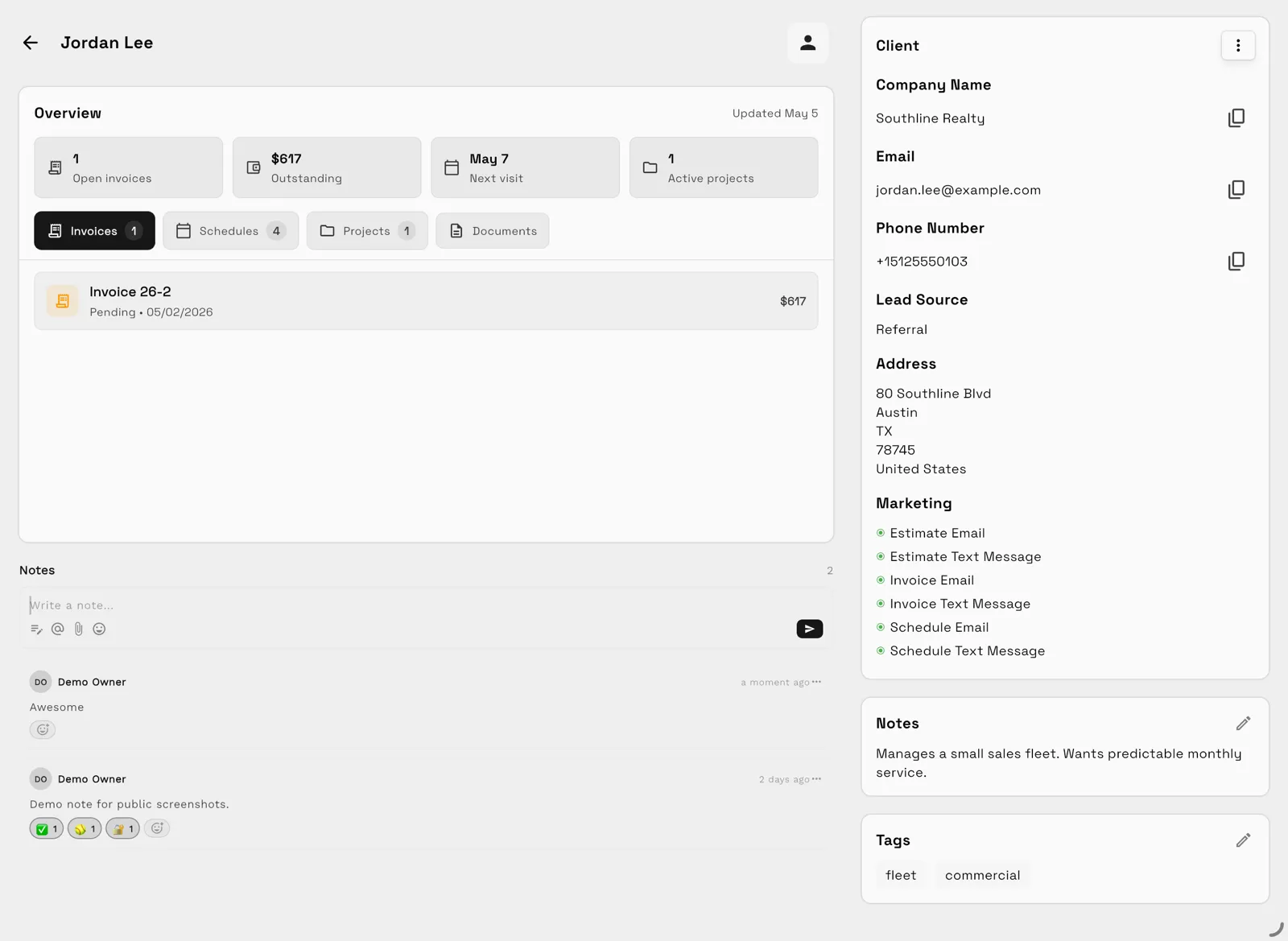
Workspace369 keeps the brand record, a proposal the brand approves online, contracts with e-signature, projects with tasks, files with versioning, a client portal and invoices in one place. Cadet is $29 a month for one user ($23.25 billed yearly) and lists all of those, plus retainers, time tracking and public intake forms. A campaign becomes a project, the creative brief sits in its files with version history, and the brand gets a client portal for its proposals and invoices, with file share links for the brief. The screenshot is a demo record, not a customer result.
Limitations: it has no creator discovery, marketplace, social metrics, gifting or creator payouts, and it does not report campaign results; pay creators in another tool and log the cost yourself. Cadet is for one user and 5 active projects; Voyager ($74 a month, $59.25 billed yearly) gives two seats and unlimited projects, with $10 a month per extra seat. Change orders and proposal revisions, which record a changed brief beside the signed proposal, start at Specialist ($149 a month, 10 seats); on Cadet and Voyager, send a new proposal for the change. Expense tracking also starts at Specialist. The 14-day trial covers Cadet through Commander, and a card is required. HoneyBook Starter is $29 a month billed yearly with a brand-facing portal, a comparable entry price with more of a creative-studio setup, and Bonsai Essentials ($19 per user billed yearly) lists proposals, contracts, a portal and retainer invoices for less.
Best for: agencies of one to ten people who want the brand agreement, the creator brief, the approval and the invoice together, and who find and pay creators elsewhere.
2. Productive, best for agencies that need budgets and resourcing
Productive is an agency operations tool built around budgets, time and resource planning. Its pricing page lists Essential at $10 per user a month billed yearly ($12 monthly) and Professional at $25 ($29 monthly), and the FAQ says all plans require at least three seats. Essential lists budgeting, resource planning, project and task management, docs, time tracking, expense management and reporting; Professional adds recurring budgets, rate cards and billable time approvals. Clients can be invited into projects free of charge. The sign-up block gives a 14-day free trial with no card required. For three people on Essential that is $30 a month billed yearly, or $36 monthly.
Limitations: the three-seat minimum makes it dearer than a solo plan for a two-person agency. The pricing page lists invoices and deal-proposal PDF export, but not e-signature contracts or a branded client portal, so the signed brand agreement would live elsewhere. It ranks second only for agencies of three or more; a one- or two-person agency gets more from HoneyBook or Bonsai. The depth in resourcing and revenue forecasting is more than most agencies of one to five people use.
Best for: agencies of three or more people running many parallel campaigns that want budgets, profitability and capacity planning.
3. HoneyBook, best for creative studios that sell with proposals and contracts
HoneyBook lists Starter at $29 a month billed yearly, Essentials at $49 and Premium at $109; monthly prices load in the browser, so see its site for those. Starter lists unlimited clients and projects, invoices and payments, proposals and contracts, a client portal, basic reports and up to 2 live lead forms. Essentials adds the Scheduler, automations, the account owner plus up to 2 team members and up to 10 lead forms; the Scheduler is on Starter with 1 session and unlimited from Essentials. Premium adds unlimited team members, advanced reports and multiple companies. The trial is 30 days with no card required. A limited-time 25% offer appears beside some prices, and we did not use it.
Limitations: it is built around single-client creative projects, so a multi-creator campaign needs workarounds, and there is no creator search or payout tool. Essentials caps the team at the account owner plus 2 team members, and Starter cannot add team members. Brief version history and change-order handling are not named on the pricing page.
Best for: one to three person studios that want proposals, contracts, a portal and payments at a low entry price.
4. Bonsai, best for per-user retainer invoices
Bonsai lists a client portal and retainer invoices from Essentials, which is $19 per user a month billed yearly ($25 monthly). Basic is $9 billed yearly ($15 monthly) with a CRM but no retainer invoices. Premium ($29 billed yearly, $39 monthly) adds more client tools and profitability reports. The trial runs 7 days, and the page says you will be asked for card details to continue.
Limitations: pricing is per user, so a team of three on Essentials is $57 a month billed yearly or $75 monthly. Brief change tracking beyond a new proposal is not named on the pricing page, and there is no creator search or payout tool.
Best for: one to three person agencies that want proposals, a portal and retainer invoices on a per-user price they can scale one seat at a time.
5. HubSpot, best as a free contact list with a deals pipeline
HubSpot's pricing page lists free tools for up to 2 users with no credit card required, and a Starter tier listed at $20 a month per seat. A limited-time new-customer offer appears beside that list price, and we did not use it. The page lists marketing, sales and service tools. HubSpot's help center says invoices can be created on all products and plans, so the brand invoice can live in HubSpot. Its current quotes tool and quote e-signatures need Revenue Hub Professional or Enterprise.
Limitations: project briefs, brief versions and a brand-facing project portal are not part of Starter; its customer portal is a support-ticket portal from Service Hub Professional. An influencer agency would run briefs and approvals in another tool. It is a general sales and marketing platform, not a creator tool.
Best for: agencies whose main need is a sales pipeline and email history for winning brand clients, paired with a project and billing tool.
6. GRIN, best for the creator side: search, gifting and payouts
GRIN is an influencer marketing platform rather than an agency CRM. Its pricing page lists Free at $0, Starter at $200 a month, Growth at $500 and Scale at $1,500, with Enterprise on custom terms. All tiers list creator search, a creator marketplace, an escrow wallet with creator payouts and a Shopify integration; the page says plans are not priced per seat, and the self-serve plans bill monthly. Starter has a 30-day free trial, with a card or ACH account on file at signup.
Limitations: it is built for brands running creator programs, so it does not hold your agency's proposals, invoices or client portal. Multi-brand programs need Growth.
Best for: the creator-sourcing and payout half of the job, used beside a client-work tool for the brand side.
Side-by-side comparison
| Tool | Plan priced | Monthly | Billed yearly | Brand proposals and invoices at that plan | Seats and limits | Trial |
|---|---|---|---|---|---|---|
| Workspace369 | Cadet | $29 | $23.25 a month | Yes (proposals, contracts, invoices) | 1 user, 5 active projects | 14 days on Cadet through Commander, card required |
| Productive | Essential | $12 per user | $10 per user a month | Invoices and proposal PDF export listed; no e-signature or portal named | 3-seat minimum | 14 days, no card |
| HoneyBook | Starter | See site | $29 a month | Yes (proposals, contracts, invoices) | Unlimited clients; Essentials: account owner plus up to 2 team members | 30 days, no card |
| Bonsai | Essentials | $25 per user | $19 per user a month | Yes (portal, retainer invoices) | Per user | 7 days, card to continue |
| HubSpot | Starter (list) | $20 per seat | Not shown | Invoices on all plans (help center); quotes tool and e-signature need Revenue Hub Professional | Free tools: up to 2 users | None stated for Starter |
| GRIN | Starter | $200 | Not offered (monthly only) | No (creator platform) | Not priced per seat | 30 days, card or ACH on file |
Which tool fits your influencer agency?
| If you mostly need | Start with | Why |
|---|---|---|
| Brand proposal, creator brief, approval and invoice on one record | Workspace369 | Proposals, contracts, file versioning, portal and invoices on Cadet |
| Budgets, profitability and capacity for a team of three or more | Productive | Budgeting, resource planning and time tracking from Essential |
| Proposals, contracts and payments for a small creative studio | HoneyBook | Starter at $29 a month billed yearly with a portal |
| Per-seat retainer invoices for a very small team | Bonsai | Retainer invoices from Essentials at $19 per user billed yearly |
| A sales pipeline for winning brand clients only | HubSpot | Free tools for up to 2 users and invoices on every plan; briefs and delivery elsewhere |
| Creator search, gifting and payouts | GRIN | Search, escrow wallet and payouts on every tier |
Workspace369 in action for a multi-creator brand campaign
A brand campaign with three creators maps onto one Workspace369 project per campaign. The screenshot below is the projects board in a demo workspace with sample data, not an influencer agency. It shows projects sorted into Planning, In Progress and On Hold columns, and each card carries a progress bar, a budget and a days count, with totals for the column above it. In a real agency, a card such as "Spring launch, three creators" would sit in In Progress while drafts are with the brand.
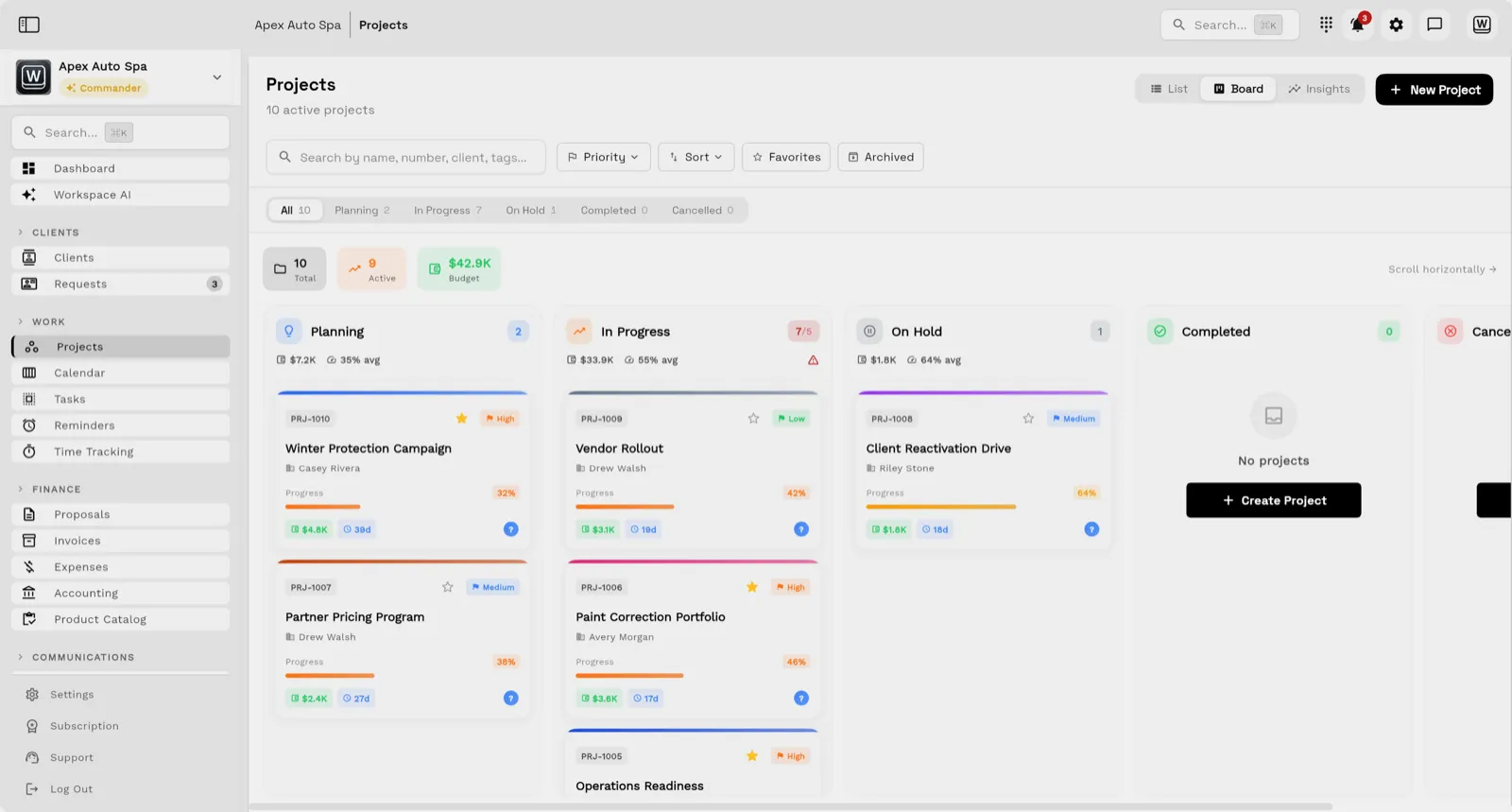
Inside that project, the creator brief goes into file management with version history, so the brief the creator filmed from stays on the record after you upload the revised one. The brand signs off on the deliverables through a proposal it approves online, and when the brand asks for an extra cut or a new posting date, a change order records the extra work beside the signed proposal (change orders start at Specialist). Messages with the brand and the final invoice sit on the same client record. If the brand pays a monthly retainer, a retainer hour bank shows the hours used against the hours sold, on every plan.
Workspace369 does not hold the creator side. There is no creator search, no follower or engagement data and no creator payouts, so pay creators from your bank or a creator platform and log the cost on the project.
Run a mid-campaign brief-change test during the trial
Take one fictional campaign through each tool you shortlist:
- Create a project for a brand campaign and send the brand a proposal for the deliverables and dates.
- Upload the creator brief to the project files and share it through the client portal.
- Have the brand ask for a change after the creator has started filming. Price it with the free scope-change request builder, send it for approval and see how the tool records the change.
- Update the brief file and check that the earlier version is still there.
- Add the approved change to the invoice, and log the creator cost as a task or expense.
- Export the client record and check what comes out.
The best tool keeps the original agreement, the changed brief, the approval and the invoice on one record. If the change is only an email thread, that is the leak this test is built to find. A creative brief template helps you write a brief that is easier to version.

Keep creator sourcing and results in their own tools
Finding creators, sending gifts, paying them and reading engagement figures are different jobs from client records. GRIN, for example, lists creator search, a marketplace and an escrow wallet from a free tier. Pair a creator platform with whichever client-work tool above you choose, and keep follower, reach and engagement figures in the social platforms and the creator tool, never in the CRM. Workspace369 will not store them for you.
When to keep it simple
If you run one or two campaigns at a time, a shared folder, a signed agreement and an invoice template can carry you a long way. Move to a client-work tool when a second person starts taking brand requests, when you cannot say which brief version a creator worked from, or when you chase late payments by hand. The influencer marketing agencies product page shows how Workspace369 handles proposals, communications, change orders and retainers, and the pricing page has current plans. Workflow Automations can send reminders and follow-ups, with email automations on every plan.
Before importing real clients, run one full campaign on demo data and check that your records can be exported.
Sources reviewed for this guide
- Workspace369 pricingPlan matrix reviewed October 26, 2026 for seats, active projects, contracts, change orders, retainers and trial terms.
- Productive pricingOfficial pricing page reviewed October 26, 2026 for monthly and yearly per-user prices, the three-seat minimum, plan feature lists and trial terms.
- HoneyBook pricingOfficial pricing page reviewed October 26, 2026 for yearly prices, plan features and trial terms; monthly prices load in the browser, so see the site.
- Bonsai pricingOfficial pricing page reviewed October 26, 2026 for per-user prices in both billing views, portal and retainer invoice rows and trial terms.
- HubSpot pricingOfficial pricing page reviewed October 26, 2026 for the free tools terms and the Starter list price per seat.
- HubSpot Knowledge Base: create invoicesHelp article reviewed October 26, 2026: invoices are available on all HubSpot products and plans.
- HubSpot Knowledge Base: e-signatures with quotesHelp article reviewed October 26, 2026: quote e-signatures are available with Revenue Hub Professional and Enterprise.
- GRIN pricingOfficial pricing page reviewed October 26, 2026 for plan prices, creator search limits and trial terms.
Workspace369 publishes this documentation-based comparison and is one of the options. It is not an independent ranking or a hands-on benchmark.
Run client follow-up in one workspace.
CRM, inbox, voice, invoicing, payments, projects, files, AI, and workflow automations — connected instead of exported.
14-day free trial. Card required. After the trial: from $29/month. Renews automatically every month until you cancel. Cancel anytime in Settings → Billing.