Best CRM for Nail Salons in 2026
Five salon booking platforms and Workspace369 compared on published price, deposits and no-show rules, packages and retail, and new-client fees.
We make Workspace369, which is on this list. Weigh our ranking with that in mind.

By Simon Dziak, Founder, Workspace369 · LinkedIn
The best CRM for nail salons keeps the appointment book, the deposit, the reminder and the checkout on one client record. For most salon owners and independent nail techs that means a booking platform such as Vagaro, Booksy or GlossGenius; Workspace369 (see its nail salons page) comes last of six here because it has no point of sale and is not built for walk-ins. For a neighbouring trade, see the best CRM for hair salons. Before you set a booking deposit, run the numbers in the free deposit calculator.
Disclosure and method: Workspace369 publishes this guide, so it is a candidate in its own comparison, and we put it sixth of six for a salon owner. The work is a desk review of published pages, not a hands-on benchmark. Each vendor's official pricing page was reviewed on October 19, 2026; confirm current terms with the vendor before you sign up.
Key takeaways
- A nail salon lives on the appointment book, the deposit and the checkout, so salon booking platforms lead this list and a general client-work tool comes last.
- Vagaro prices by headcount ($30 a month for one person, $50 for three, $70 for five) and lists online booking, packages, memberships, gift certificates, inventory tracking and a 30-day free trial; the first-six-months rate beside each price is not used.
- Booksy charges $29.99 a month with all features included and $20 for each extra team member, with a 14-day trial and no card; Square Appointments starts at $0 for a solo professional and $49 a month per location for Plus.
- Fresha charges nothing on bookings from your own links but 20% of a brand-new client's first visit (minimum $6) when the client comes through its marketplace, which matters if you take marketplace clients.
- Workspace369 has no point of sale, card reader, packages, memberships or gift cards in its plan matrix, and online booking starts at Specialist ($149 a month), so it suits only group and bridal proposals and invoices, not walk-ins.
What's inside?
What a CRM for a nail salon is (and what it is not)How we compared these toolsThe best CRM for nail salons in 2026Side-by-side comparisonWhich tool fits your nail salon?Run a bridal-party test during the trialKeep the counter and the proposal in the right toolWhen to keep it simple
What a CRM for a nail salon is (and what it is not)
For a nail salon, a CRM is the client file behind the chair: who the client is, which service and tech they usually book, when the last fill was, what deposit they put down, and who has not rebooked. Salon booking platforms bundle that file with an online booking page, reminders, card payments and retail. A general client-work tool keeps records, proposals and invoices but usually lacks the counter side: a card reader, packages, gift cards and a calendar built around services with set durations. Decide first whether your pain is the daily book or a few large group bookings, because that decides which kind of tool you need.
How we compared these tools
Every tool got the same five checks, drawn only from the vendor's own pricing page as it read on October 19, 2026:
- Price at a stated headcount: the monthly cost for one tech, three and five, after clicking each billing toggle or headcount the page offers.
- Booking protection: online booking, deposits, cancellation or no-show rules, and the plan they sit on.
- Counter and retail: packages, memberships, gift cards, inventory and card payments.
- Fees beyond the subscription: new-client commissions and text charges.
- Trial terms: length, and whether the page says a card is needed.
We did not test speed, support, reliability, mobile apps or any vendor's marketplace traffic, and we used no third-party ratings or promotional rates. The order reflects documented fit for a nail salon with a few techs, not the lowest price. Workspace369 is last because of the gaps in point 3, not because of its subscription price.
The best CRM for nail salons in 2026
1. Vagaro, best for a salon whose price should follow its headcount
Vagaro's price steps up with the size of your team. Clicking through each headcount, we read $30 a month for one person, $40 for 2, $50 for 3, $70 for 5 and $90 for 7 or more. A first-six-months rate sits beside each price; we did not use it. Every plan lists online booking on Vagaro, Instagram, Facebook and Apple Maps, a customer waitlist, memberships, packages and gift certificates, inventory tracking, invoices, unlimited reminders and notifications, rewards programs and 1,000 free emails monthly. Its FAQ says marketplace bookings cost nothing extra and that the free trial runs 30 days.
Limitations: the page does not say whether the trial needs a card. The free reader comes with Vagaro Merchant Services, and the fine print asks for 12 months of processing or a $150 early cancellation fee. Vagaro lists nail salons among many business types, so its plan is not nail-specific.
Best for: a salon with two to seven techs that wants packages, retail and online booking in one plan at a price that is easy to forecast.
2. Booksy, best for a flat price with every feature included
Booksy lists one plan at $29.99 a month with all features included, plus $20 a month for each extra team member. Its page names unlimited bookings, confirmations and reminders, email and text marketing (2,000 free SMS marketing messages a month), custom forms and liability waivers, waitlists, no-show protection, online gift cards, memberships and packages. A 14-day trial is offered, and registration needs no credit card.
Limitations: the extra-user charge adds up, so three people come to $69.99 a month and five to $109.99 by the page's own formula. The optional Boost feature charges a one-time 30% of a client's first visit, up to $100, when a new client books while it is on.
Best for: a one-to-four person nail studio that wants every feature without choosing a tier, and may use a marketplace listing.
3. GlossGenius, best for a salon that wants a branded booking site
GlossGenius shows Standard at $28 a month on its Monthly view and $24 on its Annual view, Gold at $56 and $48, and Platinum at $168 and $148. Standard lists a custom booking website, unlimited client notifications, inventory and retail management, and packages and memberships. Gold adds forms and waivers, Google booking and reviews, an automated waitlist, time tracking, and room and resource management, and is described for businesses with up to 9 staff. Its FAQ describes a 14-day free trial with no credit card needed.
Limitations: forms and waivers and the waitlist sit on Gold, so a salon that wants them pays $56 a month rather than $28. Platinum at $168 is aimed at teams of 10 or more. Payroll is a separate add-on at $40 a month plus $6 per seat.
Best for: a studio that wants a polished booking site, built-in checkout and a flat plan price rather than a per-head charge.
4. Square Appointments, best for an independent tech who wants a $0 start with deposits
Square lists a Free plan at $0 a month per location, described for solo professionals. It names an online booking site and integrations, appointment reminders, unlimited calendars, appointment deposits and invoices. Plus is $49 a month per location and adds cancellation policy and no-show fees, multi-staff appointment booking, a waitlist, class booking and packages, inventory tracking and Google Calendar sync. Premium is $149 and adds resource management. Plus and Premium each have a free 30-day trial.
Limitations: cancellation fees, a waitlist and packages start at Plus, so a salon with several techs pays $49 per location rather than $0. The feature list we read names rewards on Plus but no memberships, and the page does not say whether the trial needs a card.
Best for: an independent nail tech or a one-chair studio who already uses Square at the counter.
5. Fresha, best for a studio that wants a marketplace and accepts the new-client fee
Fresha lists an Independent plan at $19.95 a month for one bookable team member and a Team plan at $14.95 a month per bookable team member, so three techs cost $44.85 and five cost $74.75. The feature rows show both plans with calendar scheduling, waitlists, a point of sale, consultation forms, packages, memberships, gift cards, retail with inventory, and quotes and invoices. Bookings from your own website, Instagram or Facebook carry no fee. For brand-new clients who come through the Fresha marketplace there is a single 20% commission (at least $6 per client) on that first visit, and returning clients are free. The trial is 7 days, and the FAQ says businesses with teams need no credit card.
Limitations: the marketplace fee is a flat 20% of a new client's first visit, so it grows with the price of the set. Text messages beyond 100 free a month cost $0.02 each, marketing texts are $0.08. Phone support is listed on Team, while Independent lists email and chat.
Best for: a newer studio that wants marketplace discovery and will keep its regulars on direct booking links.
6. Workspace369, best for bridal-party and group proposals when the salon runs elsewhere
Workspace369 puts the client file, a proposal that collects a deposit when accepted, the client portal and invoices in one place, which suits a bridal party or an office event more than a Tuesday walk-in. Cadet costs $29 a month for one user ($23.25 on yearly billing) and includes public intake forms, the form builder, retainers, payment schedules, recurring invoices and email appointment reminders. The screenshot below is demo data, not a salon's result.
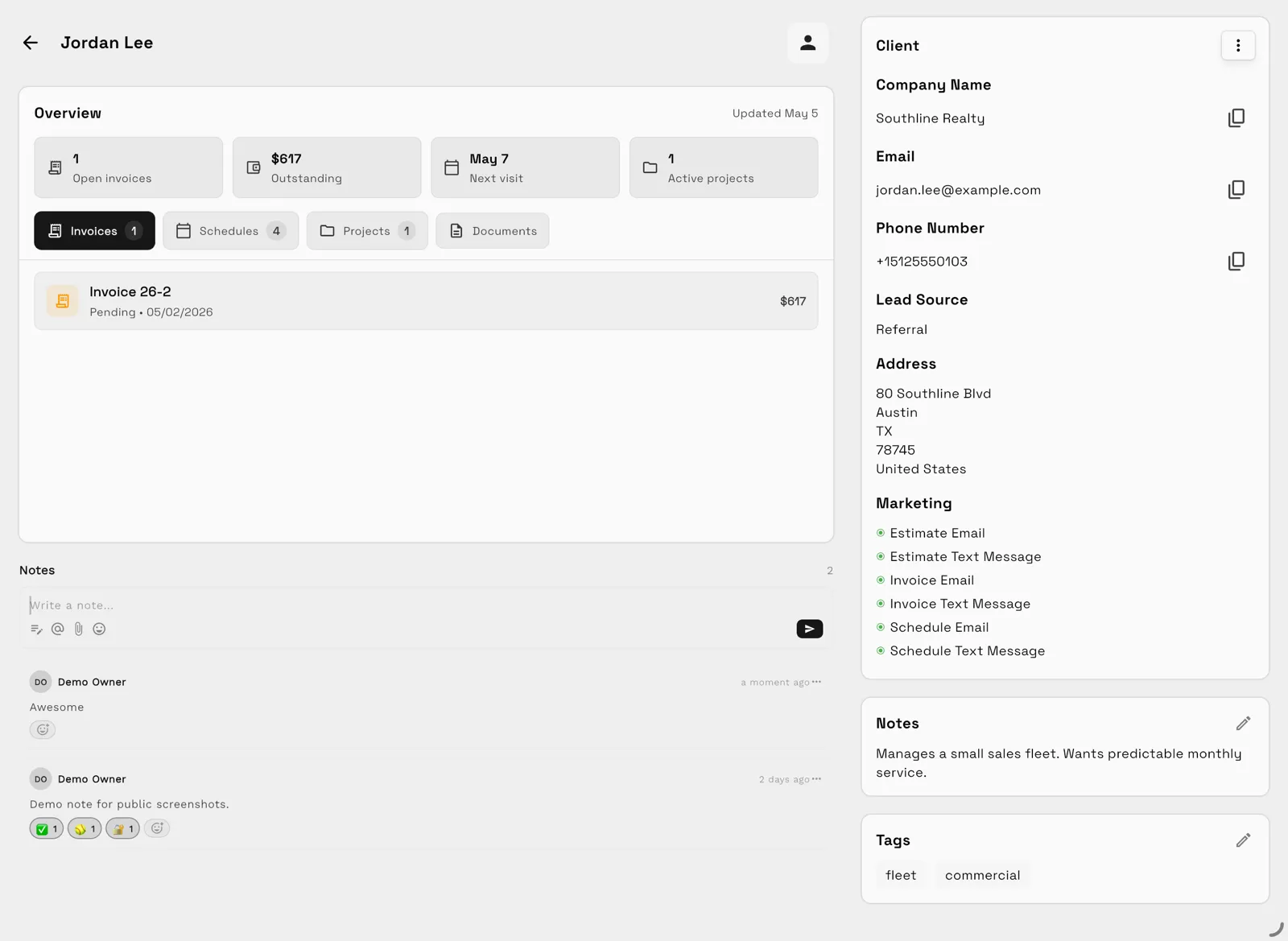
Limitations: the matrix names no point of sale, card reader, packages, memberships or gift cards. Online booking, availability rules with buffer time, payment plans and inventory tracking all begin at Specialist ($149 a month, or $119.25 on yearly billing, with 10 seats), so neither Cadet nor Voyager can publish a booking page. Cadet is capped at one user and 5 active projects; Voyager ($74 monthly, $59.25 yearly) has two seats and adds SMS messaging. The 14-day trial requires a card. Each of the five salon platforms lists packages on at least one plan (Square's start at Plus), and most list gift cards or a point of sale; the Workspace369 matrix lists none of those, though it does have a products catalog and, from Specialist, inventory tracking.
Who should not pick it: a salon with walk-ins, a counter, retail or tap-to-pay checkout, or an independent tech who wants online booking for less than $149 a month. Pick a salon platform instead.
Best for: a studio that already books the chair elsewhere and wants one place for wedding-party and corporate-event proposals, deposits and invoices.
Side-by-side comparison
| Tool | Plan priced | Monthly | Billed yearly | Booking and counter at that plan | Limits | Trial |
|---|---|---|---|---|---|---|
| Vagaro | 1 person | $30 | Not shown | Online booking, waitlist, packages, memberships, gift certificates, inventory | $50 for 3 people, $70 for 5, $90 for 7+ | 30-day free trial; card not stated |
| Booksy | Single plan | $29.99 | Not shown | Online booking, forms and waivers, waitlist, no-show protection, packages, gift cards | $20 a month per extra team member; Boost 30% of first visit | 14 days, no card |
| GlossGenius | Standard | $28 | $24 a month | Booking website, packages and memberships, inventory; forms and waitlist on Gold ($56) | Gold for up to 9 staff; Platinum $168 | 14 days, no card |
| Square Appointments | Free | $0 | Not shown | Online booking, deposits, reminders; no-show fees and packages on Plus ($49) | Per location; described for solo professionals | 30 days (Plus, Premium); card not stated |
| Fresha | Independent | $19.95 | Not shown | Point of sale, packages, memberships, gift cards, retail | 1 bookable member; Team $14.95 each; 20% on new marketplace clients | 7 days; no card for teams |
| Workspace369 | Cadet | $29 | $23.25 a month | Intake forms, deposits, portal; booking only from Specialist ($149); no point of sale | 1 user, 5 active projects | 14 days, card required |
Which tool fits your nail salon?
| If you mostly need | Start with | Why |
|---|---|---|
| A price that follows your headcount, with packages and retail | Vagaro | $30 for one person, $50 for three, $70 for five |
| Every feature at one price for a small studio | Booksy | $29.99 a month, $20 per extra team member |
| A branded booking site | GlossGenius | Standard $28 |
| A $0 start with deposits for one tech | Square Appointments | Free plan lists online booking and appointment deposits |
| Marketplace discovery for a new studio | Fresha | $14.95 per team member; 20% on new marketplace clients |
| Bridal-party proposals and invoices only | Workspace369 | Proposals with deposit on acceptance; no counter tools |
Run a bridal-party test during the trial
Push one invented bridal party through every tool on your shortlist, with no real client data:
- Enter the organizer as a new inquiry and record the party size and services.
- Take a deposit to hold the date, and check how the tool treats a missed or cancelled slot.
- Book three techs back to back on the same morning and see whether the calendar handles it.
- Sell a gift card or a fill package and see what the client receives.
- Send the reminder and move one booking to confirm the reminder follows.
- Take the final payment, add a tip and confirm everything sits on one record.
Vagaro's FAQ says its trial includes all features except email marketing, text marketing and the branded app, so those three cannot be tested there. A tool passes if the inquiry, deposit, bookings, package and payment all land on one client file with no re-entry. Then price your real headcount, since each page's headline price is for one person.

Keep the counter and the proposal in the right tool
Walk-ins, retail and card-present checkout belong in the salon platform. If you add Workspace369 for group work, hold the proposal, deposit and invoice there and leave the daily book alone. Mood boards and reference photos can attach to the same client file, versioning of files applies on every plan, and webhooks plus the API start at Specialist for anyone who wants to link a booking system.
When to keep it simple
A lone tech with a steady book can get far on a free plan, a deposit rule and a reminder. Step up when a second chair, retail or packages make it hard to see who owes what. For Workspace369, the nail salons product page walks through communications, contracts and payments, and the pricing page lists current plans. Workflow Automations can send reminders and follow-ups, and email automations come with every plan.
Use demo data for a full pass first, and confirm you can export your records before moving real clients.
Sources reviewed for this guide
- Workspace369 pricingPlan matrix reviewed October 19, 2026 for seats, online booking, reminders, deposits, payment plans, products and inventory, and trial terms. The matrix lists no point of sale, card reader, packages, memberships or gift cards.
- Vagaro pricingOfficial pricing page reviewed October 19, 2026 for the price by number of people, with each count selected, the included features, the 30-day free trial in the FAQ and the card-reader terms. The first-six-months rate shown beside each price is not used.
- Booksy pricingOfficial pricing page reviewed October 19, 2026 for the monthly price, the extra-user charge, included features, the Boost commission and the 14-day no-card trial. No yearly view is shown.
- GlossGenius pricingOfficial pricing page reviewed October 19, 2026 with the Monthly and Annual views each selected, for Standard, Gold and Platinum prices, key features and the 14-day no-card trial.
- Square Appointments pricingOfficial pricing page reviewed October 19, 2026 for Free, Plus and Premium prices per location, the feature comparison by plan and the 30-day trial of Plus and Premium. No yearly view is shown.
- Fresha pricingOfficial pricing page reviewed October 19, 2026 for the Independent and Team prices, the marketplace new-client commission, message rates and the 7-day trial in the FAQ. No yearly view is shown.
Workspace369 publishes this documentation-based comparison and is one of the options. It is not an independent ranking or a hands-on benchmark.
Run client follow-up in one workspace.
CRM, inbox, voice, invoicing, payments, projects, files, AI, and workflow automations — connected instead of exported.
14-day free trial. Card required. After the trial: from $29/month. Renews automatically every month until you cancel. Cancel anytime in Settings → Billing.