Best CRM for Lead Generation Agencies in 2026: Two Stacks
Best CRM for lead generation agencies: six tools compared on price, plan gates and fit, split into the client-side CRM and the outbound prospecting stack.
We make Workspace369, which is on this list. Weigh our ranking with that in mind.

By Simon Dziak, Founder, Workspace369 · LinkedIn
The best CRM for lead generation agencies depends on which job you are buying for: the client side or the outbound stack. GoHighLevel (now branded HighLevel) fits agencies running client campaigns in one white-labeled platform, Workspace369 fits agreements, delivery files and invoices, Pipedrive fits your own pipeline, and Apollo and Instantly fit outbound prospecting.
The client side covers the proposal, retainer or per-lead terms, delivery proof and the invoice; the outbound stack covers data, sequences and calling. Price a retainer first with the free retainer pricing calculator, and see the best agency management software guide for the broader question.
Disclosure and method: Workspace369 publishes this guide and is one of the options. It is a documentation-based shortlist, not a hands-on benchmark. Official vendor pages were reviewed on October 26, 2026; Pipedrive's page blocked automated access and Apollo's prices render client-side, so those prices say See site. Check current plans with each vendor before you buy.
Key takeaways
- A lead generation agency runs two systems: the client side (proposals, retainers, pay-per-lead terms, delivery proof, invoices) and the outbound stack (prospect data, sequences, calling). Few tools do both well, so decide which job you are buying for.
- GoHighLevel, now branded HighLevel ($97 a month, or $970 billed yearly, for 3 sub-accounts; $297 for unlimited) is built around agencies running campaigns for clients and white-labeling the app; phone, SMS and email usage is billed on top.
- Workspace369 Cadet is $29 a month ($23.25 billed yearly) for one seat and covers proposals, retainers, recurring invoices, billable time and the client portal. Its 14-day trial covers Cadet through Commander and needs a card. It is not an outbound sequencer or a campaign dialer.
- Apollo (prospect data and sequences) and Instantly (cold email sending, Growth $47 a month) are outbound tools. Neither is a place to keep a client agreement, a retainer or an invoice. Apollo and Pipedrive prices could not be read on October 26, 2026, so the table says See site.
- Before you commit, run one fictional lead dispute through each trial: the agreed acceptance definition, the delivered lead file and the unpaid invoice should be reachable from one client record.
What's inside?
What a CRM for lead generation agencies is (and what it is not)How we compared these toolsThe best CRM for lead generation agencies in 2026Side-by-side comparisonWhich tool fits which agencyInspect the lead generation agencies client recordWorkspace369 in action for a lead disputeTest a lead dispute before you buy
What a CRM for lead generation agencies is (and what it is not)
For an agency selling retainers or pay-per-lead and pay-per-appointment deals, "CRM" means two different things. The first is the agency's own client pipeline: who bought, what counts as an accepted lead, what you invoice and what you delivered. The second is the outbound prospecting stack that finds contacts, sends sequences and books calls, often on the client's behalf. A tool that stores contacts is not automatically an outbound sequencer, and a sequencer does not hold a signed agreement or an invoice. Mixing the two is how an acceptance definition ends up in a Slack thread when a client disputes a lead.
How we compared these tools
We compared each tool on the same five points, using only the vendor's own pages:
- Entry price, monthly and billed yearly, as shown on October 26, 2026, and a three-person team figure where the plan is per seat. Where a page blocked us or showed no price in its text, we wrote See site.
- Which job it covers: client pipeline, client paperwork and billing, or outbound prospecting.
- Plan gates: sequences, contracts, API, sub-accounts or seat minimums that sit above the entry plan.
- Usage-billed items and limits the page names, such as phone, SMS and email usage or contact caps.
- Trial terms and whether the page states that a card is required.
We did not test deliverability, data accuracy, call quality or support, and we used no third-party ratings. The order reflects documented fit for an agency that needs both jobs covered, with the two outbound-only tools last.
The best CRM for lead generation agencies in 2026
1. GoHighLevel, best for agencies running client campaigns in one white-labeled platform
GoHighLevel's pricing page (the company now brands itself HighLevel) describes a platform for agencies. Starter is $97 a month ($970 billed yearly) with 3 sub-accounts, unlimited contacts and unlimited users; Unlimited is $297 a month ($2,970 yearly) with unlimited sub-accounts, rebilling of phone and email usage at no markup and basic API access; Agency Pro is $497 a month ($4,970 yearly) and adds SaaS Mode and advanced API access. The page says you can connect custom domains for funnels and websites and white-label the desktop web app, and that plans run month to month with no long-term contract. The trial is 14 days and billing begins automatically after it. The page says phone, SMS, email and premium AI usage is billed on top, and lists optional add-ons such as a $49 a month branded client portal app per sub-account.
Limitations: the pricing page lists Payments & Invoicing and CRM & Pipelines among its core features but not proposals, contracts, retainers or time tracking, so confirm in the trial how you would bill a retainer and hold the signed terms. Usage-billed phone, SMS and email can grow with campaign volume. Three sub-accounts on Starter means one per client.
Best for: agencies that run campaigns for several clients and want one white-labeled account per client.
2. Workspace369, best for the agency's own client side (proposals, retainers, delivery and invoices)
Workspace369 is a client-work system, not an outbound tool. Proposals with online approval, contracts with e-signature, retainers and recurring invoices, billable time, invoices and the client portal are on every plan. Cadet is $29 a month ($23.25 billed yearly) for one seat and five active projects, with one live funnel and 100 funnel leads a month. Voyager is $74 a month ($59.25 billed yearly) with two seats, lead-source tagging on clients, three live funnels, SMS and calling from the CRM. The screenshots in this guide are demo data, not a customer result.
Limitations: it is not an outbound sequencer or a campaign dialer: the plan matrix lists no cold-email warmup, mailbox rotation or power dialer, and Cadet automations are email-only. It does not count delivered leads for you, so per-lead invoice lines are entered by you. Webhooks and API start at Specialist ($149 a month). HubSpot's free tools start lower, and GoHighLevel covers campaign work this does not. The 14-day trial covers Cadet through Commander and needs a card.
Best for: agencies that sell retainers or per-lead deals and need the agreement, delivery files and invoices on one client record.
3. Pipedrive, best for the agency's own sales pipeline
Pipedrive is a per-seat sales pipeline tool. Its pricing page blocked our automated request on October 26, 2026 (HTTP 403), so we could not re-read its plan prices, plan gates or trial terms, and every Pipedrive number in this guide says See site. Check which plan adds automations, sequences and contracts before you buy.
Limitations: we could not confirm from the vendor's page whether it lists retainers, time tracking or a client portal, so assume delivery and billing live in other tools until you check. Sequences are for your own pipeline; list building for clients needs a separate source.
Best for: agencies whose main pain is tracking their own prospects and deals through stages.
4. HubSpot CRM, best for a free contact record before you pay
HubSpot lists a free tools tier at $0 for up to 2 users with no credit card required. Sales Hub Starter is a $20 per seat list price (the page also shows a $7 per seat offer for new customers for a limited time, which is not the plan price). The Starter feature table lists 500 minutes of calling, up to 50 workflows with restricted triggers and actions, up to 15 pipelines and 500 HubSpot credits. Three seats at list price are $60 a month. Sales Hub Professional lists $90 to $100 per seat a month plus a $1,500 one-time onboarding fee.
Limitations: HubSpot's own listing puts the current quotes tool and e-signature at Revenue Hub Professional and above, so Starter agencies would handle agreements elsewhere (invoices can be created on every plan). Automation limits are marked restricted on Starter. The pricing page does not mention a trial for Starter or Professional.
Best for: small agencies that want a free shared contact and deal record while they decide what to buy.
5. Apollo, best for prospect data and sequences (outbound only)
Apollo is a prospecting tool. Its pricing page names Free, Basic, Professional and Custom plans: Basic for individual sellers doing regular outbound with email sequencing and core integrations, Professional for higher credit limits, AI features, call recording and advanced CRM integrations. The plan prices render client-side and could not be read in the text we fetched on October 26, 2026, so we say See site rather than quote a number. All seats on an account share one plan, and credits (which cover data, phone numbers and email warmup) reset each billing cycle. The page says a free trial gives access to most features and that you can move to the free plan afterward; it does not say whether a card is needed.
Limitations: it holds no proposals, retainers or invoices, and credit limits decide how much data you can pull. It is for finding and contacting prospects, not for the agency's own client records.
Best for: agencies that build prospect lists and run outreach sequences for themselves or clients.
6. Instantly, best for cold email sending at volume (outbound only)
Instantly is a sequencer. On the pricing page's Outreach plans, the Monthly view shows Growth at $47 a month, Hypergrowth at $97 and Light Speed at $358; the Yearly view shows $37.60, $77.60 and $286.30 a month, and the page does not state the billing basis, so check the total at checkout. The plans list unlimited email accounts and unlimited warmup on Growth and Hypergrowth. Growth lists 1,000 uploaded contacts and 5,000 emails a month; Hypergrowth lists 25,000 uploaded contacts. Its comparison table lists 100,000 emails a month for Hypergrowth while the plan card says 125,000, so check the volume in the trial. The page also sells bundles that add a lead database and credits, which we did not price. Its sign-up form says no credit card is required.
Limitations: it is a sending tool with no client agreements, proposals or invoicing. Deliverability depends on your domains and mailboxes, which we did not test.
Best for: agencies sending high-volume outbound email who already keep client records elsewhere.

Side-by-side comparison
| Tool | Job it covers | Entry price (monthly / billed yearly) | Key gate | Main limitation |
|---|---|---|---|---|
| GoHighLevel | Client campaigns, white-label | $97 / $970 a year (3 sub-accounts) | Unlimited sub-accounts at $297 | Usage costs on top; no proposals or retainers listed |
| Workspace369 | Client paperwork and billing | $29 / $23.25 (Cadet, one seat; 14-day trial, card required) | Two seats and SMS at Voyager $74 | No outbound sequencer or dialer |
| Pipedrive | Own sales pipeline | See site | Not re-read: page blocked automated access | Check retainers, time tracking and portal on the vendor page |
| HubSpot CRM | Contact and deal record | $0 free, Starter $20 list per seat | 50 restricted workflows on Starter | Invoices on every plan; quotes and e-signature need Revenue Hub Professional |
| Apollo | Prospecting and sequences | Free plan; paid prices See site | Credits cap data and warmup | No client records or billing |
| Instantly | Cold email sending | $47 monthly view / $37.60 yearly view (Growth) | Contact and email caps by plan | No client records or billing |
Which tool fits which agency
| Your situation | Look at |
|---|---|
| Run campaigns for several clients, each in its own white-labeled account | GoHighLevel |
| Sell retainers or per-lead deals and need the agreement, delivery files and invoices together | Workspace369 |
| Track your own prospects through stages | Pipedrive |
| Want a free contact record to start | HubSpot CRM |
| Build prospect lists and sequences | Apollo |
| Send cold email at volume | Instantly |
Inspect the lead generation agencies client record
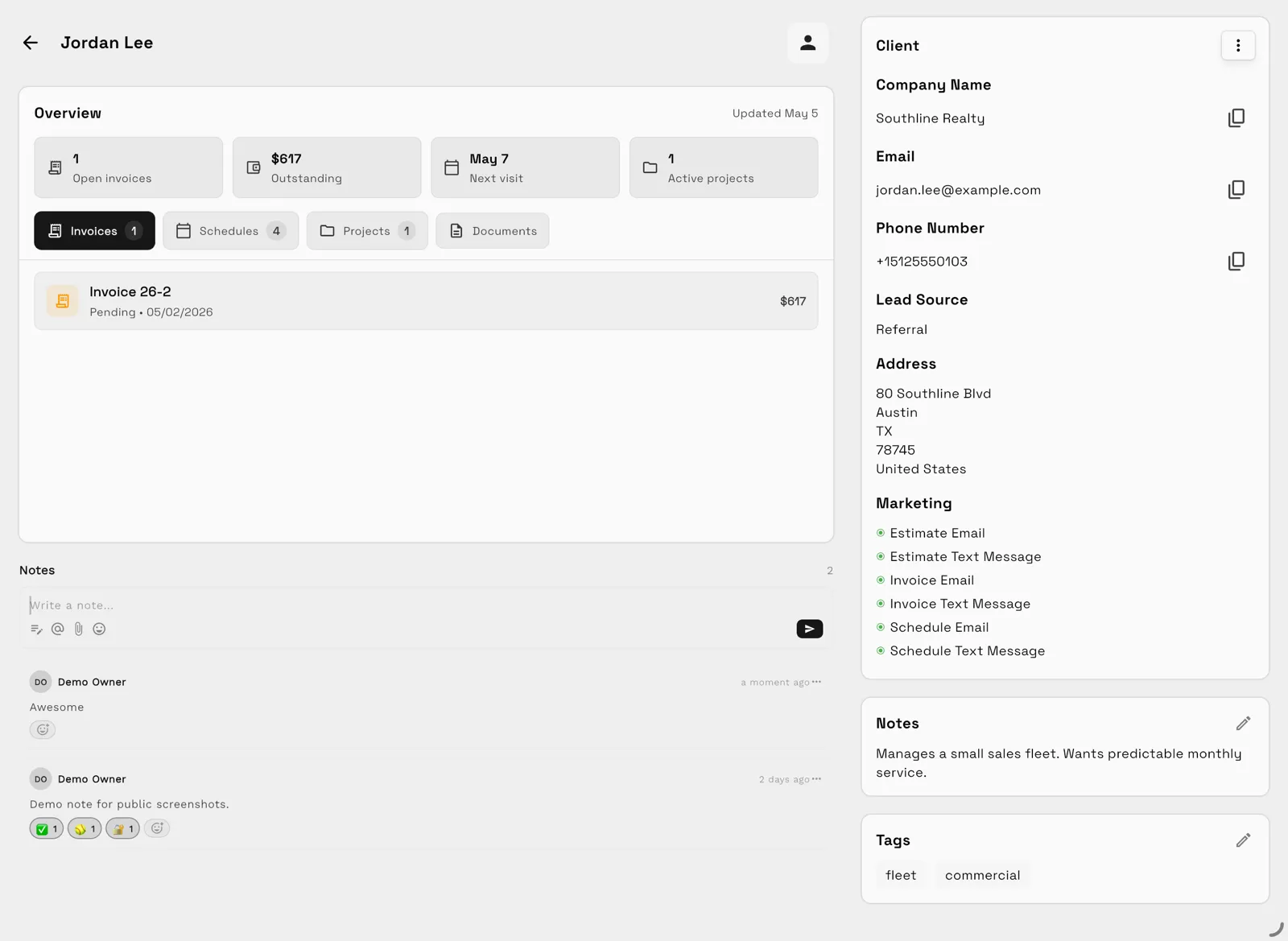
Demo data, not a customer outcome or specialist industry interface.
Use the lead generation agencies product overview to locate the agreement, responsible person, related work and invoice. Prepare the agreed scope with Proposals, keep follow-up in communications, and review billing under invoices. Workflow Automations create tasks, send email (and SMS from Voyager), issue reminders and notify the right people; check the workflow with a simulated test run and its execution log.
Workspace369 in action for a lead dispute
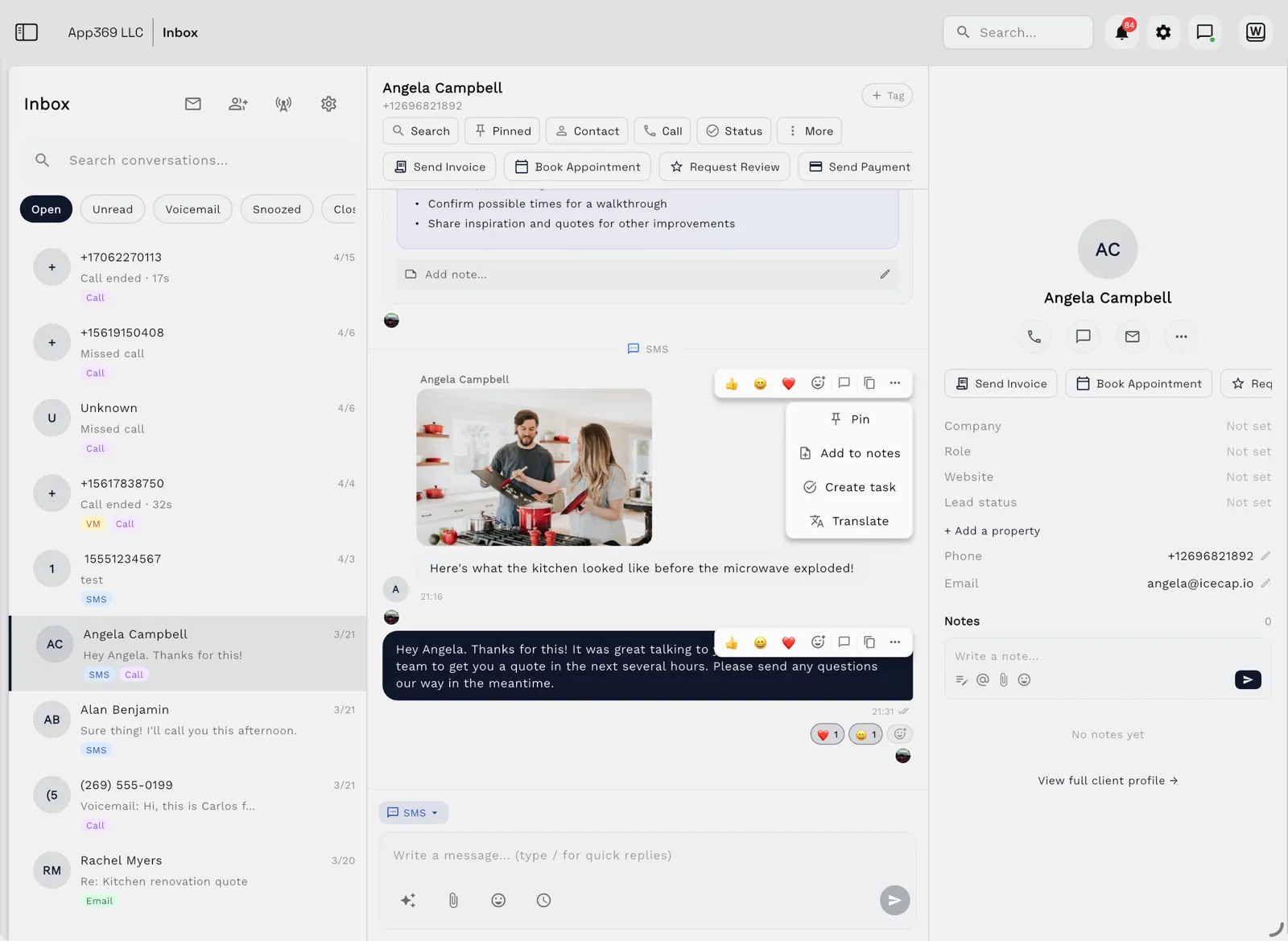
When a client disputes three delivered leads, the useful screen is the conversation next to the record. The first screenshot is the Workspace369 inbox in a demo workspace with sample data (a kitchen-renovation lead, not a lead agency). It shows a conversation list with call, SMS and email labels, an SMS thread, a message menu with Add to notes and Create task, and a client panel with notes on the right. A dispute message could become a task from that menu, with the history beside it. The communications page covers the inbox; SMS and the shared inbox start at Voyager, and Cadet has the email inbox.
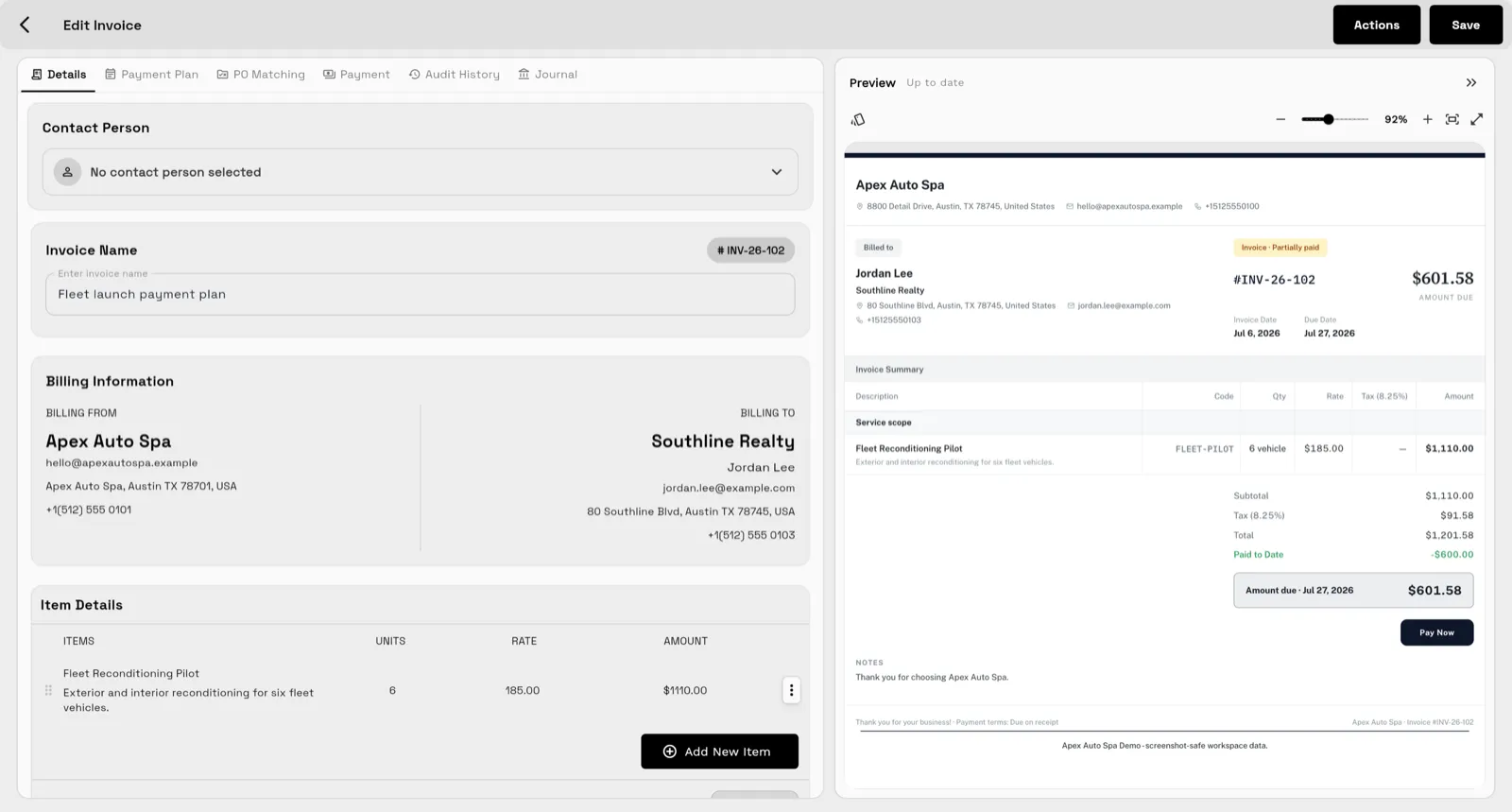
The second screenshot is the invoice editor in the same kind of demo workspace. It shows a payment plan tab, an invoice with one line item of six units at a rate you enter, and a preview marked partially paid. For a per-lead deal, you would enter the accepted lead count as the quantity yourself. The invoices page covers the editor, and the retainers and recurring billing page covers monthly fees. Payment plans start at Specialist.
What it does not do: it does not count delivered leads, check them against your acceptance definition or sync with your outbound tool, so the lead file and the count are things you upload and enter.
Test a lead dispute before you buy
Run this exercise in every trial with a fictional client. First, record the lead acceptance definition, the ideal customer profile, exclusions and volume commitment in the proposal. Second, upload a sample delivery file. Third, log a message in which the client disputes three leads. Fourth, raise the invoice. The tool passes if an operator can open the criteria, the file and the invoice without leaving the client record, and fails if they sit in unlinked places. When the dispute becomes a change in scope, draft it with the free scope-change request builder.
Compare the current Workspace369 pricing matrix against the seats and features you need. Plans run from one seat on Cadet to 50 on Enterprise, extra seats are $10 a month from Voyager, and Cadet through Commander start with a 14-day free trial that requires a card.
Sources reviewed for this guide
- Workspace369 pricingPlan matrix reviewed October 26, 2026 for seats, projects, funnels, lead sources, SMS and calling, inbox, retainers, invoices, webhooks and API, and trial terms.
- GoHighLevel pricingOfficial pricing page reviewed October 26, 2026 for monthly and yearly prices, sub-accounts, the 14-day trial and billing after it, usage-based costs and add-ons. The page is branded HighLevel.
- Pipedrive pricingOfficial pricing page requested October 26, 2026 and blocked automated access (HTTP 403), so prices, plan gates and trial terms could not be re-read and are shown as See site.
- HubSpot CRM pricingOfficial pricing pages reviewed October 26, 2026 for the free tools, the Sales Hub Starter $20 list price, the $7 new-customer offer (not used), Starter calling minutes, workflows and pipelines, and the Professional price and onboarding fee.
- Apollo pricingOfficial pricing page reviewed October 26, 2026 for plan names and the trial answer. Plan prices render client-side and could not be read, so they are shown as See site.
- Instantly pricingOfficial pricing page reviewed October 26, 2026 for the Outreach plans (Growth, Hypergrowth, Light Speed) on the Monthly and Yearly views, their limits and the sign-up note. The page also sells bundles with a lead database and credits, which we did not price.
Workspace369 publishes this documentation-based comparison and is one of the options. It is not an independent ranking or a hands-on benchmark.
Run client follow-up in one workspace.
CRM, inbox, voice, invoicing, payments, projects, files, AI, and workflow automations — connected instead of exported.
14-day free trial. Card required. After the trial: from $29/month. Renews automatically every month until you cancel. Cancel anytime in Settings → Billing.