Best CRM for Makeup Artists in 2026
Six tools compared for bridal and appointment-based makeup artists on price, deposits, party add-ons, contracts and booking, for on-location work or a chair.
We make Workspace369 and list it first here. Weigh our ranking with that in mind, and if another tool fits you better, use it.

By Simon Dziak, Founder, Workspace369 · LinkedIn
The best CRM for makeup artists depends on how you sell: Workspace369 fits on-location bridal artists who quote a party with add-ons, a deposit and a contract, and HoneyBook is the closest alternative. GlossGenius, Square Appointments, Fresha or Vagaro fit artists who book appointments in a chair.
A bridal artist who travels to the venue sells a bride plus a party, a trial, an early start and a travel fee, so the quote, deposit, contract and invoice have to sit on one record. For the broader comparison across freelance trades, see the best CRM for freelancers. To size a bridal deposit first, use the free deposit calculator.
Disclosure and method: Workspace369 publishes this guide and is one of the options. It is a documentation-based shortlist, not a hands-on benchmark. Official vendor pages were reviewed on October 26, 2026. Check current plans with each vendor before you buy.
Key takeaways
- A bridal makeup artist sells a package, not a slot: bride plus party headcount, a trial, an early start and a travel fee. The tool should keep the quote, deposit, contract and invoice on one client record, so a bridesmaid added four weeks out becomes a priced change.
- Workspace369 Cadet is $29 a month ($23.25 billed yearly) for one user, with a 14-day trial on Cadet through Commander that needs a card. It lists Proposals with optional add-on lines, deposit on acceptance, contracts, retainers and payment schedules, public intake forms and a client portal on every plan; online booking starts at Specialist, and Cadet allows 5 active projects.
- For an artist who works from a chair and sells slots, the beauty tools fit better: GlossGenius Standard is $28 a month ($24 billed yearly), Square Appointments has a $0 Free plan, Fresha Independent is $19.95 a month and Vagaro is $30 a month for one person.
- HoneyBook lists proposals, contracts, invoices and a client portal from $29 a month billed yearly (monthly price: see site), with 1 Scheduler session on Starter and unlimited sessions from Essentials ($49 yearly). It is the closest creative-business alternative for on-location work.
- None of the six is built for face charts or skin-reaction records. Keep patch-test and allergy notes in whatever form you already use, and test one fictional wedding party in each trial before you pay.
What's inside?
What a CRM for makeup artists is (and what it is not)How we compared these toolsThe best CRM for makeup artists in 2026Side-by-side comparisonWhich tool fits your business?Workspace369 in action for a wedding-season calendar of eventsRun a wedding-party test during the trialWhen to keep it simple
What a CRM for makeup artists is (and what it is not)
A CRM for a makeup artist is the business side of the work: who the client is, which package you quoted, how many people are in the party, what deposit was paid, what the contract says about the trial and the start time, and what is still unpaid. It is not a face-chart app, a skin-reaction record or a product catalog. Looks, shade notes and allergy details stay wherever you already keep them. The CRM holds the paperwork around them, so when a bride adds a bridesmaid and moves the start from 8:00 AM to 7:00 AM, the original quote, the agreement and the invoice are one click away.
How we compared these tools
We compared each tool on the same five points, using only the vendor's own pricing pages as read on October 26, 2026:
- Entry price for one person, monthly and billed yearly, as listed on the page. Where a page shows only one billing view, or a price renders client-side, the table says "Not shown" or "See site".
- Event-package chain on the entry plan: quotes or proposals, contracts, invoices, and deposits where the page names them.
- Booking: which plan lists online booking or a scheduler for trials and appointments.
- Hard limits on the entry plan: active projects, sessions, seats or staff.
- Trial terms: length, and whether the vendor says a card is needed.
What we did not test: speed, support, reliability or mobile apps. We did not use third-party ratings.
Why the order is what it is: it reflects documented fit for a freelance bridal artist who sells packages on location. HoneyBook lists proposals, contracts, invoices, a portal, payment plans and "Services and pricing guides" that let clients make selections, and Square Appointments lists estimates, contracts with e-signature, deposits and invoices on its $0 Free plan. Workspace369 ranks first only for an on-location artist who wants optional add-on lines per extra person or travel fee, deposit on acceptance and retainers on one record, and who can work within Cadet's 5 active projects. Booking is weighed separately: Workspace369 lists online booking only from Specialist, while the four beauty tools are built around it and are the better fit for an artist who sells appointments.
The best CRM for makeup artists in 2026
1. Workspace369, best for on-location bridal packages with add-ons and deposits
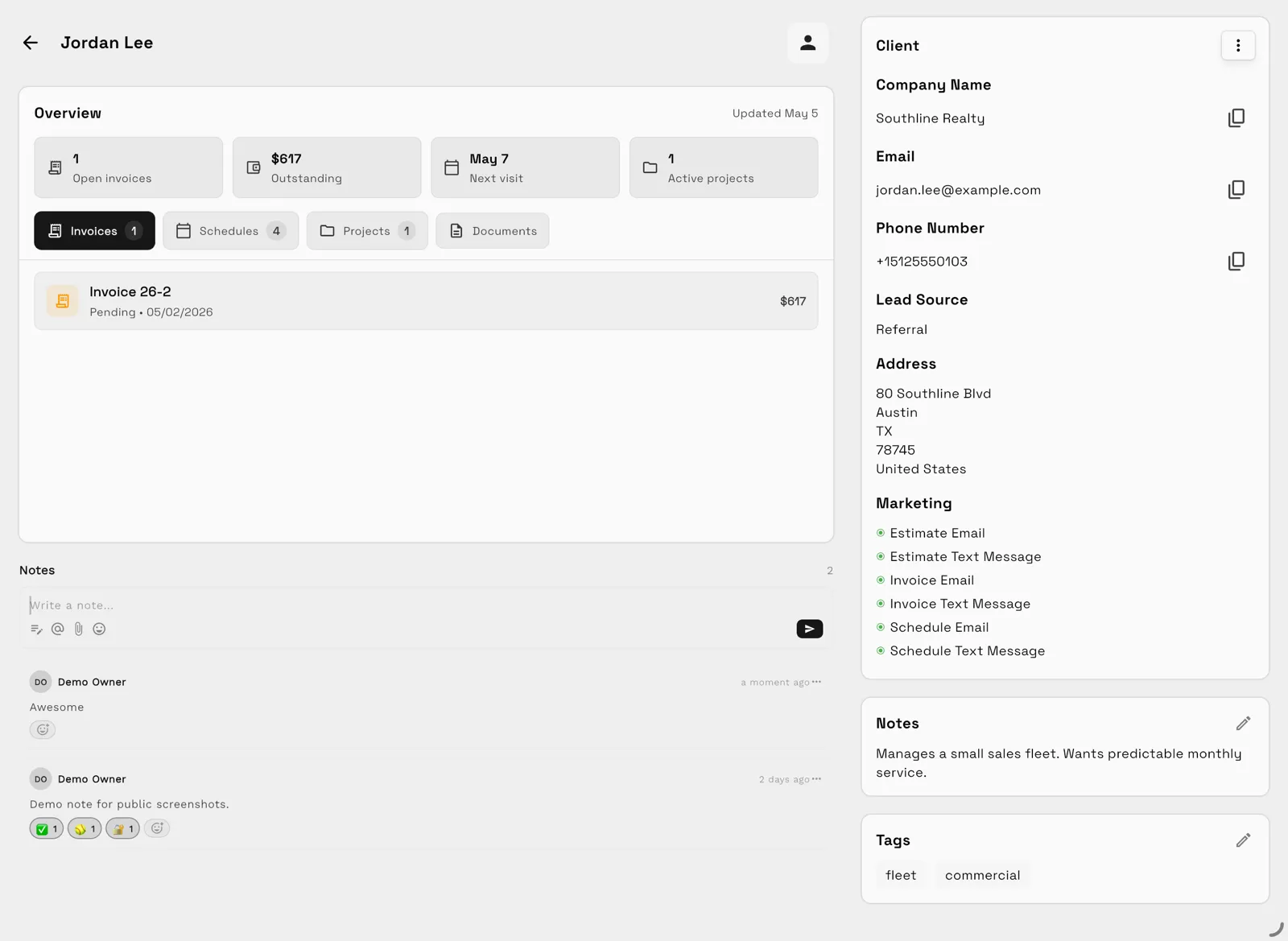
Workspace369 lists Proposals with optional and add-on line items on every plan, so each extra bridesmaid, the early-start fee and the travel fee are lines the client ticks when they accept. Deposit on acceptance, contracts the client signs online, retainers and payment schedules, a public intake form builder for questionnaires, file versioning for lookbooks and timelines, and a client portal are listed on Cadet, which is $29 a month for one user ($23.25 billed yearly). Email appointment reminders and Google Calendar sync are on every plan. The screenshot is a demo record, not a customer result.
Limitations: Cadet allows 5 active projects (archived projects do not count) and one seat, so a busy wedding season means closing out finished events. Online booking starts at Specialist ($149 a month, $119.25 billed yearly), as do change orders and proposal revision history, so on Cadet or Voyager trials are requested through an intake form and booked by hand. It has no beauty marketplace, no face-chart template and no retail point of sale. The 14-day trial covers Cadet through Commander and needs a card.
Best for: solo bridal and event artists with up to five live events who want quote, deposit, contract, invoice and files on one record, and who will take trial requests by form or phone.
2. HoneyBook, best creative-business alternative for on-location work
HoneyBook Starter is $29 a month billed yearly (the monthly price renders client-side, so see site) and lists unlimited clients and projects, invoices and payments, proposals and contracts, a calendar, a client portal and up to 2 live lead forms. The feature table lists the Scheduler on every plan: 1 session on Starter, unlimited sessions from Essentials ($49 a month billed yearly), which also adds automations, SMS reminders and up to 2 team members. The FAQ gives a 30-day free trial with no credit card required, and the page says all plans start with a free trial.
Limitations: unlimited Scheduler sessions need Essentials, so a trial-session booking page costs more than the entry plan. The page does not name optional line items or inventory. It lists payment plans and "Services and pricing guides" (clients make selections), so test whether a client can tick an add-on and whether a deposit can be set before you rely on them. Starter allows only 2 live lead forms, and nothing on the page is specific to beauty.
Best for: bridal artists who want inquiry, signature and payment in one polished client flow and will pay Essentials for a booking page.
3. GlossGenius, best for a beauty-specific booking site with deposits
GlossGenius runs a "Makeup Studio" industry page and prices by plan. Standard is $28 a month, or $24 a month billed annually, and lists a custom booking website, unlimited client notifications, email and text marketing, inventory and retail management, and packages and memberships. Gold is $56 a month ($48 billed annually), for businesses up to 9 staff, and adds forms and waivers, Google booking and reviews, an automated waitlist and time tracking. The comparison table also lists built-in deposits, card-on-file policies and service add-ons; the text version of the page does not show which plan carries each, so confirm that before you buy. The FAQ gives a free 14-day trial with no credit card required.
Limitations: it is built for a studio or booth, not a multi-person wedding quote with a contract; proposals and contracts are not named on its pricing page. Forms and waivers sit on Gold.
Best for: artists who book trials, lessons and studio appointments online and want a branded booking website with deposits and reminders.
4. Square Appointments, best for a free start at the chair
Square Appointments lists a Free plan at $0 a month, Plus at $49 and Premium at $149 per location. Free lists an online booking site, appointment reminders and unlimited staff calendars. Plus adds a cancellation policy with no-show fees, multi-staff appointment booking and a waitlist, and its FAQ gives a free 30-day trial on Plus and Premium. The feature table lists estimates, contracts with e-signature, prepayments and appointment deposits, and invoices and recurring invoices on all three plans, including Free. Plus and Premium add multi-package estimates, auto-convert from estimate to invoice, custom contract fields and required contract signatures.
Limitations: the model is a slot on a calendar. The page names estimates (multi-package estimates from Plus) but no optional add-on lines on a quote, and describes contracts as sent automatically when a client books.
Best for: artists with a steady appointment book who want to start on a $0 plan and add paid features later.
5. Fresha, best low price for one bookable artist
Fresha Independent is $19.95 a month for one bookable team member, with a 7-day trial; Team is $14.95 per team member monthly. The plans page lists calendar and appointment scheduling, client management, consultation forms, patch tests, quotes and invoices, packages, group bookings and direct booking links. Its FAQ says businesses with teams get the 7-day trial with no credit card; the page does not say that for Independent.
A second artist means moving to Team, and the feature rows also list a point of sale, reporting, gift cards, memberships and a business mobile app. Fresha does not publish a yearly view on the page we read.
Limitations: it is built for salons and chairs, so a wedding party is a set of group bookings, not a quote.
Best for: appointment-based artists who want the lowest monthly price, consultation forms and patch-test records in one tool.
6. Vagaro, best for a full salon-style back office
Vagaro shows $30.00 a month for one person ("Just Me"), with a selector for two up to seven or more team members. Every plan lists online booking on Vagaro, Instagram, Facebook and Apple Maps, a booking widget, calendar and resource management, a customer waitlist, forms and SOAP notes, invoices, memberships and packages, 1,000 free emails a month and customer tracking. Its FAQ gives a 30-day free trial; the page does not say whether a card is needed. The page also shows a $23.99 rate for the first six months next to the struck-through $30.00; we used the $30.00 price and did not use the offer.
Limitations: it is the broadest tool here and the least tailored to a traveling artist: there is no quote, contract or optional line item named on the page. The price steps up with the headcount selector, which renders client-side, so see site for two or more people.
Best for: artists who also rent a chair or run a studio and want booking, forms, memberships and reporting in one system.
Side-by-side comparison
| Tool | Entry price (monthly) | Billed yearly | Quote, contract and invoice on entry plan | Booking | Main entry-plan limit | Trial |
|---|---|---|---|---|---|---|
| Workspace369 | $29 (Cadet, one user) | $23.25 a month | Proposals with add-ons, deposit, contracts, invoices | Specialist ($149 monthly) | 5 active projects, 1 seat | 14 days on Cadet to Commander, card required |
| HoneyBook | See site (Starter) | $29 a month | Proposals, contracts, invoices | 1 session on Starter; unlimited from Essentials ($49 yearly) | 2 live lead forms | 30 days, no card |
| GlossGenius | $28 (Standard) | $24 a month | Invoices; proposals and contracts not named | Booking website on Standard | Forms and waivers on Gold ($56 monthly) | 14 days, no card |
| Square Appointments | $0 (Free); Plus $49 per location | Not shown | Estimates, contracts with e-signature, deposits and invoices on Free; multi-package estimates from Plus | Online booking site on Free | No-show fees and waitlist on Plus | 30 days on Plus and Premium |
| Fresha | $19.95 (Independent) | Not shown | Quotes and invoices listed | Direct booking links | One bookable team member | 7 days; no card for teams |
| Vagaro | $30.00 (one person) | Not shown | Invoices; quote and contract not named | Online booking on every plan | Price steps up per team member | 30 days; card not stated |
Which tool fits your business?
| If you mostly need | Start with | Why |
|---|---|---|
| Bridal packages with add-ons, deposit and contract on one record | Workspace369 | Optional line items, deposit on acceptance and contracts on every plan |
| A polished inquiry-to-signature flow with a booking page | HoneyBook | Proposals, contracts and a Scheduler from Starter |
| Online booking for trials, lessons and studio appointments | GlossGenius | Booking website on Standard, Makeup Studio page |
| A free start for an appointment book | Square Appointments | $0 Free plan with online booking and reminders |
| The lowest price with consultation forms and patch tests | Fresha | $19.95 a month for one artist |
| A full salon-style back office | Vagaro | Booking, forms, treatment notes, memberships and invoices on every plan |
Workspace369 in action for a wedding-season calendar of events
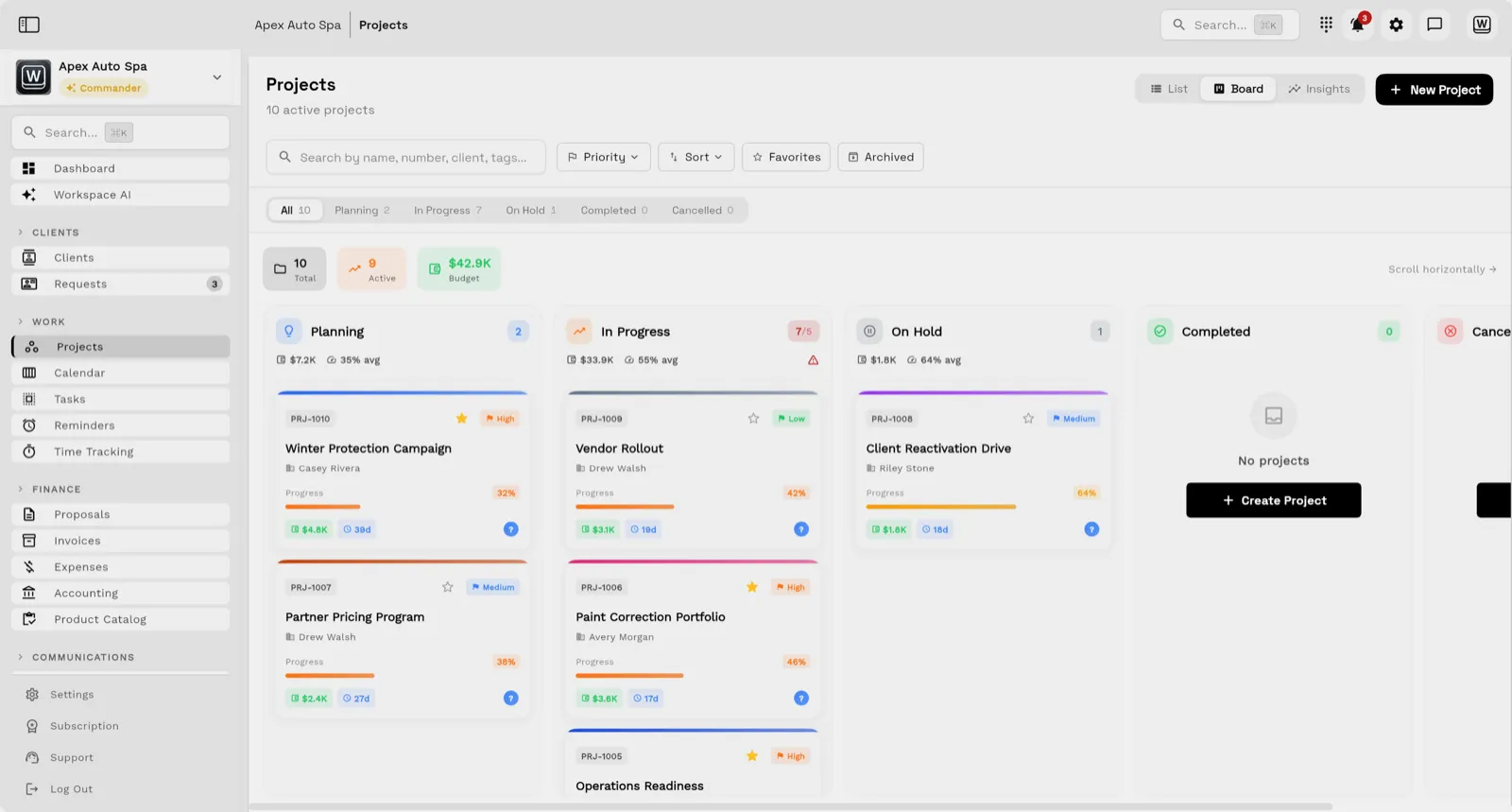
For a bridal artist, the Workspace369 side of a booking is one project per wedding and one invoice that can change. The first screenshot is the projects board in a demo workspace with sample data (an auto-detailing business, not a makeup studio): each card is a job with a stage, a due window and a budget, and a toggle switches between Board and List. Each wedding would be a card, and the client portal shows the client what is theirs. Cadet allows 5 active projects at once (archived ones do not count), so a board like the demo's 10 active projects needs a higher plan.
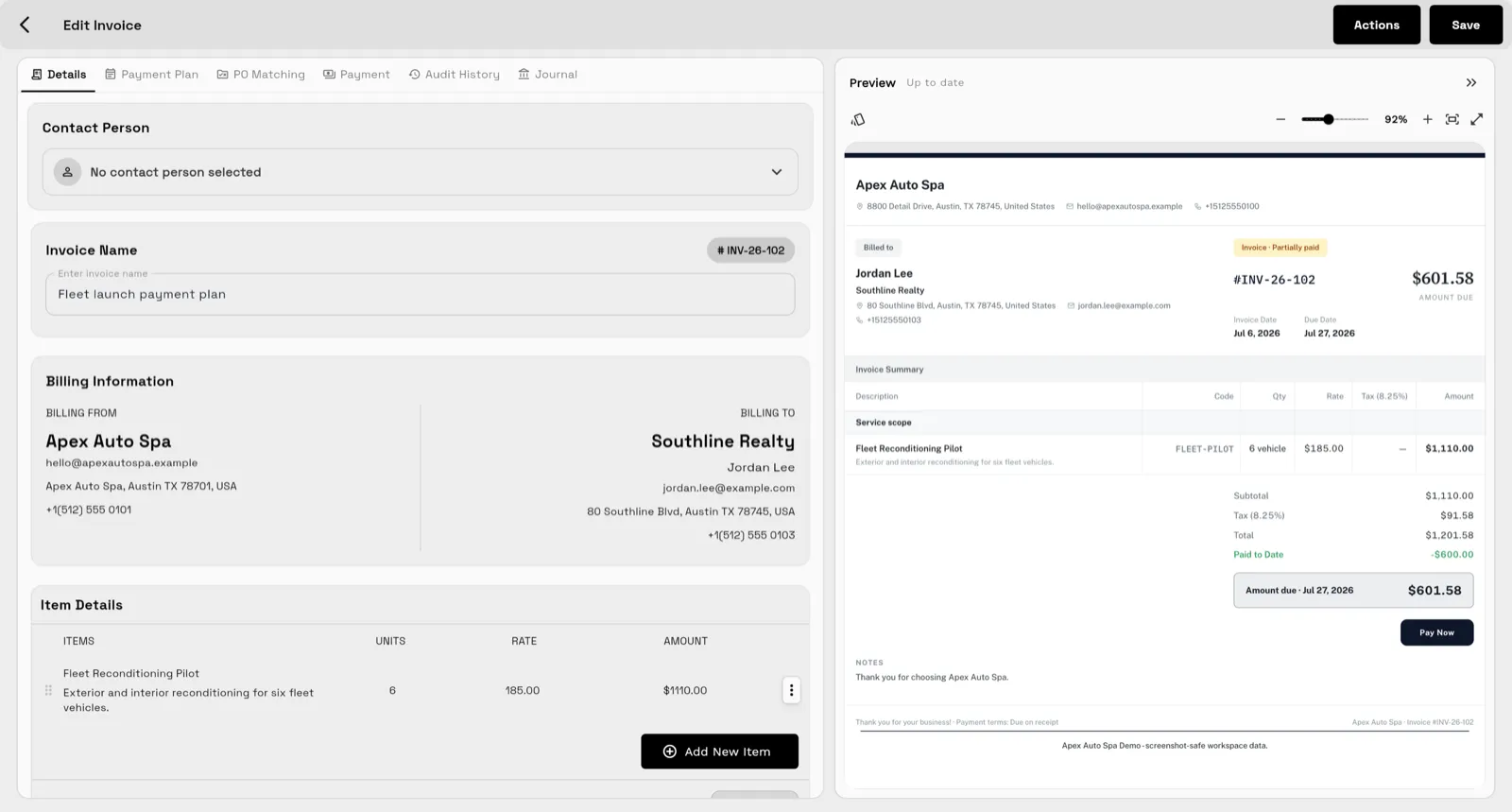
The second screenshot is the invoice editor in the same demo workspace: a line item with units and a rate on the left, and a live preview on the right marked partially paid, with a deposit already taken and the balance due. When a bridesmaid is added four weeks out, you would add a line and the preview updates; the deposit and payment history stay on the same invoice. The tab row includes Payment Plan, which starts at Specialist, and you set the original add-on lines on the proposal before the client signs a contract.
What it does not do: Workspace369 has no face charts, no skin-reaction or patch-test record and no trial-session booking page before Specialist, so keep those in your own forms and take trial requests through an intake form.
Run a wedding-party test during the trial
Take one fictional wedding party through the sequence below in each tool you shortlist. The scenario is an exercise, not a customer result.
- Build a bridal quote with the bride, three party members, a trial session and a travel fee, with an early-start fee as an option the client can choose.
- Collect the deposit when the client accepts, and send the contract with the trial date, the start time and the cancellation terms.
- Create the event, attach the lookbook and send the intake questionnaire.
- Four weeks out, the bride adds a bridesmaid and moves the start to 7:00 AM. Send a priced change and an updated invoice.
- Open the client record and check that the original quote, contract, files, questionnaire and both invoices are linked together.
If you run the test, the best tool keeps all five on one client record and lets you find the original terms in seconds.

When to keep it simple
If you take a handful of weddings a season, a quote template, a contract template and an invoicing app can carry you. Move to a client-work tool when headcount changes overlap, when you cannot find what a bride agreed to months ago, or when trials and weddings land on the same weekend. The makeup artists product page shows how Workspace369 handles Proposals, communications and invoices, and the pricing page has current plans. On Specialist, change orders record a scope change against the original agreement, and inventory tracking with low-stock alerts is included for a kit you restock. Keep sensitive skin and allergy notes in a system you are comfortable storing them in, and keep looks and reference photos in your gallery.
Before importing real clients, run one full event on demo data and check that your records can be exported.
Sources reviewed for this guide
- Workspace369 pricingPlan matrix reviewed October 26, 2026 for seats, active projects, optional line items, deposits, contracts, retainers, online booking, change orders, proposal revisions, inventory, automations and trial terms.
- HoneyBook pricingOfficial pricing page reviewed October 26, 2026 for the yearly prices, plan features, Scheduler limits and trial terms. The monthly prices render client-side and were not read.
- GlossGenius pricingOfficial pricing page reviewed October 26, 2026 for monthly and annual prices, plan features and trial terms.
- Square Appointments pricingOfficial pricing page reviewed October 26, 2026 for plan prices, plan features and the trial terms in its FAQ.
- Fresha pricingOfficial pricing page reviewed October 26, 2026 for subscription prices, listed features and trial length.
- Vagaro pricingOfficial pricing page reviewed October 26, 2026 for the one-person price, the included features and the 30-day free trial in the FAQ. The page does not say whether a card is needed.
Workspace369 publishes this documentation-based comparison and is one of the options. It is not an independent ranking or a hands-on benchmark.
Run client follow-up in one workspace.
CRM, inbox, voice, invoicing, payments, projects, files, AI, and workflow automations — connected instead of exported.
14-day free trial. Card required. After the trial: from $29/month. Renews automatically every month until you cancel. Cancel anytime in Settings → Billing.