Best CRM for Performance Agencies in 2026
Best CRM for performance marketing agencies: five client-work tools and one reporting tool compared on price, retainer billing and access onboarding.
We make Workspace369 and list it first here. Weigh our ranking with that in mind, and if another tool fits you better, use it.

By Simon Dziak, Founder, Workspace369 · LinkedIn
The best CRM for performance marketing agencies keeps the retainer, the bonus clause, ad-account access requests and the invoice on one client record. Workspace369 suits small agencies selling retainers, Productive suits teams that manage budgets and margin, and Teamwork.com suits hour-based retainers. SuiteDash is the flat-price option with portals, and AgencyAnalytics is the pick for client reporting.
Channel results such as spend and ROAS stay in the ad platforms or a reporting tool. If you run only paid search, the sibling PPC agency CRM guide covers that narrower case. Before you pick a tool, work out your base fee with the free retainer pricing calculator.
Disclosure and method: Workspace369 publishes this guide and is one of the options. The ranking comes from reading pricing pages, not from running the software. Vendor pricing pages were reviewed on October 26, 2026, in both billing views where a switch exists; confirm current plans with the vendor.
Key takeaways
- A CRM for a performance marketing agency should hold the retainer agreement, the fee schedule, the onboarding access request, every extra-test request and the invoice on one client record. It does not pull channel data or build performance reports.
- Workspace369 Cadet at $29 a month ($23.25 billed yearly) lists proposals, contracts, retainers, recurring invoices, intake forms, a client portal and projects for one user and 5 active projects. Change orders and proposal revisions start at Specialist ($149 a month, 10 seats).
- Productive prices per user with a three-seat minimum: invoices are on every plan from Essential at $10 a month billed yearly ($12 monthly), and recurring budgets and retainer invoicing sit on Professional at $25 ($29 monthly). Teamwork.com lists retainers on Accelerate at $24.99 per user billed yearly ($29.99 monthly).
- SuiteDash charges one price rather than per user: Start is $19 a month ($180 a year) and lists unlimited staff and portals, while proposals and deal pipelines start at Thrive ($49 a month, $480 a year). HubSpot Starter lists at $20 per seat and names no invoicing or retainers on its pricing page.
- Cross-channel dashboards belong in a reporting tool: AgencyAnalytics lists $20 per client a month billed annually, 85+ integrations and a white-labeled client portal, and beats every CRM here for built-in reporting.
What's inside?
What a CRM for performance marketing agencies is (and what it is not)How we compared these toolsThe best CRM for performance marketing agencies in 2026Side-by-side comparisonWhich tool fits your performance agency?Workspace369 in action for a fee-plus-bonus monthRun a mid-month test-budget trialKeep reporting in a reporting toolWhen to keep it simple
What a CRM for performance marketing agencies is (and what it is not)
Performance work is rarely one channel. A single client may buy paid search, paid social and landing page tests, on a retainer that pairs a base fee with a bonus tied to a measured result. The CRM is the commercial memory of that account: the signed terms, which channel each fee covers, who opened access to which ad account, which tests the client approved and which invoices are open. It is not a bid manager, an attribution model or a dashboard, and ROAS, CPA and spend should not live in it as the source of truth. Media budgets go to the platforms, so they do not belong on your invoice as income. When contacts sit in one app and the agreement and billing sit in others, a test added mid-month turns into unpaid work.
How we compared these tools
Five checks, applied to every tool from its own pricing page (reviewed October 26, 2026):
- What the retainer plan costs. The cheapest plan that names retainer or recurring-budget billing, monthly and billed yearly, with per-user prices multiplied out at the vendor's seat minimum.
- Paper trail for a fee-plus-bonus deal. Whether the page names contracts or proposals and invoices, so the bonus clause, its approval and its invoice line can be traced.
- Ad-account access intake. Forms that collect account IDs per channel, and a portal or client login to receive them.
- Test-budget scope control. A named way to price and approve an extra test, such as change orders or proposal revisions.
- Fit at two to five people. Seat minimums, user caps and trial length.
Not covered: how fast any tool feels, support quality, uptime, mobile apps, or whether any connection to an ad platform works. We also ignored review-site ratings.
Why Workspace369 ranks first here: the order follows documented fit for a small agency selling retainers, and price did not decide it. On the Workspace369 matrix, proposals, contracts and e-signature, retainers and payment schedules, recurring invoices, proposal-to-invoice conversion, public intake forms, a client portal and projects are all listed on Cadet, so the agreement, the access form and the invoice can sit on one record from the first plan. Productive, Teamwork.com and SuiteDash each list some of these rows, but none of their pricing pages names contracts with e-signature, retainers, public intake forms, a branded client portal and invoices together on one plan. Cheaper tools exist, and tools that beat Workspace369 for other readers: Productive for budgets and margin, Teamwork.com for hour-based billing, and AgencyAnalytics for built-in ad reporting.
The best CRM for performance marketing agencies in 2026
1. Workspace369, best for small agencies selling retainers on one record
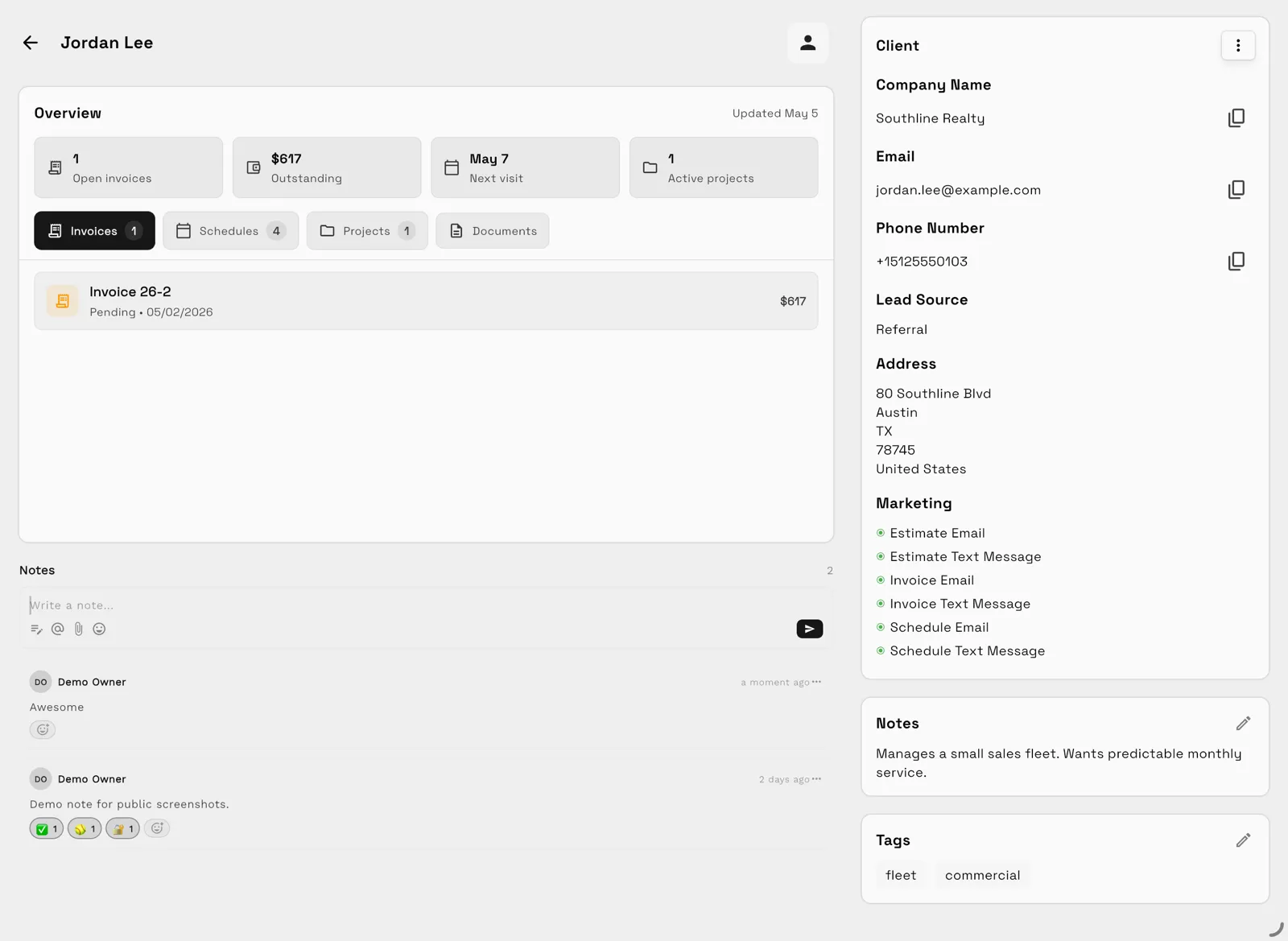
Workspace369 puts the client record, a proposal with contract and e-signature, a retainer, projects, tasks, timers, a client portal and invoices in a single workspace. Cadet is $29 a month for one user ($23.25 billed yearly) and lists retainers and payment schedules, recurring invoices, public intake forms, a drag-and-drop form builder and proposal-to-invoice conversion. A public form can ask for each channel's ad account ID and the person granting access, and the reply is filed on the client. The screenshot shows demo data only.
Limitations: there is no link to Google Ads, Meta or any ad platform and no performance reporting, so a bonus amount is typed onto the invoice by hand. Webhooks and API start at Specialist ($149 a month, 10 seats), where you could build your own connection. Cadet allows one user and 5 active projects; Voyager is $74 a month ($59.25 billed yearly) with two seats, unlimited projects and $10 a month for each additional seat. Change orders and proposal revisions start at Specialist, so on Cadet and Voyager an extra test needs a new proposal. The 14-day trial covers Cadet through Commander, card required.
Best for: paid search, paid social and CRO shops of up to ten people that sell fixed or fee-plus-bonus retainers and want each signed term next to the invoice, with results read from the platforms or a reporting tool.
2. Productive, best for agencies that manage budgets and margin
Productive is a project and finance tool for agencies, organised around budgets, time and capacity. On its pricing page, Essential is $10 per user a month billed yearly ($12 monthly) and Professional is $25 ($29 monthly); the page defaults to ten users, which reads $100 and $250 a month billed yearly. A FAQ answer sets a three-user floor on every plan. All plans list invoices that you create and send to clients from the app, credit notes, deals with proposal export to PDF, time tracking, budgets and expense management. Professional and Ultimate add recurring budgets, retainer invoicing (draft invoices from retainer budgets), payment reminders and client access to budgets. Public forms are Ultimate only. Clients can be invited into projects at no charge. A three-person team on Professional pays $75 a month billed yearly.
Limitations: the page names no contracts with e-signature and no branded client portal, and the public forms you would use for ad-account intake sit on Ultimate, which is priced by talking to sales. Capacity planning and forecasting go further than most agencies under five people will use.
Best for: agencies of three or more that bill retainers from budgets and care about margin per client.
3. Teamwork.com, best for hour-based retainers with client users
Teamwork.com charges per user. Billed monthly, Basics is $13.99 and Accelerate is $29.99; billed yearly, $9.99 and $24.99. Basics lists intake request capture, billable time tracking and client users invited into projects. Accelerate lists basic invoices, time budgets and unlimited time retainers; time and cost retainers and quotes sit on higher plans, with Optimize priced through sales. The Free plan covers up to five users and five projects. Accelerate needs at least five users (Basics needs three). For five users, Accelerate comes to $124.95 a month billed yearly or $149.95 monthly; Workspace369 Specialist is $149 monthly for ten seats.
Limitations: an agency charging a base fee plus a bonus may never use the time-budget features it pays for, since the retainers listed are measured in hours. The pricing page does not name contracts with e-signature or a branded client portal on Accelerate. Quotes sit on a higher plan. Both Basics and Accelerate carry a 14-day trial with no card.
Best for: teams of five or more that sell blocks of hours for account management or creative testing and bill straight from timesheets.
4. SuiteDash, best for a flat price with unlimited staff and portals
SuiteDash prices by plan, not by user. Monthly, Start is $19, Thrive is $49 and Pinnacle is $99; billed yearly, Start is $180 a year, Thrive $480 and Pinnacle $960. All three list unlimited CRM contacts, unlimited staff and unlimited portals with white labeling. Thrive adds dynamic proposals and deal stage pipelines, and Pinnacle adds an automation toolkit, an onboarding toolkit, support tickets and task dependencies. The 14-day trial runs on Pinnacle and the page says no card is needed. Its general product description names invoicing and recurring billing, subscription management and contracts with e-signature, but ties none of them to a plan.
Limitations: the plan lists do not say which tier carries recurring billing, and change orders are not named, so confirm how a monthly fee and an extra test are billed before you commit. Proposals start at Thrive. A one-person agency may not need the portal and onboarding depth, and Pinnacle at $99 a month is the dearest of the three plans.
Best for: agencies of three to ten people that want a portal and onboarding for many clients at one flat monthly price.
5. HubSpot, best for tracking new-business leads before they sign
HubSpot lists a free tier for up to 2 users, with no card required, and Starter at $20 per seat a month list price. Both billing views show new-customer promotions, which we ignored. Under its marketing tools the page names ad management, ad retargeting, pipelines and workflows. For Starter the pricing page lists no contracts, retainers or time tracking, so retainer billing and the signed fee-plus-bonus terms would sit in another product. HubSpot's help center documents invoices on all plans, and quotes with e-signature are sold in Revenue Hub Professional and Enterprise.
Limitations: nothing on the page covers delivery or billing for a client account, and no trial terms are stated for Starter. The ad rows sit under its marketing tools and say nothing about billing client accounts.
Best for: agencies whose weak spot is the new-business pipeline and email history, with billing handled elsewhere.
6. AgencyAnalytics, best for built-in cross-channel reporting (not a CRM)
AgencyAnalytics is reporting software rather than a CRM, and it does one job better than anything else in this guide: showing clients their results. The pricing page lists $20 per client a month billed annually and includes unlimited staff accounts, unlimited reports and dashboards, 85+ marketing integrations, automated client reporting, goal tracking and alerts, and a white-labeled client portal. The page offers a free 14-day trial with no credit card required. A roster of eight clients works out to $160 a month billed annually.
Limitations: it does not hold your agreement, access request, scope changes or invoices, and the per-client price grows with your client list. The page names only the annual rate, and we did not find a monthly price.
Best for: agencies that report on several channels per client and need dashboards more than they need a billing record.
Side-by-side comparison
| Tool | Plan priced | Monthly | Billed yearly | Retainer billing at that plan | Seat rules | Trial |
|---|---|---|---|---|---|---|
| Workspace369 | Cadet | $29 | $23.25 a month | Yes (retainers, recurring invoices) | 1 user, 5 active projects | 14 days on Cadet through Commander, card required |
| Productive | Professional (recurring budgets) | $29 per user | $25 per user a month | Yes (recurring budgets, retainer invoicing) | 3-seat minimum | 14 days, no card |
| Teamwork.com | Accelerate (invoices, retainers) | $29.99 per user a month | $24.99 per user a month | Yes (time retainers, basic invoices) | Per user; Accelerate 5-user minimum (Basics 3) | 14 days, no card |
| SuiteDash | Thrive (proposals, pipeline) | $49 | $480 a year | Recurring billing named, not tied to a plan | Unlimited staff and portals | 14 days, no card |
| HubSpot | Starter (list) | $20 per seat | Not shown | Not listed on page | Free tier: 2 users | None stated for Starter |
| AgencyAnalytics | Core plan (reporting only) | Not shown | $20 per client a month | Not a billing tool | Per client; unlimited staff | 14 days, no card |
Which tool fits your performance agency?
| Your main need | Pick | Reason |
|---|---|---|
| Retainer contract, access form, portal and invoice on one record | Workspace369 | Proposals, contracts, retainers, recurring invoices, intake forms and portal on Cadet |
| Budgets, margin and capacity for a team of three or more | Productive | Recurring budgets from Professional, resourcing and reporting |
| Hour-based retainers billed from logged time | Teamwork.com | Time retainers and basic invoices on Accelerate |
| A flat price with unlimited staff and client portals | SuiteDash | Unlimited staff and portals on Start; proposals from Thrive |
| Tracking leads before they sign | HubSpot | Free tier for 2 users; contracts and invoices live elsewhere |
| Cross-channel client dashboards and automated reports | AgencyAnalytics | $20 per client a month billed annually; 85+ integrations |
Workspace369 in action for a fee-plus-bonus month
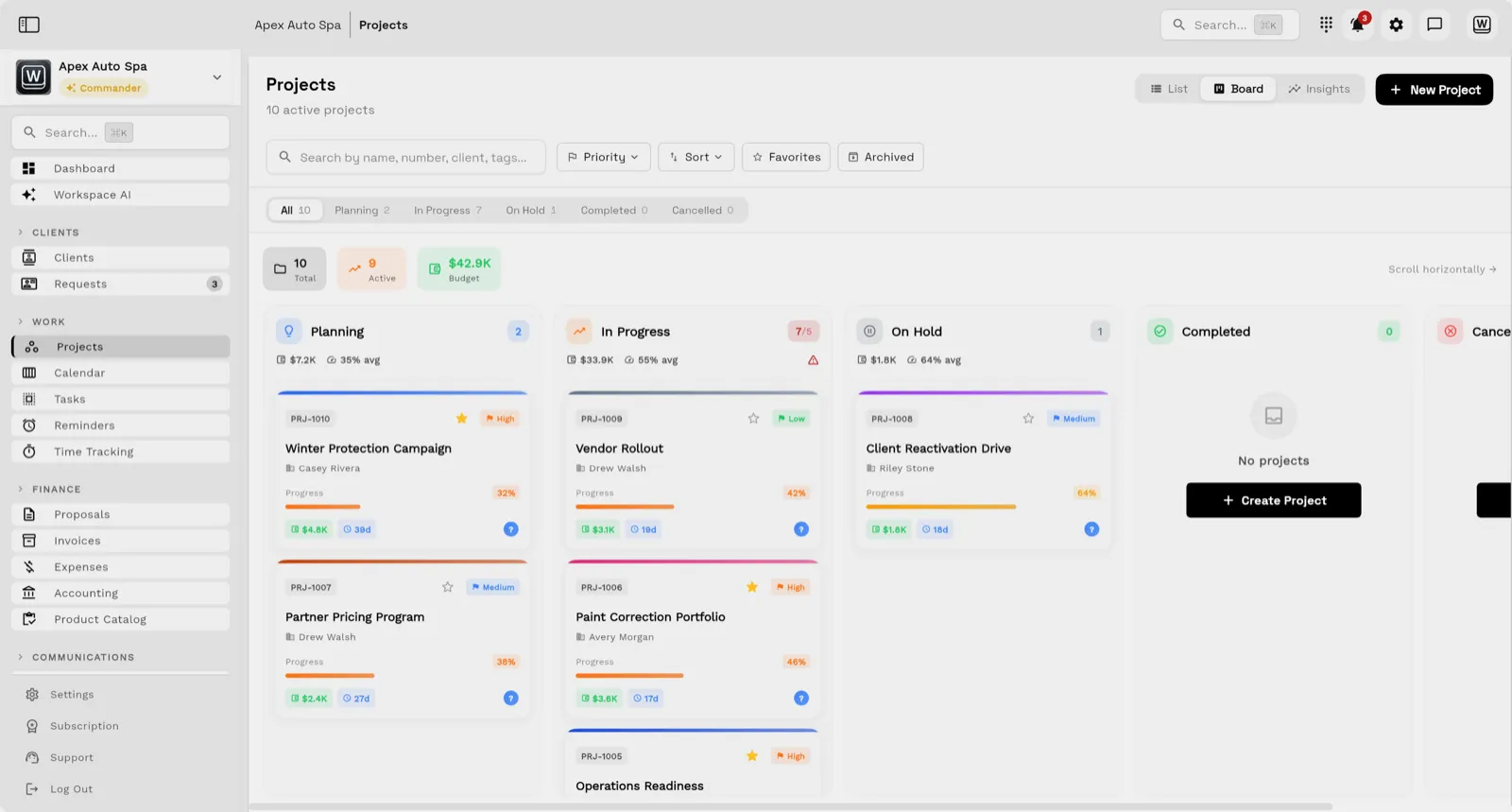
A performance retainer in Workspace369 is one project per client month and one invoice at the end of it. The first screenshot is the projects board in a demo workspace with sample data (an auto-detailing business, not an agency). Projects sit in Planning, In Progress and On Hold columns, and each card shows a progress bar, a budget and a day count. In an agency account, a card such as "Paid social, November" would sit in In Progress, with the extra test as a task on it and its hours logged with time tracking.
The second screenshot is the invoice editor from the same demo workspace. The live preview shows an invoice marked Partially paid, with $600.00 paid to date, $601.58 still due and a Pay Now button. For a fee-plus-bonus deal, the base fee repeats through retainers and recurring billing, and the bonus goes on as its own line once you have checked the figure in the platform. The client sees the signed terms and every invoice in the client portal.
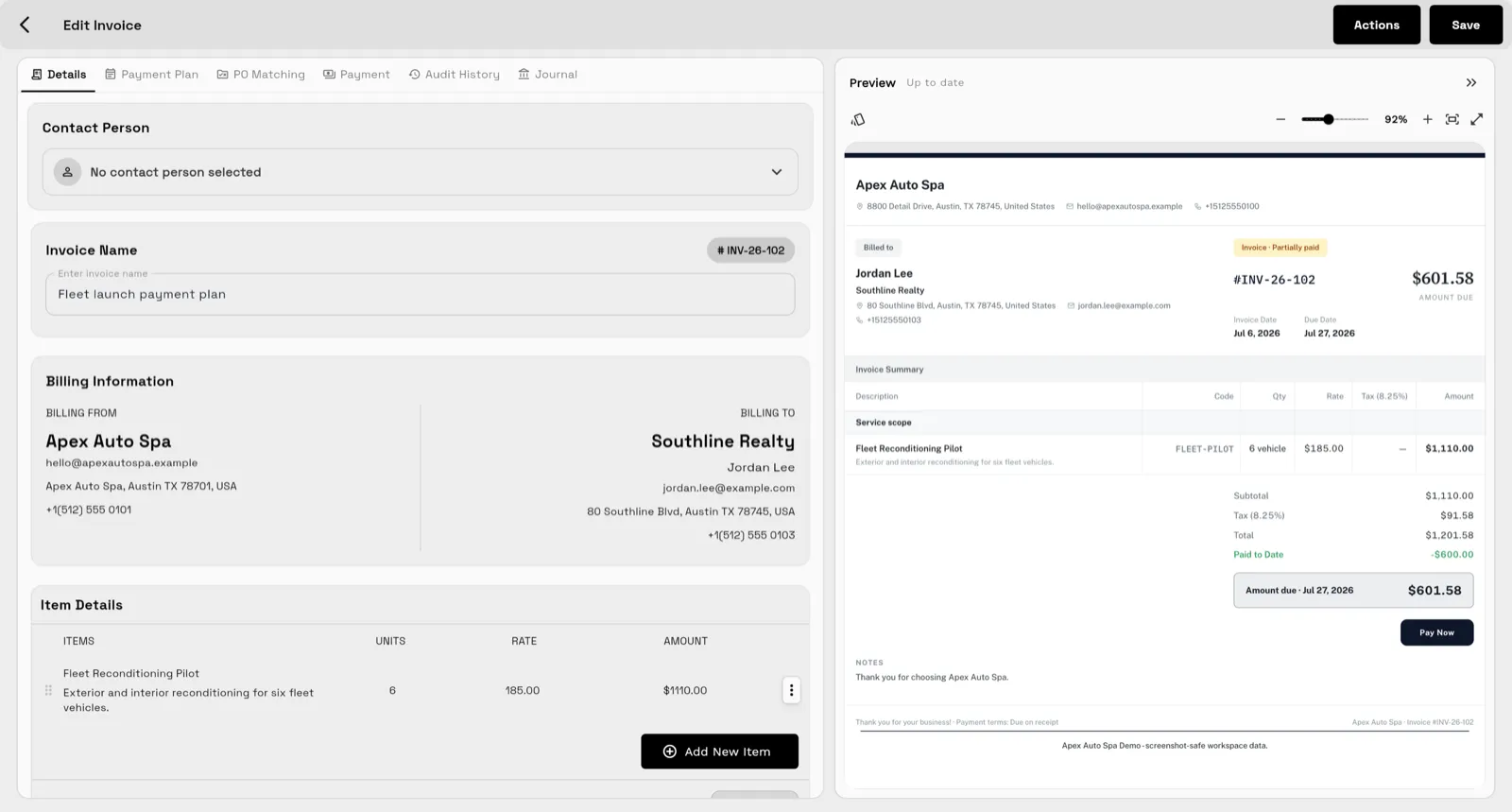
What it does not do: Workspace369 does not connect to Google Ads, Meta or LinkedIn, read spend or work out a bonus, so the bonus figure is typed by hand. Splitting a balance into instalments (the Payment Plan tab in the editor) starts at Specialist.
Run a mid-month test-budget trial
Use trial time to push one invented client through a full month in every tool on your shortlist:
- Send an onboarding form asking for the ad account ID on each channel and the person who will grant access. Confirm the answers attach to the client record.
- Draft the retainer as a proposal containing the base fee, the bonus rule, the measurement source and the review date, and approve it as the client.
- Create the first month's recurring invoice or retainer draw.
- As the client, ask for an extra paid social test halfway through the month. Draft the ask with the free scope-change request builder, approve it, and note where the tool stores that approval.
- Log hours on the test and put its fee on the invoice, with the bonus as its own line after you verify the figure in the platform.
- Download the client record and look at what you get.
A tool passes if the access answers, the signed terms, the approved test and the invoice are all reachable from one client record. A test that only exists in an email thread is the leak this exercise is designed to expose.

Keep reporting in a reporting tool
Reading results and recording commitments are separate jobs. A reporting tool such as AgencyAnalytics reads the channels; the client-work tool records what you promised and what you billed. Leave ROAS, CPA and spend in the platforms and the dashboards, and pair the reporting tool with whichever record-keeper you choose. No CRM reviewed here is documented to replace it.
When to keep it simple
With two or three clients on one channel, a shared task list, a signed agreement and an invoice template may be enough. Switch when a second person starts accepting requests, when nobody can say what test scope was agreed three months ago, or when late payments are chased by hand. The performance marketing agencies product page shows how Workspace369 handles proposals, communications, change orders and retainers, and the pricing page has current plans. Workflow Automations handle reminders and follow-ups, and email automations are on every plan.
Run a full month on demo data and confirm an export works before moving any live client in.
Sources reviewed for this guide
- Workspace369 pricingPlan matrix reviewed October 26, 2026 for seats, active projects, retainers, contracts, change orders, webhooks and trial terms.
- Productive pricingOfficial pricing page reviewed October 26, 2026 in both billing views for per-user prices, the three-seat minimum and plan feature rows.
- Teamwork.com pricingOfficial pricing page reviewed October 26, 2026 in both billing views for per-user prices and plan feature rows.
- SuiteDash pricingOfficial pricing page reviewed October 26, 2026 in the monthly and yearly views for plan prices, plan feature lists and trial terms.
- HubSpot pricingOfficial page read October 26, 2026 for the free tier terms and the Starter list price.
- AgencyAnalytics pricingOfficial page read October 26, 2026 for the per-client rate, included features and trial.
Workspace369 publishes this pricing-page-based comparison and is one of the options. It is a desk review, not an independent ranking or a product test.
Run client follow-up in one workspace.
CRM, inbox, voice, invoicing, payments, projects, files, AI, and workflow automations — connected instead of exported.
14-day free trial. Card required. After the trial: from $29/month. Renews automatically every month until you cancel. Cancel anytime in Settings → Billing.