Best CRM for web development agencies in 2026: scope to invoice
Best CRM for web development agencies: six client-work tools compared on price, plan gates and handling a late scope change, with a five-step trial test.
We make Workspace369 and list it first here. Weigh our ranking with that in mind, and if another tool fits you better, use it.

By Simon Dziak, Founder, Workspace369 · LinkedIn
The best CRM for web development agencies keeps the client, the signed scope, the build tasks and the invoice on one record, so a late integration request does not turn into unbilled work. For agencies that want that in one place, our pick is Workspace369. Teamwork and Productive go deeper on delivery, and HubSpot and Pipedrive on sales pipelines. Need to write up a change first? Start with the free scope-change request builder.
Disclosure and method: Workspace369 publishes this guide and is one of the options. It is a documentation-based shortlist, not a hands-on benchmark. Official vendor pages were reviewed on October 15, 2026; Productive's page was re-read on October 19, 2026. Check current plans with each vendor before you buy.
Key takeaways
- A web development agency CRM earns its place when a client adds a late requirement: it should link the request to the proposal, the project tasks and the invoice.
- Workspace369 fits agencies that want client records, change proposals, project tasks, the client portal, time tracking and invoices together from $29 a month; Cadet is one seat and 5 active projects.
- Teamwork and Productive are deeper on project delivery and resourcing; Teamwork lists client invoicing from logged time on Accelerate, and Productive lists invoices on every plan and retainer invoicing from Professional.
- HubSpot and Pipedrive are stronger sales pipelines, but billing, delivery and the client portal sit in other tools.
- None of these tools replaces hosting or source control; connect them by webhooks and the API, which Workspace369 lists from Specialist at $149 a month.
What's inside?
What a web development agency CRM is (and what it is not)How we compared these toolsThe best CRMs for web development agencies in 2026Side-by-side comparisonWhich tool fits your agency?Run a late scope-change test during the trialKeep code and client records separate
What a web development agency CRM is (and what it is not)
A CRM for a web development agency is the client-side record of a build: who the client is, what you proposed and they signed, which tasks and files belong to the project, what was said, and what has been invoiced. It is not your code host, your deployment pipeline or your staging environment, and no CRM should pretend to be. The test is administrative: when scope shifts at content freeze, can someone find the agreement, add the work and bill for it without opening five apps?
How we compared these tools
We compared each tool on the same five points, using only the vendor's own pricing and product pages:
- Entry price for a small team, as listed on October 15, 2026.
- Scope-change path: whether the plan covers client record, proposal, project tasks and invoice together.
- Time and billing: whether developer hours can become invoice lines on the plan.
- Client access: whether clients can see files, status and invoices themselves.
- Hard limits: seats, projects, minimum users or features reserved for higher plans.
We did not test integrations with Git, hosting or deployment tools, speed or support, and we did not use third-party ratings. Order reflects fit for an agency that sells and bills website builds and changes to them.
The best CRMs for web development agencies in 2026
1. Workspace369, best for agencies that want scope, delivery and billing on one client record
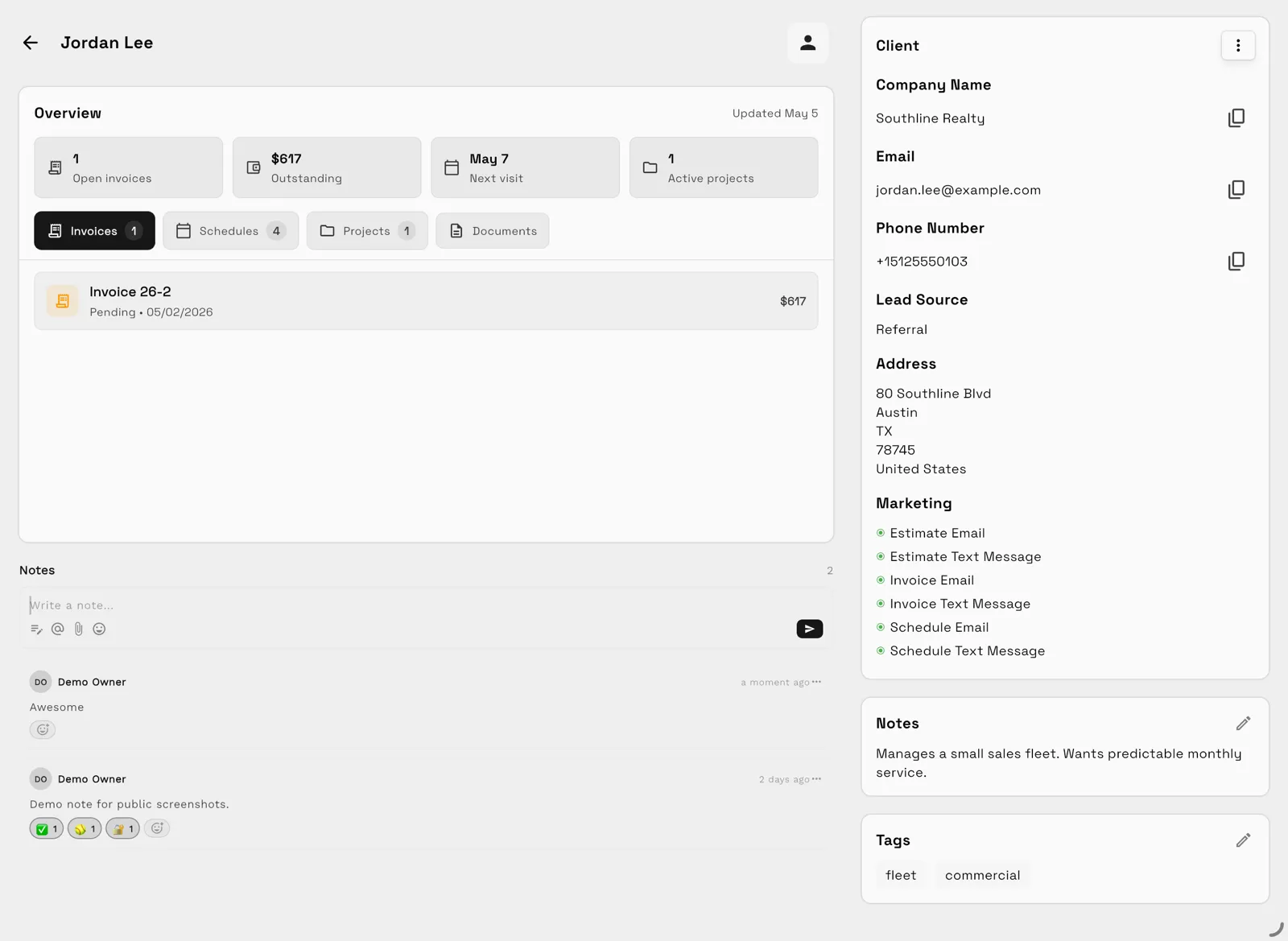
Demo data, not a customer outcome.
Workspace369 links the client record to proposals signed by public link, project task boards, a private client portal, time tracking and invoices with online card payments through Stripe. All of that is on Cadet, $29 a month for one seat ($23.25 a month billed yearly), along with deposits on acceptance, recurring invoices and retainers for maintenance clients, and custom fields for the brief. Workflow automations offer 53 triggers, with email automations and 3 active workflows on Cadet. If you run the scope-change test below, expect the request, revised proposal, tasks and invoice to stay on one record.
Limitations: Cadet is one seat and 5 active projects; Voyager ($74 a month for two seats) removes the project cap, and extra seats are $10 each. Webhooks and the API, which you would use to connect source control or deployment tools, start at Specialist ($149 a month). Workspace369 is not a sales forecasting pipeline and has no Git or hosting features. The 14-day trial needs a card.
Best for: small and mid-size web agencies whose week is spent copying scope changes between a CRM, a task tool and an invoicing tool.
2. Teamwork, best for delivery-heavy agencies that bill from logged time
Teamwork's pricing page lists Free for up to 5 users and 5 projects, Basics at $9.99 per user a month billed yearly with billable time tracking, and Accelerate at $24.99 with client invoicing from logged time and workload planning. Optimize adds CRM-pipeline-to-projects and is priced through sales. Paid plans offer a 14-day trial with no card. Teamwork is built around project delivery, so if you run the test, expect the task and time steps to be strong. See the Workspace369 vs Teamwork comparison for more.
Limitations: invoicing and workload planning need Accelerate, and the pricing page does not describe a client portal for Teamwork.com plans.
Best for: agencies with several developers who care most about project delivery and capacity.
3. Productive, best for resourcing and project financials
Productive's pricing page lists Essential with budgeting, resource planning, project and task management, time tracking and expense management, at $10 per user a month billed yearly ($12 monthly). Professional is $25 ($29 monthly) and adds rate cards, billable time approvals and retainer invoicing; invoices are listed on every plan (checked October 19, 2026). The trial is 14 days with no card. If you run the test, expect budgets and hours to be strong; check how proposals and client records work for you.
Limitations: the pricing page lists invoices on every plan and accounting integrations from Professional, but it does not describe a client portal.
Best for: agencies that run on budgets, utilization and resource plans.
4. HubSpot, best for free contact and deal tracking
HubSpot's product page says its free CRM covers up to two users and 1,000 contacts with no expiry, and no card is required. Starter is $20 per seat a month at list price, with limited-time offers for new customers. HubSpot is a strong place to track leads and deals, so if you run the test, expect the request log and follow-up to be easy and the proposal, tasks and invoice to need other tools. See Workspace369 vs HubSpot.
Limitations: the product page does not list invoicing, a client portal or project delivery in the CRM tiers described.
Best for: agencies that mainly need to remember leads and already have delivery and billing sorted.
5. Pipedrive, best for a visual sales pipeline
Pipedrive's pipeline page describes customizable pipelines, drag-and-drop deal stages, activity tracking, stage-triggered automation and a LeadBooster add-on for web forms and chat. It offers a 14-day trial with no card. We could not fetch its pricing page, so no price is shown here. Pipedrive suits agencies that sell many small projects, so check how it hands an accepted deal over to delivery. If you run the test, expect the request log and stage change to be quick, and the revised proposal, tasks and invoice to depend on other tools you connect. Its LeadBooster add-on is separate from the core pipeline.
Limitations: the page describes sales features and does not list project delivery, time tracking or invoicing. See Workspace369 vs Pipedrive.
Best for: sales-led agencies that qualify many leads before the build starts.
6. Bonsai, best for freelance developers and very small studios
Bonsai's pricing page lists time tracking on every plan and invoices, proposals and contracts and a client portal from Essentials, at $25 a month or $19 billed yearly, per user. Each extra seat costs the plan's per-user price. The trial is 7 days, and the page says no card is asked at sign-up, though one is needed to continue. If you run the test, expect the proposal and invoice steps to connect for a small team.
Limitations: it is per-user priced, so a five-person agency pays five times the plan price, and the 7-day trial is short for a build-cycle test.
Best for: freelance developers and two-person studios who want proposals, hours and invoices without a heavy setup.
Side-by-side comparison
| Tool | Entry price | Billed yearly | Covers scope-to-invoice on entry plan | Main gate | Trial |
|---|---|---|---|---|---|
| Workspace369 | $29 (Cadet) | $23.25 a month | Yes | 1 seat, 5 active projects | 14 days, card required |
| Teamwork | Free (5 users); Basics $13.99 per user | $9.99 per user (Basics) | Invoicing from Accelerate | Priced per user | 14 days, no card |
| Productive | $12 per user (Essential) | $10 per user | Invoices on all plans; no e-signature or portal named | Rate cards, approvals and retainer invoicing on Professional | 14 days, no card |
| HubSpot | Free | Free | No | 2 users, 1,000 contacts | Free CRM, no card |
| Pipedrive | Not checked | Not checked | No | Pricing page not fetched | 14 days, no card |
| Bonsai | $25 per user (Essentials) | $19 per user | Yes | Per-user pricing | 7 days, card to continue |
Which tool fits your agency?
| If you mostly need | Start with | Why |
|---|---|---|
| Scope, tasks, portal and invoices on one record | Workspace369 | All on Cadet, with webhooks and API from Specialist |
| Delivery and workload across a dev team | Teamwork | Client invoicing from logged time on Accelerate |
| Budgets, utilization and resource plans | Productive | Budgeting and resource planning on Essential |
| Free lead and deal tracking | HubSpot | Free for 2 users and 1,000 contacts |
| A high-volume sales pipeline | Pipedrive | Visual pipeline and stage automation |
| Proposals and hours for a studio of one or two | Bonsai | Time tracking, proposals and invoices per user |
Run a late scope-change test during the trial
Feature lists look alike. Use one fictional website build that has reached content freeze, and add a new third-party integration request. Run these five steps in each tool you shortlist:
- Record the integration request on the client record, with the brief.
- Send a revised proposal for the extra development hours and accept it by link as the "client".
- Add tasks for the integration to the live project.
- Ask the client to supply access details through the client portal or messages.
- Invoice the extra work and attach the logged hours.
If you run the test, expect the test to pass when the request, proposal, tasks, files and invoice are all findable from one project record, and fail when you need hosting or code data to finish the admin trail. Count the tabs you opened.

Keep code and client records separate
Hosting, source control and deployment belong in your engineering stack, and a CRM should not try to replace them. Connect the two sides only where it saves a manual step. Workspace369's workflow automations create tasks, send email or SMS, set reminders and notify the right people, with conditions, timed waits and a simulated test run before you switch a workflow on; review workflow automations. Webhooks and the API start at Specialist, so confirm the events and fields you need and test failure handling with sample records. Prepare the agreed scope with proposals, keep follow-up in communications, and review billing under invoices.
Whichever tool you trial, finish one full change cycle with demo data before you import real clients, and confirm you can export your records. Compare current plans on the pricing page.
Sources reviewed for this guide
- Workspace369 pricingPlan matrix reviewed October 15, 2026.
- Teamwork pricingOfficial pricing page reviewed October 15, 2026 for plan prices and plan gates.
- Productive pricingOfficial pricing page reviewed October 19, 2026 for plan prices, features and trial terms.
- HubSpot CRMOfficial product page reviewed October 15, 2026 for free CRM limits and Starter pricing.
- HubSpot pricingOfficial pricing page reviewed October 18, 2026 for the Starter list price ($20 per seat) and limited-time new-customer offers.
- Pipedrive pipeline managementOfficial product page reviewed October 15, 2026 for pipeline features and trial terms; the pricing page could not be fetched.
- Bonsai pricingOfficial pricing page reviewed October 15, 2026 for Essentials features and trial terms.
Workspace369 publishes this documentation-based comparison and is one of the options. It is not an independent ranking or a hands-on benchmark.
Run client follow-up in one workspace.
CRM, inbox, voice, invoicing, payments, projects, files, AI, and workflow automations — connected instead of exported.
14-day free trial. Card required. After the trial: from $29/month. Renews automatically every month until you cancel. Cancel anytime in Settings → Billing.